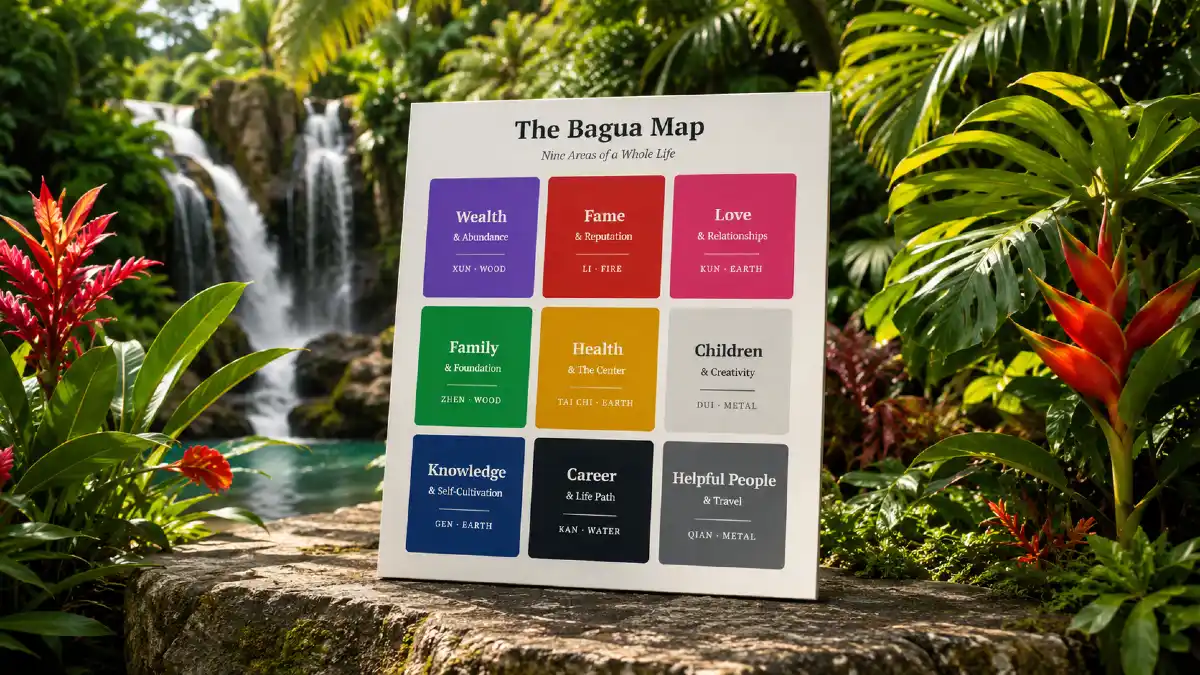
Most vision boards are beautiful, hopeful, and quietly disappointing.
You pull magazine clippings of travel destinations and dream homes, glue them onto cardstock, hang it somewhere visible — and within a few months, it fades into the background of your life like a forgotten houseplant. The vision was real. The structure to support it wasn’t.
This is where the Bagua vision board offers something different. Rather than collecting random images of what you want, a Bagua vision board uses an ancient nine-area map — drawn from Feng Shui and the I Ching — to organize your intentions across the actual dimensions of a human life. Career and wealth. Love and family. Health, creativity, knowledge, reputation, and the network of helpful people who shape your path.
It’s a framework that turns wishful thinking into something more honest: a map of where you are, where you’re going, and which corners of your life you’ve been quietly neglecting.
This guide will walk you through what a Bagua vision board actually is, the meaning behind each of the nine areas, and how to build one that does more than gather dust. It treats the practice the way it deserves — not as mysticism, but as a thoughtful tool for self-reflection and intentional living.
What Is a Bagua Vision Board?
A Bagua vision board is a vision board structured around the Bagua map — a nine-section grid used in Feng Shui to represent the essential domains of human experience. Each of the nine sections, called a gua, corresponds to a specific area of life: career, wealth, relationships, health, and so on.
The word “Bagua” (八卦) means “eight trigrams” in Chinese. These trigrams come from the I Ching, one of the oldest texts in Chinese philosophy, and represent the fundamental energies that shape reality. Feng Shui practitioners have used the Bagua for centuries to assess how physical spaces — homes, offices, gardens — influence the people who live in them.
A Bagua vision board borrows this same map but applies it to your inner landscape instead of your living room. You divide your board into nine sections corresponding to the nine guas, then fill each section with images, words, and symbols that represent your intentions for that specific area of life.
The result is something traditional vision boards rarely achieve: a complete picture. You don’t just see what you’re chasing — you see what you’ve ignored. The empty squares are often more revealing than the full ones.
It’s worth noting that this is a Western adaptation of an Eastern tradition. Classical Feng Shui is far more complex than a single grid, and serious students of the practice would point out that the Bagua is one tool within a much larger system. Used here, it functions as a thinking tool — a structure for clarity — rather than a metaphysical claim about how the universe operates.
The Nine Areas of the Bagua, Explained
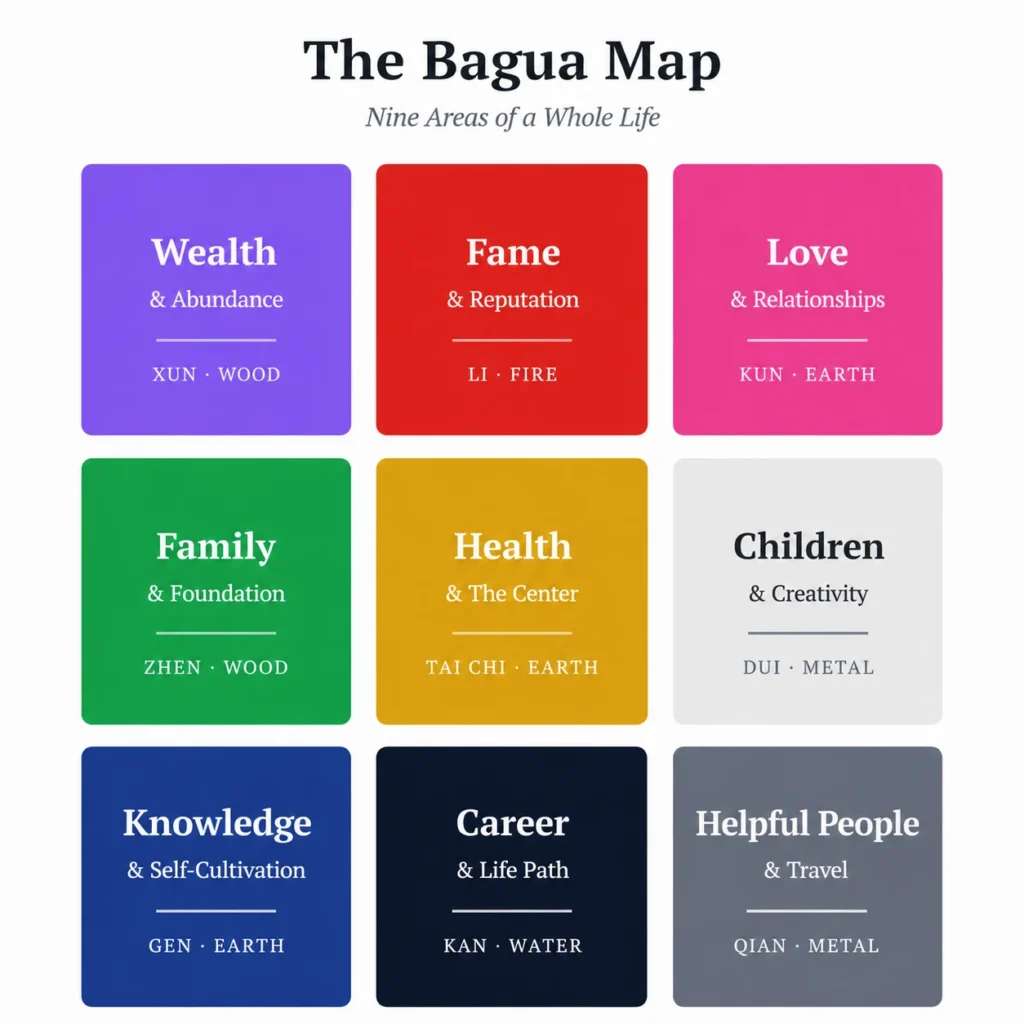
The Bagua map is typically arranged as a three-by-three grid. Imagine your vision board standing upright in front of you; the bottom edge represents the “entrance” of your life, and the rest of the board extends outward from there. The areas are positioned like this:
- Top row: Wealth, Fame, Love
- Middle row: Family, Health, Children & Creativity
- Bottom row: Knowledge, Career, Helpful People
Each gua has its own meaning, element, and color associations. Understanding them is what gives the practice its depth.
A quick note on orientation: this layout follows the BTB (Black Sect Tantric Buddhist) school of Feng Shui, which positions the map relative to the entrance rather than to a compass. Classical Feng Shui schools use cardinal directions instead — wealth in the southeast, fame in the south, love in the southwest, and so on. For a vision board, the BTB approach is simpler: align the bottom of the board with what feels like the “front,” and you’re set. The contents of each gua remain the same in either system.
1. Career and Life Path (Kan) — Bottom Center
The Career gua sits at the bottom center of the board, the entry point. Its element is water, and its colors are deep blue and black. This area represents not just your job but your sense of direction — the larger current you’re moving with.
When you fill this section, ask yourself: What does meaningful work look like for me right now? Career here isn’t about titles or income; it’s about alignment between what you do and who you are.
2. Knowledge and Self-Cultivation (Gen) — Bottom Left
To the left of Career sits Knowledge — represented by the mountain trigram, with earthy blues and greens. This is the area of inner study: the books you want to read, the skills you want to develop, the kind of wisdom you want to grow into.
This gua honors the unglamorous work of becoming. It’s where you place intentions for therapy, mentorship, journaling, contemplative practice, or simply learning how to listen to yourself better.
3. Family and Foundation (Zhen) — Middle Left
Family represents your roots — both your biological lineage and the people who function as family in your life. Its element is wood, its color is green, and its energy is generative and nourishing.
This section can hold images and words about how you want to relate to parents, siblings, chosen family, or your own role as a parent. It can also represent ancestral healing, breaking generational patterns, or simply spending more present time with the people who raised you.
4. Wealth and Abundance (Xun) — Top Left
The Wealth gua, in the top-left corner, is often the most popular section — and the most misunderstood. Its color is purple, and while it does relate to money, its deeper meaning is prosperity in the broadest sense: a felt sense of having enough, of moving through life with resources and flow.
Place financial goals here, of course, but also include the things that signal real wealth to you: time freedom, generosity, peace of mind, a sense of contribution.
5. Fame and Reputation (Li) — Top Center
Fame might be the most awkwardly named gua for modern readers. It doesn’t actually mean celebrity. Its element is fire, its color is red, and it represents how you are seen in the world — your visibility, recognition, and the integrity of your reputation.
This is the area of being known for something real. It speaks to the courage of putting your work out into the world, of being witnessed, of letting your contribution be visible rather than hidden.
6. Love and Relationships (Kun) — Top Right
The Love gua, in the top-right corner, governs intimate partnership. Its element is earth, its colors are pink and red. This is the area for your romantic life — whether you’re cultivating a relationship, repairing one, healing after a loss, or learning to be in healthy partnership for the first time.
What goes here should reflect more than a fantasy of love. It should reflect the kind of love you are willing to grow toward — the qualities, dynamics, and emotional patterns you want to embody as a partner.
7. Children and Creativity (Dui) — Middle Right
This gua holds two things that share more in common than they appear to: children, and the creative projects we bring into the world. Its element is metal, and its colors are white and pastels.
Whether or not you have or want children, this section is fundamentally about generativity — what you are bringing forth. Place creative work here. Place play. Place anything that emerges from you because it wants to be born.
8. Helpful People and Travel (Qian) — Bottom Right
The Helpful People gua, in the bottom-right corner, represents the network of mentors, allies, teachers, and unexpected helpers who appear when you need them. Its color is gray, and its element is metal.
Travel lives here too — the literal kind and the metaphorical kind. This is the gua of expanding your world, encountering new people, and trusting that you are not doing your life alone.
9. Health and the Center (Tai Chi)
At the heart of the Bagua sits the Health gua — the center of the grid, the Tai Chi. Its color is yellow or gold, and it represents the balance of everything. Physical health, yes, but also emotional well-being, the integration of all eight surrounding areas into a coherent life.
Place self-care here. Place sleep, nourishment, movement, mental health practices. But also place the felt sense of being whole — the deeper health that comes from a life lived in reasonable alignment with itself.
The Five Elements: A Deeper Layer
Beneath the nine guas sits another layer of the Feng Shui system: the five elements — wood, fire, earth, metal, and water. Each element carries its own qualities, colors, and energetic relationships to the others. Most people building a Bagua vision board never engage with the elements at all, and the practice still works. But for those who want more texture, the elements offer a way to reinforce each gua through color choice, material, and image.
The basic correspondence looks like this:
- Wood (Family, Wealth) — green, growth, upward movement. Plants, fresh leaves, trees.
- Fire (Fame) — red, warmth, visibility. Candlelight, sunrise, anything that suggests being seen.
- Earth (Love, Health, Knowledge) — yellow and brown, stability, grounding. Stone, ceramic, soft textiles.
- Metal (Children & Creativity, Helpful People) — white, gray, precision. Polished surfaces, clean lines.
- Water (Career) — deep blue and black, flow, depth. Rivers, mirrors, anything that suggests movement.
You can use this in two ways. The simpler way is to weave each element’s color into the corresponding gua — green tones in your family section, deep blue in career, red in fame. The more involved way is to place a small physical object on or near the board that embodies the element: a tiny plant near the wealth gua, a candle near fame, a smooth stone near love. Treat the elements as invitation, not rule. If they sharpen your attention, use them. If they distract, leave them.
How to Create Your Bagua Vision Board
You don’t need to be an artist or a Feng Shui expert to do this well. You need a few hours, some honesty, and a willingness to look at your whole life — not just the parts you find easy to think about.
Materials. A large poster board or piece of foam core works best. You’ll also need magazines, scissors, glue or tape, markers, and — optionally — printed photos, quotes, or symbols that mean something to you. Some people prefer to make digital Bagua boards using tools like Canva or Pinterest, organized into nine grids. Either works.
Step one: Draw the grid. Divide your board into nine equal sections, three by three. Label each section lightly in pencil with the corresponding gua. Don’t skip this — it’s the spine of the entire practice.
Step two: Reflect, then collect. Before you start cutting and gluing, sit with each area for a few minutes. Ask yourself: What does this part of my life actually look like right now? What do I want it to look like a year from now? What’s been quietly missing? Take notes. The vision board is the second step; the inner inventory is the first.
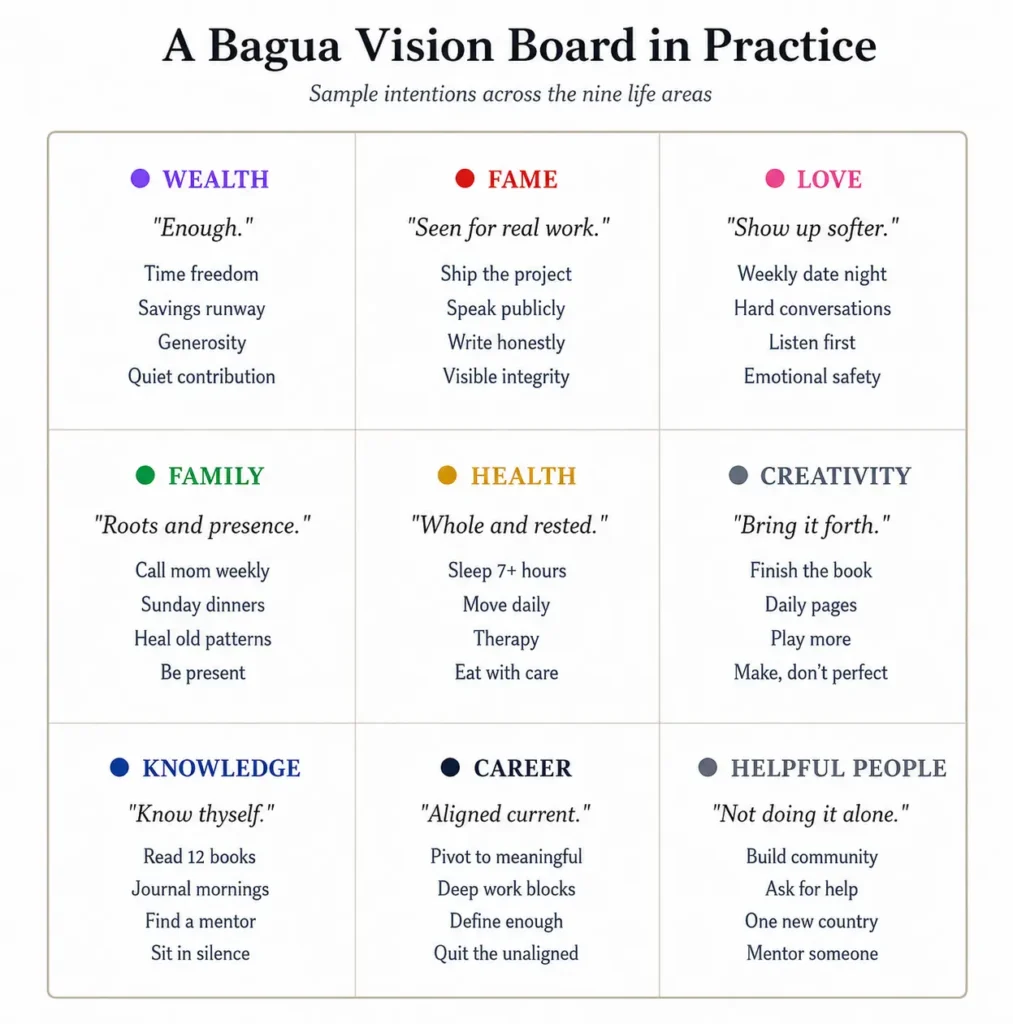
Step three: Fill the squares. Now choose images and words that represent your intentions for each gua. Be honest. If your wealth section feels easy and your relationships section feels stuck, notice that. Don’t force balance — let the imbalances show. They’re the most useful information you’ll get.
Step four: Place it somewhere you’ll actually see it. Not on the back of a closet door. Somewhere ordinary. Your office wall. Above your desk. The point isn’t decoration — it’s friction. A vision board you walk past daily slowly rewires how you orient your attention.
Step five: Build a small ritual around it. This is the step most people skip, and it’s the one that makes the difference between a poster on a wall and an actual practice. Light a candle, pour a cup of tea, sit for five minutes once a week, and let your eyes move across each gua. Notice what feels active and what feels distant. Notice what you’ve been quietly avoiding. The ritual doesn’t have to be elaborate — it just has to be consistent enough that the board becomes a touchstone rather than wallpaper.
When to Build a Bagua Vision Board
There’s no perfect moment to create a Bagua vision board, but certain transitions tend to invite the practice naturally. The beginning of a new year is the most common — though birthdays, the start of a season, or the end of a long chapter often work better because they’re more personal. A break-up, a job change, the kids leaving home, recovery from an illness, or the simple sense that something needs to shift can all be reasons to sit down with the nine guas and take inventory.
The practice is also useful when you feel stuck without knowing why. Sometimes the stuckness isn’t actually in the area you’re focused on — it’s in a neglected gua several squares away. A career that won’t move forward might really be a health problem, or an isolation problem, or a meaning problem. The Bagua map gives you a way to find that out.
Why a Bagua Vision Board Works Better Than a Traditional One
The difference between a traditional vision board and a Bagua vision board is essentially the difference between a wishlist and a map.
A standard vision board tells you what you want. A Bagua vision board tells you where you are. It forces you to consider every dimension of your life, including the ones you’ve been avoiding. Most people, when they sit down to build one, discover something uncomfortable: certain sections fill up immediately while others stay stubbornly blank.
The blank sections are the point.
Maybe you’ve been pouring your energy into career and wealth for years, and your relationships gua has gone unfed. Maybe your family section is rich, but you can’t think of a single thing to put in the knowledge gua because you stopped growing intellectually somewhere along the way. The structure exposes the imbalance, and the imbalance, once seen, becomes something you can actually work with.
This is also what makes the practice align with serious psychological work. Real growth doesn’t usually come from chasing more of what’s already working. It comes from tending to what’s been ignored.
There’s research behind this, too. The psychologist Gabriele Oettingen, who has spent decades studying motivation at NYU, has shown that pure positive visualization — imagining the desired outcome without confronting what stands in the way — actually tends to reduce the energy people put toward their goals. What works better is something she calls mental contrasting: holding the desired future and the present reality side by side. The Bagua vision board does exactly this. The full squares show you what you want; the empty ones show you what’s missing. That tension is the engine.
Common Mistakes That Quietly Sabotage the Practice
A few patterns tend to undermine the effort, even with the best intentions.
Overloading the board. Every square doesn’t need to be packed. A few well-chosen images often work better than a collage of everything you’ve ever wanted. Restraint signals clarity.
Generic, aspirational imagery. Magazines are full of beautiful, anonymous pictures that don’t actually mean anything to you. Be selective. If an image doesn’t make something real shift inside you when you look at it, leave it out.
Treating it as decoration. A Bagua vision board isn’t art — it’s a tool. If you make it once and never look at it again, it doesn’t do its work. Build a habit of returning.
Confusing surface desires with real ones. A photo of a luxury car might represent freedom, status, or simply the imitation of someone you admire. Look beneath each image and ask: What is this actually pointing to? Often the deeper desire is more interesting — and more achievable — than the surface one.
Keeping Your Bagua Vision Board Alive
The most overlooked part of vision board practice is what happens after you build it.
Set a recurring time — weekly, monthly, or seasonally — to sit with your board and reflect. Ask: What’s shifted? What still feels alive? What feels stale? A vision board should be a living document, not a monument. Some intentions will be reached and replaced. Others will reveal themselves as not really yours. Both outcomes are useful.
Some people refresh their entire board annually, often around the new year or their birthday. Others build a new one only when a significant life chapter opens or closes. There’s no correct rhythm — only the one you’ll actually keep.
The deepest work the Bagua vision board does is quiet. Over time, you stop needing to look at the board to remember what you’re building. The map starts to live inside you.
Frequently Asked Questions
What is the difference between a Bagua map and a Bagua vision board? A Bagua map is the underlying Feng Shui tool — a nine-area grid representing key areas of life. A Bagua vision board applies that map to a personal vision board, using the grid as a structure for organizing your intentions and goals across the nine domains.
Do I need to know Feng Shui to make a Bagua vision board? No. While the Bagua originates in Feng Shui, you can use it effectively as a self-reflection tool without practicing Feng Shui formally. Treat it as a structured way of thinking about your whole life rather than as a metaphysical system.
How often should I update my Bagua vision board? Most people benefit from reviewing their board monthly and refreshing it annually, though the right rhythm is the one you’ll actually maintain. Significant life transitions are also natural moments to rebuild it.
Can a Bagua vision board be digital? Yes. Digital tools like Canva, Pinterest, or Notion work well, especially if you want a board you can access from anywhere. The key is keeping the nine-area structure intact.
Where should I place my Bagua vision board? Somewhere you’ll see it daily without it becoming invisible. An office wall, a bedroom, or a workspace works well. Avoid places that feel hidden, like the inside of a closet or a drawer, since the board does its work through repeated, unforced exposure.
Do Bagua vision boards actually work? They work as a structured self-reflection and goal-priming tool — not as magic. Research on visualization (notably Gabriele Oettingen’s work on mental contrasting) suggests that vision boards are most effective when they pair imagined outcomes with honest reflection on the present. The Bagua’s nine-area structure naturally encourages that pairing, which is why it tends to produce more durable results than a freeform vision board.
A Final Thought
The Bagua vision board is, at its best, a quiet act of self-respect. It says: all the parts of my life matter, not just the ones I find easy to think about. It honors the complexity of being human — career and love and health and creativity and family and meaning, all asking for attention at once.
You won’t always tend to each area equally. No one does. But the map keeps the whole picture in view, which is usually the part of a meaningful life that’s hardest to hold.
If a traditional vision board is a wish, a Bagua vision board is a practice. And practices, more often than wishes, are what actually move us.
Read More about Bagua Map
Related posts:
 How to Create a Vision Board That Actually Works (And Why Most People Fail)
 How to Set Goals and Achieve Them With Audacious: A Bold Guide to Building the Life and Career You Want and Deserve
 The Wealth Score: Why Measuring Success in Just One Dimension Is Destroying Your Life (The 5 Types of Wealth by Sahil Bloom)
 How to Actually Transform Your Life Using the 5 Types of Wealth Framework (The 5 Types of Wealth by Sahil Bloom)
 The Entrepreneurial Path to Integrated Wealth: Building a Business That Serves All Five Dimensions