There’s a particular kind of frustration that comes with the phrase life balance. We hear it constantly — magazines, podcasts, well-meaning advice from people who seem to have figured something out we haven’t. You just need to find your balance. As if balance were a secret object, located somewhere, that some people have found and others haven’t.
If you’ve ever quietly wondered why you can’t seem to find it, no matter how hard you try, you’re not failing. The concept itself is broken. And the more you chase it, the more it eludes you — which is exactly what business coach Michelle McCullough discovered after her own months-long search for what everyone seemed to have but her.
In Make It Happen Blueprint, McCullough makes a case that has freed many of her readers: life balance is a myth. The better organizing principle — the one that actually produces a full, sustainable life — is prioritization. This article walks through why she came to this conclusion, why it’s such a relief, and what to do instead.
The Search That Led to Nowhere
After the birth of her second child, McCullough was struggling to get back into the swing of her demanding work-at-home responsibilities. Entrepreneurs don’t get maternity leave, and she had a major event coming up just six weeks after delivery — Seth Godin was speaking.
She looked around at other entrepreneur friends and started asking the comparison question: She has five kids. What does she know that I don’t? How does she make it look so easy? When she shared this with a friend, the response was the standard answer: Honey, you’ll get there. You just need a little life balance.
So she went looking for it. Read books. Read articles. Asked friends. Prayed about it. Nine months passed. The more she searched, the less fulfilled she felt. She kept assuming there was a secret everyone else knew.
Then Danielle LaPorte came to speak at one of McCullough’s events. Mother and entrepreneur, LaPorte was someone McCullough thought might have the answer. She asked. LaPorte’s response was something like: Life balance doesn’t exist. It’s about priorities.
The conversation was cut short, but something clicked. As a planner and productivity person, McCullough understood priorities. She just hadn’t realized she’d been chasing the wrong concept the entire time.
Why “Balance” Is the Wrong Word
McCullough walks through several specific reasons life balance is a flawed concept.
Balance implies equal distribution. Picture Lady Justice with her scale — same weight on both sides. If you work nine hours a day, is it possible to spend nine hours with family and friends? Of course not. Under a literal definition of balance, you’d never reach it. The premise of the concept is impossible from the start.
Obsessing about balance creates more stress. When the framework itself is unreachable, the chase becomes its own depleting activity. You’re constantly evaluating whether things are “balanced enough,” noticing where they aren’t, feeling guilty about the imbalance, and adding the cognitive overhead of monitoring to an already-full life. The pursuit of balance becomes one more thing draining your energy.
Balance assumes it’s the only path to happiness. All the articles and books promoting balance imply that until you achieve it, you can’t be fully happy. This isn’t true. You can be wildly out of balance and deeply content. You can be technically balanced and miserable. Happiness isn’t a function of equal time distribution. It’s a function of how you spend whatever time you have.
The framework implies there’s a secret. People searching for life balance often feel like they’re missing some specific piece of knowledge — a system, a routine, a trick — that everyone else has figured out. They haven’t. There’s no specific blueprint that, once you find it, will take you to balanced bliss. People who appear to have it figured out have just developed their own personal prioritization system, not a universal one.
The cumulative effect: chasing balance gives you guilt, exhaustion, and a sense of inadequacy without ever actually delivering the thing you were promised.

What Prioritization Looks Like Instead
The shift McCullough makes is from balance (equal distribution across all roles) to prioritization (clarity about what matters most in this season, and protection of that).
This sounds subtle. The difference in practice is huge.
When you’re balanced, you measure success by how evenly your time is distributed.
When you’re prioritized, you measure success by whether you’re protecting the things that genuinely matter to you, even though the distribution will be wildly uneven by necessity.
McCullough’s own example: she spends much less time with her husband than with her children, because she’s home with the kids all day. That doesn’t mean she loves her husband less. It means the structure of her current season produces uneven time distribution, and she’s okay with that — provided the time with her husband, however limited, is genuinely prioritized when it happens.
She spends less time on spiritual and religious practice than on work. That doesn’t mean her faith is less important than her job. It means work has a different time profile than spiritual life by design.
The shift: instead of trying to make all the slices equal, she focuses on whether the most important things are getting protected, prioritized time. The unevenness becomes acceptable — even necessary.
The Two Play Lists
One of the most practical tools in McCullough’s chapter on this topic is her two-list system for the often-neglected category of play. Most ambitious people sacrifice play first when life gets busy. McCullough’s argument: this kills you in the long run, because play is part of what makes the work sustainable.
Her solution is two lists, each with at least 25 items.
The Free Play List. Things you enjoy that are free or cheap and easily accessible. Reading a book. Watching a movie. Taking a hike. Crafting. Soaking in a hot tub. Calling a friend. Playing a sport. The list is your menu of small recharges — what you can pull from on a regular day when you have an hour or two and need to reset.
The Wish Play List. The bigger, more expensive, higher-reward activities. Dream travel destinations. Major experiences. The hotel stay in your own city. The retreat. The dream concert. The bucket-list adventure. This list is what drives you financially. These are the things you’re working toward, the goals that go on your vision board.
The two lists serve different purposes. The Free Play List keeps you topped up. The Wish Play List keeps you motivated. Both are essential. Neither replaces the other.
McCullough is direct: every now and again, put new things on the lists. Learn a new language. Try a new athletic activity. Read a book outside your usual genre. You don’t have to love everything you try, but the act of trying expands you. Part of high performance is being a well-rounded person, not just a high-output one.
What to Do When Play Has Gone Missing
McCullough opens her chapter with a client who’d been working 60-70 hour weeks. Even with two assistants, the work was endless. When she wasn’t working, she gave every spare minute to family. The things she once enjoyed — making art, creative outlets — had quietly disappeared.
This is incredibly common. The honest answer to the question what do you do for fun? for many adults is: I don’t really know anymore.
If this is you, McCullough’s recommendation is to take small steps. Don’t try to revive an entire hobby in a weekend. Start with something that moves you in the direction. Clean out a corner of a room. Buy the basic supplies. Sign up for the class. Watch a video about the thing. The momentum builds slowly. Eventually you find yourself doing the activity. Then, eventually, looking forward to it.
If 25 items on your Free Play List feels impossible to generate, start with five. Notice what genuinely lights you up versus what you think should light you up. The list will grow over time as you reconnect with parts of yourself that have been neglected.
The Permission Aspect
There’s a thread running through this chapter that connects to McCullough’s earlier chapter on Permission: many of us don’t play because we feel we haven’t earned it.
This is one of those quietly damaging beliefs. I’ll relax when the project is done. I’ll take a vacation when work calms down. I’ll start that hobby when the kids are older. The waiting never ends, because the conditions never arrive. There’s always more to do.
McCullough is unsentimental about this: all work and no play makes you a workaholic. Figuring out the time and place for work and play, and honoring both, will bring you more joy and fulfillment than any paycheck or place you live.
You don’t need permission to play. You need to schedule it.
The Word of the Year Practice
McCullough mentions that for 2014 she chose “savor” as her word of the year. The choice came from noticing she’d been racing through life too fast — full calendar, lots of activities, but not actually experiencing the moments as they happened.
“Savor” became a small daily reset. Slow down. Be in this moment. Enjoy the time her kids were home. Enjoy the conversations with people she met. Notice the day instead of rushing through it.
You don’t have to do an annual word. But the practice points at something real: high performance done well includes presence. Without presence, you can achieve a lot and feel like none of it happened to you.
What’s Actually Sustainable
McCullough is clear that prioritization, unlike balance, is genuinely sustainable. It accepts the reality that some weeks will be dominated by work, others by family, others by recovery. The unevenness is built into the model.
What sustains the system is the regular protected time you give to your highest priorities — not equal time, but reliable time. The weekly date night with your spouse. The daily morning routine. The exercise blocks. The play list activity once a week. The annual vacation. Each priority gets its space, not its equal share.
She does add one caveat: in your flexible prioritized state, don’t give up the regular practices that keep you in check. You can move blocks to accommodate big needs. But don’t delete the blocks that keep you healthy, energized, and connected. The flexibility is for moving, not for cutting.
How to Start the Shift This Week
If you’ve been chasing balance and feeling like you can’t catch it, try this experiment.
Stop using the word. Notice when “balance” comes into your thinking or speaking, and replace it with “priorities.” Watch what happens to the conversation in your head.
Identify your top three priorities for this season. Not for life — for this specific season, however long you define it. Family, health, your most important work project. Or three different things. Be honest. The point isn’t to capture every value, just to name what most matters right now.
Audit how those three are getting protected. Are they getting time, attention, and energy proportionate to how much they matter to you? If not, what specific blocks need to be added or defended?
Start your play lists. Even a starter Free Play List of ten items is enough. Put it where you’ll see it. Do one item this week.
Let the rest be uneven. Give yourself permission to be wildly out of balance in the areas that aren’t your current priorities. They’ll get their turn. The point isn’t perfect distribution. The point is a full life lived intentionally.
The relief of dropping the balance pursuit is genuine. You stop measuring yourself against an impossible standard. You start working with a model that fits actual human lives. And paradoxically, by giving up the chase for balance, you often end up with something better — a life that, however uneven on the surface, is grounded in what actually matters.
You don’t need balance. You need priorities. Build from there.
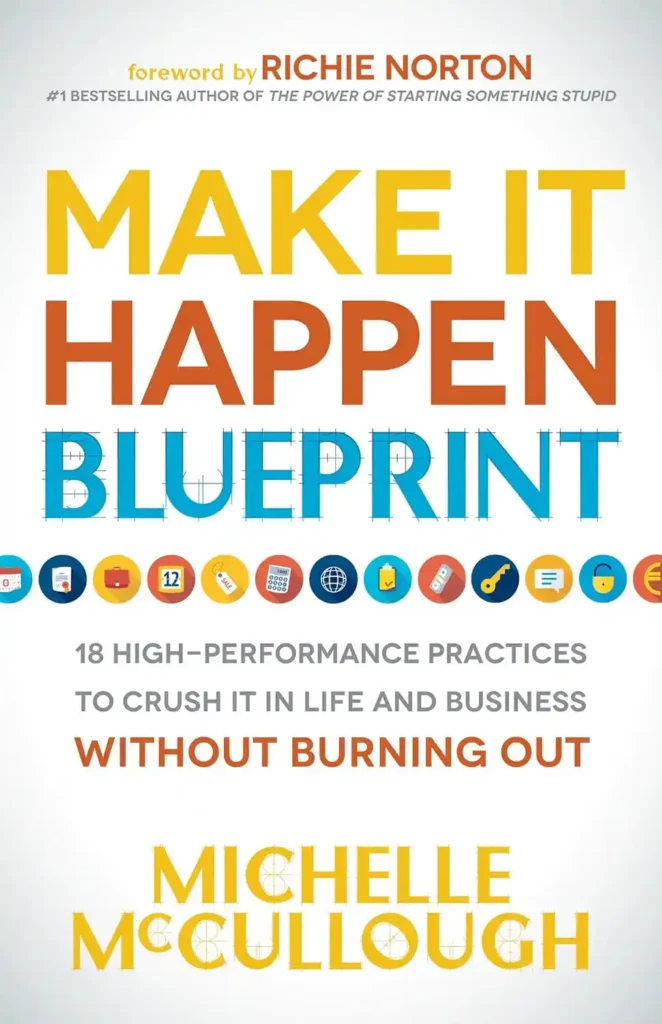
This article is inspired by the chapter on Play in Make It Happen Blueprint: 18 High-Performance Practices to Crush It in Life and Business Without Burning Out by Michelle McCullough (Morgan James Publishing, 2017).
Related posts:
 Ridge Wallet Review (2026): Is the Minimalist Metal Wallet Actually Worth It?
 Hume Band Review: Does This Stress-Tracking Wearable Actually Work?
 10 Most Popular Gifts for Men in 2026 (That He’ll Actually Use)
 WHO IS JEFFREY PFEFFER: Stanford’s Revolutionary Power Expert & Organizational Behavior Pioneer
 The Four Ways to Meet Women in 2026: A Modern Dating Strategy for Men