There’s a particular kind of busy that doesn’t produce anything. You sit down at your desk in the morning. You open your inbox. You answer a few messages. You check on a project. You get pulled into a quick call. You realize you forgot to follow up on something. You handle three more interruptions. Suddenly it’s 4 PM and the actual work — the work you sat down to do — is still waiting.
If this sounds familiar, you’re not lazy. You’re not undisciplined. You’re caught in one of the four predictable traps that drain most people’s productivity.
In Make It Happen Blueprint, business coach Michelle McCullough identifies these four traps from years of working with thousands of clients. They’re not exotic. They’re not new. But they’re the patterns that show up again and again in people who are working hard and getting nowhere.
This article walks through each one, explains why it costs more than you think, and offers a practical escape.
Trap #1: Failure to Plan
The first trap is the most foundational, and the easiest to dismiss because it sounds obvious. Most people who struggle with productivity don’t have a planning problem in the sense that they don’t know planning matters. They have a planning problem in the sense that they keep skipping it, hoping their productivity skill alone will compensate.
It won’t.
The honest math: thirty minutes of planning at the start of your week saves several hours of reactive scrambling during it. The trade is wildly favorable. But planning feels like meta-work — work about the work — and so it’s the first thing to get cut when you feel pressed for time. The result is a week that controls you instead of one you control.
The escape isn’t complicated. McCullough recommends building a Time Map (covered in detail in her chapter on Planning) — a weekly schedule that protects time for your most important recurring work. You can pair it with a Goal Map for specific projects. The tools aren’t proprietary. The discipline is the hard part.
If a full system feels like too much, start smaller. Sunday evening, take fifteen minutes. Look at the week ahead. Identify three things that absolutely must happen and put them on the calendar — not as items on a list, but as protected blocks of time. That alone will move you ahead of most people.
Trap #2: Distraction
Here’s the cost most people underestimate. According to research McCullough cites, the average employee in corporate America spends 2.1 hours a day on interruptions — about 28% of the workday. Ten and a half hours a week. Lost.
For people who work for themselves, the number is likely higher. Without a boss or structural pressure pulling them back to the work, the rabbit holes go deeper.
The interruption itself is bad enough. Worse is the hidden tax: the same research found that when someone is distracted from a task, it takes an average of 25 minutes to fully return to it. So a five-minute “quick check” of email isn’t five minutes. It’s thirty.
The escape requires being honest about where the distractions actually live. For most modern workers, the answer is some combination of email, social media, messaging apps, and notifications. McCullough’s tactics are practical and immediate.

Turn off notifications. Not snooze. Off. On your phone, on your computer, on every app that pings you. The notification system is designed to hijack your attention, and you cannot win this fight by using willpower in the moment.
Check email three times a day on a schedule. Not constantly. Three times — say, mid-morning, after lunch, and end of day. The world will not end. Most “email emergencies” aren’t, and the genuine ones can wait an hour.
Limit social media to scheduled check-ins. McCullough does five minutes, three times a day. The instinct is to call this restrictive. The reality is most people scroll for far longer than that and feel worse afterward, with nothing to show for the time.
Post office hours. This works whether you’re at a corporate desk or working from home. Let coworkers, kids, and household members know your focus hours. Honor them yourself, and most people will adapt.
Don’t answer the phone during focus blocks. Voicemail exists. Call them back during a scheduled communication block.
The point isn’t to become unreachable. It’s to be reachable on your schedule, not on the schedule of every notification system competing for your attention.
Trap #3: The Misdirection of Multitasking
For years, the ability to do many things at once was treated as a virtue. People put “great multitasker” on resumes. It signaled competence, range, capacity.
The research has been clear for a while now: it’s a lie. The brain doesn’t actually do two cognitive tasks simultaneously. It rapidly switches between them, and the switching cost is significant. People who multitask perform measurably worse on each task than people doing them sequentially. They also feel more stressed and remember less of what they did.
McCullough is candid about her own history with this trap. For years, she wore the multitasker badge as honor. Compliments about her ability to do multiple things at once kept her invested in the pattern. When she finally let it go and committed to focused single-tasking, she discovered her productivity went up, not down. So did the quality of her relationships — because she was actually present with the people in front of her instead of half-attending while she did something else.
The escape is straightforward to describe and harder to do: when you’re working on something, work on that. When you’re with someone, be with them. Close other tabs. Put the phone face down or in another room. Give the activity in front of you the full attention it deserves.
This is especially important for relationships. McCullough notes she can’t be the parent she wants to be if her head is in her phone instead of in the game she’s playing with her kids. The principle extends to spouses, friends, colleagues, clients. People can tell when they have your full attention versus your divided attention. The full version is much more expensive to give and worth much more in return.
Trap #4: Failure to Delegate
The fourth trap is the one people resist hardest, usually because of beliefs that masquerade as virtue. I should do it myself. I can’t afford help. No one can do it as well as I can. It’s faster if I just handle it.
These beliefs cost you more than they save.
McCullough tells the story of a graphic designer client who was spending one to two hours a week on bookkeeping — a task she hated and wasn’t particularly good at. Her hourly rate as a designer was $75-100. The bookkeeping was costing her $150-200 a week in opportunity cost, plus the emotional drain of dreading something she resisted constantly. When McCullough pointed this out, the math was suddenly obvious: hiring a bookkeeper would free up time worth far more than the cost.
The principle from Ken Blanchard’s One Minute Manager Meets the Monkey — which McCullough cites as having shaped her professional life for fourteen years — is that “all monkeys must be handled at the lowest organizational level consistent with their welfare.” Translated: tasks should be done by the most appropriate (and usually lowest-cost) person who can do them well, freeing higher-leverage people to do higher-leverage work.
The escape starts with an honest list. Take a current week’s worth of work. Mark each item with one of three letters: D (delegate or outsource), B (batch with similar work), or F (focus — only you can do this). Most people are surprised to discover how much of their work falls into D and B, and how little is genuinely F.
Then make a plan. Some D items can be outsourced to professionals (bookkeeping, cleaning, virtual assistance). Some can be delegated to existing team members or family. Some can be done by hiring a teenager in the neighborhood — McCullough started early by paying neighborhood teens to put stickers on her promotional product catalogs, freeing her time for marketing.
For solopreneurs and people without budget for help, the question becomes harder but not impossible. Can you trade with a friend? Can you batch errands so you spend less time on them? Can you eliminate something entirely?
The Hidden Fifth Trap: Beating Yourself Up
Throughout the chapter on productivity, McCullough returns to a quieter point that doesn’t make her main list but probably should. People who struggle with productivity often have a punishing inner critic that turns every missed deadline and uncompleted task into evidence of personal failure.
This doesn’t make people more productive. It makes them more avoidant. The dread of looking at the to-do list because of how the inner critic is going to respond keeps people from looking at it at all. The cycle compounds.
McCullough’s recommendation: stop. Either delegate it, do it, reschedule it, or make peace with it — but don’t let it become a 24/7 guilt fest. The energy spent on self-flagellation is energy not available for the actual work. Drop the punishment. Just handle the next thing.
How These Traps Reinforce Each Other
The four traps aren’t independent. They feed each other.
When you don’t plan, you can’t protect time. When you can’t protect time, distractions win. When distractions win, you start multitasking to feel like you’re keeping up. When multitasking degrades quality, you take on more yourself because you don’t trust anyone else to do it right. The cycle compounds and most people experience it as just being chronically overwhelmed.
The corollary is that addressing one trap helps with the others. Better planning makes it easier to focus. Better focus makes single-tasking feel natural. Single-tasking makes the work better, which builds the trust required to delegate. Each habit makes the next one easier.
Start With One This Week
If you try to fix all four traps at once, you’ll likely fix none. Pick one. Run a focused experiment for a week.
If planning is your weakest area, take Sunday evening to map the week ahead.
If distraction is killing you, turn off all notifications for a week and check email only on a schedule.
If multitasking is the habit, try one full day of single-tasking and notice what changes.
If you’ve never delegated anything, find one task this week to take off your plate — pay someone, trade with someone, or simply stop doing it.
Productivity isn’t about cramming more into your day. It’s about removing the things that are quietly stealing your energy and attention. The four traps explain a lot of where that energy goes. Reclaiming even one of them changes the texture of your week.
The work that matters has been waiting for your attention. Give it some.
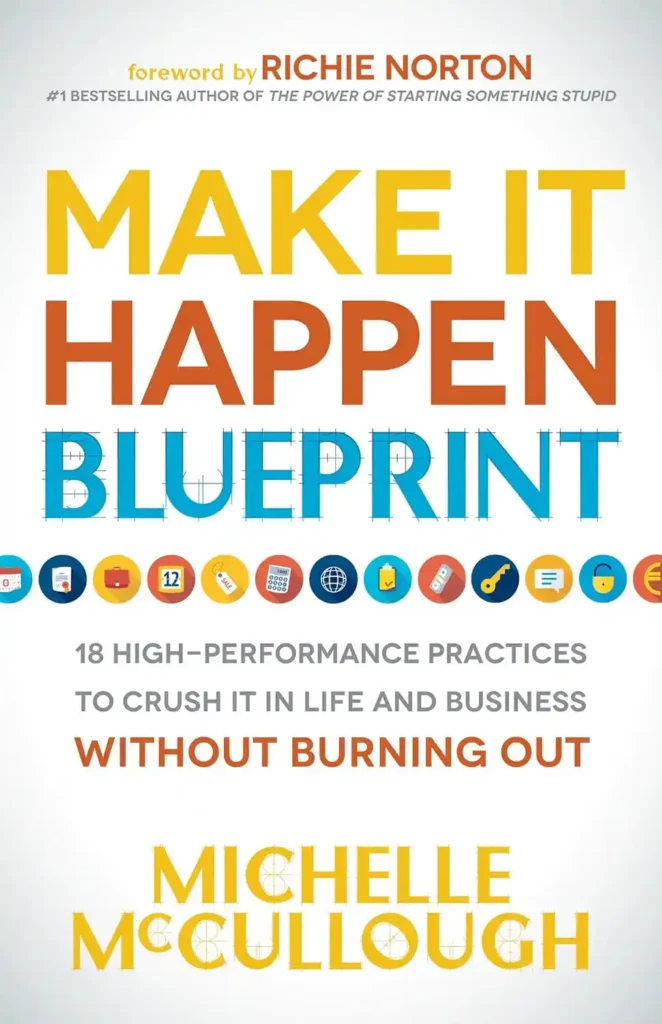
This article is inspired by the chapter on Productivity in Make It Happen Blueprint: 18 High-Performance Practices to Crush It in Life and Business Without Burning Out by Michelle McCullough (Morgan James Publishing, 2017).
Related posts:
 Make It Happen Blueprint: 18 High-Performance Practices to Crush It in Life and Business Without Burning Out (Full Summary & Course)
 Time Blocking Made Simple: The Time Map Method Explained
 Carbon Diet Coach: The Science-Based Macro Tracking App Created by Dr. Layne Norton That’s Revolutionizing Nutrition Coaching
 What Is a Vibe Check in Dating? How Emotional Compatibility Actually Works
 How to Create a Vision Board That Actually Works (And Why Most People Fail)