The old version of YouTube is dead. Not dramatically, not all at once, but slowly enough that many creators still haven’t noticed. For years, the platform rewarded consistency, decent thumbnails, and enough persistence to survive the algorithm’s mood swings. Upload enough videos and eventually momentum would come. At least that was the theory.
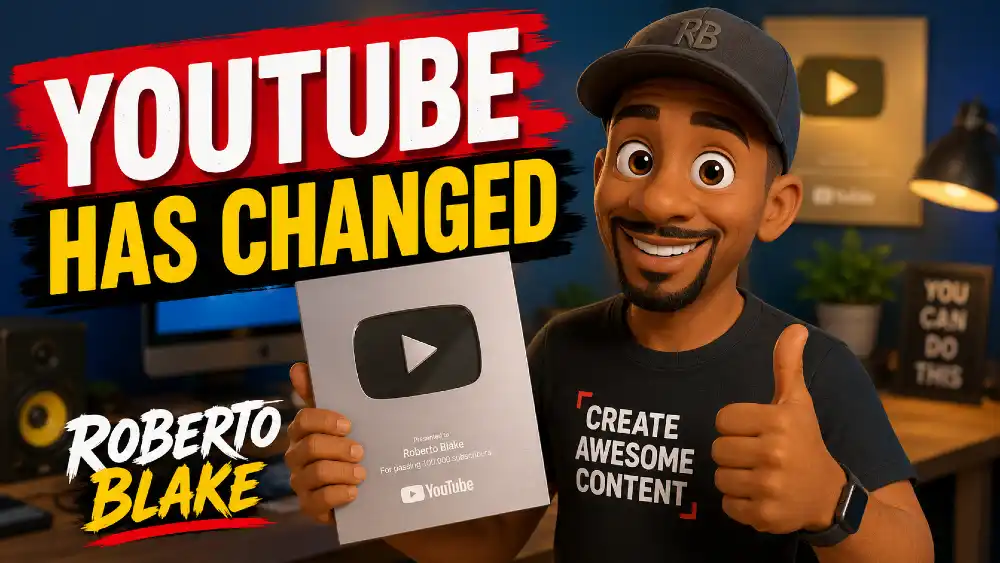
But according to creator strategist Roberto Blake, the rules have changed completely.
Today’s YouTube creator is no longer competing against a handful of niche channels armed with DSLR cameras and editing software. They’re competing against miniature media companies operating at industrial scale, powered by AI tools, clipping networks, multi-platform distribution systems, and audiences whose viewing habits change depending on whether they’re watching on a phone, a laptop, or a 70-inch television.
“The YouTube of 2016 is not the YouTube of 2026,” Blake says matter-of-factly.
It’s a line that sounds obvious until he begins unpacking it. Streaming culture exploded. Shorts rewired audience attention spans. Device behavior fragmented viewing patterns. Meanwhile, AI entered the picture and quietly eliminated massive chunks of creative labor that once consumed creators’ time.
For Blake, the creators still approaching YouTube like it’s 2018 are already behind.
What’s replacing that era is something far more sophisticated—and, in many ways, far more demanding.
At the center of Blake’s philosophy is a deceptively simple framework: topic, title, thumbnail, and timing. He calls it the foundation of YouTube packaging, the four variables that determine whether someone clicks on a video at all. The difference now is that creators have access to tools capable of optimizing each step with frightening precision.
YouTube’s own “Ask Studio” feature, for example, allows creators to interact with their analytics through AI. Blake points out that most creators still don’t even know it exists. The system analyzes channel data, identifies patterns, and helps generate ideas directly tied to audience behavior. It’s free, deeply integrated into the platform, and dramatically underused.
The limitation, however, is that it only understands your ecosystem—not the wider battlefield.
That’s where tools like VidIQ and One of 10 enter the conversation. Blake views them less as novelty software and more as intelligence systems. Instead of blindly brainstorming ideas, creators can now analyze competitors, identify outlier-performing videos, and study content patterns across entire niches.
In other words, YouTube ideation is beginning to resemble market research.
But despite all the excitement surrounding AI, Blake repeatedly returns to the same point: the technology should supplement creativity, not replace it.
That distinction matters because much of the internet currently feels trapped between fascination and panic over artificial intelligence. Some creators believe AI will replace human originality entirely. Others dismiss it as soulless automation. Blake sits somewhere in the middle.
For him, AI’s greatest value lies in removing friction.
Photo retouching, for instance, is no longer worth spending twenty minutes on. Audio cleanup can happen instantly. Structural editing decisions can be assisted. Research can be accelerated. Workflow bottlenecks disappear.
“I just move myself into the role of art director,” he explains.
That may be the clearest description yet of what AI is actually doing to creative work. It isn’t eliminating creators. It’s compressing the gap between creator and production team.
The average solo YouTuber can now operate with the efficiency that once required employees.
And Blake believes many creators are still thinking too small.
One of the most compelling ideas he raises is what he calls “device context.” Most creators obsess over formats—shorts versus long-form versus livestreams—but Blake argues the more important variable is where and how audiences are consuming content.
A viewer watching YouTube on television behaves differently from someone scrolling Shorts on a phone while waiting in line for coffee. One environment encourages lean-back viewing. The other rewards hyper-aggressive pacing and immediate stimulation.
Creators who ignore that difference often blame the algorithm when their videos underperform.
But the algorithm isn’t confused. The audience is.
This is especially visible in the ongoing debate surrounding YouTube Shorts. Many long-form creators still believe Shorts damage channels or cannibalize audiences. Blake thinks the problem is less about the format itself and more about creators misunderstanding its language.
“You have eight to fifteen seconds to hook somebody in long-form,” he says. “In Shorts, you have two to five.”
That changes everything: editing rhythm, scripting, visual pacing, even emotional delivery. Most creators, according to Blake, are simply repurposing long-form thinking into a short-form environment and wondering why it fails.
Then comes the controversial part.
Blake believes the optimal upload cadence for Shorts isn’t once a day—it’s closer to five to twelve uploads daily.
To traditional YouTubers, that sounds almost absurd. But short-form content operates on probability. More uploads create more opportunities for breakout distribution. The creators dominating vertical video aren’t necessarily producing masterpieces every time. They’re increasing statistical exposure.
It’s less Hollywood filmmaking and more media manufacturing.
That industrialized mindset becomes even more apparent when the conversation shifts toward clipping culture.
The rise of clippers may be one of the least understood yet most important shifts happening in the creator economy right now. For audiences, clippers appear as harmless fan accounts reposting snippets of podcasts, livestreams, or interviews across TikTok, Shorts, and Instagram Reels. But behind the scenes, an entire ecosystem has formed around them.
Some major creators now incentivize clippers directly, paying freelancers based on view performance. Blake describes situations where creators pay roughly $50 per 100,000 views generated through distributed clips. At scale, those economics become staggering.
A hundred clippers each generating one million views per month creates 100 million impressions.
That level of exposure would cost a fortune through traditional advertising.
But the genius of clipping networks is that they feel organic. Audiences perceive clips as recommendations, not advertisements. The algorithm sees engagement velocity. The creator receives attention at a fraction of the cost.
Blake refers to it as “the clipping industrial complex,” and while the phrase sounds half-joking, the implications are serious. The creator economy is beginning to resemble decentralized media distribution at scale.
And in many ways, it already is.
That same scalability is influencing how creators think about second channels. Years ago, creators launched second channels as casual side projects—vlogs, gaming content, behind-the-scenes experiments. Today’s second-channel strategy is far more intentional.
The new model isn’t about changing niches. It’s about deepening audience retention.
A creator might maintain a polished flagship channel while using a secondary channel for livestream clips, reactions, commentary, or lower-production content aimed at their most engaged viewers. The second channel becomes an extension of the brand rather than a departure from it.
“The main channel attracts you,” Blake explains. “The second channel retains you.”
But he’s also realistic about who should attempt this strategy. Beginners struggling to sustain one upload schedule have no business splitting focus across multiple channels. Blake argues second-channel systems only make sense once creators have operational efficiency, team support, or streamlined workflows.
That operational focus is ultimately what ties all of his ideas together.
For all the discussion about AI, Shorts, livestreams, and clipping armies, Blake’s larger point has surprisingly little to do with technology itself.
It’s about sustainability.
Most creators don’t fail because they lack talent. They fail because they lack systems.
The creator economy romanticizes hustle, but Blake emphasizes structure instead: systems, support, boundaries, workflow optimization, strategic planning. AI simply amplifies those systems for creators who already understand how to operate efficiently.
That’s why he’s particularly passionate about working-class creators and part-time YouTubers. Someone balancing family responsibilities and limited time doesn’t need AI to replace their creativity. They need it to eliminate exhaustion.
“What’s wrong with using a supplemental system,” Blake asks, “if your battery is running low?”
That may be the defining question of the next era of online creation.
Because the future of YouTube no longer belongs solely to charismatic personalities with cameras and clever ideas. Increasingly, it belongs to creators capable of building sustainable operational systems around their creativity.
The platform is evolving from a creator playground into a media infrastructure layer. The people who understand that shift early will likely dominate the next decade.
Everyone else may still be trying to figure out why their views are down.
Related posts:
 The YouTube Algorithm Update: What Creators Need to Know About the 2026 Gemini Update
 The Four Ways to Meet Women in 2026: A Modern Dating Strategy for Men
 Social Media Trends 2026: Expert Predictions from Kallaway and GaryVee That Will Transform Your Strategy
 Platform Capitalism: How Digital Monopolies Extract Value From Your Life
 Who Is Hindz? The Rise of a Modern Mindfulness Influencer