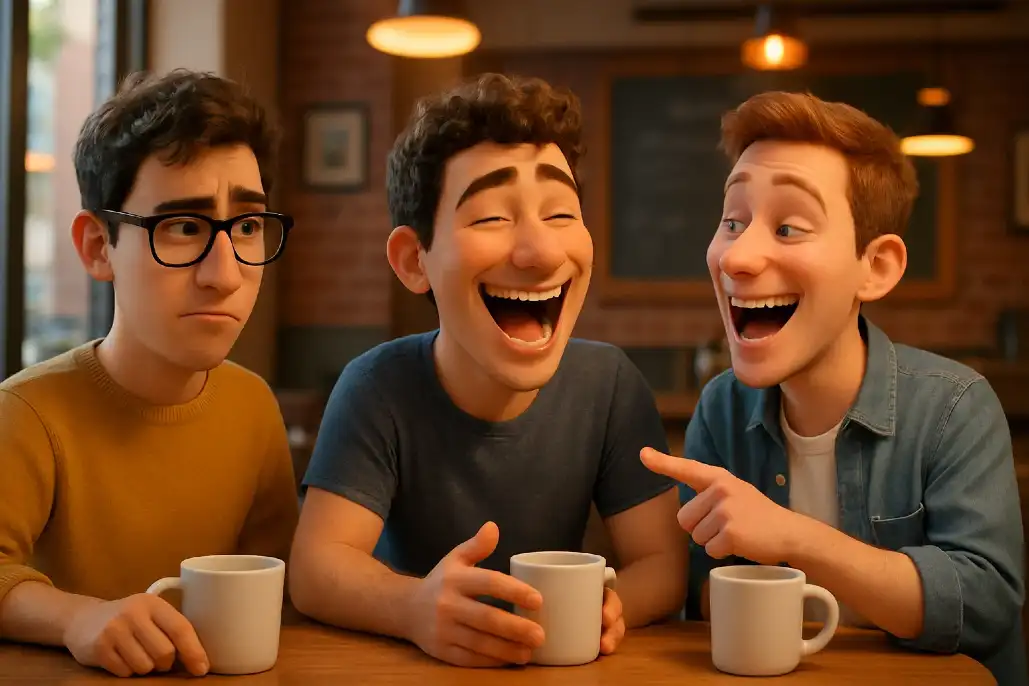
Why do some jokes feel like personal attacks? Discover the psychology behind teasing, insults, humor boundaries, and how to respond with confidence and emotional awareness.
Your best friend calls you an idiot for forgetting your keys again, and you both laugh. A coworker makes the same comment at a meeting, and you spend the rest of the day feeling diminished. Same words, radically different emotional impact. Why?
William B. Irvine’s “A Slap in the Face: Why Insults Hurt—And Why They Shouldn’t” explores this seemingly paradoxical phenomenon with clarity and depth. The answer isn’t about the words themselves. It’s about the invisible social dynamics beneath them—dynamics that our brains track with sophisticated precision, even when we’re not consciously aware of what’s happening.
Understanding this distinction matters more than you might think. It’s not just about social etiquette or knowing when to laugh. It’s about recognizing the psychological mechanisms that determine whether words strengthen relationships or damage them.
The Social Test Hidden in Teasing
Playful teasing, Irvine explains, serves a crucial social function. It’s a test. When friends tease each other, they’re actually probing the boundaries of the relationship, confirming that the bond is strong enough to withstand minor provocations. It’s a way of saying: our connection is secure enough that I can joke about your flaws without threatening the fundamental respect between us.
This is why teasing often increases as friendships deepen. New acquaintances stick to safe topics and polite exchanges. Close friends mock each other relentlessly. The teasing itself becomes evidence of intimacy. If you can joke about my receding hairline and I laugh, it proves I trust you enough to be vulnerable without fear of genuine attack.
Babies understand this instinctively. Irvine notes that even infants engage in playful teasing—hiding objects their parents are looking for, then laughing when the parent discovers them. This isn’t malicious behavior. It’s relationship-building through play. The child tests whether the parent will respond with warmth and amusement, confirming the security of their bond.
Why Context Changes Everything
The same insult delivered in different contexts carries entirely different meanings. When Marc Connelly, a member of the famous Algonquin Round Table in 1920s New York, had someone rub his bald head and compare it to the man’s wife’s backside, Connelly responded with perfect wit: he felt his own head and said, “So it does, so it does.” The exchange has been retold for nearly a century because it represents playful teasing at its finest—clever, unexpected, and devoid of actual malice.
But imagine the same interaction between a boss and an employee, or between strangers at a bar. The power dynamic shifts. What was playful becomes predatory. What was bonding becomes dominating.
Irvine emphasizes that the key difference lies not in the words but in the social relationship between the people involved and the intent behind the exchange. Playful teasing happens within a framework of mutual respect and established relationship security. Malicious insults happen when someone wants to establish dominance, express hostility, or lower another person’s social standing.
The Joking Relationship
Anthropologists have documented what they call “joking relationships” across cultures—formalized social bonds where teasing and mock insults are expected and enjoyed. Irvine discusses research by Alfred Radcliffe-Brown, who observed these relationships in various tribal societies. In these contexts, certain relatives or social positions are designated as appropriate targets for teasing, and the teasing itself strengthens rather than weakens social cohesion.
These joking relationships reveal something important: humans have evolved sophisticated mechanisms for using potentially hurtful behavior in constructive ways. The teasing serves to release social tension, affirm bonds, and create shared enjoyment. But it only works when both parties understand and accept the framework.
This is why office “banter” can be so problematic. What one person experiences as playful teasing might feel like harassment to another, especially when power imbalances exist. The person with authority might think they’re building camaraderie through jokes, while the subordinate feels they have no choice but to laugh along or risk professional consequences.
Nicknames: Endearment or Insult?
Nicknames occupy interesting territory in the landscape of teasing and insults. A nickname can be the ultimate sign of affection and inclusion, or it can be a tool of humiliation and exclusion. The difference, again, comes down to consent and context.
When friends give each other nicknames based on embarrassing incidents or physical characteristics, those names often become badges of belonging. They signal that you’re part of the inner circle, that the group knows you well enough to reference your quirks with affection rather than cruelty. Irvine notes that this kind of nicknaming is ubiquitous across cultures and age groups.
But nicknames can also weaponize someone’s vulnerabilities. A cruel nickname assigned by bullies serves the opposite purpose—it marks you as an outsider, as someone whose weaknesses are public knowledge and fair game for mockery. The same nickname that would be affectionate between friends becomes a tool of degradation when wielded by antagonists.
The person being nicknamed usually knows immediately which category they’re in, even if they can’t articulate how they know. Your nervous system reads the social cues beneath the words. Are people laughing with you or at you? Is the nickname offered with warmth or with contempt? Are you included in the joke or excluded by it?
The Intent Behind the Words
Irvine makes a crucial point about intentionality. For something to be playful teasing rather than a malicious insult, both parties need to be in on the joke. If one person feels hurt and the other responds with “I was just teasing,” that’s often a sign the boundary was crossed.
This is where many conflicts arise. The teaser genuinely believes they’re being playful, while the target experiences the comment as an attack. Who’s right? Irvine argues that if you find the behavior insulting, you’ve been insulted, regardless of the speaker’s intent. The impact matters more than the intention.
This doesn’t mean people should never joke with each other or that every perceived slight deserves confrontation. It means we need to be attentive to how our words land, especially with people whose relationship security with us is unclear. The friend you’ve known for twenty years has a different baseline than the colleague you met last month.
When “Just Joking” Becomes Manipulation
There’s a particular form of insult that hides behind the mask of teasing, and it’s one of the most psychologically damaging. Irvine describes situations where someone delivers a genuine insult, then watches the target’s reaction. If the target looks hurt, the insulter quickly claims they were “just joking” or “just teasing,” making the target feel foolish for being offended.
This is manipulation. The insulter gets to wound while maintaining plausible deniability. If the target protests, they’re accused of being too sensitive or lacking a sense of humor. The original insult gets reinforced with a second one: you’re not only [whatever the insult targeted], you’re also humorless and unable to take a joke.
Genuine playful teasing doesn’t require this kind of escape clause. When friends tease each other, there’s no confusion about whether offense was intended or taken. The relationship is solid enough that minor provocations don’t threaten the fundamental respect between them. But when someone uses “just joking” as a shield for genuine hostility, they’re not teasing. They’re testing whether they can get away with cruelty.
The Pain That Playful Teasing Doesn’t Cause
One of the most interesting aspects of genuine playful teasing is what doesn’t happen: the target doesn’t experience the deep pain associated with malicious insults. Irvine explains that this is because playful teasing doesn’t threaten your position in the social hierarchy.
When a friend mocks your terrible fashion choices, you might feel momentary embarrassment, but not the searing pain of status loss. Why? Because the teasing actually confirms your status. Your friend feels comfortable enough with you to joke. They’re not trying to diminish you in the eyes of others. They’re engaging in a form of social play that both of you understand and accept.
Malicious insults work differently. They’re designed to lower your standing, to mark you as inferior, to establish dominance. Your nervous system recognizes the threat even if your conscious mind tries to brush it off. The pain you feel is your brain signaling that your social position is under attack.
This is why the same person might laugh off one comment and be devastated by another that seems similar on the surface. Your subconscious is extraordinarily skilled at reading intent and social context. It knows when you’re safe and when you’re threatened.
The Role of Humor in Defusing Tension
Irvine draws on Stoic philosophy to explore how humor can transform potentially hurtful exchanges. The Stoics recommended self-deprecating humor as a response to insults—essentially, beating your insulter to the punch by insulting yourself even more thoroughly than they did.
This technique works because it refuses to treat the insult as a serious attack on your status. When someone tries to lower you and you respond by cheerfully agreeing and exaggerating their criticism, you’ve drained the insult of its power. You’ve signaled that your self-worth doesn’t depend on their opinion, and you’ve made them look foolish for attempting the attack in the first place.
Playful teasing among friends often operates on a similar principle. When everyone is comfortable mocking themselves and each other, no individual insult carries much weight. The humor creates a buffer zone where status concerns temporarily fade, allowing for honest, unguarded interaction.
Reading the Room: Social Intelligence and Teasing
The ability to distinguish between playful teasing and malicious insults requires sophisticated social intelligence. You need to read facial expressions, tone of voice, body language, and social context. You need to understand power dynamics, relationship history, and cultural norms.
Some people naturally excel at this. They seem to know instinctively when a joke will land as playful versus hurtful. Others struggle, either because they’re less attuned to social cues or because they’re operating in an unfamiliar cultural context. Irvine notes that what counts as acceptable teasing varies enormously across cultures and subcultures.
This is why the safest approach, especially in professional settings or with people you don’t know well, is to err on the side of restraint. The potential downside of a playful tease that lands wrong far exceeds the upside of a successful joke. Save the edgier material for established relationships where you’ve earned the right to push boundaries.
When Teasing Reveals Deeper Issues
Sometimes what appears to be playful teasing actually masks genuine resentment or contempt. A partner who constantly jokes about your weight might claim they’re teasing, but the repetition and focus suggest something more hostile underneath. A friend who always makes you the butt of the joke in group settings might be expressing unacknowledged competitive feelings.
Irvine encourages paying attention to patterns rather than individual incidents. Isolated jokes, even mildly barbed ones, are normal in close relationships. But when the teasing is consistently one-directional, when it always targets the same vulnerabilities, when it happens in front of audiences, it’s worth questioning whether what you’re experiencing is actually playful.
The person doing the teasing might not even be aware of their own hostility. They might genuinely believe they’re being affectionate while simultaneously using humor to express feelings they can’t acknowledge directly. This is one of the complications of human psychology—we’re remarkably skilled at hiding our true motives from ourselves.
Building Resilience Without Losing Sensitivity
The goal isn’t to become immune to all teasing or to view every joke as a potential insult. That would rob you of the genuine pleasure and intimacy that playful teasing can create. The goal is to develop the discernment to know the difference and the strength to respond appropriately to each.
Irvine’s Stoic-influenced approach suggests that you should be less concerned with whether specific words constitute teasing or insult, and more concerned with whether you’re going to let either one disturb your peace. The truly resilient person can laugh at playful teasing without defensiveness and dismiss malicious insults without pain. But this kind of resilience comes from internal security, not from emotional numbing.
When you’re genuinely confident in your worth, when you’re not playing the social hierarchy game that makes insults sting, you can receive even harsh criticism with equanimity. You can distinguish between feedback worth considering and attacks worth ignoring. You can engage in playful banter without fear that you’re actually being diminished.
The Practice of Discernment
Developing this discernment is a practice, not a permanent achievement. Even people skilled at reading social situations sometimes misinterpret teasing as insult or miss genuine hostility masked as joking. The key is to stay curious about your own reactions and honest about what you’re actually experiencing.
When something someone says bothers you, don’t immediately dismiss it as “too sensitive” or automatically confront them as an attacker. Ask yourself: What is my relationship with this person? What is the broader context? Is there a pattern here, or is this an isolated incident? What am I actually responding to—the words themselves, or the social dynamics beneath them?
These questions won’t always give you clear answers, but they’ll help you respond more skillfully than if you simply react based on your initial emotional flash. They’ll help you preserve relationships worth preserving while setting boundaries with people who consistently cross lines.
The line between playful teasing and malicious insult will never be perfectly clear in every situation. But understanding that the line exists, knowing what distinguishes one from the other, and recognizing which game is being played—these skills can transform how you navigate social interactions. They can help you enjoy the genuine warmth of playful teasing while protecting yourself from attacks disguised as jokes.
Your relationships will be stronger, your boundaries clearer, and your internal peace more secure. And perhaps most importantly, you’ll know when to laugh with someone and when to walk away.
Related posts:
 33 Powerful Takeaways from William B. Irvine’s “A Slap in the Face” (Book Summary)
 A Slap in the Face by William B. Irvine: How Stoicism Makes You Immune to Insults
 Why Do People Insult Each Other?: The Hidden Motivations Behind Our Cruelest Words
 How Stoic Philosophy Makes You Immune to Insults—Without Emotional Detachment
 How to Respond to Insults: 6 Practical Strategies That Actually Work