Discover who Hoemath is, how he rose to viral fame, and why his controversial content is capturing massive attention online. Learn what his messaging reveals about modern internet culture, masculinity, and digital influence. Understand the impact of his content and why he continues to spark debate across social media platforms.
In an online space where male content creators tend to compete for volume — who can be the angriest, the most provocative, the most aggressively certain — a creator who goes by the name Hoemath has found an unusual lane. He is calm. He draws charts. He quotes integral theory. And somehow, he has built an audience of nearly 800,000 subscribers without ever showing his face.
If you have stumbled across Hoemath’s content and wondered who he actually is, what drives his approach, and why his videos feel different from much of the so-called red pill space, this article is for you. Drawing from his recent appearance on the Pearl Daily podcast with Hannah Pearl Davis, we can piece together a clear picture of one of the more intellectually serious voices in a conversation that rarely rewards that quality.
A Viral TikTok and an Unlikely hoe_math Origin Story
Like many creators, Hoemath did not plan his career. His entry into content creation was almost accidental — born from disruption, not ambition.
During the COVID-19 pandemic, Hoemath lost what he described as “pretty much everything”: his income, his social circle, his extracurricular life, and the sense of forward momentum that gives ordinary life its shape. Living in a neighborhood that changed overnight in the wake of the George Floyd protests — a neighborhood where he had never before witnessed crime, and suddenly watched people attempting to break into businesses from across the street — he was left with an unusual combination of too much time and too much to say.
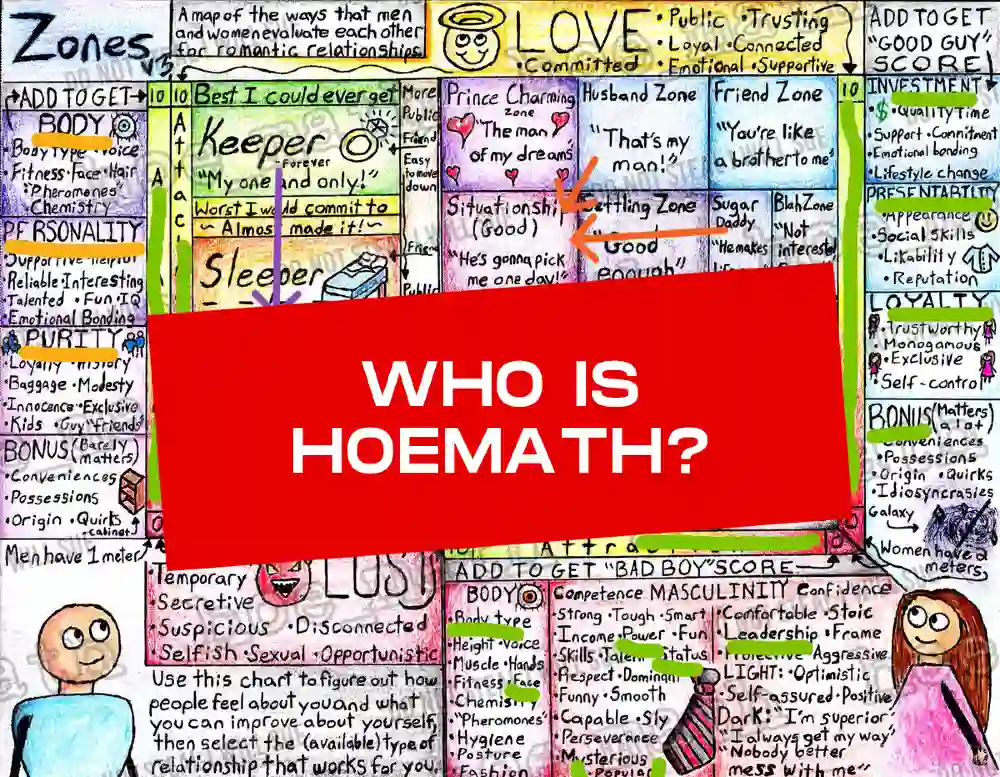
He made a TikTok. A “cranky” one, he admits. It showed a simple chart explaining why the women asking “where are all the men with no hoes?” were systematically ignoring those exact men on dating apps. The video got four million views.
“It was a total fluke,” he told Pearl Davis. “I just happened to have all the skills to make this into a successful career.”
What is interesting about that origin is what it reveals: Hoemath had been studying human behavior, consciousness, and psychology long before the camera ever turned on. He was not radicalised into the dating space by heartbreak or humiliation, as is common with creators in this niche. He came in with a framework already built — a background in communications, a deep interest in integral theory (the developmental psychology framework created by philosopher Ken Wilber), and a reading list that included The 48 Laws of Power, How to Win Friends and Influence People, and Scott Adams’ Win Bigly. The viral moment did not create his perspective; it simply gave it an audience.
What Makes Hoemath Different
The red pill content space is not short of people willing to tell men that women are manipulative, hypergamy is destiny, and marriage is a legal trap. What it is short of is creators who approach these ideas with genuine psychological curiosity rather than grievance.
Hoemath sits closer to the curious end of that spectrum than almost anyone else in the space. His videos — built around hand-drawn charts and diagrams, often made during live streams — are less manifestos than they are attempts to model human behavior. He is interested in why people behave the way they do, not simply in assigning blame.
In his conversation with Pearl Davis, this quality came through clearly. When asked about the most common breakthroughs in his life coaching work, he did not describe moments of men “waking up” to female nature or women being exposed. He described something quieter and more real: a man who could not understand why he felt justified cheating at work — until they found the root together. A young woman who had been damaged by bad dating experiences — whom he helped by reframing her past as incompletely written, not fixed. A man whose reaction to his girlfriend’s new job was making the relationship worse — until Hoemath helped him see how a simple shift in language could change the emotional content of the whole dynamic.
“The most common thing I hear from women,” he said, “is ‘you understand me so well that you explained me to myself.'”
This is not typical red pill content. It is closer to what a thoughtful therapist or a sharp-eyed friend might offer — someone who has done the reading, observed carefully, and is genuinely interested in the human beneath the behavior.
The Psychology Behind the Charts
Hoemath’s framework draws heavily on integral theory — the developmental model that maps how individuals and cultures grow through increasingly complex stages of consciousness and values. This is an unusual intellectual foundation for a dating and male psychology creator, and it shows in the texture of his work.
Where many in the space make hard deterministic claims about gender — women always do X, men always do Y — Hoemath tends to model tendencies, trade-offs, and thresholds. His famous chart showing how dating dynamics shift when social infrastructure breaks down is a good example. It does not say women are bad. It says that unfamiliarity increases selectivity, that proximity and repeated interaction generate attraction, and that when technology replaces organic social connection, the incentive structures of dating shift in ways that hurt most people — men and women alike.
He described this chart in detail on the Pearl Daily podcast: in functioning societies, men and women interact through shared institutions — churches, schools, neighborhoods — and stable long-term relationships form organically between roughly matched partners. When those institutions erode and dating moves online, female selectivity rises sharply for men they don’t know, more men end up in what he calls “the not people zone,” and the whole ecosystem becomes less stable for everyone.
This kind of analysis — structural rather than personal, descriptive rather than prescriptive — is part of why Hoemath’s content resonates with women as well as men. You do not have to feel attacked to engage with it. You just have to be willing to look honestly at what is happening.
The Anonymity Question
One of the more striking things about Hoemath’s career is that he has maintained almost complete anonymity throughout it — no face reveals, no real name, no verified physical presence in the world. He lives and works from home, has not had a day off in months, and goes out primarily for groceries.
When Pearl Davis asked how he had managed to stay anonymous despite a recognizable voice and nearly 800,000 subscribers, he was candidly modest about it. A family member had called to ask if a video was him. A few people from his past had reached out digitally. That was essentially it.
There is something both practical and philosophically consistent about the anonymity. Hoemath is a man who thinks carefully about incentive structures and how systems shape behavior. He is aware that public recognition comes with real costs — the demonetization that Pearl Davis described enduring for over a year, the scrutiny, the way public identity constrains what you can say and do. By staying anonymous, he preserves a kind of freedom — to be wrong, to change his mind, to speak without the performance anxiety that visibility brings.
“I don’t ever want to be recognized,” he said simply. And there is something admirable about a content creator who means it.
On Modern Dating, Marriage, and Male Psychology
A large portion of Hoemath’s content addresses what he sees as the structural challenges facing men in contemporary dating — not as a victim narrative, but as an honest accounting of how incentives have shifted.
His view on marriage is not the scorched-earth position common in harder red pill circles. It is more nuanced and, in its own way, more sobering: that marriage as a cultural institution has lost the social and structural pressures that once made it more stable, and that this loss has created real risk for men without creating equivalent benefit. He uses the analogy of a contract whose enforceability has been quietly removed — not maliciously, necessarily, but through the accumulated effect of cultural change, technology, and evolving expectations.
“Marriage has become a fashion item,” he told Davis. “It’s like a hat you buy. It doesn’t have any of those bonds anymore. And so it just lifts right out as soon as you have a fight.”
This is not the same as saying don’t get married, or that women are inherently untrustworthy. It is closer to saying: be clear-eyed about what you are entering, because the structural support that once gave the institution its stability is largely gone. That is a serious observation, not a rant.
When asked about dating advice for a 28-year-old just out of law school moving to New York City, he offered something that distinguished him entirely from the typical red pill playbook. He did not talk about not catching feelings, or dominance, or never committing. He said: know what you want. Figure out why you are going to the city. Think about the next five, ten, twenty years. Don’t just arrive and cross your fingers.
“Don’t go to the city and cross your fingers,” he said. “That would be my first piece of advice.”
That is not ideology. That is wisdom.
The Selfmax Project and Life Coaching Work
In addition to his content work, Hoemath has developed a service called Selfmax — an AI-guided framework designed to help people clarify what they want, understand what is getting in their way, and build systems for learning from their experience. It grew out of his earlier life coaching work, which he described as among the most meaningful things he has done professionally.
The tool reflects his psychological orientation: it is less about giving men instructions and more about helping them develop the self-awareness to figure out what they actually want and who they actually are. He described getting people to “breakthroughs within an hour” — not by delivering answers, but by asking the right questions, helping people see where their thinking was tangled, and giving them frameworks to return to on their own.
This is probably the cleanest expression of what Hoemath is really doing beneath the chart-drawing and the dating analysis: trying to help people become clearer about themselves. In that sense, his content is less about men versus women, and more about what it looks like to move through the world with a little more self-knowledge and a little less reactive confusion.
Why Hoe_math Matters in This Conversation
The conversation about men, masculinity, and modern relationships is not going away. If anything, it is intensifying. And within that conversation, there is a real shortage of voices that are psychologically sophisticated, emotionally honest, and genuinely curious rather than simply angry or entrepreneurially grievance-driven.
Hoemath is not perfect, and he is not trying to be. He is working through the same cultural chaos as everyone else, using the particular tools he has — a background in consciousness studies, a talent for visual explanation, and an unusual capacity to observe human behavior without immediately needing to assign moral blame.
In a space that often trades in certainty and outrage, that kind of open, curious intelligence is rarer than it should be.
You can find him on YouTube, TikTok, Instagram, and X simply by searching Hoemath — spelled H-O-E-M-A-T-H — and his full range of content, including charts, a coffee table book of his drawings, and the Selfmax framework, is available through his Linktree.
FAQ
Who is Hoemath? Hoemath is an anonymous YouTuber and content creator with nearly 800,000 subscribers who focuses on male psychology, modern dating dynamics, and self-development. He uses hand-drawn charts and an integral theory framework to explain human behavior. His real identity has not been publicly disclosed.
What is Hoemath’s background? He has a degree in communications and studied integral theory — a developmental psychology framework by Ken Wilber. He is widely read in influence and persuasion literature and draws on personal experience in dating alongside his academic interests.
Where did Hoemath come from? Hoemath went viral during the COVID-19 pandemic with a TikTok video that used a simple chart to explain dating dynamics. The video got four million views and launched his career as a full-time content creator.
Is Hoemath red pill? He describes himself as “red pill adjacent.” His content addresses similar themes — dating, hypergamy, male disadvantages in modern relationships — but with a calmer, more psychological approach than most red pill creators. He is notably less polarizing and appeals to a mixed audience including women.
What is Hoemath’s Selfmax service? Selfmax is an AI-guided self-development tool Hoemath created to help users clarify their goals, identify what is blocking them, and build frameworks for learning from experience. It grew out of his earlier one-on-one life coaching work.
Related posts:
 Understanding Why Men Are Walking Away From Modern Dating and Relationships and The Rise of MGTOW movement
 The Modern Dating Crisis: A hoe_math Analysis
 Female vs. Male Nature: The hoe_math Breakdown
 What Is “High Value” in Modern Dating? How Relationships, Morality, and Money Are All the Same Problem
 The Four Ways to Meet Women in 2026: A Modern Dating Strategy for Men