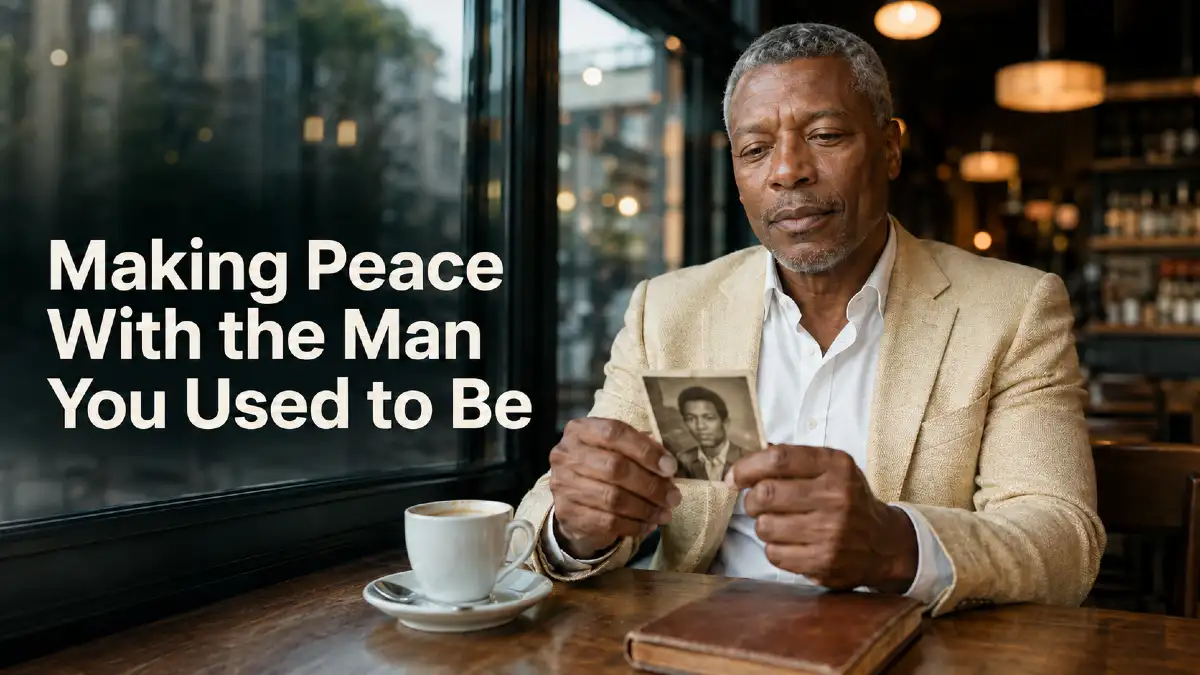
There is a particular weight that begins to accumulate, around midlife, that most men do not name and many men carry as if it were a private failure of their own. It is the slow accumulation of regret — about choices that look worse in retrospect than they looked at the time, about relationships handled badly, about years that, examined from this distance, appear to have been wasted on the wrong things. The accumulation has been gathering quietly for years. Around forty, it tends to make itself known. By fifty, for many men, it has become one of the steadier features of their inner landscape.
What people usually do with this weight is one of two things. They either suppress it — push it down, drown it in work or distraction, refuse to look at it for long — or they nurse it, returning again and again to the particular failures, building a private case against the younger version of themselves that hardens over years into something close to self-contempt. Neither approach works. The suppression takes ongoing energy and the regret keeps returning anyway. The nursing produces a man who is, in some quiet way, at war with himself, with all the costs that an interior war exacts on the man fighting it and the people who have to live with him.
There is a third approach that is harder to find but more sustaining. It involves doing the actual work of making peace with the man you used to be — not by excusing him, not by indicting him, but by seeing him whole, the way you might eventually see your father in the work that older men do. The man you were is not gone. He is part of you. Your relationship with him, going forward, will shape much of how you live the rest of your life. The work of getting on better terms with him is one of the more important interior projects available to a thoughtful adult.
The accumulation of regret
It is worth being honest about what is actually being regretted, because the specifics matter and the cultural conversation tends to keep the topic vague.
There are usually relationships in the inventory. The partner who was treated worse than she deserved. The friendship that you let fail through neglect or selfishness. The family member you said something to that you cannot unsay. The colleague you betrayed, in some small or larger way, when the situation tested you. The relationships you handled with the limitations you had then, which feel, in retrospect, like more than they should have been.
There are choices in the inventory too. The career path you took for the wrong reasons. The opportunity you turned down out of fear. The years you spent on something that, looking back, was not worth the years. The money you made and lost, the trust you violated, the version of yourself you displayed when no one was looking who could correct you.
There are absences as well. The conversations you did not have. The risks you did not take. The kind of man you knew, at some level, you should be becoming, who you did not become. The fatherhood you fell short of. The friendships you let lapse. The slow accumulation of things that should have been done and were not.
The inventory is private and particular to each man. By midlife, most men have one. The differences between them are mostly differences of content, not of structure. The structure is the same: a list of specific things that the younger version of you did or failed to do, which you now look at with a clarity that you did not have at the time, and which you find yourself disappointed in.
What is actually true about who you were
The honest part of this work is the part most men avoid, because it cuts in a direction that is hard to hold. The honest part is that the younger version of you was, in real terms, doing the best he could with what he had. This is not a way of letting him off the hook. It is a more accurate account of what was actually happening, and the accuracy is the foundation of any real peace.
The man you were at twenty-five did not have the perspective the man at forty-five has. He did not have the developmental work. He did not have the failures-and-recoveries that taught him what they taught you. He did not have the relationship experience that lets you see now what he could not see then. The picture you have of his choices, from your current vantage point, includes information he did not have access to at the time. The judgments you are applying to him are being applied from a position he could not have occupied.
This does not mean his choices were good. Some of them were not. It does not mean the harm he did was acceptable. Some of it was not. It means that the harshness with which you are evaluating him, from the future, contains a basic unfairness — the unfairness of judging a person by standards that became available to you only through the experiences that judging him is part of. You know what you know now because of who you were then, including the parts of him that you find regrettable. Without that history, including the regrettable parts, the person doing the judging would not have come into existence in his current form.
The patterns that have been operating in your life often look obvious in retrospect and were anything but obvious at the time. The younger version of you was caught inside them in a way he could not have seen out of. The fact that you can see out of them now is not evidence that he should have. It is evidence that you have done some of the work, often partly because of the regrettable things, that has produced the current view.
This is not an argument for not regretting anything. It is an argument for regretting accurately. The accurate regret recognizes that some specific things were wrong, that you did them, and that you wish you had not. The inaccurate regret extends this into a global indictment of the man who did them, as if he should have been the man you have become before he had done the living that produced you. The first is sober and bearable. The second is, in the long run, corrosive.
What the work of peace actually requires
Making peace with who you were is not a single event. It is a slow re-relating to your own history that happens, when it happens, across years. A few moves that tend to be part of the work.
Look honestly at what you actually did. This is the first move, and it is the one most easily skipped. The accurate inventory matters. Not the worst version that the inner critic generates when it is most active. Not the sanitized version that the defenses generate when honesty would be uncomfortable. The actual thing. What did you actually do, in the relationships and choices that you regret? Naming it precisely, even just to yourself, is the foundation. Without the precise naming, the regret floats in a vague cloud that cannot be addressed. With it, you have something specific to be in relationship with.
Recognize the conditions under which you did it. The man you were was operating in particular circumstances, with particular pressures, with the developmental level he had at the time. None of these excuse the actions; they contextualize them. The young man who treated his first partner badly was, often, doing so out of fears and patterns that he could not see, in a culture that was modeling certain things to him, with no one teaching him how to do better. The man who took the wrong career path was making the best decision he could with the information and self-knowledge available. The recognition of conditions is not the same as forgiveness; it is what allows you to see the actual situation rather than a stripped-down version of it.
Make amends where you can. For some of the regrets, real action is possible. The friendship you neglected may still be reachable. The apology you owe can still be delivered, even years later. The harm you did can sometimes be addressed, in some way that begins to repair it. Not all regrets admit of this, but some do, and the active work of making amends is often part of how the peace becomes available. The man who has done what he can to repair what is reachable carries the unrepairable parts more lightly, because he has made the gesture he could make. The architecture of an apology that actually heals becomes especially useful here.
Grieve what cannot be undone. Some of what is regretted cannot be repaired. The person you cannot reach. The years you cannot get back. The choices whose consequences are now permanent features of your life. For these, the work is the work of grief — of letting the loss be a loss, fully felt, rather than carrying it as a continuing punishment. The grief, like all grief, takes time. It does not produce resolution in the bumper-sticker sense. It produces, over years, the slow incorporation of the loss into a life that continues, in a way that lets the loss be present without dominating.
Take what was learned forward. The hardest move and the most important. The regrettable things you did taught you, often, much of what you now know. They produced the man you became. The use of that learning, in your current life, is the closest thing to redemption that this kind of accounting allows. The man who handled his first marriage badly and learned from it can be a different husband in his second marriage, or in the remaining decades of his first one. The man who treated a friend with selfishness and learned from it can be a different friend, going forward, to the people still in his life. The learning, taken forward, is the way the harm done becomes part of something other than only itself. Real self-acceptance does not require approving of what was done — it requires being able to hold the whole of who you have been with some honesty.
What this is not
It is worth being honest about what this kind of peace is not.
It is not approval of what was done. The peace does not require pretending the regrettable things were acceptable. They were not. The peace is about how you carry them, not about whether they should be carried. The man who has made some peace with his history is not endorsing his earlier failures. He is finding a way to be in relationship with the man who committed them without ongoing self-attack.
It is not forgiveness in the cheap sense. The cultural language around self-forgiveness sometimes implies a magical resolution that the actual work does not produce. The work produces something more textured — a complicated relationship with your own past that has more peace than war in it, but that includes the truthful acknowledgment of what was wrong. The cheap version flattens this into a simple “I forgive myself” that often does not stick. The honest version is messier and more durable.
It is not the end of regret. Even after the work, there will be moments when the regret returns — the song that brings up the relationship, the article that reminds you of the wrong choice, the encounter that activates the old failure. These moments are not setbacks. They are the regret continuing to do its work, on its own timeline, in a man who is now able to receive it without being destroyed by it. The work is not the elimination of regret. It is the change in how the regret is held.
Real self-compassion is not the cheerful affirmation it is sometimes packaged as. It is the more difficult practice of being able to hold your own failures without converting them into self-condemnation, and of being able to acknowledge them honestly without minimizing what was wrong about them. The man who has built some of this capacity is the man who can carry his own history without it crushing him.
The relationship to the man you are becoming
There is something worth noting about how this work changes the relationship to the man you are still becoming. The man who is at war with his past tends to be a particular kind of man in the present. He is often defensive, because the past failures are a vulnerability he is protecting. He is often driven, because the unworthiness has to be outrun. He is often hard on himself in ways that show up as being hard on others. The interior war has external costs that touch the people around him whether he intends them to or not.
The man who has done some of the peace work tends to be different. He is, in some quiet way, more settled in himself. The past, no longer a constant threat to his self-respect, can simply be the past. The present can have his full attention rather than competing with the inner argument about his history. The future can be approached with the energy that was being spent on managing what he had already done.
The work of becoming the man you mean to be is, in significant part, the work of being in good enough relationship with the man you used to be that he is no longer running interference. The man you are becoming needs the man you were, with all his failures, to be part of the foundation rather than part of the obstacle. The peace is what makes that possible.
A starting place
You probably have an inventory. The names you avoid thinking about. The chapters you skip past when you mentally review your life. The specific failures that, even now, can produce a small wince when they surface.
You do not have to do all of this at once. The work unfolds across years, and forcing it produces something other than the actual peace it is reaching for. The starting place is small.
Pick one specific regret. Not the largest. One that is large enough to matter and small enough to be worked with. Look at it honestly. What did you actually do? What conditions were you operating under? What did it teach you that you have carried forward into who you are now? Is there any action available — an apology to make, a repair to attempt, a follow-through to complete — that you have not done? If so, consider doing it. If not, consider letting the grief for what cannot be undone have its time, fully felt, without being immediately pushed aside.
Then come back to it, over months, as it asks to be returned to. Notice, slowly, that something is shifting. The specific regret is not vanishing. It has become possible to hold without quite as much weight as it carried before. The man who did the regretted thing is starting to come into focus as a real person — a particular man, in a particular phase, who made a particular choice — rather than as the dark figure your harsher inner narration had made him into.
Repeat with another regret, as you become ready. Over years, the inventory does not get longer but the weight of each item gets lighter. The man you used to be becomes, gradually, someone you can hold a more accurate and tender relationship with — the way you might, eventually, hold your father, or the way good fathers eventually hold their own sons.
The peace is real, when it comes. It does not announce itself. It just becomes, slowly, the way you carry your own history. The years of regret, transformed through this work, become something other than only the burden they once were. They become, also, the foundation of the more honest and more useful man you are still becoming. That is what was being built, the whole time, in the difficult middle of your life. It is being built still.
Related posts:
 The Male Self-Deception Pattern: Why Smart, Capable Men Lie to Themselves
 Coming to Peace With Your Father
 The Hero’s Journey for Men: The Making of a Hero Through Twelve Stages
 “She’s the Prize” or “I’m the Prize”? Why Both Are Wrong (And What Actually Works)
 The Marathon Continues: What Nipsey Hussle Taught Us About Ownership, Brotherhood, Legacy and Being a Man