
Discover how sexual market value (SMV) explains why men and women tend to peak at different ages — learn when you’re likely at your most attractive in the dating world, what makes SMV rise or fall over time, and how to maximize your appeal across different life stages.
Introduction
One of the most controversial yet important concepts in modern dating is “sexual market value” (SMV)—a term that makes many people uncomfortable but describes dynamics that affect everyone’s romantic prospects. In a revealing conversation on the Sean Kim podcast, clinical psychologist Dr. Orion Taraban breaks down this concept and explains why men and women peak at dramatically different ages (watch the full discussion here).
Understanding sexual market value isn’t about reducing people to numbers—it’s about recognizing the real dynamics that shape dating success at different life stages. As Dr. Taraban explains, “Everyone kind of uses this implicitly” when they tell someone “you could do better.” This guide will help men understand how SMV works, when they peak, and how to maximize their dating prospects throughout their lives.
What Is Sexual Market Value (SMV)?
Sexual market value represents how attractive someone is in the dating marketplace based on various factors that potential partners find desirable. While the term can feel reductive, Dr. Taraban argues that everyone already makes these calculations unconsciously: “More or less everyone is trying to secure a relationship with their perceived best option, which has to do with some kind of ranking metric that is going on inside of their minds.”
Why SMV Matters
The concept matters because it helps explain:
- Why dating feels easier or harder at different ages
- Why some strategies work better than others depending on life stage
- How to invest in yourself to maximize romantic opportunities
- When to make major relationship decisions like marriage
Research in evolutionary psychology and behavioral economics confirms that mate selection involves complex value assessments, even if we’re not consciously aware of making them.
The Three Types of Sexual Market Value
Dr. Taraban introduces a sophisticated framework that moves beyond simplistic rankings, identifying three distinct types of SMV:
1. Normative Sexual Market Value (NSMV)
This represents “socially objective value”—how attractive someone is to the general population based on cultural beauty standards. For women, Dr. Taraban notes this means approximating “a Sports Illustrated swimsuit model,” while for men it means looking like “Ronaldo”—fit, handsome, and successful.
Key factors include:
- Physical attractiveness and fitness
- Facial symmetry and features
- Height (especially for men)
- Overall presentation and grooming
Research published in Evolution and Human Behavior confirms that certain physical traits (facial symmetry, body proportions, secondary sexual characteristics) are consistently rated as attractive across cultures, supporting the existence of normative standards.
2. Perceived Sexual Market Value (PSMV)
This is where individual preferences come into play. As Dr. Taraban explains: “People have types. Sometimes they’re conscious of those types, sometimes they’re not.” He personally prefers “cute nerds,” who might not grace magazine covers but “light me up.”
This explains why someone who isn’t conventionally attractive might be a “nine or ten” to a specific person. Individual preferences are shaped by:
- Personal experiences and associations
- Psychological attachment patterns
- Cultural background and values
- Unconscious templates from childhood
A study in Psychological Science found that people’s attractiveness ratings of the same faces varied significantly based on personal familiarity and positive associations, demonstrating that perceived value differs substantially from normative standards.
3. Transactive Sexual Market Value (TSMV)
Dr. Taraban offers a crucial insight: “No one really knows how much anything is worth until the money hits the table.” Transactive SMV represents actual market value—the quality of partners someone can actually attract and commit.
Importantly, this is measured differently for men and women:
- For women: The normative SMV of men who actually commit to them (since women can get sex more easily than commitment)
- For men: The normative SMV of women they can attract sexually (since men can get commitment more easily than sex)
This framework acknowledges a fundamental market asymmetry: “It’s easier for women to get sex than commitment and it’s easier for men to get commitment than sex.”
The Age Curve: When Men and Women Peak
The most striking aspect of sexual market value is how dramatically it changes with age—and how differently it affects men and women.
Women’s SMV Timeline
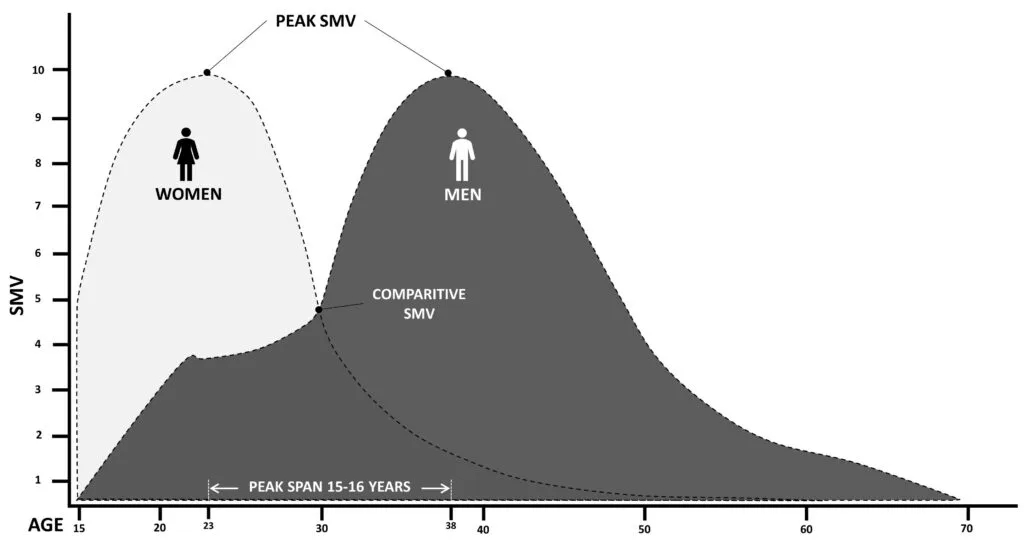
Dr. Taraban presents a controversial but research-supported claim: “When men and women enter the sexual marketplace in our culture at 18, a woman is probably never going to be higher in terms of her sexual marketplace value.”
This is because male attraction primarily focuses on:
- Youth and fertility signals
- Physical attractiveness
- Reproductive capacity
According to revealed preference studies on dating apps, women peak in male eyes around age 23, though Dr. Taraban notes he’s “read even younger than that.”
A comprehensive analysis of dating app data by OkCupid found that men of all ages consistently rated women in their early twenties as most attractive, regardless of the men’s own age—a finding that sparked considerable controversy but aligns with evolutionary psychology predictions.
Research published in Evolution and Human Behavior explains this pattern: men have evolved to prioritize fertility cues, which peak in women’s early twenties and decline thereafter. While individual women vary considerably in how they age, the general trend shows declining male interest as women move through their thirties and forties.
Men’s SMV Timeline
In contrast, men typically start at their lowest point and increase over time: “Men’s sexual marketplace value tends to increase as a function of time as long as they don’t screw anything up.”
Why? Because female attraction is multidimensional, incorporating:
- Financial resources and career success
- Social status and power
- Life skills and emotional maturity
- Confidence and experience
- Physical fitness (which men can maintain or improve)
Dr. Taraban notes that “to become an attractive man, you have to work really fucking hard. You have to make something of yourself. You have to get a lifestyle and make some money and learn some skills and become emotionally mature.”
According to the research Dr. Taraban cites, men peak in female eyes between ages 40 and 50, with one dating app study showing peak male attractiveness at age 50. This creates a decades-long window where men’s value is rising while women’s is declining.
The Crossover Point: Age 30
The most significant moment in the sexual marketplace occurs around age 30, when the trajectories cross: “Up until that point, the average woman was more attractive than the average man. And after that point, the average man is more attractive than the average woman. And it never changes again.”
Why This Matters for Relationship Timing
This crossover helps explain key patterns in relationship formation:
Average Age of First Marriage: In America, it’s 29—right at the crossover point. As Dr. Taraban explains: “That’s from pure game theory when she should settle and make a lifetime commitment to the best available option, especially if that option is going to keep rising past that point of contract.”
From a strategic perspective, this represents optimal timing for women: they’re at peak bargaining power and can secure commitment from a man whose value will continue increasing. For men, marrying at 29 means committing while still relatively low-value, which may not be optimal.
The 35+ Male Advantage: Dr. Taraban suggests “men don’t seriously consider marriage or long-term relationship until they’re at least 35” because by then they’ve:
- Built significant career success and financial stability
- Developed emotional maturity and life skills
- Experienced what it’s like to be “the prize”
- Had time to understand their preferences and deal-breakers
Research on marital stability supports waiting: couples who marry in their late twenties and early thirties have lower divorce rates than those who marry younger, according to data from the University of Utah.
The Volatility Factor: Why Male SMV Is Less Stable
An important nuance Dr. Taraban introduces is that male SMV is “more volatile” than female SMV. While women’s value follows a relatively predictable curve based primarily on age and physical appearance, men’s value can fluctuate dramatically based on:
Career and Financial Changes
A man can jump from low SMV to high SMV through career success, business ventures, or financial windfalls. Conversely, job loss or financial setbacks can crash his value quickly.
Social Status Shifts
Gaining fame, influence, or respected positions can rapidly elevate a man’s SMV. This explains why celebrities and athletes, regardless of physical attractiveness, attract enormous female interest.
Lifestyle and Presentation
Men can significantly improve their SMV through:
- Physical fitness and body composition changes
- Style and grooming improvements
- Developing interesting hobbies and experiences
- Building social skills and charisma
The Time Investment Required
This volatility cuts both ways. Dr. Taraban acknowledges: “It’s actually very difficult to be a young man. You don’t generally have the things that women want.” Most young men face years of investment before seeing returns:
“It can take years to make something of yourself. What’s the alternative? Just roll over and get high? You might as well get started.”
Practical Strategies for Maximizing SMV
Understanding these dynamics allows for strategic life planning:
For Men in Their 20s
Focus on building foundations:
- Invest heavily in career and skill development
- Build your body through consistent training
- Develop your social circle and networking
- Learn from dating experiences without expecting easy success
- Avoid serious commitments that could derail your development
Dr. Taraban notes that men in this phase face the greatest challenges: “You might not have any skills or experience. You might not have any money or status. It’s very difficult to start from the bottom.”
For Men in Their 30s
Capitalize on increasing value:
- Continue career advancement and wealth building
- Expand your social proof and status
- Refine your style and presentation
- Date strategically with clear relationship goals
- Consider when you want to settle down vs. exploring options
This is when many men experience the shift Dr. Taraban describes, finally becoming attractive to women who previously wouldn’t have considered them.
For Men in Their 40s+
Leverage peak value:
- Maintain physical fitness (it becomes more differentiating with age)
- Use your resources and experience wisely
- Be clear about what you want from relationships
- Recognize your advantages while staying grounded
- Mentor younger men navigating earlier phases
Universal Principles for All Ages
Regardless of age, Dr. Taraban advises:
Lean into your type: “It’s generally a good idea for men in particular to be more attractive to fewer women than to be less attractive to more women.” Being a “ten” to 1% of women provides more opportunities than being a “six” to everyone.
Build multidimensional value: Don’t rely solely on looks, money, or status—develop yourself across multiple dimensions.
Understand the numbers game: “If you can be really attractive to 1% of women, that’s going to be more women than you’re going to know how to deal with in your entire life. That’s millions and millions of women.”
The Controversial Nature of SMV Discussions
Dr. Taraban acknowledges that “sexual marketplace value can be an icky term for some people because people don’t like the idea that they have a value, a number assigned to them.”
However, he argues this discomfort doesn’t change the underlying reality: “Everyone kind of uses this implicitly, at least on the terms of quantity.” The question isn’t whether these dynamics exist, but whether we understand them well enough to navigate them successfully.
Research in behavioral economics and evolutionary psychology consistently demonstrates that humans make relative value assessments in mate selection, whether consciously or unconsciously. Ignoring these dynamics doesn’t make them disappear—it just leaves people confused about their dating experiences.
The Role of Assortative Mating
An important principle underlying SMV is assortative mating: “People more or less tend to pair up with people of comparable attractiveness.” This applies not just to physical appearance but to overall lifestyle, status, and attractiveness.
Studies published in Personality and Social Psychology Bulletin confirm strong assortative mating patterns, with correlations between partners’ attractiveness levels ranging from 0.4 to 0.6—substantial effects in social science research.
This means:
- Understanding your own SMV helps calibrate realistic expectations
- Significant SMV gaps between partners create relationship instability
- Improving your SMV expands your dating pool to higher-quality partners
Conclusion
Sexual market value, while uncomfortable to discuss, provides a framework for understanding the dramatically different dating trajectories men and women experience. As Dr. Taraban explains in his conversation on the Dating Doctor podcast (full episode here), women generally peak early while men peak late—a pattern with profound implications for dating strategy and relationship timing.
For men, the message is ultimately hopeful: while your twenties may be challenging, sustained investment in your career, fitness, skills, and social life pays increasing dividends throughout your thirties, forties, and beyond. The key is understanding these dynamics, playing the long game, and making strategic decisions about when and with whom to commit.
The sexual marketplace may be competitive, but it’s not random. Understanding how value is assessed, when different people peak, and how to maximize your own attractiveness provides a roadmap for romantic success at every life stage.
References:
- Dating Doctor On What Women Really Want & The NEW Dating Rules To Attract Women. YouTube. https://www.youtube.com/watch?v=hqXM3fmeYcs
- Rhodes, G., Simmons, L. W., & Peters, M. (2005). Attractiveness and sexual behavior: Does attractiveness enhance mating success? Evolution and Human Behavior, 26(2), 186-201.
- Bressan, P., & Stranieri, D. (2008). The best men are (not always) already taken: Female preference for single versus attached males depends on conception risk. Psychological Science, 19(2), 145-151.
- Rudder, C. (2014). Dataclysm: Who We Are When We Think No One’s Looking. Crown Publishers.
- Buss, D. M., & Schmitt, D. P. (1993). Sexual strategies theory: An evolutionary perspective on human mating. Psychological Review, 100(2), 204-232.
- Kenrick, D. T., & Keefe, R. C. (1992). Age preferences in mates reflect sex differences in human reproductive strategies. Behavioral and Brain Sciences, 15(1), 75-91.
- Wolfinger, N. H. (2015). Want to avoid divorce? Wait to get married, but not too long. Institute for Family Studies.
- Lee, A. J., Dubbs, S. L., Von Hippel, W., Brooks, R. C., & Zietsch, B. P. (2014). A multivariate approach to human mate preferences. Evolution and Human Behavior, 35(3), 193-203.
- Luo, S., & Zhang, G. (2009). What leads to romantic attraction: Similarity, reciprocity, security, or beauty? Evidence from a speed-dating study. Journal of Personality, 77(4), 933-964.
- Watson, D., Klohnen, E. C., Casillas, A., Nus Simms, E., Haig, J., & Berry, D. S. (2004). Match makers and deal breakers: Analyses of assortative mating in newlywed couples. Journal of Personality, 72(5), 1029-1068.
Related posts:
 The Truth About Modern Marriage: Why So Many Marriages Fail Today
 The Four Ways to Meet Women in 2026: A Modern Dating Strategy for Men
 Understanding Why Men Are Walking Away From Modern Dating and Relationships and The Rise of MGTOW movement
 What Women Want in Dating: The Truth Most Advice Gets Wrong
 Why Nice Guys Finish Last: Understanding Attachment and Attraction in Dating