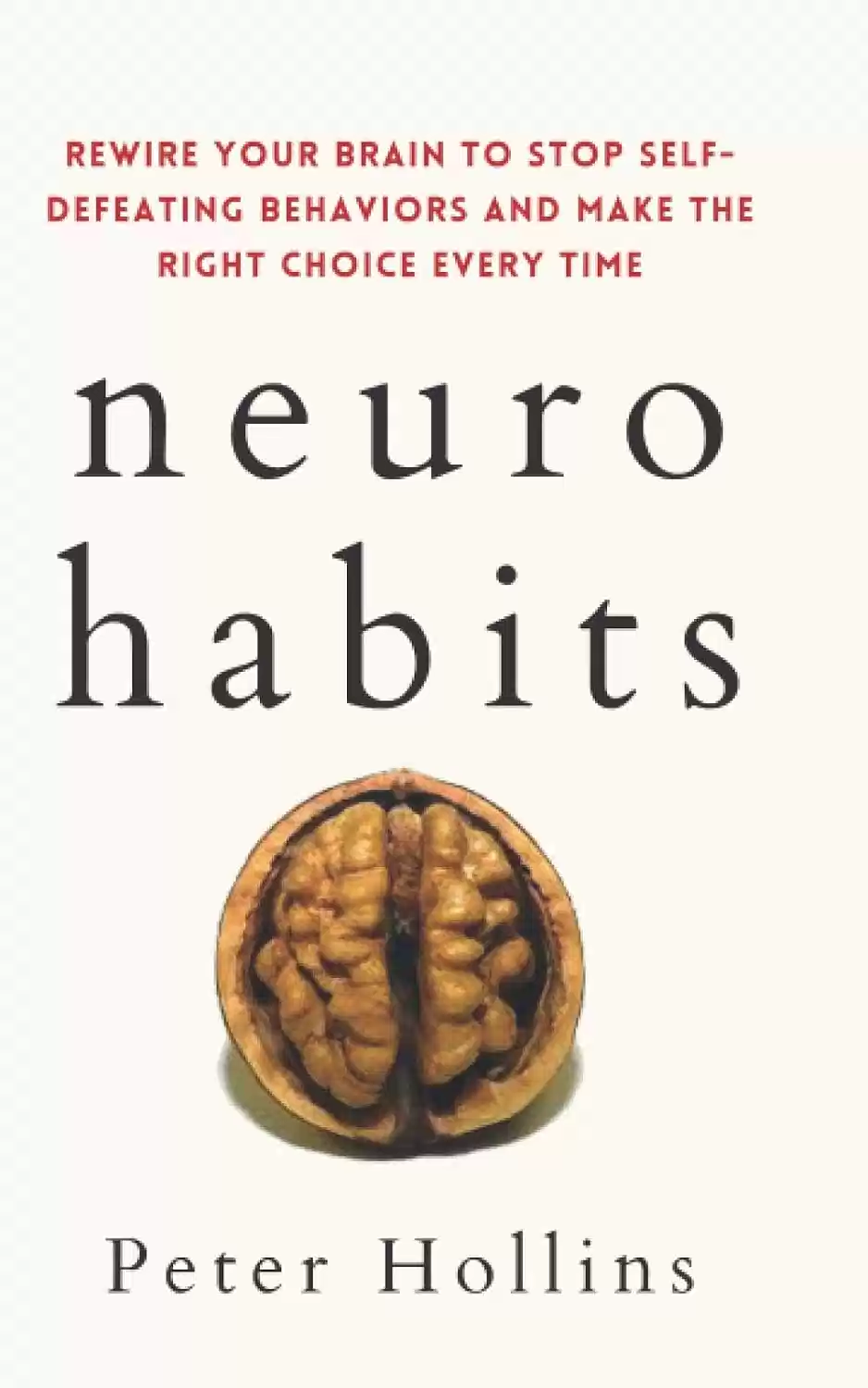
Neuro-Habits by Peter Hollins is a practical guide to how habits are wired in the brain and how to rewire them, built around the habit loop of trigger, routine and reward, the pull of pleasure and pain, and a toolkit of techniques such as replacing routines, if-then planning and designing your environment. Its core message is that lasting change comes from working with your brain’s machinery rather than fighting it with willpower. This summary walks through the book chapter by chapter, checks its key claims against the research, and links to a dozen in-depth articles on each idea.
The full title makes a bold promise: Rewire Your Brain to Stop Self-Defeating Behaviors and Make the Right Choice Every Time.
Every time. Read that phrase twice and a sceptical man might put the book down. Nobody makes the right choice every time, and anyone claiming to teach it is selling something. But open the book and the tone is different from the cover. Hollins is frank that change is hard for everyone, that relapses are normal, and that habits are never fully erased. The real promise inside is more modest and more useful: understand how your brain builds automatic behaviour, and you can tilt the odds so the right choice becomes the easy one more often than not.
That’s a promise worth testing. Here’s what the book says, and how well it holds up.
What Is Neuro-Habits About?
Neuro-Habits argues that most of what we do each day runs on automatic loops wired into the brain, and that by understanding those loops, along with the pleasure-and-pain logic that drives them, we can deliberately replace self-defeating habits with better ones. It’s less a book about motivation than about mechanism.
Peter Hollins is an author and researcher who has written many short, practical books on psychology and self-improvement. Neuro-Habits, published in 2021, follows that pattern: six chapters, plain language, plenty of examples, and frequent nods to research, with each chapter ending in a short summary. It draws heavily on Charles Duhigg’s The Power of Habit, B.J. Fogg’s behaviour-design work and James Clear’s writing, and adds Hollins’s own framing around the pleasure principle and obstacles to change.
The book moves from the brain, to the psychology of change, to building habits, to breaking them, to a toolbox of techniques, and finally to common mistakes. We’ll follow the same order.
Chapter One: The Brain’s Habit Machinery
Hollins opens with the habit loop popularised by Duhigg. Every habit, he explains, has three parts: a trigger that tells the brain which behaviour to run, a routine that is the behaviour itself, and a reward that tells the brain the loop was worth remembering. Repeat the loop enough and it becomes automatic.
He then moves into the brain. Early in learning, the prefrontal cortex, which handles conscious decision-making, does most of the work. As a behaviour is repeated, control shifts towards the basal ganglia, deeper structures that store and run automatic routines. That’s why habits feel effortless once established, and why they’re so hard to change: they run below the level of deliberate choice. Hollins describes research at MIT showing that a small region of the prefrontal cortex can switch habits on and off in rats, and that old habits return when this region is disrupted, evidence that habits are suppressed rather than deleted. Our article on how habits form in the brain covers this research in depth.
Hollins also discusses neurotransmitters, especially dopamine, which he links to reward and motivation. Here the research has moved on in a useful direction. Kent Berridge and Terry Robinson, in a 2016 paper in American Psychologist, distinguished between wanting, the motivational pull driven largely by dopamine, and liking, the actual pleasure of a reward, which depends more on other brain systems. That distinction explains why we can crave things we no longer enjoy, such as the fourth hour of scrolling. Our article on dopamine and habits explains why this matters for anyone trying to change.
The Pleasure Principle
The heart of the first chapter is Hollins’s treatment of the pleasure principle, an idea he traces to Sigmund Freud: that people are driven to seek pleasure and avoid pain. Hollins turns it into five practical rules.
Every decision, he argues, ultimately traces back to pleasure or pain. People work harder to avoid pain than to gain pleasure, illustrated by his thought experiment of choosing between saving a treasure chest and escaping an oncoming lorry. Perception matters more than reality, so the same food can be a delicacy to one person and revolting to another. Time distorts pleasure and pain, which is why the smoker trades distant risk for immediate relief. And emotion usually beats logic, with survival instincts overriding everything else.
The second rule lines up with one of the best-known findings in behavioural science: Daniel Kahneman and Amos Tversky’s work on loss aversion, which suggests losses tend to weigh roughly twice as heavily as equivalent gains. Our article on the pleasure principle explores each rule and how to use it, including how to make bad habits feel more costly and good ones more rewarding.
Chapter Two: Why Change Is So Hard
The second chapter tackles the psychology of change. Hollins cites research suggesting that more than half of people who make New Year’s resolutions have abandoned them within six months, a figure broadly consistent with a well-known study by John Norcross and colleagues. That same study also found that people who made explicit resolutions were far more likely to succeed than people who wanted to change but didn’t commit.
Hollins then covers how long habits take to form, citing Phillippa Lally’s research at University College London. In that 2010 study, 96 participants each adopted a new daily behaviour, and the average time to reach peak automaticity was 66 days, with a range from 18 to an estimated 254 days. Missing a single day didn’t materially derail the process. Hollins uses this to dismiss the popular 21-day myth, which our article on how long it takes to form a habit traces back to a 1960 book by a plastic surgeon.
The most distinctive part of the chapter is Hollins’s map of obstacles to change. He divides them into three families. Conscious obstacles include low self-esteem, a negative self-image, over-tolerance of discomfort, avoiding confrontation and fear of failure or rejection. Subconscious obstacles include limiting beliefs, a fixed mindset in Carol Dweck’s sense, and past trauma. External obstacles include lack of knowledge, too many obligations, being a big fish in a small pond, a harmful environment and social inertia. Our article on why change is so hard explores all thirteen and offers a way to diagnose which ones are blocking you.
Chapter Three: Building Good Habits
The third chapter turns to building habits. Hollins insists habits are value-neutral: the brain reinforces whatever is repeated and rewarded, good or bad. He recommends a three-column exercise, mapping trigger, routine and reward for existing habits and then designing new loops on purpose.
His practical advice includes piggybacking new habits onto existing ones, attaching immediate rewards, tracking progress visibly, using affirmations carefully and starting small. He draws on the work of Benjamin Gardner and Amanda Rebar, who identify several factors that help habits form: repetition in a consistent context, clear cues, conscious planning, goals and milestones, and self-monitoring. Our guide on how to build a habit turns this chapter into a step-by-step method.
Hollins also introduces the idea of replacing rather than simply breaking habits, using the memorable image of Indiana Jones swapping the golden idol for a bag of sand. Keep the trigger and the reward, change the routine in the middle. And he discusses Kaizen, the Japanese philosophy of continuous small improvement, as a counterweight to the all-or-nothing thinking that sinks so many attempts.
Chapter Four: Commitment, Keystones and Breaking Bad Habits
Chapter four argues that commitment matters more than willpower. Hollins’s memorable example is the man who does a single push-up when he’s ill, to keep the chain unbroken. He emphasises process over outcome and the value of accountability, citing a widely repeated statistic from the American Society for Training and Development: a 65 percent chance of success when you commit to someone, rising to 95 percent with a specific accountability appointment. That figure can’t be traced to an original source, so it’s best treated as illustrative. Stronger evidence comes from a 2016 meta-analysis by Benjamin Harkin and colleagues, which found that monitoring progress improves goal attainment, especially when progress is recorded and shared. Our article on how to stay consistent builds on this chapter.
Hollins introduces keystone habits, routines that set off a chain reaction of other positive changes, and groups them into physical, intellectual, emotional and spiritual categories. Exercise is his central example. Our article on keystone habits looks at the research and helps you choose yours.
The chapter then turns to bad habits. Hollins lists ways to identify them: cognitive dissonance, rationalisation, autopilot behaviour, emotional cues, poor results and habits of omission. He explains positive and negative reinforcement and punishment, and returns to the replacement strategy, summarised as the three Rs: recognise, replace and repeat. He recommends logging every instance of a bad habit, noting place, time, emotional state, trigger, reward and effect, while adopting the stance of a neutral scientist. Our guide on how to break a bad habit walks through this process in detail.
Chapter Five: The Toolbox
The fifth chapter is the most practical. It offers several techniques, each with a clear purpose.
For impulse control, Hollins cites mouse research from the European Molecular Biology Laboratory suggesting that chronic social stress weakens the brain’s ability to regulate defensive reactions. His techniques include the power of ten (wait ten seconds or ten minutes before acting), labelling your feelings, writing down the facts of a situation, and asking why five times to find the need beneath an urge. The labelling technique has solid support: brain-imaging work by Matthew Lieberman at UCLA found that putting feelings into words reduces amygdala activity. Our article on how to control impulses covers all of these.
Hollins recommends visualisation, citing a study on basketball free throws whose original source is hard to trace. More reliable support comes from a 1994 meta-analysis by James Driskell and colleagues showing that mental practice improves performance, though less than physical practice. Our article on whether visualisation works explores the evidence.
The strongest tool in the chapter is if-then planning, known in research as implementation intentions. Hollins cites a British exercise study in which 91 percent of people who wrote an if-then plan exercised weekly, compared with far fewer who received only motivational material. The broader evidence is strong: a 2006 meta-analysis by Peter Gollwitzer and Paschal Sheeran, covering 94 independent tests, found a medium-to-large effect on goal attainment. Our guide on if-then planning shows how to write plans that work.
Finally, Hollins turns to environment, opening with Kurt Lewin’s equation that behaviour is a function of the person and the environment. He discusses social influence, citing Nicholas Christakis and James Fowler’s finding that obesity appeared to spread through friendship networks, and the importance of accountability partners and mentors. He also cites Brian Wansink’s plate-size research, which should be treated cautiously, as Wansink resigned from Cornell in 2019 after an investigation found academic misconduct and many of his papers were retracted. Our article on designing your environment for habits offers more reliable evidence and practical steps.
Chapter Six: The Mistakes That Derail Change
The book closes with a summary of common behaviour-change mistakes identified by Stanford’s B.J. Fogg. Relying on willpower for long-term change. Taking big leaps instead of baby steps. Trying to stop behaviours instead of starting new ones. Believing that information leads to action. And trying to change forever rather than for a defined period. Hollins adds two from James Clear: confusing results with rituals, and assuming small changes don’t add up.
These mistakes act as a useful checklist for any failed attempt. Most collapses involve at least one: an over-ambitious start, a reliance on feeling motivated, a plan that’s really just knowledge, or a commitment so permanent it’s paralysing. Our article on self-discipline and persistence explores how to recover when one of them catches you.
What Neuro-Habits Gets Right
The book’s greatest strength is its consistent message that change is a design problem rather than a test of character. Hollins repeatedly sets aside morality and willpower as explanations and focuses on mechanism: triggers, rewards, friction, cues, planning. That shift is both kinder and more effective. A man who sees his bad habits as loops to be redesigned is far more likely to try again than one who sees them as proof of his weakness.
Many of the book’s core tools are well supported by research. Habit formation through repeated, cue-linked behaviour; realistic timelines of around two months or more; if-then planning; self-monitoring; the power of environment and social influence; and affect labelling all have solid evidence behind them. The emphasis on starting small, replacing rather than resisting, and expecting relapse is practical and wise.
The book is also readable and short, which matters. Many men who’d never open an academic text will get through it in a couple of evenings and come away with tools they can use the next morning.
Where the Book Needs Caution
Like many popular psychology books, Neuro-Habits sometimes leans on studies that don’t hold up or can’t be traced. The accountability statistics attributed to the American Society for Training and Development and the basketball visualisation figures are examples. The Wansink plate research is compromised. Some neuroscience is simplified, particularly around dopamine, which is better understood as driving wanting than pleasure itself.
The willpower discussion also deserves an update. The popular theory that willpower is a depletable resource, known as ego depletion, struggled in a large 2016 replication across 23 laboratories, which found an effect close to zero. Hollins’s practical advice, to rely on commitment and design rather than willpower, holds up well regardless.
None of this undermines the book’s core message. But readers should treat specific numbers with caution and lean on the principles, which are better supported than some of the statistics used to illustrate them. Our article on whether willpower is limited covers the ego-depletion debate.
Who Should Read Neuro-Habits
The book suits men who know what they should do and keep failing to do it, which describes most of us at some point. It’s particularly useful for those who’ve tried motivational approaches and found them short-lived, and for those who like to understand why something works before trying it.
It’s less suited to readers looking for an academic treatment of habit science; for that, Wendy Wood’s Good Habits, Bad Habits goes deeper into the research. And it’s not a substitute for professional help with addictions, compulsive behaviours or mental-health conditions, which need more than self-help techniques. If you’re struggling with alcohol, gambling, drugs or persistent low mood, a doctor or counsellor is the right first step. Our articles on overcoming anxiety and how to ask for help can help.
For readers who enjoy the book, it pairs well with Clear’s Atomic Habits; our article on Atomic Habits quotes offers a taste, and systems versus goals develops a related idea.
Putting the Book to Work
If you take only one thing from Neuro-Habits, make it this: choose one habit, map its loop, and change one piece. Not your whole life. One loop.
If it’s a habit you want to build, pick a tiny version, attach it to an existing daily cue with an if-then plan, reward yourself immediately and track it on a wall calendar for two months. If it’s a habit you want to break, log it like a neutral scientist for a week, find the real trigger and reward, and design a replacement routine that delivers something similar. In both cases, change your environment so the right choice is the easy one.
You’ve already built habits that run your days without effort. The same brain that built them can build better ones. The book won’t let you make the right choice every time; nothing will. But it can help you make it more often, and over months, more often is what changes a life. Start with one loop this week; the others will still be there when you’re ready.
Which loop in your day, if you rewired it, would make the next year look different?
Frequently Asked Questions About Neuro-Habits by Peter Hollins
What is Neuro-Habits by Peter Hollins about?
Neuro-Habits explains how habits are wired in the brain through the loop of trigger, routine and reward, and how to rewire them. Peter Hollins covers the pleasure principle, obstacles to change, building and breaking habits, impulse control, if-then planning, environment design and common behaviour-change mistakes, with an emphasis on design over willpower.
What is the main lesson of Neuro-Habits?
The main lesson is that lasting change comes from working with your brain’s habit machinery rather than relying on willpower. Hollins recommends identifying the triggers and rewards behind your habits, replacing routines rather than resisting them, starting small, planning in advance with if-then statements and designing your environment so good choices are easy.
Is Neuro-Habits backed by science?
Many of its core ideas are well supported, including the habit loop, realistic habit-formation timelines, if-then planning, self-monitoring and the influence of environment. Some specific statistics in the book, such as certain accountability and visualisation figures, can’t be traced to original sources, and the Wansink plate-size research it cites has been discredited.
How long does it take to form a habit according to Neuro-Habits?
Hollins cites Phillippa Lally’s research at University College London, which found an average of 66 days for a simple daily behaviour to become automatic, with a range from 18 to an estimated 254 days. He rejects the popular 21-day figure and advises patience and commitment for around two to three months.
What are the 3 Rs in Neuro-Habits?
The three Rs are recognise, replace and repeat. Recognise the trigger and reward that keep a bad habit going. Replace the routine in the middle with a healthier one that delivers a similar reward. Repeat the new routine consistently until it becomes stronger and more automatic than the old one.
How does Neuro-Habits compare with Atomic Habits?
Both build on the habit loop and emphasise small changes and environment. Atomic Habits by James Clear focuses more on identity and systems, while Neuro-Habits gives more attention to the brain, the pleasure principle and the psychological obstacles to change. Neuro-Habits is shorter and more introductory; the two books complement each other well.
References
- Hollins, P. (2021). Neuro-habits: Rewire your brain to stop self-defeating behaviors and make the right choice every time. Peter Hollins.
- Berridge, K. C., & Robinson, T. E. (2016). Liking, wanting, and the incentive-sensitization theory of addiction. American Psychologist, 71(8), 670–679.
- Lally, P., van Jaarsveld, C. H. M., Potts, H. W. W., & Wardle, J. (2010). How are habits formed: Modelling habit formation in the real world. European Journal of Social Psychology, 40(6), 998–1009.
- Gollwitzer, P. M., & Sheeran, P. (2006). Implementation intentions and goal achievement: A meta-analysis of effects and processes. Advances in Experimental Social Psychology, 38, 69–119.
- Hagger, M. S., Chatzisarantis, N. L. D., Alberts, H., Anggono, C. O., Batailler, C., Birt, A. R., … Zwienenberg, M. (2016). A multilab preregistered replication of the ego-depletion effect. Perspectives on Psychological Science, 11(4), 546–573.
Related posts:
 The Expectation Effect Summary: David Robson’s Key Lessons, Chapter by Chapter
 How to Practice Self-Compassion Without Losing Discipline or Standards
 SAFE by Jessica Baum: 25 Essential Lessons and Takeaways on Healing Attachment Wounds (Complete Summary)
 Self-Discipline and Character: How to Build Integrity That Wins
 Is Willpower Limited? The Science Behind Mental Strength and Self-Control