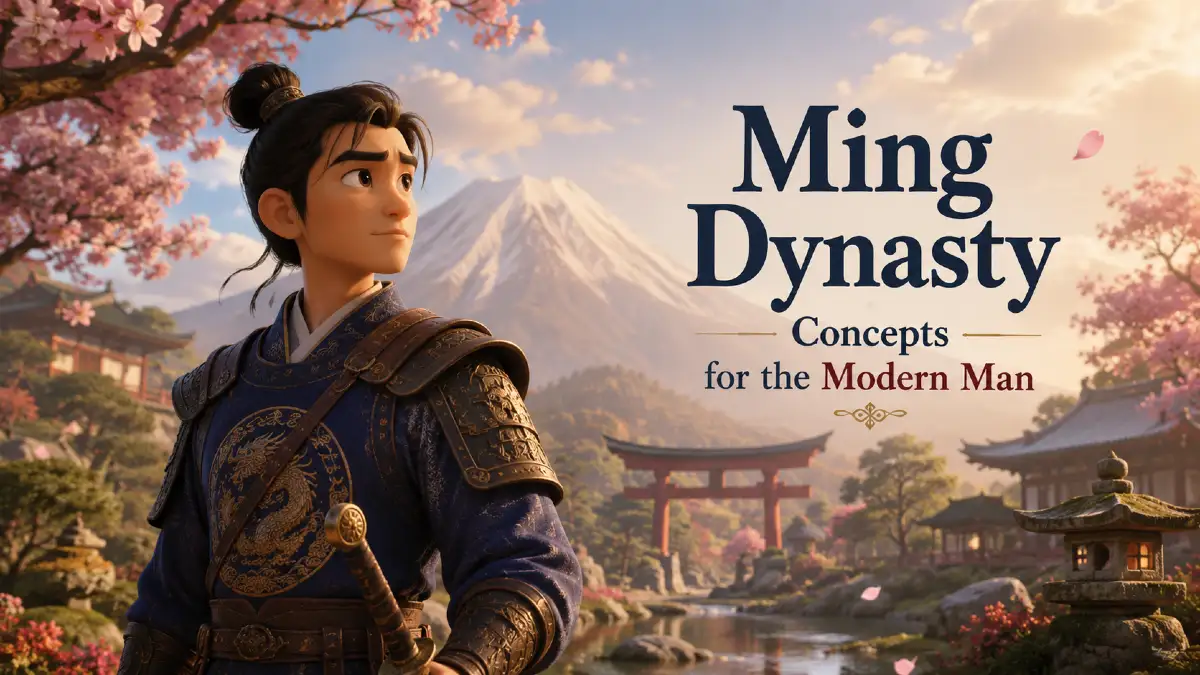
The Ming Dynasty (1368–1644) was the period in which Chinese Confucian thought reached one of its highest refinements—the era of Wang Yangming, whose philosophy of innate moral knowledge and the unity of knowledge and action remains one of the most penetrating frameworks for masculine character ever developed. Most modern Western men have read Marcus Aurelius. Almost none have read Wang Yangming, which means they are operating without one of the sharpest tools the world has produced for the inner work of becoming a man.
The Ming Dynasty inherited a thousand years of Confucian, Daoist, and Buddhist philosophical work and synthesized it into something distinctive. The classical Confucian texts—the Analects, Mencius, the Great Learning, the Doctrine of the Mean—were the bedrock. The Song-era Neo-Confucian innovations of Zhu Xi (1130–1200) supplied the scholastic framework. And then, in the early sixteenth century, a single Ming philosopher named Wang Yangming (1472–1529) reshaped the entire tradition by insisting on the unity of knowledge and action—the radical idea that real knowledge is what you can demonstrate in conduct, and that everything else is just talk.
Wang Yangming was the great Ming masculine philosopher. He was also a successful general, an effective official, and a teacher of thousands. He is the rare case of a thinker whose conceptual framework was matched by his actual life. His central concept—liangzhi, the innate moral knowledge every man possesses if he attends to it—became the operating principle of Ming-era masculine education at its highest level, and it remains, four hundred years later, one of the most useful concepts available for a man who is trying to take his own development seriously.
This article is written for two readers. The man with East Asian heritage who has perhaps heard of these concepts but never seen them framed for modern masculine life. And the man with no connection to the tradition who is curious what one of the world’s longest-running schools of human character development might have to teach him. Neither will be talked down to.
What follows are seven of the most useful Ming Dynasty concepts for the modern man, drawn from classical Confucian thought as refined and intensified in the Ming, with particular emphasis on the work of Wang Yangming.
A Note on the Junzi
The framing figure of this piece is the junzi (君子)—a Confucian concept that predates the Ming by nearly two thousand years but reached one of its sharpest articulations during it. The word literally means son of the lord, but in Confucian usage it had long since shed its aristocratic origin to mean the gentleman, the superior man, the morally exemplary person. The junzi is the Confucian masculine ideal: a man whose character has been so deliberately cultivated over decades that his presence, conduct, and decisions all flow from an integrated interior.
The junzi is the East Asian parallel to the mensch, vir, omoluabi, insân-ı kâmil, hatun runa. Every serious masculine wisdom tradition produces this figure under a different name. The Ming refinement is specifically that the junzi is built through the practices below.
1. Ren (仁) — Humaneness as the Foundation
Ren (仁) is the most foundational Confucian virtue, often translated as humaneness, benevolence, or humanity. The character itself shows a person beside the number two—a human being in relationship—and the meaning hinges on that image. Ren is the felt orientation toward other humans as fully human, the disposition to treat each person you encounter with the seriousness their personhood demands.
Confucius treated ren as the integrating virtue that makes all other virtues coherent. A man with knowledge but no ren is dangerous. A man with skill but no ren is corrosive. A man with power but no ren is a problem. Ren is the substance underneath every other Confucian virtue—the warmth, the recognition of shared humanity, the fundamental decency that makes a man’s other capacities trustworthy.
For the modern man, ren is a structural critique of the optimization culture that has come to define contemporary masculinity. Skills can be optimized. Strength can be optimized. Productivity can be optimized. Ren cannot. It is not a metric. It is the quality of a man’s basic orientation toward the other humans in his life, and it cannot be acquired except by deliberate cultivation over years.
The practical move is unglamorous. Practice attention to the actual humans in your day. Acknowledge them. Notice their condition. Refuse to treat anyone as merely a function of their role. The man who cultivates ren over a decade becomes someone other people instinctively trust and feel safer around. That is not a small achievement. In Confucian terms, it is the precondition for everything else.
2. Yi (義) — Righteousness as Choosing the Right Action
Yi (義) is the Confucian virtue of righteousness or appropriateness—the discipline of choosing the right action in a given situation, even when easier or more profitable options are available. Where ren is the orientation, yi is the operational practice. Confucian thought treats yi as the daily test by which a man’s character is revealed.
The Ming Neo-Confucians were particularly precise about yi. The right action is not always obvious. It depends on circumstance, relationship, role, and timing. The man with developed yi has spent years training his judgment to see what each situation actually requires, and then training his will to do it. This combination—clear seeing plus disciplined doing—was the substance of Ming masculine education at its peak.
A classical Confucian formulation captures it: faced with profit, the small man thinks of his advantage; the junzi thinks of yi. The test is concrete. When advantage and rightness diverge, which way does the man move? Most modern decision-making rewards the small-man answer. Yi names the alternative, and the discipline of choosing it even when the costs are real.
For the modern man, yi is the practical question underneath every meaningful choice. What does this situation actually require? Not what does my self-interest prefer, not what does culture validate, not what does my anxiety prescribe. What is yi—appropriate, right, fitting? A man who learns to ask this question, and then to act on the answer, has built one of the strongest internal structures any masculine tradition has ever produced.
3. Li (禮) — Ritual Propriety as Substance, Not Show
Li (禮) is one of the most misunderstood Confucian concepts. Often translated as ritual or propriety, li is the structured form a man’s conduct takes—the ways he greets, eats, mourns, celebrates, transitions between roles, handles formal occasions. The Western reflex is to dismiss li as empty formality. The Confucian insight is the opposite: the form shapes the substance. A man who never observes proper conduct in form will not eventually develop it in substance.
Li in the Ming refinement was understood as the external scaffolding by which interior character is actually built. Bowing properly to one’s elders trains respect for elders. Mourning the dead with full form develops the capacity for grief. Eating with care trains the broader capacity for attention. The rituals are not arbitrary. They are the technology by which interior masculine substance gets constructed.
For the modern man, li is the structural answer to a culture that has dismantled most of its ritual scaffolding in the name of authenticity and informality. The contemporary assumption is that real feeling exists prior to and independent of form. Confucian thought disagrees. Strip out the forms, the tradition argues, and what is left will not be authentic feeling. It will be feeling with no shape, which is just chaos.
The practical move is to identify the forms missing from your life and rebuild them. Family rituals around meals. Marking transitions with intention. Greeting your wife or partner with care. Acknowledging significant moments rather than letting them pass unobserved. Each small return to li does something to the man practicing it. Over years, it builds the internal substance li is supposed to produce.
4. Cheng (誠) — Sincerity as Integration of Self
Cheng (誠) is the Confucian virtue of sincerity, but in a sense English barely has words for. Cheng is the integration of a man’s inner state, his speech, and his action into a single coherent reality. The man with cheng does not say one thing and feel another. His behavior is not separable from his interior. There is no gap between the public and the private self, because the work of integration has been done.
The classical Confucian text Zhongyong (the Doctrine of the Mean) treats cheng as one of the highest spiritual achievements available. The fully sincere man, the text suggests, can move heaven and earth—not because he has magical power, but because his integration is so complete that what he says and does carries the weight of an undivided being.
For the modern man, cheng is one of the sharpest correctives to the era’s culture of personal branding. The contemporary playbook teaches a man to manage his image, perform his identity, present his best self. Cheng treats all of this as a structural failure. The man who is performing is, by definition, not in cheng. The work is not to perform a better self. The work is to actually become the self that no longer needs performance.
The practical question is concrete. Where in your life is there a gap between what you say, what you feel, and what you do? The gap is the diagnosis. The work of cheng is the slow closing of that gap, over years, until eventually a man’s interior and his exterior are the same substance.
5. Liangzhi (良知) — The Innate Moral Knowing
Now we arrive at Wang Yangming’s central contribution, the concept that defines Ming Neo-Confucianism at its peak. Liangzhi (良知)—often translated as innate moral knowing or the moral mind—is the radical claim that every man already possesses, within himself, the capacity to know what is right. The work of becoming a junzi is not the acquisition of external moral knowledge. It is the uncovering of the moral knowledge that is already present, by clearing away the self-deceptions, distractions, and habits that obscure it.
This is a profound psychological insight. The Ming Confucian tradition does not see moral knowledge as something imposed on a man from outside. It treats moral knowledge as something a man already has access to, the moment he attends to it carefully and honestly. The reason men do wrong, Wang Yangming argues, is not that they don’t know what is right. It is that they have allowed self-interest, fear, or laziness to obscure what their liangzhi was already telling them.
For the modern man, liangzhi is one of the most useful concepts in any tradition. It says: stop outsourcing your moral compass. Stop looking for the right answer in algorithms, influencers, or trend analysis. Sit quietly. Attend to what you already know. The honest answer to “what should I do here?” is almost always available the moment a man stops avoiding it.
Wang Yangming’s practical instruction was direct. In every situation, ask: what does my liangzhi say? The first honest answer is usually the right one. The hesitation, justification, and reframing that come after are usually the self-deception trying to override what was already known.
6. Zhi Xing He Yi (知行合一) — The Unity of Knowledge and Action
Wang Yangming’s second major contribution—and the concept for which he is most famous—is zhi xing he yi (知行合一): the unity of knowledge and action. The radical claim is that real knowledge and real action are not two things. They are one. A man who knows something but does not act on it does not actually know it yet. He has, at best, intellectual familiarity. Real knowledge, Wang argues, manifests immediately in conduct.
This is a sharp standard. Most contemporary men know enormous amounts that they do not act on. They know they should exercise. They know they should call their mother. They know they should leave the job that is killing them. They know they should stop the behavior that is hurting their family. The gap between the knowing and the doing, the modern mind says, is a motivation problem. Wang Yangming says it is a knowledge problem. They do not actually know what they think they know. If they did, they would already be acting.
For the modern man, zhi xing he yi reframes the entire self-improvement enterprise. Reading more books is not the answer. Listening to more podcasts is not the answer. Acquiring more information is not the answer. The man who keeps acquiring without integrating is failing the unity-of-knowledge-and-action test. The Ming Confucian solution is to take less in—and to act on more of what is already taken in.
The practical move is unflinching. Identify one thing you have been “knowing” but not doing for over six months. Stop reading about it. Start doing it. Every day. Imperfectly. Until the gap between the knowing and the doing has closed. That is zhi xing he yi, and it is the most reliable engine of masculine development the Ming tradition produced.
7. Xiu Shen (修身) — The Cultivation of the Self
The final concept on this list is the integrating one. Xiu shen (修身)—the cultivation of the self—is the Confucian master practice underneath everything above. The classical text the Great Learning makes the framework explicit. To bring order to the world, first bring order to your state. To bring order to your state, first bring order to your family. To bring order to your family, first cultivate your own self. The whole architecture starts with the man working on the man he is.
This is not narcissism. It is the opposite. Xiu shen treats personal cultivation as the precondition for any meaningful contribution to anything beyond the self. A man who has not done the work on himself cannot help his family. A man whose family is in chaos cannot help his community. A man whose community is in chaos cannot serve a larger cause. Everything begins with the daily work of refining the actual man.
For the modern man, xiu shen is the structural answer to the externalization culture. Most contemporary self-improvement is, paradoxically, externally oriented—building a brand, generating outputs, accumulating recognition. The Confucian frame insists that all of that is downstream of one question: have you actually been cultivating yourself? The reading, the reflection, the daily attention to character, the deliberate building of habit and virtue—that is xiu shen, and there is no shortcut around it.
The practice is what every concept above is pointing toward. Sit with yourself. Notice what needs work. Address it deliberately. Repeat tomorrow. Over years, you become a different man, and the world responds accordingly. The Confucian tradition has been saying this for two and a half millennia, and the Ming refinement is among its sharpest expressions.
Where the Modern Man Can Actually Begin
Seven concepts is more than a man can integrate at once. The Ming approach was patient and sequential, focused on one foundational practice at a time.
Begin with zhi xing he yi. Identify one thing you have been “knowing” but not doing. Stop reading about it. Start doing it daily, imperfectly. After thirty days, you will understand viscerally what Wang Yangming meant.
Add liangzhi. Before any meaningful decision, pause and ask: what does my honest moral knowing say? Trust the first honest answer. Notice the justifications and rationalizations that try to override it. Begin acting on the first answer rather than the second.
Then practice xiu shen. Spend ten minutes each evening reviewing the day with honest attention. Where did you act in accord with your liangzhi? Where did you not? What pattern is repeating? No judgment. Just clear sight, day after day, for a year.
The rest will follow. Ren grows as attention to other humans deepens. Yi sharpens as the daily decision-practice continues. Li reasserts itself as the man rebuilds the forms he had let slip. Cheng emerges as the gap between interior and exterior gradually closes.
Living the Way of the Junzi
The seven concepts above were never independent virtues. The Ming Confucian tradition treated them as facets of a single integrated human being. Ren was the foundational orientation. Yi was the operational test. Li was the structuring form. Cheng was the integration. Liangzhi was the inner compass. Zhi xing he yi was the standard for whether anything had actually been learned. Xiu shen was the daily practice underneath it all.
The modern man does not need to be Chinese or Confucian to take this framework seriously. He needs only to recognize that Wang Yangming and the broader Ming Neo-Confucian tradition built tools as sharp as anything in the Western canon for the work of becoming an actual man. Read Wang Yangming. Read the Analects. Read the Great Learning. The path is open.
The junzi is not a relic. He is the integrated, cultivated, fully formed man toward which 2,500 years of Confucian thought has been pointing. The seven concepts above are seven of the most refined tools the Ming Dynasty produced for the work of becoming one.
Related posts:
 Alexandr Wang’s Story: From MIT Dropout to Meta AI Chief
 Why Alexandr Wang Is Waiting for Neuralink Before Having Children
 How Moral Awakenings Spark Social Change: The Psychology Behind Sudden Ethical Insight
 Masculine Leadership in Relationships Without Control
 The Way of the Lugal: 7 Mesopotamian Virtue Concepts for the Modern Man