
The Three Pillars That Actually Create Lasting Wealth
In “The 5 Types of Wealth,” Sahil Bloom poses what might be the most important financial question you’ll ever consider: “What is your definition of enough?” Not more. Not maximized. Not optimized. Simply: enough. When will you have enough money to feel secure? Enough to feel successful? Enough to stop chasing and start living?
For most people, this question is uncomfortable because it forces a confrontation with a painful truth: they’ve never actually defined enough. They’re playing a game with no finish line, climbing a mountain with no summit, running a race that only ends in exhaustion. They know what “more” looks like—a bigger house, a nicer car, a larger investment account. But they have no idea what “enough” looks like, which means they can never actually win.
This is what Bloom identifies as the central paradox of Financial Wealth in modern society: we’re simultaneously the wealthiest generation in human history and one of the most financially stressed. We have more money than our ancestors could imagine, yet we feel more anxious about money than they did. We’ve achieved unprecedented material abundance while experiencing unprecedented financial anxiety.
The problem isn’t money—it’s our relationship with money. And that relationship, Bloom argues throughout “The 5 Types of Wealth,” has become fundamentally distorted by what he calls “the financial amusement park”—an endless array of attractions designed to keep you spending, comparing, and chasing without ever reaching satisfaction.
The Financial Amusement Park
One of the most insightful frameworks in “The 5 Types of Wealth” is Bloom’s metaphor of the financial amusement park. Imagine entering an amusement park where every ride promises excitement, every attraction promises fulfillment, and every vendor promises happiness. But no matter how many rides you experience, how many attractions you visit, or how much you consume, you never feel satisfied. The park keeps offering new experiences, and you keep chasing them, believing the next one will finally deliver the happiness you seek.
This is modern consumer culture, Bloom argues. We’re surrounded by messages that promise happiness through purchase. We see others apparently achieving fulfillment through consumption (or at least projecting that image on social media), and we believe that if we just earn a bit more, spend a bit more, acquire a bit more, we’ll finally feel content. But the hedonic treadmill ensures that we never do—each new purchase provides brief satisfaction before our baseline happiness returns to its previous level.
The financial amusement park operates on several psychological mechanisms that Bloom explores:
Lifestyle Inflation: As income increases, expenses mysteriously increase to match. The person earning $50,000 who thought they’d feel rich at $100,000 discovers that at $100,000, they need $200,000. The person at $200,000 needs $500,000. There’s always a new level of spending that feels necessary, justified, deserved.
Social Comparison: We don’t evaluate our financial situation in absolute terms but relative to our reference group. If your friends are buying vacation homes, your perfectly adequate house suddenly feels insufficient. If your colleagues are driving luxury cars, your reliable sedan feels like failure. The comparison is endless and unwinnable.
Status Signaling: We’ve been conditioned to use consumption as communication—demonstrating success, taste, and worth through visible purchases. Bloom draws on Geoffrey Miller’s work showing that much consumer behavior is actually status signaling disguised as personal preference. We buy things not because we truly want them but because we want what they signal about us.
The Hedonic Treadmill: Each new purchase provides diminishing returns. The first nice dinner out is magical; the fiftieth is mundane. The new car is exciting for weeks, then just becomes your car. We adapt to any improvement in circumstances, always returning to baseline happiness while requiring increasing stimulation to achieve even temporary boosts.
The result of these mechanisms is what Bloom calls “high-income poverty”—people earning substantial incomes who feel financially stressed because their expenses have expanded to match (or exceed) their income. They look successful on paper while feeling anxious in reality.
The Three Pillars of Financial Wealth
In “The 5 Types of Wealth,” Bloom presents three pillars that support true Financial Wealth:
1. Earning: The ability to generate income through value creation. Bloom emphasizes that earning is not about maximizing income at any cost but about developing capabilities that allow you to create value in the marketplace. This pillar focuses on what he calls “meta-skills”—transferable capabilities that enable value creation across different contexts.
These meta-skills include clear communication (writing and speaking), problem-solving, building relationships, learning quickly, and strategic thinking. Bloom argues that investing in these fundamental capabilities provides better returns than chasing specific credentials or job titles. A person with strong meta-skills can adapt to changing markets, create opportunities, and generate income across different economic conditions.
The earning pillar also addresses the relationship between time and money. Bloom distinguishes between linear income (trading time for money) and leveraged income (creating value that scales beyond your direct time investment). Building Financial Wealth ultimately requires some form of leverage—whether through business ownership, investments, or creating intellectual property that generates returns beyond direct labor.
2. Saving: The discipline to spend less than you earn and protect the margin. Bloom cuts through the complexity of financial advice to focus on a simple truth: wealth is built not by earning more but by maintaining a gap between income and expenses. The size of this gap matters more than absolute income—someone earning $60,000 and spending $45,000 is building more wealth than someone earning $200,000 and spending $210,000.
The saving pillar requires what Bloom calls “conscious spending”—being intentional about what provides genuine value versus what merely signals status or provides fleeting pleasure. It means asking before each purchase: Does this align with my values? Will it provide lasting satisfaction? Or am I spending reactively, trying to fill an emotional void with consumption?
Bloom shares research showing that beyond a certain threshold (studies suggest around $75,000-$85,000 in most U.S. locations, adjusted for inflation), additional income provides minimal increase in day-to-day happiness. The implication is powerful: for many people, the answer isn’t earning more—it’s spending more wisely on what actually matters to them.
3. Investing: Deploying capital to generate returns that compound over time. Bloom demystifies investing, cutting through the noise of complex strategies and financial products to focus on time-tested principles that work: start early, invest consistently, minimize fees, diversify appropriately, and stay invested through market volatility.
He advocates for simple, low-cost index fund investing for most people, arguing that the evidence overwhelmingly shows that consistent investment in diversified market indexes outperforms active stock picking for the vast majority of investors. The key is what he calls “time in the market” rather than “timing the market”—the compounding returns from staying invested over decades vastly outweigh the potential gains from trying to optimize entry and exit points.
The investing pillar also addresses what Bloom sees as the greatest investment: investing in yourself. While financial investments compound, investments in your capabilities—through education, skill development, health, and relationships—can compound even more dramatically. The person who invests in becoming more capable, more valuable, and more adaptable is building sustainable Financial Wealth.
The Enough Equation
Perhaps the most practical tool in “The 5 Types of Wealth” is what Bloom calls the “Enough Equation”—a framework for actually defining your financial finish line. He guides readers through calculating three numbers:
Security Number: The amount needed to cover basic needs (housing, food, utilities, healthcare, insurance) without working. This is your absolute minimum—the baseline for independence.
Freedom Number: The amount needed to maintain your desired lifestyle without working. This includes not just necessities but the experiences and purchases that genuinely add to your quality of life.
Abundance Number: The amount needed to live your ideal life while also being generous with others—supporting causes you care about, helping family, and making a positive impact.
Bloom emphasizes that your target should be the Freedom Number, not the Abundance Number. Once you’ve reached freedom, additional accumulation should be in service of impact, not comparison. The Abundance Number isn’t about living more luxuriously—it’s about living more generously.
The power of this framework is clarity. When you know your numbers, you can make informed decisions about trade-offs. You can calculate how many more years of a job you dislike to reach freedom. You can evaluate career changes in terms of their impact on your timeline. You can stop chasing “more” once you’ve reached “enough.”
The Three Careers Framework
An innovative section of “The 5 Types of Wealth” introduces Bloom’s three-career framework for thinking about financial life:
Career 1: The Earning Career (Ages ~20-45): This phase is about building capabilities and generating income. You’re establishing yourself professionally, developing skills, and creating the financial foundation for later stages. Bloom argues that this phase should focus on earning and learning—maximizing income while minimizing lifestyle inflation, investing consistently, and developing transferable skills.
Career 2: The Doing Career (Ages ~45-65): This phase is about meaningful work aligned with your values and interests. You have the financial foundation and capabilities to be more selective. You can pursue work that matters to you, even if it pays less. You can take risks on ventures you find exciting. You have enough saved and invested that you’re working for fulfillment, not survival.
Career 3: The Sharing Career (Ages 65+): This phase is about giving back—mentoring, advising, supporting causes, and sharing wisdom gained over a lifetime. Bloom envisions this not as retirement in the traditional sense but as a shift from accumulation to contribution.
This framework challenges the conventional retirement model (work hard for decades, then stop completely) by proposing a more nuanced approach where financial independence enables career evolution rather than career cessation.
The Hidden Costs of Wealth Chasing
A sobering section of “The 5 Types of Wealth” examines what Bloom calls “the hidden costs of wealth chasing”—the other forms of wealth sacrificed in pursuit of Financial Wealth. He shares his own story of earning into the six figures in his twenties while living across the country from family, working exhausting hours, and feeling miserable despite “success.”
The hidden costs include:
Time Wealth: Hours and years sacrificed to earning, often during the prime years when you have energy and capability to enjoy life.
Social Wealth: Relationships neglected or lost because career demands left no space for connection and presence.
Mental Wealth: The anxiety, stress, and rumination that comes from constant financial pressure and comparison.
Physical Wealth: Health compromised by sedentary work, poor eating, inadequate sleep, and chronic stress.
Bloom argues that the greatest financial mistake most people make is not under-earning or overspending—it’s sacrificing all other forms of wealth in pursuit of Financial Wealth, only to discover that money without time, health, relationships, and peace is not wealth at all.
The math is brutal: you might sacrifice 30 years of your prime to accumulate enough to retire comfortably, only to discover that you’ve traded the best years of your life for the financial ability to enjoy your declining years. As Bloom writes, “What good is a full bank account if you have an empty life?”
Financial Independence vs. Financial Freedom
Bloom makes an important distinction in “The 5 Types of Wealth” between financial independence and financial freedom. Financial independence is having enough invested that you could live without working. Financial freedom is having enough autonomy over your time that you work by choice, not necessity—and that choice might be to keep working in meaningful ways.
Many people in the Financial Independence, Retire Early (FIRE) movement focus exclusively on the independence part—how to accumulate enough to quit working as soon as possible. But as Bloom explores, many people who achieve early retirement discover that not working isn’t actually fulfilling. Humans need purpose, challenge, growth, and contribution. Complete retirement often leads to boredom, loss of identity, and decline rather than the blissful freedom imagined.
Bloom advocates for financial freedom as a better goal: building enough Financial Wealth that you have complete autonomy over how you spend your time, then choosing to spend it in ways that provide meaning—which might include work you find fulfilling. The goal isn’t never working; it’s always choosing.
Practical Systems for Building Financial Wealth
“The 5 Types of Wealth” provides straightforward, actionable systems for building Financial Wealth:
The 50/30/20 Budget: Allocate 50% of after-tax income to needs, 30% to wants, and 20% to savings/investing. This simple framework provides structure without requiring complicated tracking.
The Automatic System: Set up automatic transfers to savings and investment accounts immediately when income arrives. This removes willpower from the equation—you save first, spend second.
The 24-Hour Rule: For any purchase over a certain threshold (Bloom suggests $100), wait 24 hours before buying. This pause interrupts impulse purchases and allows emotional reactions to subside.
The Values Audit: Quarterly, review your spending and ask: Does this align with what I say I value? Many people are shocked to discover massive misalignment—they say family is most important but spend heavily on things that impress strangers while being stingy with experiences that create family memories.
The One Account Method: Bloom recommends keeping financial tracking as simple as possible. Rather than dozens of accounts, credit cards, and subscriptions, consolidate to the minimum necessary. Complexity creates confusion, which leads to poor decisions.
The Role of Financial Education
A significant theme in “The 5 Types of Wealth” is the importance of financial literacy and the shocking absence of financial education in conventional schooling. Bloom argues that one reason so many people struggle with Financial Wealth is that they were never taught the fundamentals—how compound interest works, the power of consistent investing, the difference between assets and liabilities, or how to think about risk and return.
He advocates for self-directed financial education and provides a reading list of essential resources. But more importantly, Bloom emphasizes that financial literacy isn’t about memorizing formulas—it’s about developing what he calls “financial intuition”: the ability to make sound decisions about earning, saving, and investing based on fundamental principles rather than emotional reactions or social pressures.
Conclusion: The Foundation That Enables Choice
As Sahil Bloom makes clear throughout “The 5 Types of Wealth,” Financial Wealth matters—but not for the reasons most people think. It matters not because money creates happiness (the evidence shows it doesn’t, beyond meeting basic needs). It matters not because wealth is virtuous in itself (it’s morally neutral). It matters because Financial Wealth creates options, and options enable freedom.
With sufficient Financial Wealth, you can choose meaningful work over lucrative work. You can be generous with your time because you’re not enslaved to earning. You can take calculated risks knowing failure won’t destroy you. You can support causes you believe in and help people you care about. You can design your life according to your values rather than accepting whatever life necessity dictates.
But—and this is crucial—Financial Wealth only provides these benefits if it’s built sustainably, without sacrificing the other four types of wealth in pursuit of it. The person who reaches financial independence at 35 but has no relationships, declining health, chronic anxiety, and no idea how to spend time meaningfully has not achieved wealth—they’ve traded one form of poverty for another.
The answer to “What is your definition of enough?” is personal and specific. For some, it’s a modest income that supports a simple life rich in time and relationships. For others, it’s substantial wealth that enables significant impact and generosity. There’s no universal answer. But as Bloom powerfully demonstrates in “The 5 Types of Wealth,” the question itself is essential. Without defining enough, you’re doomed to chase more forever, sacrificing what cannot be bought in pursuit of what ultimately doesn’t satisfy.
True Financial Wealth isn’t having the most money—it’s having enough money to support the life you actually want to live, built without destroying the other forms of wealth that make life worth living. It’s freedom without sacrifice, abundance without anxiety, and means aligned with meaningful ends.
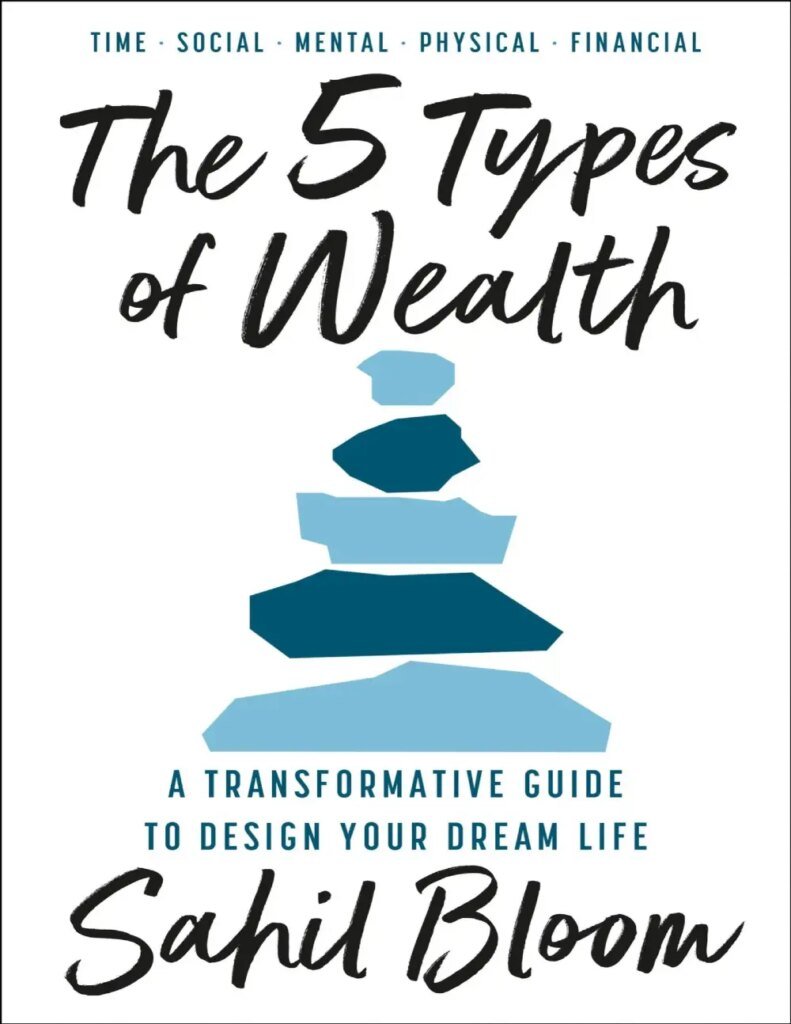
About “The 5 Types of Wealth”: Published by Ballantine Books in 2025, Sahil Bloom’s “The 5 Types of Wealth: A Transformative Guide to Design Your Dream Life” offers a comprehensive framework for building genuine wealth across five dimensions. Moving beyond conventional financial advice, Bloom explores Time, Social, Mental, Physical, and Financial Wealth, providing both philosophical grounding and practical systems for creating a truly rich life.
Related posts:
 The Wealth Score: Why Measuring Success in Just One Dimension Is Destroying Your Life (The 5 Types of Wealth by Sahil Bloom)
 How to Actually Transform Your Life Using the 5 Types of Wealth Framework (The 5 Types of Wealth by Sahil Bloom)
 The Entrepreneurial Path to Integrated Wealth: Building a Business That Serves All Five Dimensions
 Mental Wealth: How to Build Clarity in an Age of Infinite Distraction
 The Body Budget: Why Your Physical Wealth Determines Every Other Form of Success