Ryan Holiday’s “Ego is the Enemy” has become essential reading for entrepreneurs, athletes, leaders, and anyone pursuing ambitious goals. Published in 2016, this modern Stoic masterpiece delivers a counterintuitive message: your biggest obstacle isn’t external competition, market conditions, or lack of resources—it’s your own ego.
Drawing from ancient philosophy, historical examples, and contemporary case studies, Holiday constructs a comprehensive framework for understanding how ego sabotages us at every stage of life: when we’re aspiring to achieve something, when we’re experiencing success, and when we’re dealing with failure. This guide explores the book’s key insights and practical wisdom for anyone seeking to build lasting achievement without letting ego destroy it.
The Three-Part Structure: A Lifetime of Ego Management
Holiday organizes his exploration of ego around three distinct life phases, each with unique challenges and traps:
Part I: Aspire – When we’re starting out, building skills, and working toward our goals Part II: Success – When we’ve achieved something and must manage the psychological effects of winning Part III: Failure – When we face setbacks, losses, and must rebuild
This structure acknowledges a fundamental truth: ego management isn’t a one-time achievement but an ongoing practice that adapts to changing circumstances. The strategies that help us when aspiring differ from those we need when successful, which differ again from what failure demands.
Understanding Ego: Not Just Arrogance
Before diving into solutions, Holiday clarifies what ego actually means. It’s not simply arrogance or self-confidence—it’s an unhealthy belief in our own importance. Ego is the voice that says:
- Talk about your plans before executing them
- Demand credit for everything you contribute
- Feel entitled to recognition and rewards
- Need to control outcomes you can’t actually control
- Make everything about you and your needs
- Define yourself by external validation
Ego is the enemy because it distorts our perception of reality, making us simultaneously overestimate our abilities and underestimate the challenges we face. It prevents learning, damages relationships, and ultimately sabotages the very success we’re pursuing.
Part I: Aspire – Ego When Starting Out
The aspiration phase—when we’re building skills, establishing ourselves, and working toward initial success—presents specific ego challenges:
Talk, Talk, Talk
One of ego’s most seductive traps is substituting talk for action. Holiday recounts Upton Sinclair’s failed gubernatorial campaign, where the author wrote and published a book describing his time as governor before winning the election. The book became a bestseller; the campaign was a disaster. Sinclair had satisfied the emotional need for recognition through talk, eliminating the motivation to actually do the work.
In today’s social media landscape, this trap has intensified exponentially. Every blank text box invites us to broadcast our intentions, share our plans, and receive validation for work we haven’t done. The performance we give online is almost universally positive: “Look how great I am” rather than the vulnerable truth: “I’m scared and struggling.”
The antidote? Silence and action. Let your work speak before you do.
The Canvas Strategy
Perhaps Holiday’s most counterintuitive advice appears in the “canvas strategy”—the practice of making yourself indispensable by helping others succeed without demanding credit.
Benjamin Franklin exemplified this as a young man, submitting anonymous writings to his brother’s newspaper that became wildly popular. Bill Belichick, before becoming one of football’s greatest coaches, volunteered without pay to analyze game film—work senior coaches considered beneath them. Both understood that those who clear the path ultimately control its direction.
This strategy works because ego prevents most people from even considering it. While others fight for immediate recognition, you’re building genuine expertise, authentic relationships, and a reputation that can’t be manufactured through self-promotion.
Restrain Yourself
Holiday’s chapter on Jackie Robinson delivers one of the book’s most powerful lessons. The young Robinson wasn’t known for restraint—he regularly confronted injustice and wouldn’t accept disrespect. But when Branch Rickey asked him to be baseball’s first Black player, the challenge was clear: “I’m looking for a ball player with the guts not to fight back.”
Robinson faced coordinated campaigns of abuse, deliberate attempts to injure him, and constant provocations designed to make him react. If he had, it would have confirmed racist stereotypes and kept baseball segregated. Instead, his strategic restraint changed sports forever and influenced the broader civil rights movement.
The lesson extends beyond sports: sometimes fighting back costs more than winning. Ego demands immediate satisfaction, but wisdom understands delayed gratification in service of larger goals.
Be a Student, Not a Passionate Visionary
Counter to contemporary advice about following your passion, Holiday argues for becoming a student above all else. Passion can be expensive, making us emotional, defensive, and unwilling to adapt. The student mindset, by contrast, keeps us humble, curious, and perpetually learning.
This orientation becomes especially crucial when starting out. Raw talent matters far less than the capacity to learn, adapt, and improve. Passion fades when things get difficult; student mentality persists because it’s oriented toward growth rather than immediate gratification.
Work, Work, Work
There’s no substitute for the actual work. Holiday emphasizes that while everyone wants the results and recognition, few are willing to put in the unglamorous hours of deliberate practice, skill development, and execution that create genuine capability.
Bill Bradley reminded himself: “When you are not practicing, remember, someone somewhere is practicing, and when you meet him he will win.” Success isn’t about brilliance or inspiration—it’s about showing up consistently and doing the work whether you feel like it or not.
Part II: Success – Ego When You’ve Won
Success creates its own dangerous psychology. The very achievements we worked so hard for become potential sources of our downfall:
Always Stay a Student
The most dangerous transition in life happens when we stop seeing ourselves as students and start believing we’ve become masters. Success breeds confidence, confidence breeds certainty, and certainty kills the curiosity that enabled success.
Bill Walsh, despite building a football dynasty, remained intensely focused on learning and improvement. He didn’t rely on past success to carry him forward; he studied constantly, adapted continuously, and never assumed his methods couldn’t be improved.
The antidote to expert syndrome is maintaining beginner’s mind—approaching situations with openness even in areas where you’re experienced. Combining expertise with curiosity creates antifragile capability that adapts as circumstances change.
What’s Important to You?
Success often means achieving goals we thought would satisfy us, only to discover we’re still restless, still chasing. Holiday introduces the Greek concept of euthymia—the sense of your own path and how to stay on it without getting distracted by others’ paths.
Without clarity about what actually matters to us, ego defaults to wanting everything: more money, more recognition, more power, more everything. This insatiable appetite leads to accepting opportunities that dilute focus, compromising values for growth, and ultimately losing sight of why we started.
The solution requires brutal honesty about our actual priorities and accepting the trade-offs they demand. You cannot be an opera singer and teen pop idol simultaneously. Life requires choosing, but ego resists acknowledging these constraints.
Entitlement, Control, and Paranoia
Holiday identifies three toxic mindsets that successful people almost inevitably develop:
Entitlement: The belief that our success proves we deserve special treatment, recognition, and rewards. We begin thinking normal rules and constraints don’t apply to us.
Control: The addiction to managing outcomes and circumstances, extending our belief that will and effort can overcome any obstacle. We try to control things genuinely beyond our influence.
Paranoia: The sense that others are envious, competitors are conspiring, and any relaxation leaves us vulnerable. Reasonable vigilance warps into destructive suspicion.
These poisons combine into what basketball coach Pat Riley called “the disease of me”—the self-absorption that destroys teams, organizations, and ultimately, ourselves. The person who once worked collaboratively becomes impossible to work with. The leader who inspired loyalty becomes suspicious of everyone.
Meditate on the Immensity
One of Holiday’s most powerful antidotes to success-induced ego is cultivating cosmic perspective. He recounts John Muir’s experience in Alaska’s Glacier Bay, where the naturalist suddenly perceived the entire ecosystem as an integrated whole, experiencing what Stoics called sympatheia—connectedness with the cosmos.
This “oceanic feeling” reminds us that human concerns are “an infinitesimal point in the immensity.” Not to devalue our work, but to properly contextualize it. We’re temporary participants in something vast, adding our verse to an infinite poem.
Success actively pulls us away from this perspective. Material achievement, recognition, and power encourage believing we’re special, important, central. Ego tells us meaning comes from being the center of attention. But when we lack connection to anything larger than ourselves, success feels empty, and we become exhausted by the treadmill of constant striving.
Part III: Failure – Ego When You Lose
Perhaps the most challenging ego test comes in failure, when our plans crumble and our achievements unravel:
The Effort is Enough
Holiday presents Belisarius, one of history’s greatest yet most forgotten military generals. By age forty, he had saved Western civilization three times, won brilliant victories across the known world, and recaptured territories lost for generations. His thanks? Suspicion, betrayal, and according to legend, being stripped of wealth and forced to beg in the streets.
Yet historians find no record of Belisarius complaining. He could have seized the throne on numerous occasions but was never tempted. In his eyes, he was doing his duty. He knew he did it well. He knew he had done what was right. That was enough.
The brutal lesson: we have minimal control over rewards for our work. Belisarius could control his strategy, leadership, and ethics. He couldn’t control whether his work would be appreciated or whether a dictator would treat him fairly.
John Wooden’s definition of success captures Holiday’s point: “Success is peace of mind, which is a direct result of self-satisfaction in knowing you made the effort to do your best to become the best that you are capable of becoming.” Notice what’s missing: winning, recognition, rewards, external validation.
Draw the Line
One of failure’s greatest dangers is not knowing when to stop fighting. Ego can’t accept defeat, so it doubles down, makes desperate moves, and often transforms manageable setbacks into catastrophic collapses.
Holiday recounts the DeLorean story—how John DeLorean’s ego prevented him from accepting his company’s failure, leading him to make increasingly desperate and ultimately illegal choices to save it. His inability to accept defeat and draw the line destroyed not just the company but his reputation and freedom.
The wisdom is knowing when to make “a full stop,” as Alexander Hamilton advised a friend. A fighter who can’t tap out or a boxer who can’t recognize when to retire gets seriously hurt. You have to see the bigger picture, but when ego controls perception, who can?
Maintain Your Own Scorecard
The New England Patriots drafted Tom Brady in the 6th round, 199th pick overall. He’s since become arguably the greatest quarterback in NFL history. Yet the Patriots’ front office views the Brady pick as both triumph and failure—triumph in outcome, failure in evaluation that let him wait so long.
This paradox illustrates Holiday’s point about internal scorecards. The scoreboard isn’t the judge of whether you achieved success. Meeting your own standards, regardless of external outcomes, is what matters.
Coach Wooden was crystal clear: winning games wasn’t his definition of success. Bo Jackson didn’t celebrate home runs because “he hadn’t done it perfect.” These high performers held themselves to standards that exceeded what society considers objective success. Their self-assessment mattered more than external validation.
The Practical Framework: Applying Holiday’s Wisdom
While “Ego is the Enemy” is rich with philosophy and historical examples, its ultimate value lies in practical application:
Daily Practices
Morning Reflection: Begin each day reconnecting to larger purpose and cosmic perspective. Remind yourself you’re a temporary participant in something vast.
Reality Checks: Regularly question your assumptions, acknowledge what you don’t know, and seek feedback that challenges rather than confirms your beliefs.
Process Focus: Shift attention from outcomes you can’t control to process you can. Did you prepare well? Execute with integrity? Learn from the experience?
Silence Periods: Create deliberate gaps between impulse and action. When ego demands immediate response, practice restraint and strategic thinking.
Learning Time: Schedule non-negotiable periods for reading, studying, and engaging with ideas beyond your expertise.
Relationship Strategies
Canvas Strategy Deployment: Actively seek ways to help others succeed without demanding credit. Make this your default mode rather than exception.
Honest Feedback Cultivation: Build relationships with people who will tell you uncomfortable truths and make it safe for them to do so.
Credit Sharing: Develop the habit of attributing success to others’ contributions. Fight the impulse to center yourself in every narrative.
Gratitude Practice: Regularly acknowledge how much you’ve inherited from others—ideas, opportunities, infrastructure, culture.
Career Approaches
Student Mentality Maintenance: Regardless of expertise, approach situations with openness to learning. Combine experience with beginner’s curiosity.
Internal Validation Development: Build capacity to know when you’ve done good work whether or not others recognize it.
Trade-Off Acceptance: Make peace with the fact that meaningful goals require sacrificing alternatives. Ego wants everything; wisdom accepts constraints.
Effort as Reward: Train yourself to find satisfaction in having given your best, regardless of results.
The Historical Lens: Learning from Those Who Came Before
Holiday’s book is ultimately a conversation across centuries with people who successfully navigated ego’s challenges. From Sherman’s quiet competence to Katharine Graham’s late-blooming leadership, from Belisarius’s duty focus to Angela Merkel’s deliberate modesty, he shows us that the struggle with ego is timeless.
These aren’t just inspiring stories—they’re case studies in what works and what doesn’t. The ego-driven paths typically end in ruin: Howard Hughes’s paranoia, John DeLorean’s desperation, Xerxes’s delusion. The ego-managed paths lead to sustained achievement: Marshall’s service orientation, Bradley’s perpetual practice, Robinson’s strategic restraint.
The Stoic Foundation
Throughout the book, Holiday draws heavily on Stoic philosophy, particularly Marcus Aurelius’s “Meditations” and Seneca’s writings. The Stoics understood that we suffer primarily from our judgments about events rather than events themselves, that we control our responses but not circumstances, and that virtue lies in maintaining principle regardless of outcomes.
This philosophical framework provides the book’s backbone: ego is essentially a distortion of perception that makes us unable to see reality clearly or respond to it wisely. The remedy isn’t eliminating self-regard but properly calibrating it through practices that reconnect us to truth.
Why This Book Matters Now
In an era of personal branding, social media performance, and constant self-promotion, Holiday’s message is both countercultural and essential. The incentive structures of modern life actively encourage ego’s worst tendencies:
- Platforms reward broadcasting over building
- Likes and shares provide dopamine hits for talk rather than accomplishment
- Self-promotion is normalized and even demanded
- Humility is often confused with weakness
- Success is measured by visibility rather than contribution
“Ego is the Enemy” provides both diagnosis and cure for these modern maladies. It reminds us that lasting achievement comes from the timeless practices of humility, learning, service, and restraint—not from the contemporary obsession with performance and positioning.
The Central Paradox
Holiday resolves in a powerful paradox: to achieve great things, we must make ourselves small. Not worthless or without ambition, but properly sized. We must see ourselves as students rather than masters, servants rather than stars, participants rather than centers.
This isn’t false modesty or strategic positioning—it’s accurate perception of reality. We are small in cosmic terms, temporary in historical terms, dependent on countless others in practical terms. Acknowledging these truths doesn’t limit us; it liberates us to focus on contribution rather than recognition, process rather than outcomes, learning rather than defending.
The people who do the most significant work aren’t those with the biggest egos—they’re those who’ve learned to manage ego effectively enough to stay connected to reality, relationships, and their actual mission.
Final Reflections: The Ongoing Battle
Holiday is clear that defeating ego isn’t a one-time achievement but a lifelong practice. Ego returns constantly, especially after successes that seem to vindicate it. The battle must be fought daily, sometimes hourly.
But the rewards for this ongoing discipline are profound: freedom from the exhausting demands of self-importance, capacity to learn and adapt continuously, relationships built on authentic connection rather than transaction, work that matters beyond personal recognition, and ultimately, a life lived in service of something larger than yourself.
As Holiday notes, the truly great people throughout history aren’t those who never struggled with ego—they’re those who recognized it as the enemy and fought it consistently. They made themselves students when others were playing expert, servants when others were seeking spotlight, contributors when others were claiming credit.
This path is harder because it offers no immediate gratification. You won’t get instant recognition for helping others succeed without demanding credit. You won’t be celebrated for restraining yourself when provoked. You won’t win popularity contests by admitting what you don’t know.
But you will build something that lasts. You will create work that matters. You will develop capabilities that compound over time. And you will be free from ego’s exhausting tyranny.
That’s not just success—it’s wisdom.
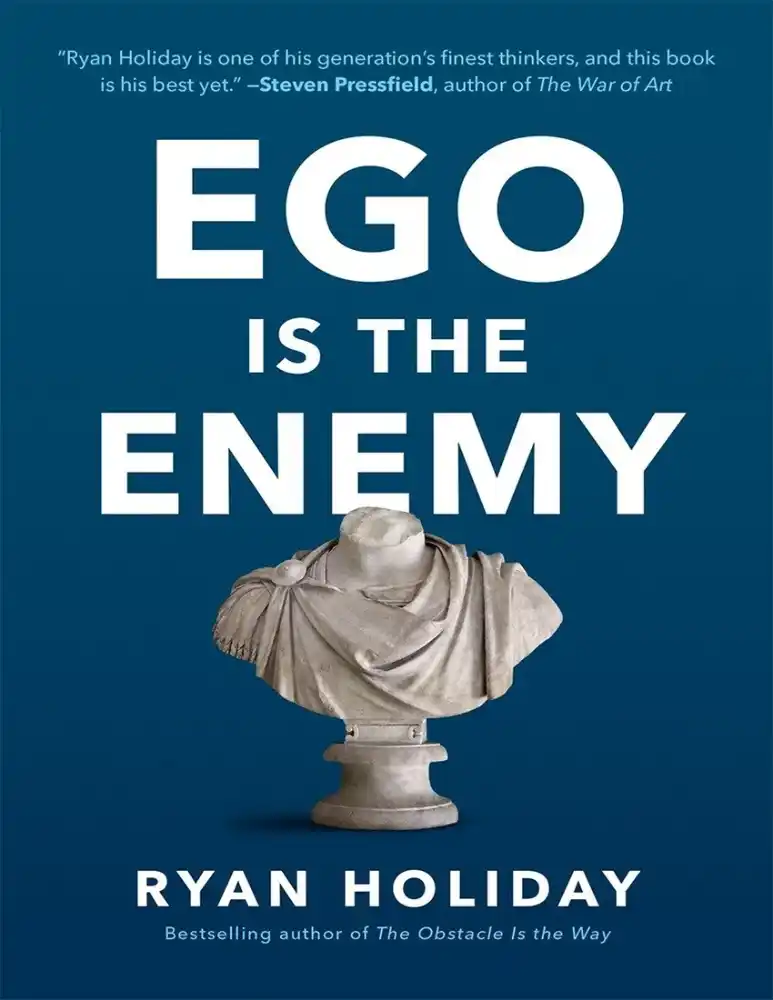
Source: “Ego is the Enemy” by Ryan Holiday – Required reading for anyone pursuing ambitious goals who wants to build lasting achievement without letting ego destroy it. Available wherever books are sold.
Related posts:
 Ego is the Enemy by Ryan Holiday: 25 Life-Changing Takeaways (Complete Summary & Review)
 Who is Ryan Holiday and His Impact on Philosophy
 The Canvas Strategy Explained (Ego Is The Enemy by Ryan Holiday)
 Why the Smartest People Never Stop Being Students Through Life Long Learning
 Lifelong Learning: Why the Wisest People Never Stop Being Students (Wisdom Takes Work by Ryan Holiday)