
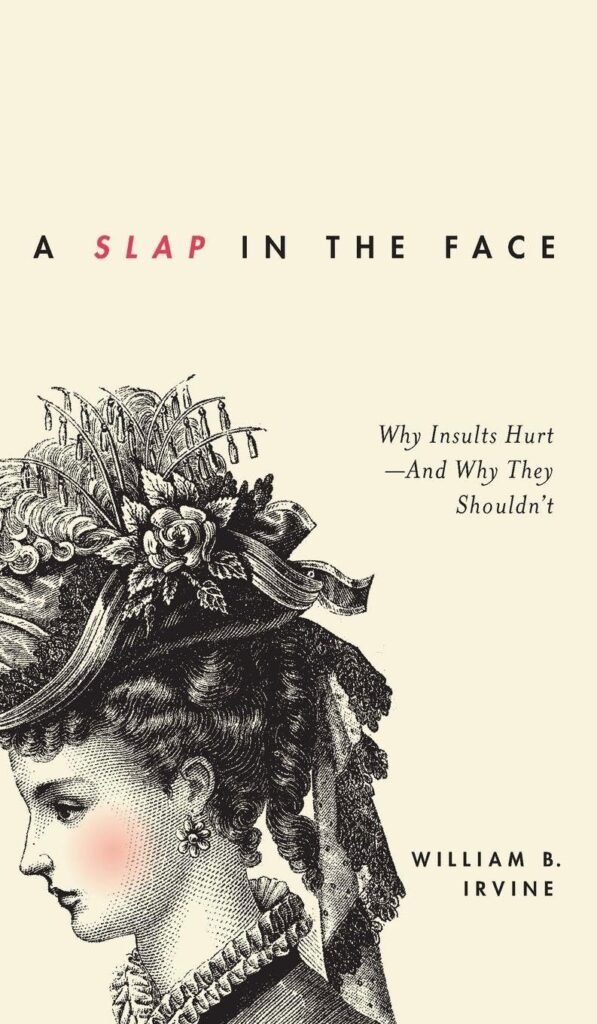
Master William B. Irvine’s ‘A Slap in the Face’: Why insults hurt through social hierarchy psychology and evolutionary roots. Discover Stoic strategies like insult pacifism, self-deprecating humor, and a 6-part response framework for overcoming verbal attacks and building true resilience.
Someone’s words just ruined your entire week. A comment at work left you questioning your competence. A relative’s criticism replays in your mind at 3 AM. You’ve tried to develop thicker skin, to care less what people think, to not let them get to you. Nothing works. The insults keep landing, and they keep hurting.
William B. Irvine’s “A Slap in the Face: Why Insults Hurt—And Why They Shouldn’t” offers something different from the usual advice about handling criticism. This isn’t about positive thinking or clever comebacks. It’s a deep philosophical and psychological investigation into why words have power over us and how we can reclaim that power. Drawing on Stoic philosophy, evolutionary psychology, and historical examples spanning millennia, Irvine presents a comprehensive understanding of insults and a practical path to freedom from their sting.
If you’ve ever been hurt by someone’s words—and who hasn’t?—this book offers insights that could fundamentally change how you move through the world.
What Makes This Book Different
Most advice about handling insults falls into two categories: either “toughen up and don’t let it bother you” or “here are some clever comebacks to put them in their place.” Neither approach addresses the underlying psychology that makes insults hurt in the first place. Irvine, a philosophy professor at Wright State University and author of the acclaimed “A Guide to the Good Life: The Ancient Art of Stoic Joy,” goes deeper.
The book is structured in three parts. The first explores the arsenal of insults humans deploy—from obvious verbal attacks to subtle digs, from backhanded compliments to benign teasing that strengthens rather than damages relationships. The second examines insult psychology: why insults hurt, who gets hurt most, and why we feel compelled to insult others. The third offers solutions, both personal and societal, for dealing with insults effectively.
What emerges is not a self-help manual but a philosophical investigation that happens to have immediate practical applications. Irvine isn’t just teaching you how to respond to the next insult. He’s showing you how to transform your entire relationship to external opinion.
The Social Hierarchy Game That’s Ruining Your Life
At the heart of Irvine’s analysis is what he calls “the social hierarchy game.” Humans are social creatures who cannot survive alone. But once we’re among other people, we immediately begin sorting ourselves into hierarchies. Other animals use teeth and claws to establish dominance. We use words.
Insults are verbal dominance displays. When someone insults you, they’re attempting to lower your position relative to theirs. The pain you feel isn’t really about the specific words used. It’s your nervous system signaling that your social status is under threat. This made evolutionary sense when social exclusion meant death on the African savannah. In modern life, it creates suffering out of proportion to any real danger.
The problem compounds because once you’re playing the social hierarchy game, you’re trapped in a cycle of striving and suffering. You spend your days trying to gain admiration from people who are too busy seeking admiration themselves to give you what you want. You’re hurt by insults that threaten your status. You fire back with counter-insults to restore it. You engage in elaborate self-promotion to climb higher. And none of it produces lasting peace because the game has no winning condition.
Irvine’s radical solution: stop playing the game. Not by becoming a hermit, but by recognizing that your worth doesn’t depend on your position in any hierarchy. When you genuinely internalize this, insults lose their power. They’re attempts to lower your standing in a game you’re not playing anymore. The move simply doesn’t apply.
The Insult Arsenal: More Sophisticated Than You Think
One of the book’s strengths is its comprehensive taxonomy of insults. Irvine doesn’t just catalog the obvious verbal attacks. He explores the sophisticated ways humans wound each other with words, many of which operate beneath conscious awareness.
There are direct insults—calling someone stupid, ugly, or worthless. These are straightforward and relatively easy to recognize. But then there are subtle digs: the slight hesitation before agreeing with your idea, the praise that’s just a bit too faint, the invitation that arrives noticeably later than everyone else’s. These microaggressions accumulate over time, creating death by a thousand cuts.
Perhaps most insidious are what Irvine calls being “bludgeoned with praise”—compliments that simultaneously insult. “You look great for your age.” “I’m surprised you could handle that.” “You’re so articulate.” The grammatical structure is positive, but the implicit message cuts. These backhanded compliments are particularly damaging because they create ambiguity. You’re not quite sure if you’ve been insulted, which means you can’t effectively respond. The uncertainty itself becomes a source of ongoing stress.
Then there are benign insults—the playful teasing between close friends that actually strengthens relationships rather than damaging them. Irvine explores why the same words that feel like attacks from strangers feel like affection from friends. The answer reveals important truths about how social bonds work and why context determines whether insults hurt.
Why Some People Are More Vulnerable
Not everyone experiences insults with the same intensity, and Irvine devotes significant attention to understanding why. The answer challenges common assumptions about self-esteem and confidence.
You might think people with high self-esteem would be less bothered by insults. They think highly of themselves, so why would external criticism matter? But research shows the opposite is often true. People with fragile high self-esteem—the kind built on external validation rather than genuine self-knowledge—are actually more sensitive to criticism, not less.
This is the psychology of narcissism. The narcissist appears supremely confident but is actually deeply insecure. Their inflated self-image requires constant reinforcement. Any hint of criticism threatens the entire structure, triggering dramatic defensive reactions. The person who explodes at minor feedback isn’t confident; they’re terrified their grandiose self-image might be revealed as hollow.
Irvine discusses how the American self-esteem movement, with its emphasis on making everyone feel special regardless of actual achievement, may have paradoxically created more fragile egos. When you’re constantly told you’re amazing but that praise isn’t connected to real accomplishment, you develop a self-image dependent on continued external validation. Your self-worth becomes a house built on sand, vulnerable to any wave that suggests you might not be as exceptional as you’ve been told.
The solution isn’t to have low self-esteem. It’s to develop what might be called realistic self-regard—honest knowledge of your strengths and limitations combined with independence from others’ opinions. This creates genuine resilience, not the false confidence that crumbles at the first challenge.
Why We Insult Others
Understanding why people insult others is crucial for two reasons. First, it helps you not take insults personally when you recognize they usually reveal more about the insulter than about you. Second, it helps you recognize and curtail your own tendency to wound others with words.
Irvine identifies multiple motivations for insulting behavior. Status anxiety is primary—people secure in their position rarely feel compelled to attack others verbally. But those worried about losing status or failing to gain it frequently use insults as preemptive strikes or defensive measures.
Narcissists insult others to maintain their fragile grandiosity through contrast. You’re bad/stupid/worthless, therefore they’re good/smart/valuable. The insult serves their internal psychological needs rather than reflecting any honest assessment of the target.
Displaced aggression explains insults that have nothing to do with the target. You’re angry about situation A but can’t safely express it at its source, so you redirect it at person B who happens to be available. The employee who can’t confront their abusive boss comes home and lashes out at family. The person humiliated at work takes out their rage on service workers.
Sometimes people insult others simply because they’re hurting and want company in their misery. If I make you feel pain too, I’m momentarily not alone in my suffering. This explains the particularly malicious practice of relaying others’ insults—the “I thought you should know what they said about you” move that wounds while maintaining plausible innocence.
The Stoic Solution: Insult Pacifism
The heart of Irvine’s practical advice comes from Stoic philosophy, which spent considerable time developing strategies for handling insults. The Stoics understood that insults were symptoms of a deeper problem—our investment in others’ opinions—and that addressing symptoms without treating the disease provided no lasting relief.
Their solution was what Irvine calls “insult pacifism.” When insulted, you carry on as if nothing of consequence happened. You don’t defend yourself, counter-attack, or even acknowledge the insult as worthy of response. This isn’t suppression or denial. It’s genuine indifference born from philosophical conviction that your worth doesn’t depend on others’ opinions.
When Cato the Younger was struck in the face during a public proceeding, he simply wiped away the blood and continued. When his attacker later apologized, Cato said he didn’t remember being struck. The message: you’re so insignificant that I don’t even register your actions.
This approach denies the insulter what they want—evidence that they’ve gotten to you, proof that their opinion matters, confirmation they have power over your emotional state. It’s more effective than any counter-insult because it frustrates their purpose entirely.
But insult pacifism only works when it’s genuine. You can’t fake indifference while secretly seething. The strategy requires the deeper philosophical work of actually not tying your worth to external opinion. This is where the book moves from technique to transformation.
Self-Deprecating Humor as Weapon and Shield
One of the most effective Stoic techniques Irvine discusses is responding to insults with self-deprecating humor. When someone tries to wound you, you insult yourself even more thoroughly than they did, and you do it with genuine amusement.
This transforms the interaction completely. The insulter wanted to make you feel bad. Instead, you’re laughing. They wanted to establish dominance. Instead, they look foolish for attempting an attack that only amused you. They wanted evidence of your vulnerability. Instead, you’ve demonstrated remarkable confidence—only someone truly secure can joke about their own flaws.
Psychologically, this works because it’s difficult to remain upset about something you’re actively making jokes about. The humor shifts your emotional state from defensive to playful. It also makes the original insult seem trivial. If you’re comfortable joking about your baldness, your weight, your failures, then those things can’t be effectively weaponized against you.
Irvine reports that after practicing this technique for years, people largely stopped trying to insult him. There’s no payoff when your attacks only make the target laugh. The technique doesn’t just defuse individual insults; it prevents future ones by removing the incentive to deliver them.
The Six-Part Response Framework
While insult pacifism and self-deprecating humor are powerful tools, Irvine recognizes that different situations require different approaches. The book presents a comprehensive framework for choosing your response:
Strategy 1: Pure Pacifism – For strangers and people whose opinions genuinely don’t matter, simply carry on as if the insult never occurred.
Strategy 2: Self-Deprecating Humor – Beat them to the punch by insulting yourself more thoroughly and with genuine amusement.
Strategy 3: Consider the Source – Before responding, evaluate whether this person’s opinion deserves consideration based on their knowledge, perspective, and relationship with you.
Strategy 4: Examine the Truth – Extract any useful feedback from the insult while remaining unbothered by the hostile delivery.
Strategy 5: Strategic Boundary-Setting – For ongoing relationships where pure pacifism isn’t sufficient, calmly establish what behavior you will and won’t accept.
Strategy 6: The Witty Riposte – Reserved exclusively for playful exchanges with people you trust, never as a genuine weapon.
The skill is knowing which strategy fits which situation and having the discipline to choose consciously rather than react automatically.
Historical Examples That Inspire
One of the book’s pleasures is its wealth of historical examples. Irvine isn’t just presenting abstract philosophy; he’s showing you how real people have handled insults throughout history, from ancient Rome to the Algonquin Round Table to modern political exchanges.
These examples serve multiple purposes. They demonstrate that insults are universal across time and culture. They provide models for responding effectively. They offer entertainment value—many historical insults and responses are genuinely witty and memorable. And they remind us that the question of how to handle words used as weapons is as old as language itself.
Reading about Cato’s dismissiveness, Churchill’s wit, and the various philosophers’ approaches to criticism provides both inspiration and practical templates. You see the principles in action rather than just reading about them in abstract.
Societal Approaches to Insults
Beyond personal responses, Irvine examines how societies have attempted to regulate insults through politeness codes, hate speech laws, and political correctness. These societal solutions have varying degrees of success and create their own complications.
Politeness codes establish norms for acceptable behavior and provide social sanctions for violations. They can reduce everyday cruelty but also create opportunities for more sophisticated insults—using the politeness code itself as a weapon by being “technically” polite while delivering cutting remarks.
Hate speech laws attempt to legally prohibit certain categories of insults, particularly those targeting protected groups. Irvine explores the tensions between preventing harm and preserving freedom of speech, the difficulty of drawing clear lines, and the risk that attempts to eliminate offensive speech may simply drive it underground or make it more appealing through forbidden fruit psychology.
Political correctness codes try to sensitize people to how their words affect others and establish new norms around acceptable language. These can reduce genuine harm but may also increase sensitivity to offense in ways that paradoxically make people more vulnerable to insults rather than less.
Irvine’s conclusion is that while societal solutions have value, they can never fully solve the problem of insults. The most effective solution remains personal transformation—immunizing yourself against insults through philosophical practice rather than trying to eliminate all insulting behavior from society.
Why This Book Matters Now
In an era of social media trolling, online cancel culture, political polarization, and constant public evaluation, Irvine’s insights feel more relevant than ever. We live in a time when insults are both more ubiquitous and more consequential than perhaps any previous era.
The internet allows anonymous attacks at scale. Social media creates endless opportunities for comparison and status anxiety. Political discourse has devolved into tribal insult contests. Cyberbullying contributes to genuine tragedies. Our sociometer—the evolved mechanism that monitors social acceptance—is in constant overdrive, reacting to digital signals with the intensity meant for genuine threats to tribal belonging.
In this environment, developing the psychological resilience Irvine describes isn’t just philosophical luxury; it’s practical necessity. You need strategies for handling the inevitable insults that come with any public presence, any online activity, any participation in modern discourse. You need a framework for maintaining internal peace amid external chaos.
“A Slap in the Face” provides that framework. It helps you understand why words wound, why you’re playing games you never chose, and how to opt out of the cycles of suffering these games create. It offers both philosophical depth and practical technique. It’s ancient wisdom updated for contemporary challenges.
The Transformation This Book Offers
Reading “A Slap in the Face” won’t make you instantly immune to insults. The patterns are too deeply wired, the conditioning too extensive. But it can begin a transformation in how you relate to external opinion, social status, and your own worth.
You’ll start noticing the social hierarchy game playing out everywhere—in meetings, family gatherings, online interactions, casual conversations. You’ll recognize insults you’ve been delivering without conscious awareness. You’ll see your own status anxiety driving reactions you thought were about principle.
This awareness is uncomfortable but ultimately liberating. When you see the machinery clearly, you can start choosing whether to participate. When you understand why insults hurt, you can begin developing genuine immunity rather than just building defensive walls.
The goal isn’t to become emotionless or disconnected from others. It’s to achieve what the Stoics called tranquility—active engagement with life combined with internal peace. You care about relationships and work and contribution, but your self-worth doesn’t rise and fall with every criticism or compliment. You’re free to receive feedback without defensiveness and to dismiss attacks without being wounded.
This freedom changes everything. Relationships become more authentic when you’re not constantly managing status. Work becomes more effective when you can hear criticism without your ego collapsing. Daily life becomes lighter when every social interaction isn’t a potential threat to your standing. You’re no longer controlled by others’ words because you’ve reclaimed authority over your own sense of worth.
Who Should Read This Book
“A Slap in the Face” will resonate with multiple audiences. If you’re sensitive to criticism and find yourself ruminating over insults long after they’ve been delivered, this book offers understanding and practical strategies. If you work in high-conflict environments—whether workplace politics, contentious professions, or public-facing roles—you need the resilience Irvine describes.
If you’re interested in Stoic philosophy but want practical application rather than just theory, this book demonstrates how ancient wisdom addresses modern challenges. If you recognize that you insult others more than you’d like and want to understand and change that pattern, Irvine’s analysis of why we wound with words is illuminating.
Parents will find valuable insights about playful teasing versus bullying, about helping children develop resilience without just telling them to ignore mean words. Anyone in a relationship with a chronic insulter—whether family member, partner, or colleague—will benefit from understanding the psychology driving that behavior and learning effective responses.
The book is accessible without being simplistic. Irvine writes clearly, uses compelling examples, and grounds his arguments in both philosophical tradition and psychological research. You don’t need background in Stoicism or psychology to benefit, but if you have that background, you’ll appreciate the depth of his analysis.
The Lasting Impact
Years after reading “A Slap in the Face,” the core insights remain: insults hurt because you’re playing the social hierarchy game. You can choose to stop playing. The people insulting you are usually revealing their own insecurities rather than accurately assessing your worth. Self-deprecating humor is remarkably effective at defusing attacks. Your value doesn’t depend on others’ opinions, even when those opinions sting.
These aren’t just intellectual concepts. Applied consistently, they transform daily experience. The criticism that would have ruined your week becomes momentarily unpleasant but forgettable. The insulter trying to diminish you loses power because you’re no longer granting them authority over your sense of self. You move through conflicts and difficult interactions with more grace and less suffering.
This is the promise of “A Slap in the Face”—not that you’ll never be insulted again, but that insults will lose their power to disturb your peace. Not that you’ll develop thicker skin, but that you’ll recognize there’s nothing to defend because your worth was never dependent on others’ approval in the first place.
That recognition, fully embodied, is freedom. And freedom from the sting of insults opens space for everything else that matters—genuine connection, meaningful work, internal peace, and the ability to move through life without constant vigilance about your position in hierarchies that ultimately don’t matter.
If you’ve ever been wounded by words and want to understand why, if you want practical strategies for responding effectively, if you’re interested in how ancient philosophy applies to modern life, or if you simply want freedom from caring too much what others think, William B. Irvine’s “A Slap in the Face” offers valuable insights and practical wisdom. The slap might come from someone else, but whether it hurts is ultimately up to you.
Related posts:
 33 Powerful Takeaways from William B. Irvine’s “A Slap in the Face” (Book Summary)
 Why Do People Insult Each Other?: The Hidden Motivations Behind Our Cruelest Words
 How Stoic Philosophy Makes You Immune to Insults—Without Emotional Detachment
 How to Respond to Insults: 6 Practical Strategies That Actually Work
 Why Do Insults Hurt So Much: The Hidden Psychology Behind Words That Wound