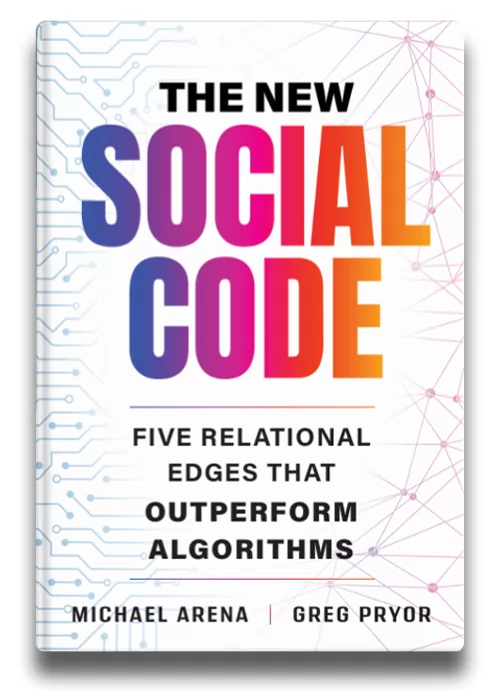
The New Social Code by Michael Arena and Greg Pryor argues that as artificial intelligence makes knowledge cheap, human relationships become the scarce resource, and that five specific relational edges (opportunity, trust, attention, insight and influence) decide who stays relevant. The surprise is that the authors’ research points away from building a bigger network and toward moving deliberately between a small trusted core and the outer edges of your world. This summary walks through the book’s central argument, the science of social agility, each of the five edges and the people who master them, and what all of it means for a man building a career while the ground shifts.
It’s late on a Tuesday and you’ve just watched a piece of software do in forty seconds what used to take you most of a morning. The report is clean. The analysis is decent. Nobody on your team will notice the difference. You close the laptop, and the thought arrives before you can stop it, the quiet fear of becoming obsolete that so many men now carry: if the work I’m good at can be done like that, what exactly am I for?
That question sits underneath this whole book. Arena and Pryor take it seriously, and their answer is neither panic nor cheerleading. It’s something more interesting, and more demanding.
What Is The New Social Code About?
The New Social Code is a research-based book arguing that in an AI-driven economy, the lasting human advantage lies in relationships: finding opportunity through people, building trust quickly, protecting attention, carrying insight across groups and earning influence upward. It’s a playbook for career relevance written by two network scientists.
Michael Arena is an organisational researcher and network scientist, chief science officer at Connected Commons and dean of the Crowell School of Business at Biola University; he was previously chief talent officer at AWS and General Motors. Greg Pryor co-founded Connected Commons, led talent at Workday, and co-edited The Social Capital Imperative. Their book, The New Social Code: Five Relational Edges That Outperform Algorithms (Wiley, 2026), draws on more than a decade of organisational network studies run with hundreds of companies.
Their opening line of attack is blunt: the real threat isn’t that machines dominate us. It’s that we slowly stop mattering, a worry sharpened by every headline asking whether AI will take all jobs. In their words, “AI is not your biggest competitor; irrelevance is!”
The Core Argument: Social Code Decides Whether Anything Happens
Arena and Pryor build the book on an analogy that’s worth holding onto. Computer code converts intent into reliable machine action. Social code is the set of relational instructions that converts intent into coordinated human action. One turns inputs into outputs. The other decides whether anything meaningful happens at all.
History, they argue, keeps rewriting that social code. The printing press mattered less because it spread information than because it created new networks of authors, printers and reformers. The telephone collapsed distance. The internet turned everyone into a potential organiser. AI follows the same pattern, compressing time and lowering the barrier between an idea and its execution. What changes is which human capacities become scarce.
To explain which capacities those are, they lean on the psychiatrist Iain McGilchrist’s picture of the brain: one mode attends to relationships, context and the whole, while another narrows down to analyse, categorise and measure. The narrow mode is a brilliant servant and a poor master. AI, in this framing, is a supercharged version of the narrow mode. The work left to us is the wide one: context, meaning, judgement, and relationships. That’s the authors’ interpretive frame rather than a neuroscientific claim, and it’s useful as one.
Research gives the argument some ballast. When MIT Sloan’s Isabella Loaiza and Roberto Rigobon analysed around 19,000 work tasks across hundreds of U.S. occupations, they found that jobs heavy in empathy, presence and networking, judgement, creativity and leadership were growing, while highly automatable tasks were tied to job loss. The capabilities AI handles worst turn out to be relational ones, which is exactly where Arena and Pryor point. We explore this angle in more depth in our piece on the skills AI can’t replace.
The Pope Nobody Predicted
The book’s most memorable story is about the 2025 papal conclave. Data scientists trained models on cardinals’ public statements and ideological positions. Prediction markets weighed popularity. Almost none of them pointed to Robert Prevost, who had been a cardinal for under two years; bookmakers gave him roughly a 1 percent chance.
Network scientists at Bocconi University in Milan took a different route. Giuseppe Soda and his colleagues mapped which cardinals had served together on Vatican bodies and who had consecrated whom, and Prevost came out first for status (being connected to other well-connected cardinals) and near the top for brokerage. Through years spent reviewing new bishops, he had worked alongside a large share of the College. When the white smoke rose, the overlooked candidate became Pope Leo XIV.
The authors are careful not to claim he built those ties in order to be chosen. The point is quieter. He made himself genuinely useful to many people over many years, and that position in the network did what no speech could. It’s a fair summary of the whole book: performance matters, but where you sit in the web of trust quietly shapes your trajectory.
Social Agility: Moving Between Depth and Reach
Before the five edges, Arena and Pryor set up the idea everything else depends on: social agility, the skill of moving deliberately between two kinds of relationships.
The first kind is what political scientist Robert Putnam called bonding capital: close, trusted ties with people who know you well. They create stability and confidence. The second is bridging capital: looser ties to people in different circles, who bring new information and perspectives. The authors use the image of a spider’s web. The dense centre absorbs shocks and holds the structure together. The outer strands reach further and catch more, but they’re fragile and costly to maintain.
Stay only at the centre and your world shrinks into an echo chamber. Live only at the edges and nothing you discover ever gets built. The answer isn’t to do both at once, which is close to impossible, but to oscillate. Sociologists Ron Burt and Jennifer Merluzzi tracked investment bankers over four years and found that the most successful ones kept repositioning themselves: bonding with trusted colleagues, bridging out to new groups, then bonding again.
The book’s Broadway example makes this vivid. Lin-Manuel Miranda built Hamilton with a trusted core (the director, music director and choreographer he’d worked with for years) and then deliberately widened the circle to outsiders who would challenge him, including the historian Ron Chernow and a producer who told him plainly when scenes weren’t working. Deep trust plus fresh friction. Research on Broadway musicals, the authors note, found the biggest hits came from teams in exactly that middle zone of familiarity and novelty.
The Network Paradox: Why Bigger Isn’t Better
Here’s where the book departs most sharply from standard networking advice. Arena and Pryor argue that more connections don’t automatically produce better outcomes, and they borrow a striking idea from traffic engineering to make the point: Braess’s paradox, in which adding a road to a congested system can make overall traffic slower.
In organisations, the same thing happens when everyone routes work through the same few trusted people. The research the authors draw on suggests that the most successful people keep a relatively small active network, somewhere around a dozen to eighteen ongoing relationships, and choose deliberately when to turn inward and when to reach out. AI, they warn, intensifies the problem: tools that promise to save time often spawn more parallel work, more checking, more coordination. Margin disappears unless you protect it.
The man who tries to know everyone ends up known by no one in particular, which is why most advice on developing networking skills misses the point. That’s a relief, honestly. You don’t need a thousand contacts. You need a handful of the right relationships and the judgement to move between them.
Edge One: Opportunity, and the Fast Finders
The first relational edge is spotting new opportunity sooner. The people who do this best, whom the authors call Fast Finders, use acquaintances as gateways.
The science starts with sociologist Mark Granovetter, who found in the early 1970s that people often landed jobs through casual contacts rather than close friends, because acquaintances move in different circles and hear different news. A 2022 study of around 20 million LinkedIn users, led by Karthik Rajkumar with colleagues from MIT, Stanford and Harvard, tested this at enormous scale and found weak ties really did drive job mobility, with moderately weak ties (not too close, not total strangers) helping most.
Arena and Pryor add a second idea: move upstream. Opportunities form long before they’re posted, priced or announced, and by the time a job reaches a public board, its shape is largely set. Their best story is Harrison Ford, working as a carpenter, hired by a casting director friend to install doors in the very offices where Star Wars auditions were happening, and asked to read Han Solo’s lines simply because he was there.
The second half of this edge is dormant ties: old colleagues and friends you’ve lost touch with, who retain a residue of trust and now know things you don’t. Research by Daniel Levin, Jorge Walter and Keith Murnighan found reconnected dormant ties offered fresher insight than people’s current contacts. Our pieces on the strength of weak ties and how to reconnect with dormant ties unpack both halves.
Edge Two: Trust, and the Fast Movers
The second edge is building deep trust faster. Connected Commons research found that most new hires take two to three years to build the network of a high performer, while a small group, the Fast Movers, do it in under a year and outperform peers early.
Their secret is unglamorous. Instead of chasing quick wins and senior visibility (the “shooting star” approach that burns bright and fades), they invest early in understanding colleagues’ work, challenges and goals. That builds what researchers call benevolence-based trust: the belief that you have others’ interests at heart. They also close capability gaps rather than showing off, and they find the informal hubs of a network by following who other people trust.
Arena and Pryor describe three layers of trust. There’s benevolence (you mean well), competence (you can actually deliver, in a specific domain), and affect-based trust, the emotional bond that grows from repeated warmth and attention. Georgetown’s Daniel McAllister showed in the 1990s that cognitive and affective trust are distinct, and the authors argue the emotional kind is what earns you the benefit of the doubt. Running through all of it is relational energy: the sense people have after an interaction with you that they’re more capable, not less.
These ideas are developed in our guides to how to succeed in a new job, how to build trust at work and relational energy.
Edge Three: Attention, and the Fast Shapers
The third edge is the one most career books ignore: success creates its own trap. Once you become the trusted, central person everyone turns to, collaboration starts consuming your days. Rob Cross, Reb Rebele and Adam Grant found that in most organisations just 3 to 5 percent of employees provide 20 to 35 percent of value-added collaboration, and those heavily sought-after helpers often report the lowest engagement and career satisfaction.
Arena and Pryor’s data shows Fast Movers sliding into what they call Fast Stallers: their early performance edge shrinks year after year as demand on them rises. Their example is Tiffany Haddish, who went from sleeping in her car to being everywhere at once, slept in her own bed only a few weeks of one year, and froze on stage on New Year’s Eve.
The people who avoid this, the Fast Shapers, reshape their networks within a year or so of becoming central. They prune redundant connections, define the small set of stakeholders who actually matter, give away work so others can grow, and fiercely protect time for deep focus, which often starts with learning to set boundaries at work. Rami Rahim of Juniper Networks was named by 125 colleagues as essential to one customer issue; when he stopped being the bottleneck and started building others’ capacity, he eventually became CEO.
The attention edge also has a cognitive side. Switching tasks leaves attention residue, and being watched makes complex work harder. Small, focused circles produce bolder ideas than large ones. See our deep dives on collaboration overload and attention residue.
Edge Four: Insight, and the Fast Spanners
The fourth edge is generating novel and strategic insight by bridging groups that don’t normally talk. These are the Fast Spanners, people who sit in what Ron Burt called structural holes, the gaps between clusters. Burt’s research found that managers whose networks spanned such gaps produced ideas judged more valuable and were more likely to be well evaluated, paid and promoted.
The book’s heroes here include the painter Joan Mitchell, who moved between New York and Paris and carried ideas in both directions; Josh Bersin, who brought engineering rigour into HR; and Satya Nadella, whose sideways moves across Microsoft gave him the panoramic view he needed as CEO. Benjamin Franklin’s Junto, a deliberately mixed club of tradesmen who met every Friday to ask structured questions, becomes a model for building your own insight exchange.
Two warnings sit inside this edge. First, bridges go stale: creative advantage fades if you keep working with the same people, so networks need regular refreshing. Second, brokers who hoard access and become gatekeepers burn out and lose trust, while those who connect others thrive. Our articles on structural holes and whether a lateral move is good for your career cover this ground.
Edge Five: Influence, and the Fast Risers
The final edge is upward influence. Fast Risers, in the authors’ research, start reshaping their networks well before a promotion arrives. They build a reputation for one clear form of strategic value, attract sponsors, form diagonal ties to senior leaders outside their own chain of command, and gradually begin to mirror the network of the role above them. If you’ve ever wondered why you’re not getting promoted despite strong results, this edge is usually the missing piece.
Alexander Hamilton is the book’s model: an orphan whose writing got him noticed, whose connections lifted him, and whose reputation travelled from “incredible writer” to “fiscal expert” just as the young nation needed one. Sherry Lansing turned script reading into a reputation for story judgement and went on to run a studio. Ursula Burns at Xerox and Andy Jassy at Amazon both accepted roles that looked like steps sideways (executive assistant, “technical assistant”) because they offered access.
Arena and Pryor draw a clear line between mentors and sponsors. A mentor talks with you; a sponsor talks about you, and stakes their reputation on your rise. They also argue that reputation travels through short, repeatable labels, so the simpler your value, the further it spreads. We develop this in mentor vs sponsor.
What the Book Gets Right, and Where to Read It Carefully
The strongest thing about The New Social Code is that it replaces vague advice to “network more” with something closer to a map. Different career moments call for different moves: reach outward when you need opportunity, go deep when you need trust, contract when you’re overloaded, bridge when you need insight, and climb diagonally when you need influence. It complements Jeffrey Pfeffer’s harder-edged account of the truth about power at work with something warmer and more generous. That sequencing alone is worth the price of the book.
It’s also refreshingly honest about the shadow side. Bridging is draining. Centrality can crush you. Gatekeeping corrodes. The authors don’t pretend relationships are free.
A few things deserve a careful reading. Much of the most striking data comes from the authors’ own Connected Commons research, which isn’t always published in detail, so figures like “six times the compensation impact” are best taken as directional. Some secondary details shift a little when you check the original sources; the Bocconi conclave model, for instance, rested mainly on formal Vatican roles and consecration ties rather than a broad map of informal friendships. And the book is written for professionals inside organisations, so men who work alone or in trades will need to translate some of the plays.
None of that undermines the core message. It’s well supported by decades of network research, and it echoes the broader idea of social wealth: who you know, how deeply, and how you move between circles shapes what you can do.
How to Use the Five Edges in Your Own Career
The most practical way to read this book is diagnostically. Ask which edge your current season calls for.
If you feel stuck, with the same conversations and the same opportunities, you probably need the opportunity edge: a few weak ties, a couple of reconnected dormant ones, and conversations upstream of where jobs get posted. If you’ve just started somewhere new, you need trust, and you’ll build it faster by understanding people’s work before you try to impress them. If you’re the go-to person and drowning, you need the attention edge, which means saying no, defining your square, and handing over some of your Legos. If you’re competent but bored, the insight edge asks you to cross into a part of the organisation you don’t understand yet. And if you’re ready to grow into leadership, influence comes from reputation, sponsorship and diagonal relationships, not from louder self-promotion.
Here’s one small practice to start with, borrowed from the spirit of the book. Tonight, write down the 12 to 18 people you interact with most. Mark each as core (deep trust) or bridge (different world). Then notice what’s missing. Most men find their list is almost all core, all similar, all from one place. One new bridge this month is enough. You don’t have to rebuild your network overnight; you just have to start moving across it.
Becoming Someone Others Seek Out
Go back to the Tuesday night and the forty-second report. The fear in that moment is real, and it isn’t foolish. Some of what you were trained to do is genuinely becoming cheaper.
But notice what the software didn’t do. It didn’t know which colleague was quietly struggling. It didn’t sense that the client’s real worry wasn’t in the brief. It didn’t introduce two people who needed each other, or earn the kind of trust that makes a senior leader ask “what does he think?” before a decision. Those things still run on a human tempo, and they’re still yours.
Arena and Pryor’s closing claim is that the advantage no longer comes from what you know but from how well you connect, absorb and influence. They add that it always did; we just forgot for a while in the noise. You don’t need to become a different man to act on that. You need to become a slightly more deliberate one: deeper with a few, braver at the edges, and protective of the attention that makes both possible.
So which of the five edges is your career quietly asking you to work on next?
Frequently Asked Questions About The New Social Code
What is The New Social Code about?
The New Social Code by Michael Arena and Greg Pryor argues that as AI makes knowledge and analysis abundant, human relationships become the scarce source of career advantage. Drawing on years of organisational network research, it outlines five relational edges (opportunity, trust, attention, insight and influence) and gives practical plays for developing each one in an AI-shaped workplace.
What are the five relational edges?
The five relational edges are opportunity (finding openings early through weak and dormant ties), trust (building it fast in new groups), attention (protecting focus from collaboration overload), insight (bridging groups to generate new ideas) and influence (earning upward pull through reputation and sponsorship). Each edge has a matching profile: Fast Finders, Fast Movers, Fast Shapers, Fast Spanners and Fast Risers.
What is social agility?
Social agility is the book’s term for moving deliberately between bonding capital, the close trusted relationships at the centre of your network, and bridging capital, the looser ties to other groups. Rather than maximising network size, socially agile people oscillate over time: reaching out to discover, then turning inward to execute. Research on investment bankers by Ron Burt and Jennifer Merluzzi supports the pattern.
Who are Michael Arena and Greg Pryor?
Michael Arena is a network scientist, chief science officer at Connected Commons and dean of Biola University’s Crowell School of Business, formerly chief talent officer at AWS and General Motors. Greg Pryor co-founded Connected Commons, was a senior vice president at Workday, and co-edited The Social Capital Imperative. Together they’ve studied organisational networks across hundreds of companies.
Is a bigger network better for your career?
Not according to this book. Arena and Pryor describe a network paradox: beyond a point, more connections create congestion and overload. They cite research suggesting the most successful people keep a relatively small active network of roughly 12 to 18 ongoing relationships, and choose carefully when to deepen trust and when to reach outward for new information.
How can I use The New Social Code in my career?
Treat the five edges as a diagnostic. If you feel stuck, build weak and dormant ties. In a new role, invest in trust before visibility. If you’re overloaded, prune and delegate. If you need fresh ideas, bridge to unfamiliar groups. If you want to advance, build a clear reputation, sponsors and diagonal ties to senior leaders.
References
- Arena, M., & Pryor, G. (2026). The new social code: Five relational edges that outperform algorithms. Wiley.
- Burt, R. S. (2004). Structural holes and good ideas. American Journal of Sociology, 110(2), 349–399.
- Cross, R., Rebele, R., & Grant, A. (2016). Collaborative overload. Harvard Business Review, 94(1), 74–79.
- Granovetter, M. S. (1973). The strength of weak ties. American Journal of Sociology, 78(6), 1360–1380.
- Loaiza, I., & Rigobon, R. (2024). The EPOCH of AI: Human-machine complementarities at work. MIT Sloan School of Management working paper.
- Rajkumar, K., Saint-Jacques, G., Bojinov, I., Brynjolfsson, E., & Aral, S. (2022). A causal test of the strength of weak ties. Science, 377(6612), 1304–1310.
- Soda, G., Iorio, A., & Rizzo, L. (2025). In the network of the conclave: Social network analysis and the making of a pope. Social Networks.
- McAllister, D. J. (1995). Affect- and cognition-based trust as foundations for interpersonal cooperation in organizations. Academy of Management Journal, 38(1), 24–59.
Related posts:
 Psychological Safety at Work: What It Is, Why It Matters and How to Build It
 What Dave Chappelle Told Michelle Obama About Joy, Simplicity and Legacy
 You’re Going to Die and You Haven’t Started Living Yet Summary: 20 Insights From Laura Falces and Uli Moreno Montana
 Build the Life You Want Summary: Arthur Brooks and Oprah’s Guide to Getting Happier
 Is Loving Your Job Always Good? The Dark Sides of Meaningful Work and How to Manage Them