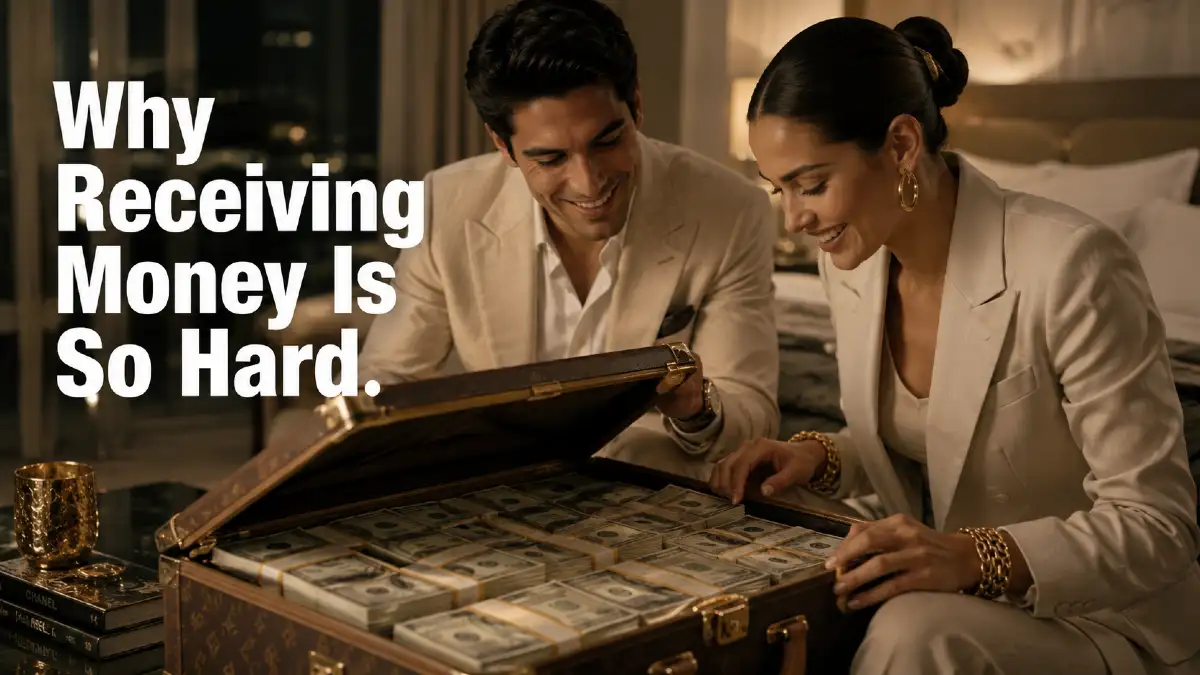
Watch what happens when someone tries to give you something. A friend picks up the check, a client pays you a generous compliment along with their invoice, someone offers help or a gift, and a little reflex fires: “Oh no, you didn’t have to.” “Let me get you back.” “It’s too much.” We treat graceful giving as the mark of a good person and barely notice that receiving — letting something come to us without deflecting, downplaying, or immediately repaying it — is often much harder, and a skill most of us never built.
Ken Honda flags this in Happy Money: The Japanese Art of Making Peace with Your Money as a quiet but serious block in many people’s relationship with money. If money is a flow — moving in and out — then being unable to receive clamps off half the circulation. You can be generous, hardworking, and good with money on the outflow side and still struggle to let it (and the appreciation, opportunity, and care that come with it) flow toward you. Honda’s point is that learning to receive graciously isn’t just good manners; it’s essential to a healthy money life, because you can’t have a full flow when you keep blocking the inflow.
Why receiving is so uncomfortable
For a lot of people, receiving triggers a surprising amount of discomfort, and it usually traces to a few roots. There’s unworthiness — a quiet sense that you don’t deserve it, so accepting feels wrong. There’s the debt reflex — the need to immediately repay or reciprocate so you don’t “owe” anyone, which is really discomfort with the vulnerability of having received. There’s pride and hyper-independence — “I don’t need anyone’s help,” which dresses up as strength but blocks connection. And there’s guilt — feeling you shouldn’t have more than others, so good things coming your way feel almost shameful.
Notice that none of these are about the gift or the money itself — they’re about your relationship with your own worth and your comfort with being on the receiving end of care. This is the same wound that makes people deflect compliments and struggle to accept help in any form; it connects to the work of self-acceptance and feeling worthy. When you can’t receive money or appreciation cleanly, you’re really saying, somewhere underneath, “I’m not sure I’m allowed to have good things.”
Rejoice out loud when money comes
Honda adds a dimension to receiving that most people miss: when money arrives, let yourself visibly enjoy it. He observes that most of us feel a flicker of joy when we receive money but are embarrassed to show it — we’ve been taught to repress our feelings about money and never, ever discuss it. Get a birthday gift and it’s fine to light up; get money and we go carefully neutral, as if delight were unseemly. That suppression quietly tells our own nervous system that receiving is something to be muted and managed rather than welcomed.
He tells a small, charming story to make the point. One day at a grocery store he received a two-dollar coupon and openly exclaimed how happy it made him. The woman next to him was so taken by his obvious delight that she handed him her coupon too — she simply wanted to see him smile over it again. The lesson isn’t about two dollars; it’s that visible, genuine joy in receiving is magnetic. When you let people see that their giving landed and pleased you, they want to give again — your delight is a gift back to them. Repressed, awkward receiving does the opposite: it makes giving to you feel flat, so the flow toward you quietly dries up. Letting yourself rejoice, out loud, keeps the inflow warm and alive.
Blocking the inflow blocks the flow
Here’s why this matters beyond etiquette. If money is energy in motion, then your ability to receive is the inflow valve — and a clamped inflow valve starves the whole system. The person who can’t comfortably accept payment undercharges and over-apologizes for their prices. The person who can’t receive help struggles alone and burns out. The person who feels unworthy of good fortune unconsciously pushes opportunities away or sabotages them when they arrive — they don’t fit the self-image.
So learning to receive isn’t passive or greedy. It’s opening a valve you’ve been holding shut, often since childhood. And it tends to have a paradoxical effect: people who can receive graciously often attract more — more generosity, more opportunity, more money — partly because they’re not repelling it with discomfort, and partly because they price and present themselves as someone worthy of it. The block on receiving is frequently the hidden ceiling on earning.
How to get better at receiving
Opening the inflow:
Practice the clean “thank you.” When someone gives you something — a gift, a compliment, a payment, help — practice simply saying “thank you” and stopping there. No deflecting (“oh it’s too much”), no downplaying, no rushing to repay. Let it land. This feels uncomfortable at first, which is exactly the sign you’re growing the muscle.
Resist the immediate-repayment reflex. When you feel the urge to instantly even the score so you don’t “owe” anyone, pause. Let yourself sit in the slight vulnerability of having received without immediately canceling it out. Genuine relationships and a healthy flow both require tolerating that.
Examine the worthiness story. When receiving feels wrong, ask what belief is firing — “I don’t deserve this,” “I should be able to do it alone,” “I shouldn’t have more than others.” These are usually old blueprint messages, not truths. Question them.
Receive on purpose. Deliberately allow yourself to accept things — let a friend treat you, charge what your work is genuinely worth, accept the help offered. Each clean reception trains the valve open and quietly raises your sense of what you’re allowed to have.
Ask for what you actually need
There’s a flip side to receiving that Honda surfaces through an observation about asking. When people have to ask for help — or for money, or for a raise — they almost always ask for less than they really need, because the shame of “not having” makes them shrink the request. It feels safer and more dignified to undershoot. But undershooting is just another form of blocking the inflow: you pre-emptively deny yourself, then wonder why you’re always a little short.
This is the receiving wound showing up at the moment of the ask. The same unworthiness that makes you deflect a gift makes you lowball your own needs — quoting a timid price for your work, requesting the minimum rather than the realistic amount, apologizing for needing anything at all. Honda’s insight (mirrored in his advice that givers should offer a little extra, since the asker has usually under-asked) is that learning to receive includes learning to ask honestly for what you genuinely need, without the reflexive discount that shame applies. Naming the real number — the real amount, the real help — is itself an act of self-worth, and an open inflow valve starts with being willing to ask for what would actually be enough.
The bottom line
We celebrate giving and overlook receiving, but a healthy relationship with money requires both — and for many people, receiving is the harder, more neglected half. The discomfort isn’t about the money; it’s about worth, pride, guilt, and the vulnerability of letting good things come to you. And as long as that inflow valve stays clamped, the whole flow stays starved.
Learn to receive graciously — money, help, appreciation, good fortune — and you open the half of the circulation you’ve been blocking. Sometimes the limit on what comes to you isn’t how hard you give, but how willing you are to take. For the full picture, see our complete Happy Money summary, and the practice that makes both giving and receiving feel good — saying thank you to your money.
This article draws on the ideas in Ken Honda’s Happy Money*, recommended for anyone who finds giving easy and receiving strangely hard.*