
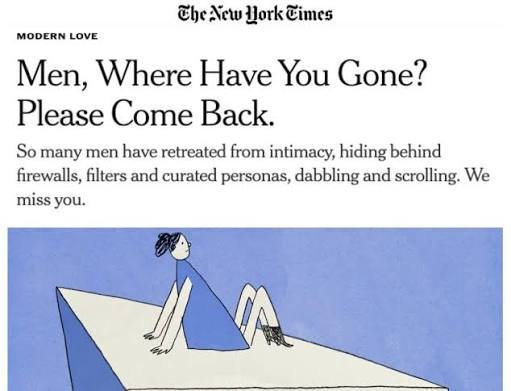
A New York Times Modern Love essay went quietly viral for saying the thing a lot of women have been feeling and not quite naming. The writer, Rachel Drucker, sat alone at a restaurant table after a last-minute cancellation and noticed something: no men. Not on dates, anyway. Just tables of women, laughing, living full lives, waiting — some of them without even realizing they were waiting — for men who weren’t showing up.
Her essay, “Men, Where Have You Gone? Please Come Back,” described a retreat. Not into cruelty, she was careful to say, but into something quieter: avoidance, exhaustion, disrepair. Men hiding behind filters and firewalls and curated personas. Men choosing the ambiguity of a “situationship” over the vulnerability of a relationship. Men dabbling and scrolling instead of showing up. She ended with an invitation — come back, not with fireworks, but with your whole, imperfect heart.
It’s a beautifully written piece. It’s also, we think, only half the story.
It deserves a real answer — not the reflexive anger that met it in some corners of the internet, and not the defensiveness that meets almost anything a man says about his own inner life. It deserves curiosity, honesty about what men are actually going through, and zero interest in turning a real and painful cultural shift into ammunition in a gender war nobody wins.
Because here’s the truth sitting underneath the whole essay, one both sides keep dancing around: men did retreat. That part is real, and it deserves to be taken seriously rather than argued away. But retreat is rarely the first move. Usually it’s the second one — a response to something. And if we actually want men to come back, we have to be honest about what pushed them out in the first place, instead of just asking them to reverse the retreat while the reasons for it stay exactly the same.
The Part She Got Right
Let’s start with what’s true, because a lot of it is.
Men are dating less, marrying later, initiating less, and disappearing from rooms where courtship used to happen. It isn’t paranoia or nostalgia. The data backs it up: 63% of young men are now single, a rate that would have seemed unthinkable a generation ago, and the real reasons behind it aren’t the ones you usually hear on talk radio. It isn’t primarily that men have “given up” on women out of bitterness. It’s a slow accumulation of risk, effort, and unclear reward that’s made a lot of men quietly conclude the juice isn’t worth the squeeze.
Drucker is also right that a certain kind of retreat has a face, and that face is a glowing rectangle. Porn on demand, AI companions that never criticize, never leave, never ask anything of you — these have become a genuine substitute for the discomfort of actual intimacy for a growing number of men, and the cost of that trade shows up clearly once you look at what these AI situationships actually take from a man in exchange for the comfort they offer. A relationship with something that can’t disagree with you, can’t grow tired of you, can’t leave — that isn’t intimacy. It’s a simulation of intimacy with all the risk engineered out, and all the growth engineered out along with it.
So no, we’re not here to tell Drucker she imagined it. Something did happen. Men did step back from the dance floor. The question worth actually sitting with is why — and that’s where the essay, like most essays written from one side of an experience, runs out of road.
What the Essay Missed: Retreat Is Usually a Response
Here’s a question that deserves more airtime than it gets: what happens to a person, generally, when the cost of an action goes up and the reward stays flat or drops? They do less of it. That’s not a male pathology. That’s just incentives.
Consider what “showing up” has actually meant for a man over the last fifteen years. It’s meant approaching a stranger with the real possibility of being filmed and posted without consent if it goes badly. It’s meant navigating dating apps where the effort-to-response ratio is brutal — where a man can send dozens of considered, thoughtful messages and hear back from almost none of them, while a small number of men absorb most of the attention. It’s meant entering relationships in a culture where the legal, financial, and custodial risks of things going wrong are not evenly distributed. It’s meant absorbing decades of cultural messaging that treated masculinity itself as something faintly suspect, something to be managed, softened, or apologized for. The man box is tightening, not loosening — men today report more pressure to perform a narrow version of masculinity than men did a decade ago, not less.
None of this excuses genuine avoidance, cowardice, or the refusal to grow up that some men are absolutely guilty of. But it does explain something the essay treats as a mystery: why a rational, otherwise decent man might look at the modern dating landscape and quietly opt out. Retreat isn’t always brokenness. Sometimes it’s a nervous system doing exactly what nervous systems are built to do — reducing exposure to a threat that keeps announcing itself as unpredictable and asymmetric.
There’s also a piece of this that rarely makes it into essays about male withdrawal: the modern “situationship” that Drucker rightly identifies as corrosive isn’t a male invention. It’s a mutual invention. Ambiguity protects both people from the vulnerability of asking for what they actually want — and plenty of men have learned, the hard way, that naming their intentions clearly and early gets them labeled “intense,” “needy,” or “too much,” while staying vague gets rewarded with continued access. The situationship isn’t men fleeing commitment out of some innate defect. It’s two people, both scared, agreeing without ever saying so to keep the exits open. Blaming one side for a dance both people are doing doesn’t actually get anyone off the floor.
The Collapse of the Provider Script — and Nothing to Replace It
There’s a deeper structural story here that the essay doesn’t touch, and it matters. For most of modern history, masculine value in a relationship had a fairly clear operating definition: provide, protect, show up with resources and stability. It wasn’t the whole story of masculinity, and it was never healthy in isolation — but it was legible. A man knew, roughly, what “showing up” meant, and so did the woman evaluating him.
That script is gone. Not because men rejected it, but because the economic and cultural ground it stood on shifted under everyone’s feet. Dual-income households are now the norm, not the exception. Many women — rightly — no longer need or want a man’s income as the organizing logic of the relationship. That’s not a loss to mourn; it’s genuine progress. But it left a vacuum where the old definition of “showing up” used to be, and nobody has handed men a clear, agreed-upon replacement. This is why more men are choosing to walk away from the traditional provider role — a lot of them aren’t refusing to show up. They genuinely don’t know what showing up is supposed to look like anymore, and they’re terrified of getting it wrong in either direction: too traditional and they’re a relic, too passive and they’re a disappointment.
Into that vacuum walked confusion, and confusion is exhausting to sit inside indefinitely. Some men resolved it by disengaging altogether — the retreat Drucker is describing. Others resolved it by doubling down on old scripts that don’t fit the modern landscape. Neither is a solution. What’s actually needed is something almost nobody is offering men: a new, honest definition of what presence and contribution look like in a genuinely mutual partnership. That’s a conversation men and women have to build together, not one men can be scolded into solving alone.
The Double Bind Nobody Names
Here’s the part that makes the “please come back” plea land strangely for a lot of men, even the well-intentioned ones who read the essay and nodded along: many of them have tried showing up before, in good faith, and been punished for it in ways that never made it into a Times essay.
The earnest man who says how he feels too early gets called clingy. The confident man who says it too late gets called avoidant. The man who initiates constantly gets called controlling; the man who waits for her to initiate gets called passive. This is the trap behind why “good guys” so often finish last and behind nice guy syndrome more broadly. It isn’t that kindness is unattractive, whatever the internet clichés claim. It’s that a specific, fear-driven, self-erasing version of “niceness” — showing up not from strength but from a desperate hope that good behavior will be rewarded with love — reads as weakness rather than warmth, and gets treated accordingly.
Men learn this pattern fast, and once burned, twice cautious. If effort has been unrewarded or actively punished, a man doesn’t conclude “I should try harder in the same way.” He concludes “trying is dangerous,” and he stops. That’s not immaturity. That’s a learned response to real experience. If we want that response to change, the answer isn’t a more eloquent essay asking him to try again exactly as before. It’s building an environment — individually, relationally, culturally — where showing up with real vulnerability is actually met with safety instead of punishment, from both sides of the table.
This is also why the framing of “come back” can feel, to a lot of men, like being asked to re-enter a game whose rules were never made clear and whose penalties for guessing wrong have been steep. It’s not that men don’t want intimacy. Almost every serious body of research on the male loneliness epidemic says the opposite — men crave real connection and are starving for it in ways our culture barely lets them admit. The appetite for closeness hasn’t disappeared. What’s disappeared is confidence that reaching
for it will go well.
Loneliness Isn’t a Competition — It’s the Same Crisis Wearing Two Faces
Here’s where we think the essay, despite its warmth, accidentally sets up a false frame: men and women as opposing teams, one retreating, one waiting, one at fault, one owed an apology. The more accurate picture is that men and women are living through the same collapse of connective tissue, from different vantage points, and mistaking each other for the cause.
The sex recession among Gen Z has climbed sharply on both sides of the aisle — not because desire has vanished, but because the infrastructure that used to manufacture chance encounters, low-stakes courtship, and slow-building trust has been dismantled by algorithms optimized for engagement, not connection. It’s not that an entire generation of men decided, in unison, to stop wanting women. It’s that the whole apparatus for turning wanting into meeting into trusting has quietly broken down for everyone, and both sexes are experiencing the wreckage as personal rejection rather than shared systemic failure.
Digital loneliness is doing this to everyone’s capacity for connection, not just men’s — screens have replaced the low-stakes, repeated, in-person contact that used to be how trust got built in the first place, between friends, between strangers, between potential partners. Men aren’t uniquely vulnerable to this. They’re just less socially equipped to name it and less culturally permitted to ask for help with it, which brings us to a piece of the puzzle Drucker’s essay doesn’t mention at all.
The Biology and Mental Health Nobody Mentions
There’s another layer to this that almost never makes it into essays about the “vanishing man,” and it deserves airtime, because it’s not speculative — it’s measurable. Something is happening to men physiologically and psychologically that predates any single dating app or cultural trend, and it’s compounding everything else we’ve discussed.
Testosterone levels in men have been declining across generations, independent of age, in ways researchers are still working to fully explain — likely some combination of environmental exposures, sedentary lifestyles, sleep deprivation, chronic stress, and diet. Lower testosterone doesn’t just affect libido; it affects motivation, risk tolerance, and the drive to pursue — the very qualities that used to power a man walking across a room to introduce himself. It’s hard to blame a man for “retreating” when part of what’s retreating is happening below the level of conscious choice, inside his own physiology.
Layer onto that the broader mental health picture. This is at the heart of the hidden crisis of male emotional health: men report depression and anxiety at rates that are likely undercounted, because the symptoms often look different in men than the standard diagnostic criteria expect — irritability and withdrawal instead of visible sadness, overwork instead of tearfulness, numbness instead of crying. A man who’s quietly depressed doesn’t show up as “sad” in a way a date can easily read. He shows up as flat, distracted, hard to reach — exactly the avoidance and disrepair Drucker describes, except the root cause isn’t a broken relationship with women. It’s an unaddressed relationship with his own mental health, one he’s rarely been given permission or tools to name, let alone fix.
We think this matters enormously for how the conversation gets framed. If the diagnosis is “men have emotionally checked out of women,” the prescribed cure is some version of “try harder with women.” But if part of the real diagnosis is “men are running on physiological and psychological empty,” the cure looks completely different, and a lot more compassionate. It looks like better sleep, movement, community, purpose, and mental health support long before it looks like a better opening line on a dating app — the throughline of what masculinity in crisis actually means today. A man who’s depleted at the root doesn’t have the reserves to be present, curious, or emotionally generous with anyone, himself included. Asking him to “come back” without addressing what hollowed him out in the first place is a bit like asking an empty tank to drive faster.
This is also, frankly, where a real share of the responsibility sits with men rather than with the culture around them. Nobody else can walk into the gym, fix the sleep schedule, build the friendships, or make the appointment with a therapist on a man’s behalf. The forces working against men are real, but they don’t remove a man’s agency to rebuild his own foundation. If anything, they make that rebuilding more urgent, not less.

What Men Actually Need to “Come Back”
If we take the plea seriously — and we do — then the honest answer isn’t “try harder at dating.” It’s something upstream of dating entirely: men need somewhere to become the kind of man who can show up without it costing him his sense of self.
A man who’s spent years without close male friendship, without anyone who calls him on his patterns, without a place to be honest about fear or grief or shame, doesn’t have the internal footing to walk into a relationship and stay open when things get hard. He hasn’t practiced vulnerability anywhere low-stakes, so the first time he’s asked for it, it’s in the highest-stakes context there is — with a woman he’s trying to impress, where the cost of getting it wrong feels catastrophic. It’s no wonder he freezes, avoids, or ghosts. This is why attachment styles in male friendship have to be repaired first, and why a quiet men’s group renaissance is now rebuilding that missing infrastructure. Brotherhood isn’t a substitute for romantic intimacy. It’s the training ground for it.
There’s also a piece about shame that has to be said plainly, because it’s the quiet engine behind a lot of the retreat Drucker describes. Many men carry a low-grade, constant fear that if they’re fully known — their doubts, their fears, their less impressive moments — they’ll be found insufficient. So they manage the impression instead of offering the truth. They curate instead of connect — the shame ceiling that keeps most men from ever being fully known. A man can’t be asked to “come back with his whole, imperfect heart” if he’s spent his whole life being taught, implicitly, that his imperfect heart is the one part of him nobody actually wants to see.
This is where we think the deepest answer lives, and it’s not a strategy for winning back a dating market. It’s a return to something more basic: a man’s sense of his own worth has to stop being contingent on whether a woman chooses him. Not because women don’t matter — they matter enormously — but because a man who only feels real when he’s being validated by female attention will always oscillate between desperate pursuit and total withdrawal, because his nervous system is being run by someone else’s approval. This is the real difference between strong men, who want to be chosen, and weak men, who need to be necessary — a man secure in his own value can show up fully, risk rejection, and stay standing either way. That security isn’t arrogance. It’s the actual precondition for the kind of presence Drucker is asking for. You cannot ask a man to be vulnerable from a place of fear. Vulnerability only holds up when it’s built on a foundation that doesn’t depend on the outcome.
A Word on the Backlash
It’s worth naming honestly: a lot of the male response to Drucker’s essay online was not generous. Some of it curdled into open contempt for women, into conspiracy theories about feminism as a coordinated project of misandry, into the kind of bitterness that mistakes wounded pride for wisdom. We won’t defend that, and we won’t pretend it isn’t out there. Some men have taken a legitimate grievance — that the modern playing field is genuinely harder to navigate, that effort often goes unrewarded, that the rules changed without a rulebook — and metastasized it into hatred of the people they’re trying to connect with. That’s not strength. It’s the exact same fear Drucker is describing, just wearing a louder costume.
Retreating into resentment is no more honest than retreating into a screen. Both are ways of avoiding the harder, scarier work: staying in the room, staying open, and risking real contact with another human being who might, in fact, disappoint you. A man who spends his energy arguing that women are the enemy has found a very sophisticated way of guaranteeing he never has to find out if he could actually build something real with one. That’s still avoidance. It’s just avoidance with better PR inside certain corners of the internet.
What Mutual Repair Actually Looks Like
So where does that leave us? Not at “men just need to try harder,” and not at “women need to apologize for feminism,” because both of those are lazy, single-cause explanations for something genuinely systemic. It leaves us somewhere more difficult and more honest: this is a shared repair job, and it requires something from both sides.
From men, it requires the willingness to do the internal work before the relational work — building self-worth that doesn’t depend on being chosen, building friendships that give practice at real vulnerability, and choosing presence over the false safety of ambiguity or digital substitutes, even when presence is frightening. It requires resisting both the pull toward numb withdrawal and the pull toward bitter blame, and choosing instead the much harder, much rarer third option: staying in the arena, clear-eyed about the risks, without either shutting down or lashing out.
From women, and from the culture more broadly, it requires something Drucker’s essay gestures toward but doesn’t quite land on: an honest reckoning with what “showing up” is actually being rewarded, versus what’s being punished. If earnestness gets mocked as needy and confidence gets read as arrogance, if initiating gets you called intense and waiting gets you called passive, the message a man receives isn’t “come back.” It’s “there’s no version of this that’s safe.” Real repair means rebuilding a set of signals clear enough that a man trying his honest best can actually tell whether he’s doing it right — and knowing that if he shows up with real vulnerability, it will be met with something other than a test he didn’t know he was taking.
None of this is about keeping score. It’s about recognizing that connection is a system, not a solo performance, and systems break down when both parties are adapting defensively to a landscape neither of them fully controls. Nobody wins that by waiting for the other side to move first.
A Societal Problem, Not a Personal Failing
There’s one more thing worth naming before we get to the close, because it’s easy to lose in an essay that keeps circling back to what individual men should do differently: this isn’t actually a problem any one man, or any one woman, can solve alone.
Part of why the shaming and the blaming keep happening on both sides is that we’re still treating a societal-scale shift as though it were a collection of personal failings. A man ghosts, and it becomes evidence that men are broken. A woman is guarded after being hurt, and it becomes evidence that women are impossible. But no single relationship failing explains a pattern this widespread, and no single person “fixing themselves” is going to reverse a shift this structural. The dating landscape, the economic script, the digital infrastructure, the cultural messaging around what men and women are each allowed to want and be — all of it moved at once, and it moved for everyone. Treating it as millions of individual character flaws, rather than a shared environment gone sideways, is exactly how we end up with essays that ask one side to simply try harder.
Some of that double standard is baked directly into how we talk about men and women differently for doing the exact same things — a man who’s guarded gets called emotionally unavailable, a woman who’s guarded gets called self-protective; a man who wants space gets called avoidant, a woman who wants space gets called independent. It’s the same asymmetry laid out plainly in Real Man vs Real Woman: The Double Standard No One Talks About, and it’s part of why the conversation keeps breaking down before it starts. If the same behavior earns opposite judgments depending on who’s doing it, neither side can ever fully trust that showing up honestly will be met fairly.
What actually gets us out of this isn’t more essays written from one side to the other, however well-intentioned. It’s understanding — real, patient, unglamorous understanding of what the other side is actually navigating, instead of assuming the worst and calling it insight. Shame doesn’t produce presence; it produces performance, or it produces withdrawal, and we’ve had a decade of both. Blame doesn’t produce accountability; it produces defensiveness on the receiving end and self-righteousness on the giving end, and neither one moves anybody closer to each other.
This is also why the work can’t stay purely private. Men and women need actual spaces — in person, facilitated, ongoing — where this can be discussed honestly by both sides at once, rather than litigated in op-eds and comment sections where nobody is listening, only responding. Couples’ spaces, men’s groups and women’s groups that talk to each other instead of only about each other, mediated public conversations that resist the pull toward point-scoring — these matter because a societal-scale disconnection needs a societal-scale forum, not a million private reckonings happening in isolation and never comparing notes. Right now most of what passes for dialogue between men and women happens through headlines, hot takes, and algorithms built to reward outrage over understanding. That’s not a conversation. That’s two monologues shouting past each other through a megaphone built by people who profit from the shouting.
What’s genuinely missing is a shared language — words and frameworks both sides actually trust, that describe what’s happening without turning it into an indictment of either sex. Until that language exists and those spaces exist, every essay like Drucker’s, and every reply like this one, will keep landing as one side’s case being made at the other, instead of a conversation both sides are actually having together.
The Media’s Role in All of This
It would be incomplete to write a response like this without turning the lens on the institution that keeps producing essays like Drucker’s in the first place — and, in fairness, on this one too. Media outlets, including the biggest and most respected ones, have a real responsibility here, and by and large they aren’t meeting it.
The pattern is familiar by now: a woman writes about what men are doing wrong, or a man writes about what women are doing wrong, each piece gets its viral moment, each side’s true believers nod along, and the other side either seethes in the comments or writes an angry rebuttal that gets its own viral moment. Rinse, repeat. It’s a business model — outrage and identification both drive engagement, and a piece that flatters one side’s grievances while blaming the other will always outperform a piece that sits with genuine complexity. But it comes at a real cost: an entire generation is being taught to understand the opposite sex through a steady diet of one-sided narratives, each one confirming what they already suspected rather than complicating it.
What’s largely missing from mainstream coverage of dating, loneliness, and intersexual conflict is the harder, less clickable work of holding both truths at once. It’s true that many men have withdrawn into avoidance, screens, and disengagement — and it’s also true that the economic, legal, and cultural landscape shifted underneath them in ways that made withdrawal a rational, if unhealthy, response. It’s true that many women feel a growing frustration and grief about men not showing up — and it’s also true that the signals women send, individually and culturally, about what “showing up” gets rewarded versus punished are often contradictory and shifting. Good journalism on this subject would sit with both of those truths in the same piece, rather than picking one side’s experience as the entire story and treating the other side as a supporting character or a problem to be solved.
Part of doing that well means actually engaging with what evolutionary psychology, developmental research, and clinical data tell us about the ways men and women differ — not to weaponize those differences into “men are like this, women are like that” stereotypes, but to understand that certain needs, timelines, and vulnerabilities are genuinely different between the sexes, and pretending otherwise doesn’t produce equality, it produces confusion. A responsible account of the current disconnection has to hold space for the reality that men and women often need different things to feel safe, seen, and motivated to pursue connection, without turning that into a hierarchy where one sex’s needs are legitimate and the other’s are a character flaw. Coverage that flattens either sex into a monolith — “men are emotionally unavailable,” “women are impossible to please” — isn’t reporting on the problem. It’s manufacturing more of it.
This matters because media doesn’t just describe the culture, it shapes it. Every essay that frames one sex as the villain and the other as the aggrieved party teaches its readers, quietly, to enter their next relationship already looking for evidence that confirms the frame. A single man reads enough pieces blaming men for the loneliness epidemic and starts approaching women defensively, expecting to be blamed regardless of what he does. A single woman reads enough pieces confirming that men are simply broken and stops extending the benefit of the doubt to the next man who’s genuinely trying. Neither of those postures builds anything. Outlets with the reach and resources to shape a national conversation about something this consequential owe their readers more than the easy, one-sided version — they owe them the complicated, uncomfortable, genuinely dual account of what’s actually happening between men and women right now, and why.
Coming Back, on Different Terms
Men shouldn’t come back the way things used to be. The old script — provide, perform, don’t feel, don’t ask — was never actually healthy, even when it looked functional from the outside. What’s needed instead is something sturdier: men who show up not out of fear of being alone, and not out of a hunger to be chosen, but because they’ve built a life and a self solid enough to offer something real. Strength that includes softness. Presence that isn’t performance. A masculinity built on truth rather than posturing, on integrity rather than approval-seeking.
Coming back, on those terms, also demands something quieter than either side has been offering: an approach built on neither blame nor entitlement. Not blame, because pointing at the other side as the sole cause of a shared collapse has never once rebuilt anything — it just gives both people a reason to stay defended. And not entitlement either, on either side — not a woman’s unspoken expectation that a man simply owes her his presence because she showed up and waited, and not a man’s quiet resentment that intimacy should be handed to him in exchange for effort spent. Trust isn’t owed. It’s built, slowly, by two people who are genuinely curious about each other rather than convinced they already understand each other. That curiosity has to extend to real, sometimes uncomfortable differences — in how men and women are wired, in what they fear, in what they’ve each been taught to expect and to hide — instead of flattening those differences into a single set of demands one side makes of the other. Respect for what makes the other person’s experience different from your own, not a request that they stop being different, is what actually starts to rebuild the trust that got worn down in the first place.
That kind of man doesn’t retreat when things get hard, and he doesn’t need a New York Times essay to shame him back into the room. He’s already there — not because a woman asked him to come back, but because he’s finally become someone who can stay.
That’s the invitation worth extending, on both sides. Not “come back to how it was,” and not another round of one side diagnosing the other. Come forward, together, into the harder work neither side has fully done yet: understanding instead of shaming, dialogue instead of blame, and the shared spaces and shared language it will actually take to get there.
Related posts:
 Understanding Why Men Are Walking Away From Modern Dating and Relationships and The Rise of MGTOW movement
 The Four Ways to Meet Women in 2026: A Modern Dating Strategy for Men
 How to Attract High-Value Women by Mastering Yourself First
 Is Having a Boyfriend Embarrassing Now? The Psychology Behind the Debate
 The Death of Dating: Why Modern Romance is Broken (And How We Got Here)