
children have beBeing known by your children means letting them see you as a whole person — your history, your fears, your mistakes, what you love and what you’re still working out — rather than only as the role of provider, rule-maker or fixer. Most fathers never do this, not because they don’t love their children but because nobody showed them how, and because being seen feels riskier than being respected. This piece explains what being known actually looks like at different ages, what the research says children gain from it, where the line sits between openness and oversharing, and five small practices to start this week.
It’s a Sunday evening, and you’re driving your fourteen-year-old back from football. She’s on her phone. You’ve asked the usual questions — how was it, did you win, have you got homework — and got the usual one-word answers. Then, out of nowhere, she asks: “Dad, what were you like at my age?”
And you realise you don’t quite know what to say. Not because you don’t remember, but because you’ve never told anyone. The kid who was scared of the older boys at school, the one who wanted to be a musician, the summer your parents nearly split up. It all seems too much, or too private, or beside the point. So you say something light, “Oh, much the same as you,” and she goes back to her phone.
Later, you wonder what would have happened if you’d answered properly. That question is the beginning of everything in this article. And the fact that you’re asking it means you’re already closer than most fathers ever get.
What Does It Mean to Be Known by Your Children?
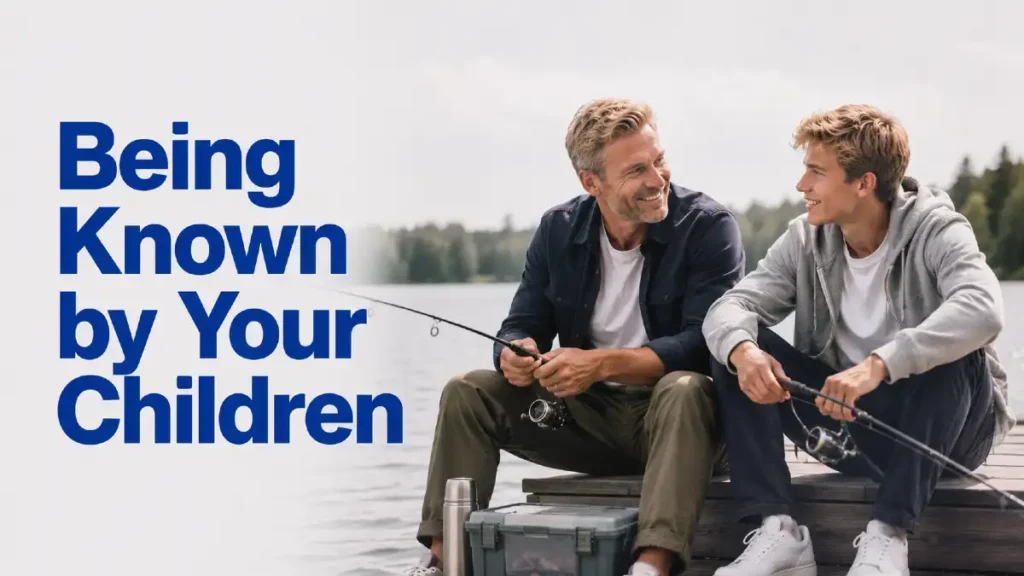
Being known by your children means they have real access to who you are — your past, your inner life, your struggles and your joys — so that their relationship is with a person, not just a parent playing a role.
That’s different from being loved. Most children love their fathers. Many still couldn’t tell you what their father was afraid of at their age, what he regrets, what makes him laugh until he can’t breathe, or what he thinks about late at night. They know the function: the man who drives, earns, fixes things, sets rules, turns up at matches. They don’t know the man.
Many children know their mothers this way already. Mothers tend to share more of their inner lives, their stories, their worries. Fathers, especially of earlier generations, often didn’t. If you ask yourself the simple question “What do my children actually know about me?”, the answer can be uncomfortably short.
Being known is what turns a father-child relationship into a relationship between two people, one that can last and deepen long after the children leave home.
Why Most Fathers Don’t Let Their Children Know Them
There are good reasons, and none of them is a lack of love.
The first is inheritance. Most men parent the way they were parented, and many of today’s fathers had fathers who were present but closed, or not present at all. You can’t easily pass on what you never received. If your own father was a figure rather than a person to you, the work of coming to peace with your father is often the first step towards being known by your own children.
The second is culture. Boys still learn, early and often, that a real man is strong, self-sufficient and doesn’t need anyone. Those rules, which make up what researchers call the man box, don’t disappear when a man becomes a father. They often get tighter, because now he feels he must be the rock for others.
The third is simple fear. Being known means being seen, including the parts you’re not proud of. For many men, the shame ceiling caps how much they’ll let anyone in, children included. It feels safer to be respected than understood. And so many fathers stay busy, in the role, keeping things functional, sometimes using busyness to avoid feeling much at all.
None of this makes you a bad father. It makes you a man who learned his lessons well. The good news is that this is learnable too.
What Children Gain When They Know Their Father
It’s often said that children of more open fathers simply turn out more secure. The research is more specific than that, and in some ways more encouraging.
Some of the clearest evidence comes from research on family stories. Psychologists Marshall Duke and Robyn Fivush at Emory University studied 40 Atlanta families, recording more than 120 hours of dinnertime conversation and measuring how much children knew about their family history: how their parents met, where their grandparents grew up, what hard things the family had been through. Children who knew more about their family’s story tended to have higher self-esteem, a greater sense of control over their lives, better relationships with peers and greater resilience. Families who talked openly about the emotions surrounding difficult events, like a death, had children with higher self-esteem too.
That’s being known in action. When you tell your children where you came from, what you struggled with and how you got through it, you’re not just sharing information. You’re giving them a story they belong to, one in which hard things happen and people survive them.
There’s a second gift, one that matters especially for sons. Children who know their father as a person get a living model of what an adult man’s inner life can look like: someone who feels, doubts, repairs, laughs and keeps going. Boys learn that strength and emotional honesty can live in the same man, a lesson at the heart of raising strong, emotionally healthy sons. Girls learn what it feels like to be close to a man who is safe and open. Both learn that intimacy with a father is possible, which shapes what they expect from men later.
And there’s a third gift, for you: a relationship that can mature as they do. Fathers who are known tend to find that their adult children still want to talk to them, not out of duty but because there’s someone there to talk to.
What Being Known Looks Like at Different Ages
Being known isn’t one big confession. It’s hundreds of small moments, matched to what your children can handle at each stage.
With young children, it’s mostly about small, safe stories and honest moods. Tell them about the time you got lost at the fair, or were scared of a teacher, or won a race you didn’t expect to. Let them see you enjoy things. When you’re tired or frustrated, you can say so in simple words — “Daddy’s had a hard day, it’s not about you” — without burdening them with adult worries.
With older children, you can share more of your own childhood: the friendships that went wrong, the things you were bad at, the times you felt left out. Their own world is full of these experiences, and knowing that you lived them too is a powerful comfort. The engaged father at different ages looks at how presence changes through these stages.
With teenagers, you can begin to share harder parts of your story, carefully. The mistakes you made at their age. What you’d do differently. Something you’re genuinely uncertain about now. Teenagers are often far more interested in a father’s real story than they let on, and the right questions can open the door; there are good prompts in questions to ask your teenage son and questions to ask your teenage daughter.
With adult children, the relationship can become more equal. This is when the fullest version of your story can be shared, if both of you want it, including the parts that would have been too heavy earlier. Many of the conversations to have with your children before they leave lay the groundwork for this.
Where Openness Ends and Oversharing Begins
Being known is not the same as unloading. There’s an important line here, and it’s worth taking seriously.
Research on parents who confide adult problems in their children shows why. In a University of Arizona study led by Susan Silverberg, researchers surveyed 62 divorced mothers and their daughters aged 11 to 17. Mothers who shared detailed information about financial worries or their anger towards the girls’ father had daughters who reported more symptoms of distress: feeling hurt, torn, upset or confused. Disclosure about intimate matters was linked to more risk behaviours. General conversation about relationships showed no such harm. The researchers didn’t conclude that parents should stay silent. They concluded that parents need to think about how certain conversations land on a child.
The same applies to fathers. A useful test before sharing something with your child is to ask: Who is this for? If it’s for them, to help them understand you, their family or their own life, it’s probably good to share at the right age. If it’s mainly for you, to relieve your own feelings, find comfort or recruit them to your side of an argument, it belongs with another adult: your partner, a friend, a therapist.
Children should never become their father’s confidant about his marriage, his money fears or his resentment towards their other parent. That’s a weight they can’t carry. Being known means letting them see you; it doesn’t mean making them hold you up.
Repair: The Most Powerful Thing a Father Can Show
If there’s one practice that matters more than any other, it’s this: when you get it wrong, say so.
Developmental psychologist Ed Tronick of Harvard Medical School has spent decades studying how parents and babies interact. He’s best known for the still-face experiment, in which babies become distressed within moments when a parent’s face goes blank. But his later work found something even more striking: around 70 percent of parent–infant interactions are out of sync, even in healthy, secure relationships. What matters is not getting it right all the time, but repairing the mismatch. Repair, Tronick argues, is what builds trust and resilience.
That principle doesn’t stop at infancy. When you lose your temper, break a promise or get something wrong in front of your children, a sincere repair — “I was wrong about that, and I’m sorry” — teaches them something few fathers teach: that strong men can admit mistakes, that relationships survive conflict, and that love includes accountability. How to apologise and repair relationships applies to children as much as to partners.
Repairs in front of your children matter too, including the ones with their mother. Children watch how their parents handle conflict closely, and seeing you make things right is one of the most protective things they can witness.
Five Ways to Start Being Known by Your Children
None of this requires a dramatic family meeting. These practices are small enough to start this week.
Tell one story they haven’t heard
Pick a specific, small story from your childhood and tell it at dinner, in the car or at bedtime. Not a lecture with a moral, just a story: the dog you had, the teacher you feared, the fight you lost. Small stories build the family narrative Duke and Fivush found so protective.
Answer “How was your day?” honestly
When your children ask, give a real answer, calibrated to their age. “Honestly, a bit frustrating; a meeting didn’t go how I hoped” is far more revealing than “fine”. It shows them you have an inner life, and invites them to share theirs.
Repair out loud
Next time you get something wrong, name it and apologise. Briefly, sincerely, without excuses. It may be the single most powerful thing you model as a father.
Ask, then really listen
Being known runs both ways, and children’s own curiosity is worth protecting rather than correcting. Ask open questions about their world, then listen fully, without fixing or lecturing. The lost art of listening is something many fathers can improve, and children notice when they’re really heard.
Share what you’re thinking about
Tell them about the book you’re reading, the question you’re puzzling over, the thing you saw that moved you. Offer it as an invitation, not a lesson. Over time, they’ll learn what you care about, which is one of the most intimate things a person can know.
Being Known When Time Is Short
Many fathers read all this and think: lovely idea, but when? Between work, commuting, homework, sport and the endless logistics of family life, there seems to be no time left for stories.
The good news is that being known doesn’t need more time so much as different time. What matters most is likely the quality of engagement rather than the hours logged; that’s the heart of the difference between a father’s presence and his mere proximity, and of what the data actually shows about an engaged father’s impact. Ten minutes of real conversation in the car can matter more than a whole Saturday spent side by side on separate screens.
Two simple shifts help. The first is to protect a few phone-free moments each day — the school run, dinner, bedtime — because children rarely open up to someone half-looking at a screen, and the attention economy is very good at taking those moments. The second is to arrive home as yourself rather than as the residue of your working day. If you walk in still carrying the office, a better way to unwind after work can give your children the version of you that’s actually available to know.
The fathers who manage this aren’t the ones with the most free time. They’re the ones who decided that being known was worth a few small rearrangements.
When Being Known Feels Too Hard
For some fathers, this all sounds simple in theory and impossible in practice. If even small disclosures feel overwhelming, or bring up old memories you’d rather not touch, that’s worth paying attention to. Often it points to unfinished business from your own childhood, the kind described in how your body keeps the score of your childhood.
You don’t have to work through that alone or in front of your children. A good therapist can help you understand what’s in the way, so you can show up more freely at home. Men who do this work often say it changed their fathering more than anything else. It’s part of not passing on the father wound, and it’s one of the most generous things a man can do for the next generation.
The Father They’ll Remember
Every father leaves an impression. The question is whether it’s of a role or a person.
Many men reach old age with children who love them dutifully but don’t really know them, and they regret it. Not because they did anything terrible, but because they stayed in the role a little too long, and by the time they wanted to open up, the habit of distance was set. The opposite is just as possible: a father who let himself be known, a little at a time, over years, and ended up with adult children who are also his friends.
You don’t have to tell your whole story at once. You only have to start. One story. One honest answer. One repair.
Back in the car, your daughter has gone quiet, but the question she asked is still there. Next time, you could answer it properly.
So what’s one thing your children don’t know about you that you’d like them to?
What Your Children Actually Know About You: 7 Questions
Answer these as if your children might one day read your answers, because one day, in one form or another, they might.
- Think of the last time one of your children asked about your life: what did you actually tell them, and what did you leave out?
- What did you learn from your own father about what a man shares and what he keeps to himself, and how much of that are you still following?
- Imagine telling your child one hard story from your youth: what do your jaw and shoulders do, and what does that tell you about the fear behind the silence?
- Which part of your story does your gut say your children are ready to hear now, and which should wait until they’re older?
- What’s one thing you love — a song, a place, a skill — that your children have never really seen you enjoy, and how could you share it?
- If millions of fathers want their children to know them but don’t know how to start, what would you create — a ritual, a tool, a format — that makes it easier for them?
- Picture your children at forty describing you to a friend: what do you already hope they’ll be able to say?
The Conversation: 5 Questions to Open the Door This Week
Pick one child and one conversation. These questions help you plan it.
- Which of your children will you share a story with this week, and when — the car, a walk, bedtime — is the moment they’re most likely to listen?
- What’s the first sentence? Write it as: “When I was about your age, something happened that I’ve never told you about…”
- What will you avoid — the moral at the end, the lecture, the adult worry that belongs with another adult — so the story stays a gift, not a lesson?
- Before the month is out, which three fathers will you ask how they let their children know them, and what simple ritual could you try together as families?
- If your child seems uninterested, rolls their eyes or changes the subject, how will you stay warm, let it go for now, and trust that the door is open?
Next time they ask what you were like at their age, you’ll have something to say.
Frequently Asked Questions About Being Known by Your Children
Why is it important for children to know their father as a person?
Children who know their father as a person, not just a role, get a model of an adult man’s inner life and a relationship that can deepen into adulthood. Research on family stories at Emory University found that children who knew more about their family’s history had higher self-esteem, a greater sense of control and more resilience.
How much should a father share with his children?
Share what helps your child understand you, their family and their own life, matched to their age. Small childhood stories suit young children; harder parts of your story can wait for teenage or adult years. Avoid sharing adult worries about money, your marriage or the other parent. Those belong with another adult.
Is it bad for parents to overshare with children?
It can be. In a University of Arizona study of divorced mothers and teenage daughters, detailed disclosure about finances or anger towards the father was linked to more distress in daughters. General conversation was not. Before sharing, ask whether it’s for your child’s benefit or mainly to relieve your own feelings.
Should fathers apologise to their children?
Yes. Developmental psychologist Ed Tronick’s research suggests that most parent–child interactions are out of sync much of the time, and that repairing those mismatches is what builds trust and resilience. A sincere, brief apology shows children that strong people admit mistakes and that relationships survive conflict.
How can a father connect with a teenager who won’t talk?
Share before you ask. Teenagers often open up when a father tells his own stories first, especially about being their age. Choose low-pressure moments, like the car or a walk, ask open questions and listen without fixing. If they seem uninterested, stay warm and try again another time; the door stays open.
What if my own father never let me know him?
You can still do things differently. Many fathers who were raised by closed or absent fathers find that understanding their own father, and grieving what they missed, frees them to be more open with their children. Working with a therapist can help, and starting small, with one honest story, is enough.
References
Tronick, E., & Gold, C. (2020). The power of discord: Why the ups and downs of relationships are the secret to building intimacy, resilience, and trust. Little, Brown Spark.en waiting to meet.
Duke, M. P., Lazarus, A., & Fivush, R. (2008). Knowledge of family history as a clinically useful index of psychological well-being and prognosis: A brief report. Psychotherapy: Theory, Research, Practice, Training, 45(2), 268–272.
Silverberg Koerner, S. (1998). Mothers turn to their adolescent daughters [Research report]. University of Arizona, College of Agriculture.