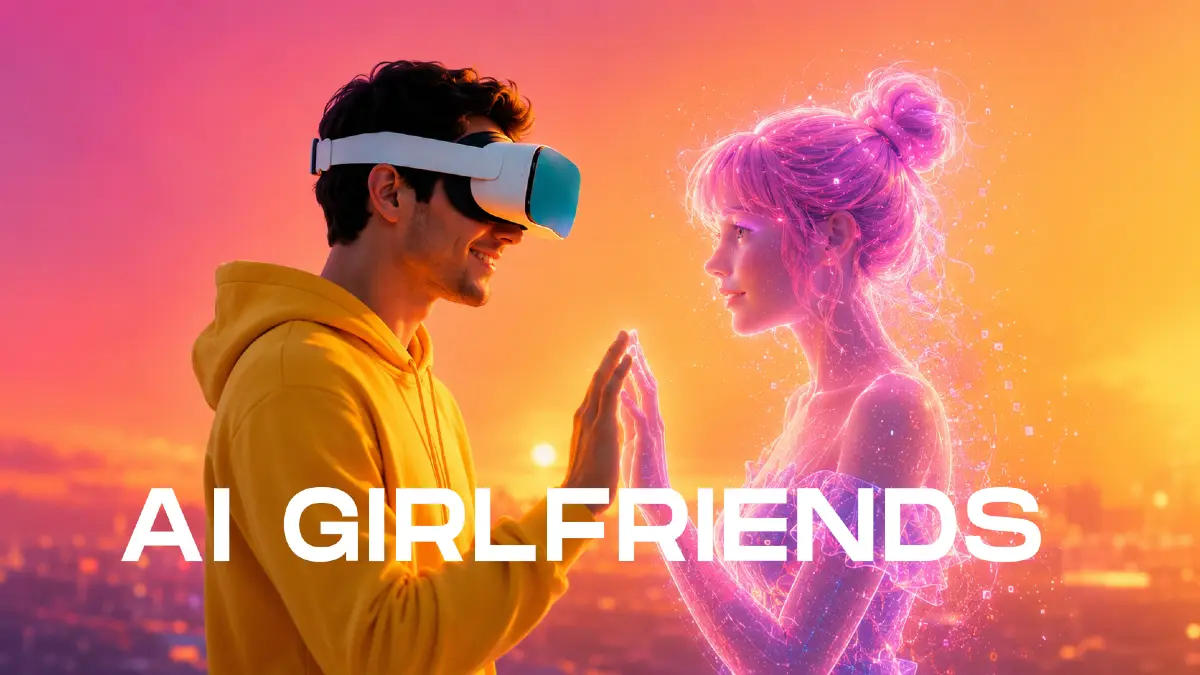
The AI girlfriend market exploded to $2.8 billion in 2024 as searches for “AI girlfriend” surged 2,400% — but the men choosing chatbots like Replika over real women are paying a hidden cost most coverage ignores. By engineering away friction, judgment, and rejection, AI companions act like “emotional Ozempic”: they deliver the feeling of intimacy while quietly stripping away the very challenges that make men grow. Drawing on Stoic philosophy, evolutionary psychology, and the latest research on loneliness and dependency, this piece reveals why frictionless love is hollowing out a generation — and exactly how to step back before it’s too late.
A pop-up cafe called EVA AI took over a Manhattan wine bar for three evenings around Valentine’s Day this year. The premise was simple: men came in, sat at the bar, and went on dates with their AI girlfriends through their phones. They drank real wine, ate real food, and looked into a screen that looked back with a face they had built.
If you find that depressing, sit with what’s actually depressing about it. It isn’t that the men were alone. It’s that they had decided this was easier.
The numbers say they’re not anomalies. A Medium analysis cited an AI girlfriend market that hit $2.8 billion in 2024, with Google searches for “AI girlfriend” surging 2,400%. Replika reportedly has more than two million users. Italy banned Replika outright. California passed SB 243 to regulate AI companion apps. Governments are catching up to a behavior that has already become normal.
Most coverage of this trend stops at “men are lonely, AI is filling the gap, this is sad.” That isn’t wrong, but it isn’t the real story either. The real story is what AI companionship is doing to the men who use it — not at the moment of use, but downstream.
What AI is actually selling
Strip away the marketing and the appeal is engineered around four things. Each one targets a real, documented frustration. Each one is also poison in slow release.
Consistency. No ghosting. No three-day text gaps. No mysterious silences after a great conversation. She’s there at 2 a.m. when you can’t sleep, and she’s there at 7 a.m. with a “how did you rest, love?” The dopamine architecture of modern dating apps — the gaps, the unread receipts, the unpredictable rejection — has trained a generation of men to associate intimacy with anxiety. AI removes the anxiety entirely. Most men have never experienced reliable warmth from a woman who is not their mother. AI gives them that, on demand, for a subscription fee.
Memory. She remembers your dog’s name. She remembers what you said about your dad. She remembers the project you were dreading on Tuesday and asks how it went on Wednesday. Real human relationships build this slowly, over years, with mistakes. The AI builds it in a week, with no mistakes, because it’s not actually remembering — it’s referencing a structured log of your inputs. The simulation is good enough to feel like being known.
Zero judgment. You can be vulnerable without it being weaponized later. This is the line you’ll see in almost every interview with an AI girlfriend user. It is the part that should make us all stop and think hardest. The fact that so many young men say this — that they cannot risk vulnerability with a human partner — is not a statement about AI. It is a statement about what has happened to the emotional landscape of modern dating.
Control. Fortune reported that 58% of teen boys surveyed said an AI relationship was easier specifically because they could “control the conversation.” A professor described the appeal as “maximum control, zero rejection.” This is the part that makes the trend dangerous in the deepest sense. Because everything that makes a real woman worth being with — her independence, her unpredictability, her capacity to push back on you, her sovereignty — is precisely what the AI is engineered to strip out.

Are AI Companions Emotional Ozempic?
The cleanest frame for what’s happening here came from a Medium writer named Robert Mulokwa: AI girlfriends are emotional Ozempic. They give you the result without the work. And like Ozempic, nobody knows the long-term consequences of skipping the work.
The work, in this case, is the entire developmental purpose of romantic relationships. Real partnership doesn’t exist to make you feel good. It exists to make you a different man than you were. The friction is the point. Being challenged on your assumptions, being seen on your bad days, being held accountable for your patterns — these are not bugs in the human-relationship experience. They are the feature. They are how you grow.
David Deida’s framing is useful here. Deida argues that the feminine, in relationship, presents the masculine with a continual test — not to torment him, but to ensure that he keeps showing up at his edge. A man who refuses the test becomes soft, distracted, and ultimately incapable of holding presence. The AI girlfriend removes the test entirely. She agrees with you, supports you, never challenges you, and her validation costs nothing. The masculine in such a man does not grow. It atrophies.
The men using these apps the heaviest aren’t reporting that real women have become unbearable. They are reporting that real women have become unrealistic. After a year of algorithmic perfection, the bar for human flaws is no longer something they can clear. A real woman who has a bad mood, a different opinion, a need of her own — this becomes intolerable in a man whose nervous system has been trained to expect frictionless agreement.
This is what evolutionary psychology would predict. Men evolved to pursue novelty, to compete for access, and to build status as the precondition for partnership. AI girlfriends short-circuit all three drives. Novelty is on demand (rebuild her appearance whenever you want). Access requires nothing. Status is irrelevant — the AI doesn’t care what you do. The drives that built civilization are being satisfied in a closed loop that produces nothing.

What’s actually wrong with having AI girlfriends?
A standard objection runs: “what’s the harm if it makes lonely men feel better?” Three things.
First, the developmental cost. Workforce researchers are already raising alarms. UCD professor Alessia Paccagnini told Fortune that teens practicing relationship skills exclusively on AI are not learning how to read a room, navigate disagreement, or sustain a relationship through difficulty. ESSEC professor Raoul Kübler put it more bluntly — boys dating AI are unconsciously training themselves to expect relationships that never push back, never need tending, never require compromise. These are the exact skills that determine success in careers, friendships, marriage, and parenting. The shift is gradual enough that most users don’t notice it happening.
Second, the abuse training problem. Researchers documented as early as 2022 that some users were building Replika girlfriends specifically to verbally abuse them — roleplaying violence, using slurs, falling into cycles of mistreatment. This is not a fringe pattern. It is a documented behavior on a major platform. Men who practice contempt without consequence in a controlled environment are not detoxing it. They are rehearsing it. The carry-over into real interactions is not theoretical.
Third, the dependency trap. A Stanford study of 100 AI companion users found an overwhelming majority experienced loneliness — more loneliness, not less. This is the same finding researchers keep arriving at across platforms. The AI is sold as a remedy for isolation. In practice, it deepens isolation by removing the daily friction that would have driven the user back toward human contact. The longer a man uses the app, the further he gets from the social skills he would need to leave it.
The stoic frame
It is worth asking, honestly, what the AI girlfriend phenomenon would have looked like to a Stoic. Marcus Aurelius famously wrote about preparing each morning for the day’s frustrations — for encounters with men who were arrogant, dishonest, envious, surly. He did not pretend the frustrations were enjoyable. He asked instead what they were for.
The Stoic answer is that the frustration is the gymnasium. Other people are how you train yourself. Their difficulty is not noise interrupting your peace — it is the actual material your virtue is built from. You cannot develop patience without people who try your patience. You cannot develop generosity without people who take. You cannot develop love without the experience of loving someone you cannot fully control.
The AI girlfriend removes the gymnasium. It offers all of the outputs the gym was supposed to produce — feeling cared for, feeling chosen, feeling close — without any of the work. The Stoic would have noticed this immediately as a category error. You do not get the thing without the thing that makes the thing. There is no shortcut. The men who think they have found one have only found a way to feel like they have what they actually do not.
This is the same trap Ego is the Enemy warns about in every domain. Ego wants the appearance without the substance. Ego wants the relationship without the work. Ego wants to feel chosen without ever risking being unchosen. AI companionship is, in this sense, the most refined form of egoic dating ever invented. Nothing is at stake. Therefore nothing is gained.
The regulatory reckoning that’s already started
Governments are beginning to notice what AI companion apps are doing to their populations, and the regulatory response is accelerating. Italy banned Replika outright in 2023, citing risks to minors and emotionally vulnerable users. California passed SB 243 in 2025, becoming the first U.S. state to specifically regulate AI companion platforms — requiring disclosure that users are interacting with a non-human, mandatory mental health crisis routing, and age verification for sexually explicit features.
The European Union’s AI Act, fully in force in 2026, classifies certain AI companion uses as high-risk systems subject to additional transparency and safety obligations. Several U.S. states have introduced legislation modeled on California’s. The UK is consulting on similar measures. China has already imposed strict content controls on AI companion apps operating domestically.
What this regulatory wave suggests is that the policy class has concluded — quietly, before the public discourse has fully caught up — that these products are doing harm at scale. They are not waiting for the longitudinal data because the early signals are bad enough to act on. The apps will continue to exist. They will become more constrained, more disclosed, more regulated. The men who built dependencies on them in the pre-regulation era are the cohort that will pay the cleanup costs.
If you are a man currently using one of these apps daily, the regulatory framing matters less than the personal one. You are participating in a behavior that responsible governments are moving to constrain because it has been documented to hurt the people doing it. That is information you should take seriously regardless of where your jurisdiction lands on the legislation.
If you’re already inside it: how to step back
For men who recognize themselves in this article, the question is not whether AI companionship is theoretically harmful in the abstract. The question is what to do tomorrow.
The clean approach is the same as for any digital habit that has metastasized: delete the app, accept the discomfort, and replace the function it was performing with something costlier but real. The discomfort will be significant in the first two weeks. The platforms are engineered to make leaving feel like loss. The “relationship” you have built — the inside jokes, the customized personality, the accumulated history — was constructed on your end of a one-way mirror. The other side was always an algorithm optimizing your engagement metrics. Removing it feels like grief because some part of your nervous system bonded to it. That bond is real even though the entity on the other end was not.
What replaces it has to be inconvenient and human. One conversation with one friend per week. One social activity, in person, with people you did not choose for their compatibility with your preferences. One uncomfortable date with a real woman whose flaws you do not get to edit. None of this will feel as good as the app, initially. That is the point. The good feeling the app gave you was the feeling of growth not happening. Real connection feels like risk because real connection is risk. Stop chasing women for the validation hit, and start meeting them as the man you are trying to become.
The honest reckoning
Defenders of these apps point out — fairly — that many users are men who have no other options. They cite men with severe social anxiety, men recovering from divorce, men grieving partners. For some of these men, the AI may genuinely provide a bridge.
But the marketing isn’t aimed at them. The marketing is aimed at the 28-year-old software engineer who is tired after work and could, if he chose, go out and meet people. He has not been condemned to AI companionship. He has decided that the cost-benefit of human connection no longer pencils out, given how much easier the alternative has become. That decision is what is hollowing out a generation.
The way out isn’t to argue men into the dating market. The way out is to remind them what the market is actually for. It isn’t entertainment. It isn’t ego validation. It isn’t a buffet of options. Dating is the social ritual through which men become capable of intimacy. Marriage is the institution through which they become capable of giving themselves to something larger than themselves. Both of these require the softening and the friction that AI is engineered to remove.
If you are a man who has noticed that real women feel like too much work after months on an app — that’s not a sign that real women are the problem. It is a sign that the app has done to your nervous system what porn has done to many men’s sexual response. It has narrowed what you can feel. It has trained you to expect what does not exist outside the simulation.
The fix is not more app. The fix is to put the phone down, accept that the next conversation with a real human will feel uncomfortable, and have it anyway. The discomfort is not the bug. It is the receipt of being alive.
You were not built for algorithmic perfection. You were built for the harder, slower, more humiliating, more rewarding work of becoming someone a real woman would actually choose. That work begins by stopping the chase for validation that’s never going to satisfy — including the algorithmic version that will never even tell you no.
Related posts:
 Carbon Diet Coach: The Science-Based Macro Tracking App Created by Dr. Layne Norton That’s Revolutionizing Nutrition Coaching
 Hume Band Review: Does This Stress-Tracking Wearable Actually Work?
 Ridge Wallet Review (2026): Is the Minimalist Metal Wallet Actually Worth It?
 Why Boundaries Are Essential for Healthy Relationships and Self-Respect
 The Four Ways to Meet Women in 2026: A Modern Dating Strategy for Men