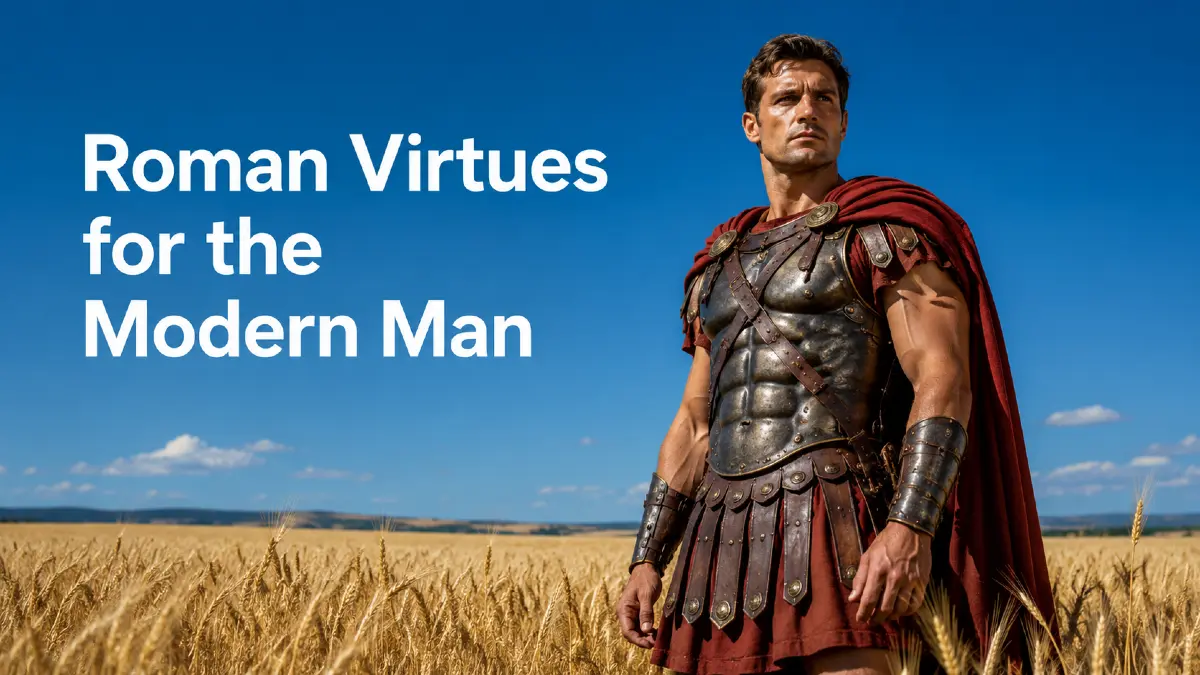
The Stoicism boom has dominated the modern masculine conversation for a decade, but it is only half the story. The Stoic philosophy that Marcus Aurelius and Seneca practiced was not an isolated system—it was a Greek import applied to an already-existing Roman virtue framework that had defined what it meant to be a man for centuries before. The Romans had a name for that framework: mos maiorum, the way of the ancestors. Its seven core virtues were the operating system underneath the empire, and they are still the most complete masculine code the West has ever produced.
Open any popular masculine self-improvement feed in 2026 and you will be told to read Marcus Aurelius. Read Meditations. Quote Seneca. Train your amor fati. Stoicism, as a brand, is now as central to modern men’s culture as protein powder. None of this is wrong. But it is incomplete, and the incompleteness matters.
Marcus Aurelius was not primarily a Stoic. He was a Roman. Before he was emperor and before he had ever read Epictetus, he had been shaped by a far older framework: the mos maiorum, the ancestral way, the codified set of virtues by which Roman men had measured themselves for half a millennium. Stoicism, when it arrived in Rome through philosophers like Panaetius and Posidonius in the second century BCE, was layered on top of this framework, not in place of it. The Romans took Greek philosophy seriously, but they always read it through the older virtue grid that already defined them.
The modern man receives the philosophy without the grid. He gets the meditations without the vir. The result is a half-translation. To understand what made Roman masculinity work—and what makes its legacy still the dominant masculine grammar of the West—a man has to go back to the seven core Roman virtues for the modern man, the bedrock the Stoicism was poured on.
This article is written for two readers. The man already steeped in Stoic content who wants to know what he is missing. And the man who has never thought about the Roman tradition at all and is curious what the most successful civilization in Western history considered the marks of an actual man. Neither will be talked down to.
A Note on Mos Maiorum
The Romans did not separate ethics from civic life the way moderns do. Mos maiorum—literally “the custom of the elders”—was an unwritten but ferociously enforced body of expectations: how a Roman man spoke, behaved, fought, voted, fathered, mourned, ate, dressed, and died. It was not a set of opinions. It was the operating system of Roman identity.
The virtues below were the load-bearing pillars of that system. They were not abstractions debated in classrooms. They were observable qualities by which Roman men judged each other in public, in the Senate, on the battlefield, in the marketplace, and in the family. A man who lacked them did not just have a personal failing—he was, in the Roman view, less of a man. The word virtus, after all, comes from vir: the Latin word for man.
What follows are seven of these virtues, translated into modern terms without losing their original weight.
1. Virtus — Excellence as the Mark of a Man
The first and most foundational of the Roman virtues is also the one whose modern English descendant—virtue—has lost most of the original meaning. Virtus literally means manliness, but Roman manliness was not a posture or an attitude. It was a track record. A man had virtus if he had demonstrated, through repeated and observable action, that he could do the difficult things a man was supposed to do: face danger, take responsibility, govern himself, deliver under pressure.
The Roman historian Sallust wrote, with characteristic bluntness, that real virtus is found “in toil and danger.” Not in talk. Not in self-image. In actual performance under real conditions. A young Roman aristocrat did not call himself a man of virtus until he had been to war, served the Republic, governed himself in public office, and accumulated the visible record of a life that bore its weight.
For the modern man, virtus is a corrective. The masculine self-improvement space has slid increasingly toward identity-performance—the projection of being someone, often before the underlying actions have been taken. Virtus refuses this. You do not have virtus because you have read about it. You have it because, over years, you have done difficult things and acquired the demonstrated capacity to do them again. There is no shortcut. The track record is the thing.
A man’s virtus is, in Roman terms, his quietly accumulated proof that he can be relied upon to perform when it counts. Less seen than spoken about. More built than displayed.
2. Gravitas — The Weight of a Real Man
If virtus is the track record, gravitas is the felt quality that emerges from it. The word literally means weight, and the Romans used it to describe the substance and depth of personality that radiates from a man who has done the work to become one. Gravitas is what makes a man’s presence change a room. It is the opposite of frivolity, performance, and theatrical seriousness alike. A man does not perform gravitas. He carries it.
Cicero, in his philosophical writings, treated gravitas as one of the foundational marks of a fully formed Roman man. It signaled, he argued, a man who had internalized the weight of his responsibilities so deeply that they no longer needed to be displayed. The opposite of gravitas was levitas—lightness, frivolity, the man whose word and presence had no weight because nothing real had ever been demanded of him.
In 2026, almost everything in the male attention economy is engineered to produce levitas. Short videos. Quick takes. Hot-take culture. Performance without substance. Reaction without reflection. Gravitas is the structural counter to all of it. It is built slowly, through deliberate withdrawal from the noise, through the patient acquisition of real knowledge, through measured speech, through the discipline of saying less and meaning more.
A man’s gravitas can be felt within seconds of him entering a room. It cannot be faked. It is the visible result of an interior life that has been actually built. And in an era of infinite chatter, it is one of the most valuable masculine assets a man can develop.
3. Pietas — Devotion to What Is Larger Than You
The third of the central Roman virtues for the modern man is pietas, often mistranslated as “piety.” That translation is too narrow. Pietas was the Roman virtue of dutiful devotion to the larger structures of life: the gods, the ancestors, the family, the Republic, the future generations. It was the recognition that a man’s life is not his alone—it is owed to the order that made him possible and the order he is responsible for carrying forward.
The model of pietas in Roman culture was Aeneas, the protagonist of Virgil’s national epic. Throughout the Aeneid, Aeneas’s defining epithet is pius Aeneas—Aeneas the dutiful. He carries his father out of burning Troy on his back. He leads his people to a new home. He fulfills his role even when his personal desires conflict. Pietas does not ask whether the duty feels good. It asks whether the duty has been fulfilled.
For the modern man, pietas is a structural challenge. Contemporary masculinity often defaults to a hyper-individualist frame: my goals, my path, my self-actualization. The Roman framework refused this. A man exists inside a chain: ancestors who made him possible, family who depends on him, community he is obligated to, descendants whose conditions he is shaping. Pietas is the daily acknowledgment of those obligations and the willingness to act on them even when they are inconvenient.
Modern life makes pietas hard to feel. Atomized work, dispersed family, weakened community. The Roman answer is to rebuild the architecture by act of will. Honor the ancestors specifically. Serve the family deliberately. Build something for the children you will never meet. Pietas does not require religion. It requires the recognition that a man owes more than he can ever repay, and the willingness to pay anyway.
4. Fides — The Power of Keeping Your Word
Fides is the Roman virtue of faithfulness—keeping your word, honoring your agreements, being trustworthy in the deepest practical sense. The Romans treated fides as foundational to the entire civilizational project. Contracts, treaties, marriages, business deals, oaths of loyalty—all of it rested on the assumption that a Roman man’s word was good. The man who broke faith was, in Roman culture, no longer fully a man.
This is harder than it sounds. Fides is not “tell the truth most of the time.” It is the unbreakable structural commitment to do what you said you would do, regardless of cost, regardless of whether anyone is watching, regardless of whether circumstances have changed. The Roman model was the man whose handshake was as binding as a signed contract, because his word and his behavior had been welded together long before the moment arrived.
For the modern man, fides is the antidote to the chronic, low-grade word-breaking that defines so much of contemporary life. The casually missed appointment. The “let me get back to you” that never gets back. The promise made under social pressure that is quietly abandoned later. Each instance is small. Together, they corrode a man’s standing in his own life.
Roman fides demands the opposite. Say less. Promise less. Then deliver everything you said you would, exactly, on time, every time. Over years, the compounding effect is staggering. A man of fides becomes the rarest creature in any community: someone whose word is structurally trustworthy. That reputation is, in practical terms, one of the highest-leverage assets a man can build. Fides is not glamorous. It is just unbreakable.
5. Dignitas — Earned Standing
Dignitas is the Roman virtue of earned standing—the visible weight a man carries in his community because of who he has shown himself to be over time. It is closely related to gravitas but operates outwardly. Where gravitas is the inner substance, dignitas is the public recognition that the substance is real. The Romans were unembarrassed about this. Dignitas was something a man worked for, defended, and—when violated—took seriously enough to fight over.
The crucial point is that Roman dignitas could not be self-claimed. It had to be ratified by the community. A man asserting his own dignitas without earning it was, in Roman terms, ridiculous. But a man who had genuinely accumulated the record—the years of service, the steady character, the kept word—possessed a dignitas that no one could remove from him short of his own disgrace. He carried it. Others recognized it.
For the modern man, dignitas is the structural answer to the social-media problem of self-branding. The modern playbook says: project your value, market your achievements, build your personal brand. The Roman framework says the opposite. Do the work. Let the recognition follow. Do not chase status; chase the substance that earns it, and then carry the resulting standing with composure.
There is a deep masculine dignity in this slower path. A man who has earned dignitas in his community does not need to fight for attention, defend his ego, or manage his image. He simply walks through his life with the visible mark of someone who has shown up consistently for long enough that everyone around him knows what he is made of.
6. Constantia — Steadiness Under Pressure
Constantia is the Roman virtue of steadiness—the unwavering, composed continuation of one’s chosen path through whatever conditions arise. It is closely related to the Stoic concept of equanimity but predates it, and the Romans understood it as a specifically masculine discipline of holding one’s position under pressure without losing form.
Constantia is what allows a man to maintain his standards when others around him are abandoning theirs. To hold his composure when the situation is loud. To continue the long project when the short-term rewards have not arrived. To stay calm in a crisis precisely because crisis is when calm becomes valuable. The Roman ideal was not a man who never felt pressure. It was a man whose felt pressure never translated into a loss of form.
For the modern man, constantia is one of the rarest assets in the room. Most of the people around him will fold under sustained stress. Few will hold their position year after year through difficulty without becoming embittered, performative, or chaotic. The man with constantia becomes, by default, the anchor others orient around. Not because he is louder. Because he does not waver when others do.
The training is unglamorous. Show up. Keep showing up. When the situation deteriorates, do not adjust your standards downward. When others panic, do not perform their panic back at them. When the long project seems to be failing, hold the position one more month, then another. Constantia is built by years of refusing to flinch in conditions designed to make a man flinch. The accumulated result is a kind of strength that cannot be acquired any other way.
7. Auctoritas — Earned Authority, Not Brute Power
The final virtue is the one most needed in 2026 and least understood. Auctoritas is the Roman concept of earned authority—the influence a man holds because of who he has become, not because of any position he occupies. It stood in deliberate contrast to potestas, which was raw power granted by position or force. A magistrate had potestas because of his office. A respected elder had auctoritas because of who he was.
The Roman insight, sharp and uncomfortable, is that real influence flows toward auctoritas and away from potestas. Men obey potestas because they must. They follow auctoritas because they want to. Over time, every position of brute power decays unless it is reinforced by the deeper authority of demonstrated wisdom, integrity, and judgment. The man who has only potestas eventually loses it. The man who has built auctoritas keeps it through every role he occupies.
For the modern man, auctoritas is the long-term play that most masculine self-improvement content quietly avoids. The shortcut version of male influence says: get the title, build the brand, accumulate the followers, project the alpha. Auctoritas refuses all of it. Real authority, the Romans understood, is what is left when the title is gone, the brand has faded, and only the man himself remains. It is built over decades, through the accumulated weight of virtus, gravitas, pietas, fides, dignitas, and constantia together.
When a man of genuine auctoritas speaks, people lean in. Not because they have to. Because they sense that his words carry the weight of a real life. That weight is the highest masculine achievement the Roman tradition ever recognized. It is still, by far, the rarest one.
Living the Way of the Vir
The seven Roman virtues above were not a checklist. They were an integrated way of being, mutually reinforcing, each one strengthening the others. Virtus generated the track record. Gravitas was its felt presence. Pietas anchored a man inside his obligations. Fides welded his word to his actions. Dignitas recognized his earned standing. Constantia held it all under pressure. Auctoritas was the cumulative influence such a man came to wield.
The modern man does not need to convert to anything Roman to take this framework seriously. He needs only to recognize that beneath the current Stoicism boom is an older, richer, more comprehensive masculine code that the Stoics themselves were merely refining. The vir Romanus—the Roman man—was, for all his cultural specificity, one of the most psychologically intact masculine ideals the West has ever produced.
Read Marcus Aurelius, by all means. But read him knowing what he himself knew: that beneath the Greek philosophy he loved was the older Roman grid that had made him a vir in the first place. The virtues above are still available. The grid still works. And the man who lives by them will, quietly and over years, become something the modern world barely produces anymore: a man with weight.
Related posts:
 How the Roman Empire Survived Collapse and Reinvented Itself
 Masculine Leadership in Relationships Without Control
 The Way of the Omoluabi: 7 African Philosophy Concepts for the Modern Man
 The Way of the Lugal: 7 Mesopotamian Virtue Concepts for the Modern Man
 How to Attract Women Without Chasing or Performing