
The Wake-Up Call That Changes Lives
It takes just one simple mathematical calculation to fundamentally alter your perspective on life. When Sahil Bloom, author of “The 5 Types of Wealth,” sat down for drinks with an old friend in May 2021, he expected the typical catch-up conversation. Instead, he received a gut punch that would redirect his entire existence.
“You’re going to see your parents fifteen more times before they die.”
This wasn’t meant to be cruel—it was just math. Bloom’s parents were in their mid-sixties, the average life expectancy is approximately eighty years, and he was seeing them once per year while living in California. The equation was devastatingly simple, and the answer changed everything. As Bloom writes in “The 5 Types of Wealth,” this moment of clarity revealed a fundamental truth: we are all suffering from an epidemic of time poverty, even while convincing ourselves that being “busy” is a badge of honor.
Understanding Time Wealth: Beyond the Clock
Time Wealth is the first and perhaps most foundational of the five types of wealth that Bloom explores in his transformative guide. But Time Wealth isn’t simply about having more hours in the day—it’s about understanding the finite nature of our most precious resource and learning to invest it wisely.
In “The 5 Types of Wealth,” Bloom explains that our relationship with time has become fundamentally distorted in the modern era. We’ve been conditioned to believe that productivity, busyness, and constant activity are virtues. We respond to “How are you?” with “Busy!” as if it’s something to be proud of. But this perspective has led us into a trap of time poverty, where we sacrifice the moments that matter most in pursuit of an ever-receding finish line of “someday.”
The concept of Time Wealth draws from both ancient wisdom and modern psychology. Bloom references the Greek concepts of chronos (chronological time) and kairos (the opportune moment), reminding us that not all time is created equal. A decade spent in misalignment with your values passes differently than a single afternoon spent in deep presence with someone you love.
The Three Pillars of Time Wealth
According to “The 5 Types of Wealth,” Time Wealth rests on three fundamental pillars:
1. Awareness: Understanding how finite and precious time truly is. This means recognizing that we worship time in ways our ancestors worshiped gods—we measure it, track it, optimize it, yet we rarely step back to consider what we’re actually doing with it. The awareness pillar challenges us to calculate not just how much time we have, but how many specific moments remain with the people and activities that matter most.
2. Allocation: Making intentional choices about where our time goes. Bloom emphasizes that time is not a renewable resource, and every hour spent is an investment with returns—positive or negative. The allocation pillar requires us to audit our time spending and ensure it aligns with what we claim to value most. As Bloom discovered, you might claim family is most important while your calendar reveals a different truth.
3. Appreciation: Being fully present in the moments we’ve chosen. This pillar acknowledges that we can have both quantity and quality of time, but quality requires presence. Bloom writes about the modern scourge of distraction, where we might physically be with loved ones while mentally being anywhere else. True Time Wealth means eliminating the constant pull of notifications, emails, and mental clutter that prevents us from experiencing the moment we’re in.
The Paradox of Modern Time Poverty
One of the most powerful insights from “The 5 Types of Wealth” is Bloom’s examination of what he calls the “time poverty paradox.” Despite living in the most technologically advanced era in human history—with dishwashers, washing machines, instant communication, and automation—we feel more time-starved than ever. Our ancestors, who had to hunt for food and build shelter by hand, might have felt they had more breathing room than we do.
The reason, Bloom explains, is that we’ve allowed Parkinson’s Law to dominate our lives: work expands to fill the time available for its completion. We’ve taken all the time savings from modern convenience and filled them with more work, more consumption, more distraction. We’ve become addicted to optimization while forgetting to ask: What are we optimizing for?
Harvard Business School research cited in the book reveals that time poverty is associated with lower levels of happiness, increased stress, reduced productivity, and decreased life satisfaction. The irony is profound: we sacrifice our time to earn money, believing it will buy us happiness, but the sacrifice itself is what’s making us miserable.
Practical Systems for Building Time Wealth
“The 5 Types of Wealth” isn’t just philosophical—it provides twelve concrete systems for building Time Wealth. Here are some of the most transformative:
The Hard Reset: Bloom advocates for conducting a comprehensive audit of how you currently spend your time. Track every hour for a week without judgment. The results are often shocking, revealing massive gaps between stated priorities and actual time allocation.
The Energy Calendar: Not all hours are equal. Bloom suggests color-coding your calendar based on energy: green for activities that energize you, yellow for neutral, and red for draining. The goal is to maximize green, minimize red, and be intentional about yellow. This simple visual tool reveals patterns you might have never noticed.
The Two-List Exercise: Borrowed from Warren Buffett, this exercise involves listing your top 25 goals, circling the top 5, and then actively avoiding the remaining 20 until you’ve achieved the top 5. As Bloom explains, those other 20 items are dangerous because they feel important enough to work on but will distract you from what truly matters.
The Art of No: Perhaps the most powerful time-building tool is learning to say no. Bloom introduces the “Yes-Damn Effect”—only saying yes to opportunities that make you think “Yes! Damn, yes!” Everything else gets a polite no. This one principle can reclaim dozens of hours per week.
The Eisenhower Matrix: Bloom revitalizes this classic framework for prioritization, helping readers distinguish between what’s urgent and what’s important. Most of us spend our lives in reaction mode, responding to the urgent at the expense of the important. True Time Wealth comes from flipping this equation.
Time Billionaires vs. Time Poverty
In “The 5 Types of Wealth,” Bloom introduces the concept of “time billionaires”—people who have successfully achieved mastery over their time. These aren’t necessarily people with empty calendars; they’re people who have complete autonomy over how they spend each hour. They’ve eliminated time debt (obligations that drain without providing value) and maximized time dividends (activities that compound in value over time).
The path from time poverty to time wealth isn’t about working less—it’s about working differently. It’s about ruthlessly eliminating what Bloom calls “time vampires”: unnecessary meetings, digital distractions, energy-draining relationships, and activities that feel productive but don’t move you toward your true goals.
Bloom shares his own transformation in the book. After that fateful conversation about seeing his parents fifteen more times, he and his wife made the difficult decision to leave California and move closer to family on the East Coast. He restructured his business to create more autonomy. He implemented hard boundaries around his time. The result wasn’t just more time—it was better time, aligned time, meaningful time.
The Ultimate Time Wealth Question
Throughout “The 5 Types of Wealth,” Bloom returns to powerful questions designed to shift perspective. For Time Wealth, the big question is: “How many moments do you have remaining with your loved ones?”
This isn’t about morbidity—it’s about clarity. When you calculate that you might have only 1,000 dinners left with your spouse, or 100 weekends left with your aging parents, or perhaps 2,000 bedtimes left with your young children, it changes how you approach each moment. Suddenly, responding to work emails during dinner feels different. The extra hour at the office feels different. The scrolling through social media while your child tries to show you something feels different.
Time Wealth is ultimately about making the invisible visible. We act as if time is infinite when it’s the scarcest resource we have. We trade it carelessly for things that don’t matter, forgetting that unlike money, time cannot be earned back.
Conclusion: The Investment That Matters Most
As Sahil Bloom powerfully demonstrates in “The 5 Types of Wealth,” Time Wealth is the foundation upon which all other forms of wealth are built. Without time, money is meaningless. Without time, relationships wither. Without time, personal growth stalls and physical health declines.
The mathematics of mortality are unforgiving, but they’re also liberating. Once you truly understand how finite your time is—how countable your remaining moments are—you gain the clarity to make different choices. You gain the courage to say no to what doesn’t matter and yes to what does. You gain the wisdom to be present in the moment you’re in rather than constantly planning for or regretting other moments.
Building Time Wealth isn’t about retirement or escape. It’s about designing your life right now to maximize what Bloom calls “kairos moments”—those opportune, meaningful moments that make life worth living. It’s about becoming a time billionaire not by having more hours, but by investing the hours you have in what truly creates value.
The question isn’t whether you can afford to prioritize Time Wealth. After reading “The 5 Types of Wealth,” the real question becomes: Can you afford not to?
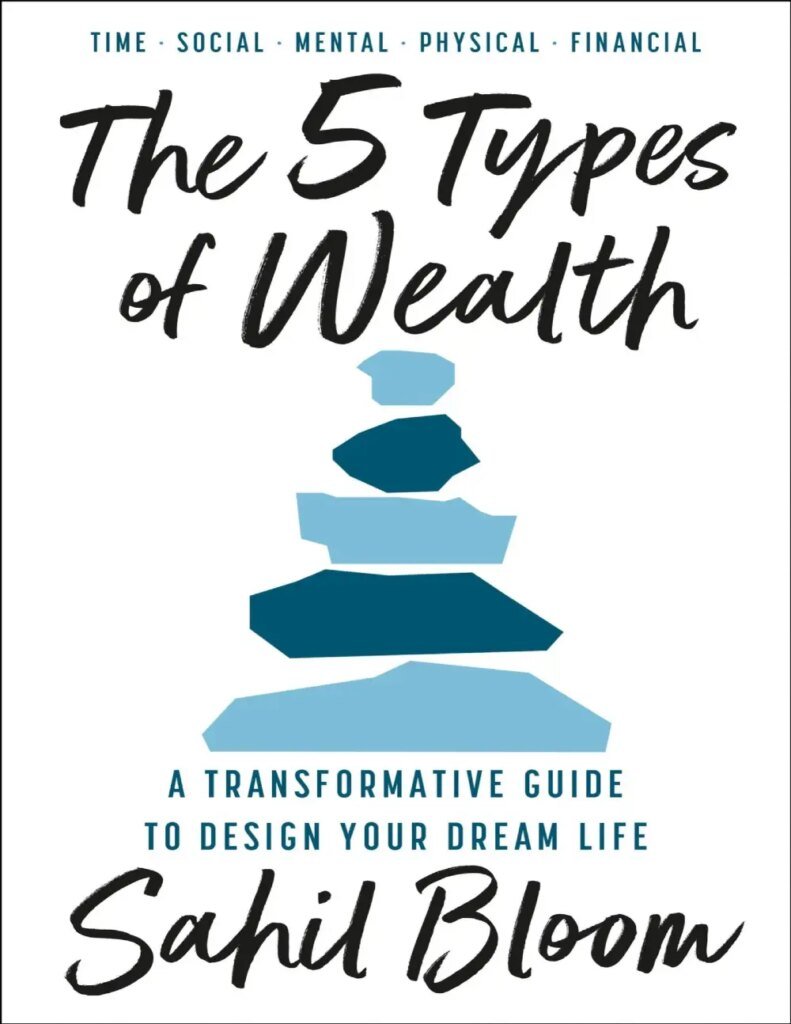
About “The 5 Types of Wealth”: Written by entrepreneur and content creator Sahil Bloom, “The 5 Types of Wealth: A Transformative Guide to Design Your Dream Life” presents a revolutionary framework for thinking about success beyond just financial metrics. Published by Ballantine Books in 2025, the book explores five interconnected types of wealth—Time, Social, Mental, Physical, and Financial—providing both philosophical insights and practical systems for building a truly rich life.
Related posts:
 The Wealth Score: Why Measuring Success in Just One Dimension Is Destroying Your Life (The 5 Types of Wealth by Sahil Bloom)
 How to Actually Transform Your Life Using the 5 Types of Wealth Framework (The 5 Types of Wealth by Sahil Bloom)
 From Money Obsession to Financial Freedom (The 5 Types of Wealth by Sahil Bloom)
 Mental Wealth: How to Build Clarity in an Age of Infinite Distraction
 The Entrepreneurial Path to Integrated Wealth: Building a Business That Serves All Five Dimensions