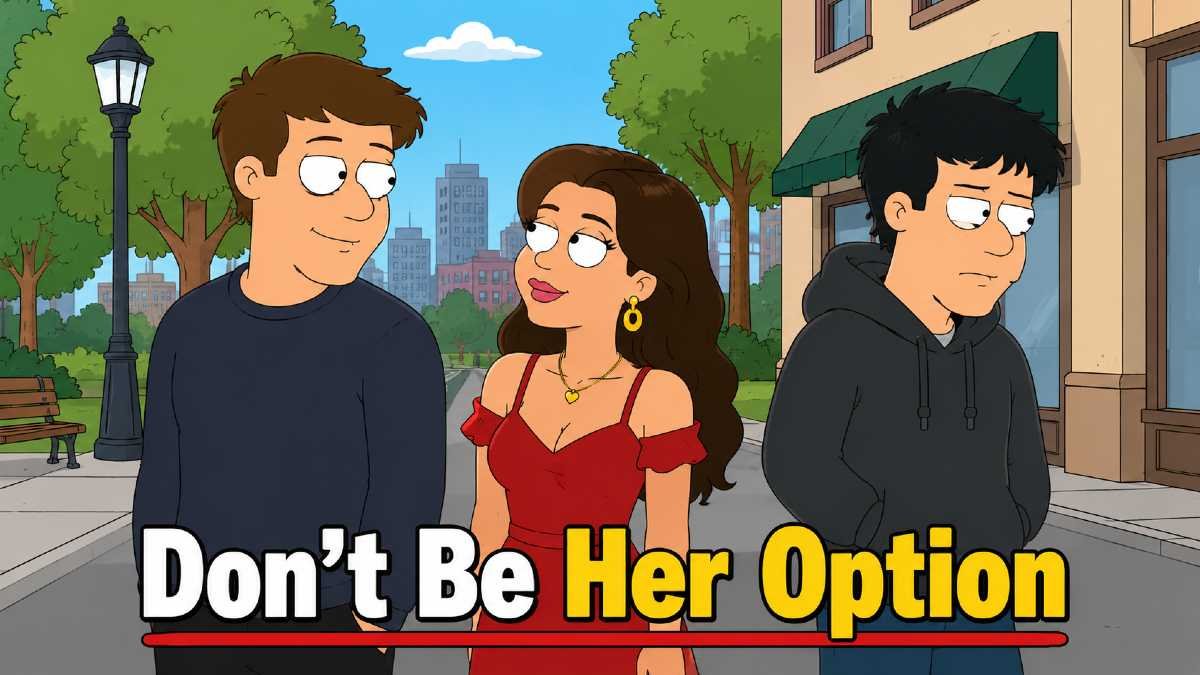
There’s an uncomfortable truth most men learn the hard way: being an option in a woman’s life is functionally the same as being nothing at all. Options get left on read. Options get called when the priority isn’t available. Options spend years orbiting a woman who is friendly enough to keep them close, but never interested enough to choose them.
If you’ve ever wondered why the woman you wanted seemed to lose interest the harder you tried, or why your most generous gestures somehow made things worse instead of better, you’re not crazy and you’re not unlucky. You’re running into one of the oldest patterns in human attraction, and the good news is that it’s a pattern you can change starting today.
This article breaks down why men end up as options, the negotiation logic behind attraction, and the specific mindset and behavioral shifts that move you from her plan B to someone she actively chooses. Read it slowly. The principles are simple, but the implications run deep.
What It Actually Means to Be “Her Option”
An option is a man a woman keeps in her peripheral vision in case her primary romantic situation falls apart. He is reliable, available, almost always interested, and almost never the one she’s lying awake thinking about. He is the safety net, not the trapeze artist.
Options come in many forms. The old flame she still texts on birthdays. The male friend who has been “such a good listener” for three years. The guy she went on two dates with who keeps liking her photos. The coworker who buys her coffee. The ex who still drives across town to help her move.
What unites them is a single trait: in her mental hierarchy, they rank somewhere below the man she is currently most invested in. If that primary partner exits the picture, the options get reshuffled. If he stays, the options stay frozen in place, useful but never chosen.
The hard part to accept is that men are usually complicit in this. Women rarely have to work to demote a man into option status. He volunteers for the role by his own behavior, and then wonders why he can’t seem to be promoted.
The Fundamental Law of Attraction
Here is the law that governs everything that follows: people want what they want, not what wants them.
Read that twice. It is the single most counterintuitive truth about romantic attraction, and it explains almost every confusing experience you have ever had with women.
You cannot make someone want you more by wanting them more. You can sometimes make them want you more by wanting them less. But the math of attraction does not work the way the math of effort works in school or sports. Showing up earlier, trying harder, and caring more do not produce proportional returns. Past a certain point, they produce negative returns.
This is why the man who sends the longest texts, plans the most thoughtful dates, and is the most consistently available is often the one who gets the friendly “I just don’t feel that spark” message. He has done everything right by the logic of effort and everything wrong by the logic of attraction.
The reason is that desire is partly a status signal. When you visibly need someone more than they need you, you are broadcasting that you have fewer alternatives, less leverage, and less perceived value in the marketplace. Your interest, instead of being flattering, becomes evidence that you are easier to obtain than the people she is comparing you to.
Every Relationship Has Three Phases
To understand where men go wrong, it helps to map the structure of any romantic connection. Every relationship, from a one-night encounter to a forty-year marriage, moves through three distinct phases:
- Attraction — She notices you. Something about you registers as desirable, interesting, or worth her attention.
- Negotiation — The two of you, mostly without saying it out loud, agree on the terms of the connection. How much time, what kind of access, what level of exclusivity, what each person gives and gets.
- Maintenance — You sustain what you negotiated. The terms can shift, but they tend to stay anchored near where they started.
Most men obsess over the attraction phase. They want to know how to get noticed, how to hold a conversation, what to wear, what to say. These things matter. But the phase where men actually lose the women they want is the negotiation phase, and most don’t even know they’re in it.
If you fumble the negotiation, you don’t get the relationship you wanted. You get whatever terms your behavior settled for. And if you set the terms by communicating that you’ll accept anything, that’s exactly what you’ll get: anything she’s willing to offer, which is usually far less than you hoped.
The Two Job Offers: A Negotiation Story
Imagine you are looking for work and have interviewed at two companies.
The first one, call it Beta Corp, calls you immediately. “We love you. You’re the best applicant we’ve ever seen. We’re hiring you today, no conditions. Your corner office is ready. Start whenever you want — today, tomorrow, next year. There’s a place for you here no matter what. Just let us know if we can do anything else to help you decide.”
Pleasant call. You feel relieved. You have a guaranteed position.
The second company calls a day later. “Thanks for applying. We have several strong candidates and a competitive process. We’ll inform you of our decision when we’ve made it. Don’t call us, we’ll call you.”
What do you do? You wait. Of course you wait. You have nothing to lose by waiting. Beta Corp has promised you it will be there no matter when you decide, so the only rational move is to see what the second company offers. If they reject you, you still have Beta Corp. If they accept you, you have leverage to compare.
And here is the kicker. Even if the second company rejects you outright, the rational move is still not to immediately accept Beta Corp. Why not interview at a third company? A fourth? A tenth? Beta Corp has unilaterally promised you unlimited time and unconditional acceptance. There is no downside to continuing to search and unlimited upside if you find something better.
The only two scenarios in which you’d accept Beta Corp’s offer are:
- You run out of money. You need a job now, and Beta Corp is what’s available. You accept not with enthusiasm but with grim resignation, because every attempt to find something better has failed.
- Beta Corp is your absolute dream job. Except — and here’s the catch — if Beta Corp had been your dream job, you would have shown obvious enthusiasm during the application, which would have signaled to them that they didn’t need to promise the moon to lock you in. The fact that they had to overpromise is itself proof you weren’t that into them.
Beta Corp did this to itself. By overpursuing and overcommitting before the negotiation was even underway, it transformed itself from a credible employer into a fallback option. And it never realizes how it happened.
This is precisely what most men do with women.
How Overpursuing Looks in Real Life
Once you see the Beta Corp pattern, you start spotting it everywhere men interact with women they want.
Excessive availability. “Want to go out Monday?” “I’m busy Monday.” “How about Tuesday?” “Busy Tuesday.” “Wednesday?” “Busy Wednesday.” A man who is genuinely in demand does not have six open evenings to offer. A man who broadcasts six open evenings is telling her that she is, by a wide margin, the most interesting thing in his calendar.
Showing all the cards. “I’ve never felt this way about anyone. You’re different. I want to show you how much I’m into you.” This kind of declaration is meant to flatter. It often does the opposite. It tells her the negotiation is already over before it began. She now knows your ceiling, and your ceiling is whatever she’ll give you.
Committing past the point of decision. “Listen, if you ever change your mind, just let me know — I’d be happy to take you out anytime.” This is the verbal equivalent of Beta Corp’s open-ended offer. The decision has been made (she’s not interested right now), but the man refuses to let the decision close. He leaves the offer permanently on the table, hoping that one day she’ll pick it up.
Disproportionate gestures. Big gifts before there’s a relationship. Long drives for short visits. Reorganizing his schedule around hers while she barely adjusts hers around his.
Each of these behaviors, in isolation, can look romantic in a movie. In practice, they communicate the same message: I need you more than you need me, and I’ll prove it by accepting terms no man with better options would accept.
The Poker Face Principle
Successful negotiators, regardless of the field, share one habit. They control their visible reaction to the offer.
Most poker hands are mediocre. Every now and then, you get pocket aces. The temptation is to celebrate — to lean forward, to bet too eagerly, to broadcast through your body language that something good just happened. Doing so jeopardizes the entire pot. The best players sit with their excitement and let it move through them without leaking out. They know that the size of the win depends on how well they conceal how much they want it.
Dating works the same way. When you meet a woman who genuinely excites you — the rare one, the one who hits multiple boxes at once — the worst thing you can do is broadcast that she’s hit them. The flattery model says she’ll be moved by your obvious interest. The negotiation model says she’ll quietly adjust her sense of your value downward, because anyone willing to advertise that level of interest must not be getting it elsewhere.
This is not about being cold, cruel, or playing games. It’s about emotional regulation. You can feel everything fully and still choose not to bet your entire stack on the second hand of the night.
The Hardest Truth About Power in Negotiation
Here is the uncomfortable principle that ties all of this together:
Whichever party is more eager to close, and less willing to walk, has less power in the negotiation.
This is true regardless of the objective value of the offer. The most beautiful, kind, accomplished, loyal man in the room loses leverage the moment he communicates that he can’t walk away. His objective value doesn’t change. His perceived value collapses, because she now knows he won’t enforce his own standards.
This applies in salary negotiations, in business deals, in real estate, and in dating. The person who needs the transaction more accepts worse terms. The person willing to walk extracts better ones.
Most men in the dating market are unwilling to walk. They believe that if they walk, they’ll lose her, and they’ve already decided that losing her is the worst possible outcome. That belief is the source of every bad deal they ever make. They accept girlfriends who don’t really want them. They tolerate situationships that go nowhere. They wait years for women who are politely keeping them in the option pool.
The willingness to walk is not a manipulation tactic. It is the precondition for any honest negotiation. If both parties know you won’t walk, you don’t have a negotiation. You have a slow-motion surrender.
When It’s Actually Fine to Be the “Beta Corp”
In fairness, there are two scenarios where being the eager party is rational.
The first is when you genuinely have no options and no time. If you’ve been alone for a long time, you’re at a stage of life where the dating market gets thinner, or your circumstances have narrowed your prospects, you may take the offer in front of you because the cost of waiting is higher than the cost of unfavorable terms. This isn’t ideal, but it is honest. Just don’t confuse it for love. Know what you’re doing and why.
The second is the genuine dream scenario — when the woman in front of you really is the absolute peak of what you could reasonably hope for. Even here, though, there’s a paradox. If she really were so out of your league, your visible eagerness would not move her. She’d have many men signaling the same thing. Restraint, not enthusiasm, is the only differentiator. So the practical advice doesn’t actually change.
How to Stop Being Her Option in Practice
The mindset shifts above translate into a handful of concrete behavioral changes. None are complicated. All require some discipline.
Build a life she has to compete for. The single most effective form of restraint is not strategic delay — it’s having things in your life that actually matter to you. Work you care about, friends you see regularly, fitness, hobbies, side projects, travel. A man with a full life cannot fake being unavailable. He simply is unavailable, and that scarcity is genuine.
Match her investment. A reasonable rule of thumb: roughly mirror the energy, frequency, and effort she’s giving. If she texts back in two hours, don’t text back in two minutes. If she suggests one date a week, don’t push for three. Matching, not exceeding, is the safer default early on.
Don’t fill every silence. When she doesn’t text, don’t text. When she doesn’t suggest plans, don’t scramble to suggest them. Let space exist. Most men cannot tolerate silence; the ones who can are the ones women remember.
Make decisions when decisions are made. If she tells you she isn’t interested, isn’t ready, isn’t sure, or needs space, hear her. Don’t leave the offer permanently open. The man who closes the door is far more attractive in retrospect than the one who keeps it propped open for years.
Walk when the terms are bad. This is the hardest one and the one that changes everything. Be willing to lose her over things that matter to you. If you’re not, she will quietly run the relationship from a position of total power, and you will quietly resent it.
Stop performing interest. You don’t need to convince her of how much you like her. If she’s interested, your presence is enough. If she’s not, your declarations won’t fix it.
What You’ll Lose, and Why It’s Worth It
Adopting this mindset has a real cost. Some attractive women will slip through your fingers because you didn’t chase hard enough. Some opportunities you might have salvaged with desperate effort will end. You will sometimes wonder, late at night, if you should have just sent the text.
This is the price. There is no version of dating where you both protect your standards and never lose anyone. The man who refuses to be an option will, by definition, leave some doors closed that the option-man would have kept ajar.
But the doors he leaves closed lead nowhere. They lead to relationships in which he is tolerated rather than chosen, to slow-burn rejections dressed up as ambiguity, to years of low-grade hope that quietly drain his confidence and his time. The doors he keeps open through pursuit are doors to rooms he doesn’t actually want to live in.
The man who walks freely walks into the only kind of relationship worth having: one in which he was chosen, on terms he agreed to, by a woman who wanted him more than she wanted the alternative.
Final Thought
It’s been said that in life we don’t get what we deserve — we get what we negotiate. Dating is no exception. The men who get the kinds of relationships they actually want are not necessarily the most handsome, the most successful, or the most charming. They are the ones who understood, often after years of getting it wrong, that you cannot earn a woman’s desire by working harder for it.
You can only create the conditions in which it has room to grow. And those conditions, every time, require you to be the kind of man who does not need to be chosen — but who is worth choosing anyway.
Don’t be her option. Be the man she chooses, on terms that work for both of you. And if those terms aren’t on the table, be the man who walks.
Related posts:
 Why You Can’t Buy a Woman’s Respect: Why Real Wealth — Not Spending — Is What Actually Earns It
 How to Attract Women Without Chasing or Performing
 The Ultimate Mini Course to Male / Female Attraction: Psychology, Power, and What Actually Works
 What Happens When You Stop Chasing a Woman? The Healthy Dating Dynamic That Leads To Clarity
 Why ‘Good Guys’ Finish Last: The Feminist Promise That Failed Men