
Among the many factors contributing to civilizational collapse throughout history, one pattern emerges with disturbing consistency: extreme inequality combined with elite extraction of resources from broader populations creates internal tensions that undermine social cohesion and resilience. In “Goliath’s Curse: The History and Future of Societal Collapse,” Luke Kemp documents how concentrated power and wealth at the top of social hierarchies has repeatedly destabilized civilizations, making them vulnerable to both internal revolt and external shocks. This historical pattern carries profound implications for contemporary societies experiencing rising inequality.
The Origins of Inequality
For most of human existence, inequality remained limited. Hunter-gatherer societies, which characterized 95% of human history, typically exhibited remarkable egalitarianism. Without means to store wealth or establish permanent hierarchies, material differences stayed modest. Leadership emerged situationally based on specific skills—a skilled hunter might lead hunting parties while others directed camp movements or conflict resolution.
These foraging societies developed cultural mechanisms actively resisting inequality. Anthropologists document traditions of “insulting the meat”—successful hunters were ritually mocked to prevent boasting and pride. Sharing norms ensured food distribution throughout groups. Consensus decision-making prevented individuals from accumulating authority. When individuals attempted to dominate, groups responded with ostracism or, in extreme cases, collective violence against would-be tyrants.
The transition to agriculture transformed possibilities for inequality. Storable grain surpluses enabled some individuals to accumulate wealth while others faced scarcity. Those controlling prime agricultural land, water sources, or food stores gained power over dependents needing access to these resources. Hereditary inequality emerged as wealthy families passed advantages to offspring while poor families transmitted poverty.
Kemp emphasizes that this inequality wasn’t inevitable or natural. It resulted from specific social arrangements accompanying agriculture and early state formation. Societies made choices—some more consciously than others—that enabled or prevented inequality’s development. Understanding this history matters because it shows that extreme hierarchy represents a historical aberration, not human nature.
The First States and Organized Extraction
Early states arose through processes often involving violence and coercion. Archaeological evidence from regions where states first emerged—Mesopotamia, Egypt, China, Mesoamerica—shows dramatic social stratification appearing relatively quickly after agricultural intensification.
Cahokia, the first major city of North America, illustrates this pattern. Initially a relatively egalitarian farming village, Cahokia transformed within a few generations into a hierarchical society featuring massive pyramid mounds, human sacrifice, and stark inequality. Burial sites reveal this transformation dramatically. One mound contains 53 young women—likely sacrificed during an elite funeral. Another pit holds four men with heads and hands removed. At the top of the burial, two men were interred with extraordinary wealth, including a blanket containing 20,000 shell beads.
This archaeological evidence demonstrates concentrated power and wealth. Elites commanded resources enabling massive construction projects and human sacrifice. Common people provided labor while receiving minimal benefits. Within just over a century of this intense hierarchical development, Cahokia began collapsing. Population declined. Eventually, the entire region was abandoned—what became known as “the Vacant Quarter.”
Kemp suggests that the rapid collapse may have reflected population resistance to extraction. People voted with their feet, abandoning centralized settlements that demanded tribute, labor, and sacrifices while concentrating benefits among elite classes. The complete abandonment and absence of oral traditions about Cahokia may indicate intentional forgetting—cultural rejection of hierarchical state-building experiments.
Elite Overproduction and Competition
Societies can tolerate some inequality without collapse. But when inequality becomes extreme and elite classes grow beyond what economies can support, instability intensifies. Historian Peter Turchin calls this “elite overproduction”—situations where too many ambitious individuals compete for limited elite positions, creating intra-elite conflict that destabilizes entire societies.
Late Republican Rome exemplified this dynamic. The traditional aristocracy—patricians and senators—faced pressure from wealthy equestrians seeking political power. Successful military generals accumulated wealth and loyal armies, competing with Senate authority. Popular politicians mobilized urban populations against aristocratic privilege. These elite factions fought increasingly violent conflicts, eventually triggering civil wars that destroyed the Republic.
The intra-elite competition wasn’t purely about personal ambition. It reflected structural problems: Roman conquests created enormous wealth concentrated among military and political elites. Traditional aristocratic families competed with newly wealthy generals and merchants. The Senate’s institutional power clashed with personal armies commanded by popular leaders. Elite rivalry intensified as the prize—control of Rome’s vast empire—grew larger.
Meanwhile, common Romans and Italian allies faced declining conditions. Small farmers lost land to large estates worked by enslaved people from conquered territories. Urban populations swelled with displaced rural people dependent on grain subsidies. Allies who fought in Rome’s wars faced taxation without political representation. These tensions between elite enrichment and popular immiseration created tinder awaiting ignition.
Taxation, Extraction, and Legitimacy
States require resources to function—building infrastructure, maintaining armies, supporting administrations. Taxation transfers resources from populations to states. When taxation remains moderate and provides tangible benefits—roads, security, dispute resolution, public works—populations may accept it. When taxation becomes extraction—when elites take resources primarily to fund luxury consumption, wars of aggression, or monumental vanity projects—legitimacy erodes.
The Tang Dynasty of China provides instructive examples. During its height (7th-8th centuries CE), the Tang developed sophisticated administration and cultural achievements. But the dynasty’s later period saw increasing taxation to fund military campaigns and court luxury. Provincial governors became semi-independent warlords keeping tax revenues for themselves. The central government’s attempts to extract more from remaining territories triggered revolts.
The An Lushan Rebellion (755-763 CE) nearly destroyed the dynasty. Though the Tang survived nominally, it never recovered centralized control. Real power shifted to provincial military governors. The dynasty finally collapsed in 907 CE after decades of internal warfare between warlords competing over resources they extracted from suffering populations.
Kemp notes that collapse often occurred not because states provided no services but because extraction exceeded perceived benefits. Populations could observe elites living luxuriously while common people paid taxes supporting that luxury. When crises struck—droughts, invasions, epidemics—elites expected populations to provide additional resources while offering little protection in return. At some threshold, populations decided that stateless existence, despite its challenges, was preferable to continued extraction.
The Archaeology of Abandonment
One of the most striking collapse patterns involves populations simply leaving. Across history, people abandoned states that exploited them excessively. The “Vacant Quarter” around Cahokia. Lowland Maya cities depopulated as people moved to regions beyond state control. Medieval peasants fled taxation by moving to forests, mountains, or marshes beyond government reach.
James C. Scott’s work on “Zomia”—the mountainous Southeast Asian region where state control remained weak—documents how populations deliberately chose mobility and subsistence strategies resistant to state extraction. Rather than being “primitive” peoples who hadn’t developed civilization, many Zomia populations were refugees from extractive lowland states, maintaining oral traditions and social organizations specifically designed to prevent state formation.
This historical record suggests that state collapse wasn’t always catastrophic for common people. For elites—losing wealth, power, and privilege—collapse meant disaster. For heavily taxed farmers providing labor and resources to support elite luxury, state collapse might bring relief. Without tax collectors, military conscription, and forced labor obligations, populations could consume more of what they produced.
Archaeological evidence supports this interpretation. After political collapse, elite residences and monumental architecture cease. But basic settlement patterns often continue. People still farmed, lived in villages, traded locally. Life continued, just without extractive hierarchies. Material culture becomes simpler—fewer luxury goods, smaller buildings—but this reflects reduced inequality rather than universal impoverishment.
Modern Parallels: Rising Inequality
The patterns Kemp identifies in historical collapses resonate powerfully with contemporary trends. Wealth concentration in developed nations has reached levels not seen since just before the Great Depression. In the United States, the top 1% now owns a larger share of wealth than at any point in the past century. CEO compensation ratios to average workers have exploded from 20:1 in the 1960s to over 300:1 today.
This inequality manifests in multiple domains: income, wealth, political influence, access to education and healthcare, life expectancy, and opportunities for social mobility. As in historical cases, extreme inequality undermines social cohesion. Trust in institutions declines. Political polarization intensifies. Populist movements emerge challenging elite consensus.
Elite overproduction appears in contemporary forms: too many law school graduates competing for limited prestigious positions, excess PhD production relative to academic jobs, Wall Street attracting vast numbers of ambitious graduates. This competition among educated elites creates frustration and instability. Increasingly, would-be elite members conclude that existing systems are rigged against them, turning to populist movements promising disruption.
Meanwhile, broad populations face stagnant wages, declining opportunities, and rising costs for housing, education, and healthcare. The social contract—work hard, follow rules, and expect improving conditions—has broken down for many. Younger generations face bleaker prospects than their parents despite increased education and productivity. This combination of elite infighting and popular frustration mirrors patterns preceding historical collapses.
The Legitimacy Crisis
Modern states face legitimacy challenges similar to historical empires. Tax revenues fund military spending, corporate subsidies, and services disproportionately benefiting wealthy populations while infrastructure crumbles and public services deteriorate. Bailouts rescue failed financial institutions while individuals struggle with debt. Politicians serve donor interests over constituent needs.
This perceived illegitimacy manifests in declining trust across institutions: government, media, corporations, universities, and even science. When populations believe systems serve elites rather than common welfare, cooperation breaks down. Tax evasion increases. Political engagement declines or channels into protest movements. Social norms enabling collective action erode.
Historically, states losing legitimacy faced two paths: reform reducing extraction and inequality, or collapse. Reform requires elites accepting reduced privilege for systemic stability. But elites typically resist reforms threatening their advantages, preferring to intensify extraction even as system instability increases. This pattern—elites fighting to maintain privilege while the systems supporting them destabilize—appears repeatedly in collapse histories.
Can Inequality Be Reduced Without Collapse?
Not all historical examples end in collapse. Some societies successfully reduced inequality through reform rather than revolution or collapse. The post-World War II era in developed nations saw substantial reduction in inequality through progressive taxation, labor rights, social welfare programs, and economic growth broadly distributed. This period—roughly 1945-1975—demonstrated that capitalist economies can function with moderate inequality and strong safety nets.
Kemp notes that this “Great Compression” period occurred following catastrophic warfare and depression that discredited previous elite dominance. Existential threats created political space for reforms that peacetime elite resistance might have blocked. Labor movements, social democratic parties, and public pressure pushed governments toward redistribution despite elite opposition.
Scandinavian nations have maintained relatively low inequality through strong welfare states, powerful labor unions, progressive taxation, and political cultures emphasizing social solidarity over individual accumulation. These societies demonstrate that modern economies can combine prosperity with equity—the trade-off between equality and efficiency that neoliberal economics emphasizes isn’t as stark as claimed.
However, recent decades show inequality increasing even in historically egalitarian societies. Globalization enables capital mobility beyond national taxation. Automation reduces labor’s bargaining power. Political systems capture by wealthy interests prevents reforms. The question becomes whether democratic institutions can check inequality’s rise or whether, as in historical cases, the gap between elites and populations will continue widening until system failure.
Lessons for Avoiding Collapse
Historical collapse from inequality offers several lessons for contemporary societies. First, extreme inequality destabilizes civilizations regardless of technological sophistication or economic output. Societies can be wealthy on average while harboring internal tensions threatening collapse.
Second, elite extraction beyond perceived benefits erodes legitimacy essential for system functioning. States depend on cooperation—tax payment, rule following, institutional participation. When populations conclude that cooperation benefits elites disproportionately, systems become brittle.
Third, elite competition for concentrated resources can prove as destabilizing as popular revolt. Intra-elite conflict often triggered historical collapses. Modern democracies aren’t immune—wealthy interests battle over policy, media narratives, and political influence while populations suffer the consequences.
Fourth, reform remains possible but requires elite willingness to sacrifice short-term interests for long-term system stability. Historically, this occurred primarily after catastrophes made clear that current paths lead to disaster. Ideally, societies would implement reforms before collapse rather than after.
Finally, collapse isn’t universally catastrophic—impacts depend on position within social hierarchies. Elite fears of collapse often exaggerate consequences for ordinary people. This doesn’t mean collapse is desirable, but it suggests that system preservation primarily benefits those benefiting from current arrangements. Popular interests might lie more in system transformation than preservation.
The Choice Before Us
“Goliath’s Curse” presents inequality not as mere unfairness but as existential threat to civilizational stability. The book documents how societies throughout history collapsed when elite extraction exceeded populations’ tolerance. We face similar dynamics today: rising inequality, declining social mobility, elite political capture, and popular frustration.
Unlike historical civilizations that collapsed in ignorance, we possess knowledge of these patterns. We can observe inequality metrics, study historical precedents, and model systemic risks. The question is whether knowledge translates into action. Will contemporary elites accept reforms reducing privilege? Will political systems implement redistribution before revolt or collapse? Will populations demand change or accept gradual deterioration?
As Kemp argues, the curse of Goliath—that concentrated power eventually triggers its own destruction—needn’t be inevitable. But breaking the cycle requires recognizing inequality not as side effect of prosperity but as path toward instability. Sustainable civilization demands broader distribution of benefits and burdens. Whether we achieve this through reform or learn through collapse remains to be determined.
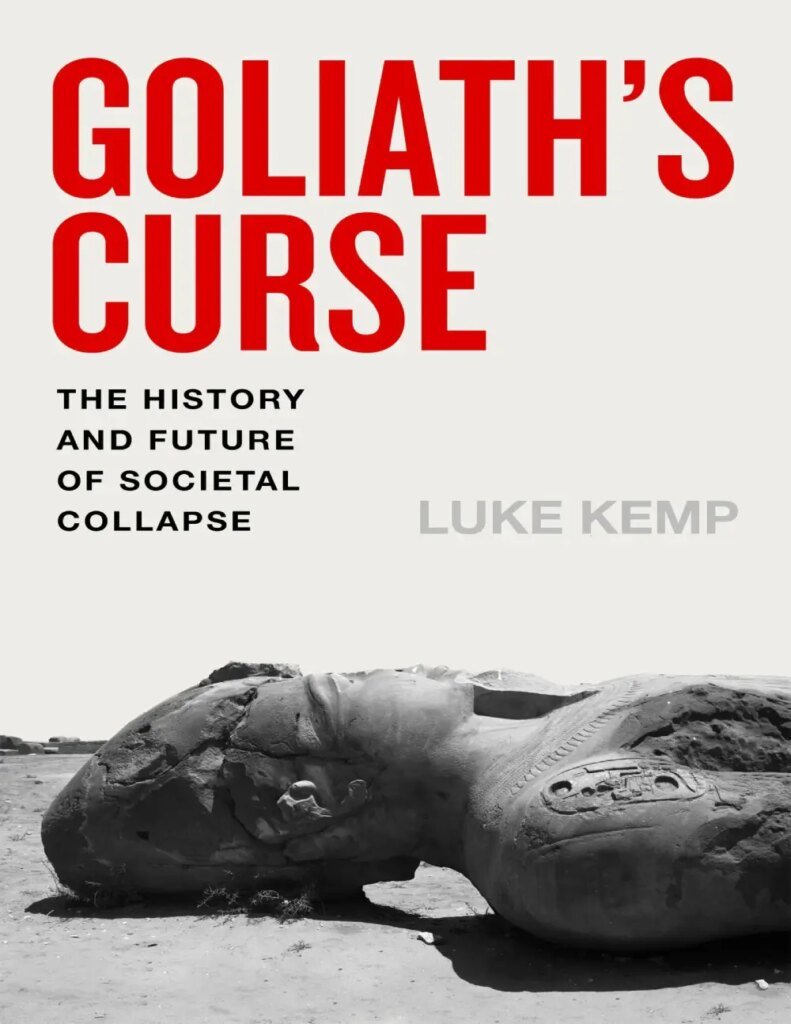
25 Key Takeaways From Luke Kemp’s Book Goliath’s Curse
Related posts:
 25 Key Takeaways From Luke Kemp’s Book Goliath’s Curse
 From Maya to Rome: How Environmental Degradation Triggers Societal Collapse (Goliath’s Curse by Luke Kemp)
 Could Civilization Rebuild After Collapse? The Terrifying Rungless Ladder Theory (Goliath’s Curse by Luke Kemp)
 How the Roman Empire Survived Its Own Collapse (Goliath`s Curse by Luke Kemp)
 Why Every Great Civilization Eventually Falls: Lessons from Goliath’s Curse by Luke Kemp