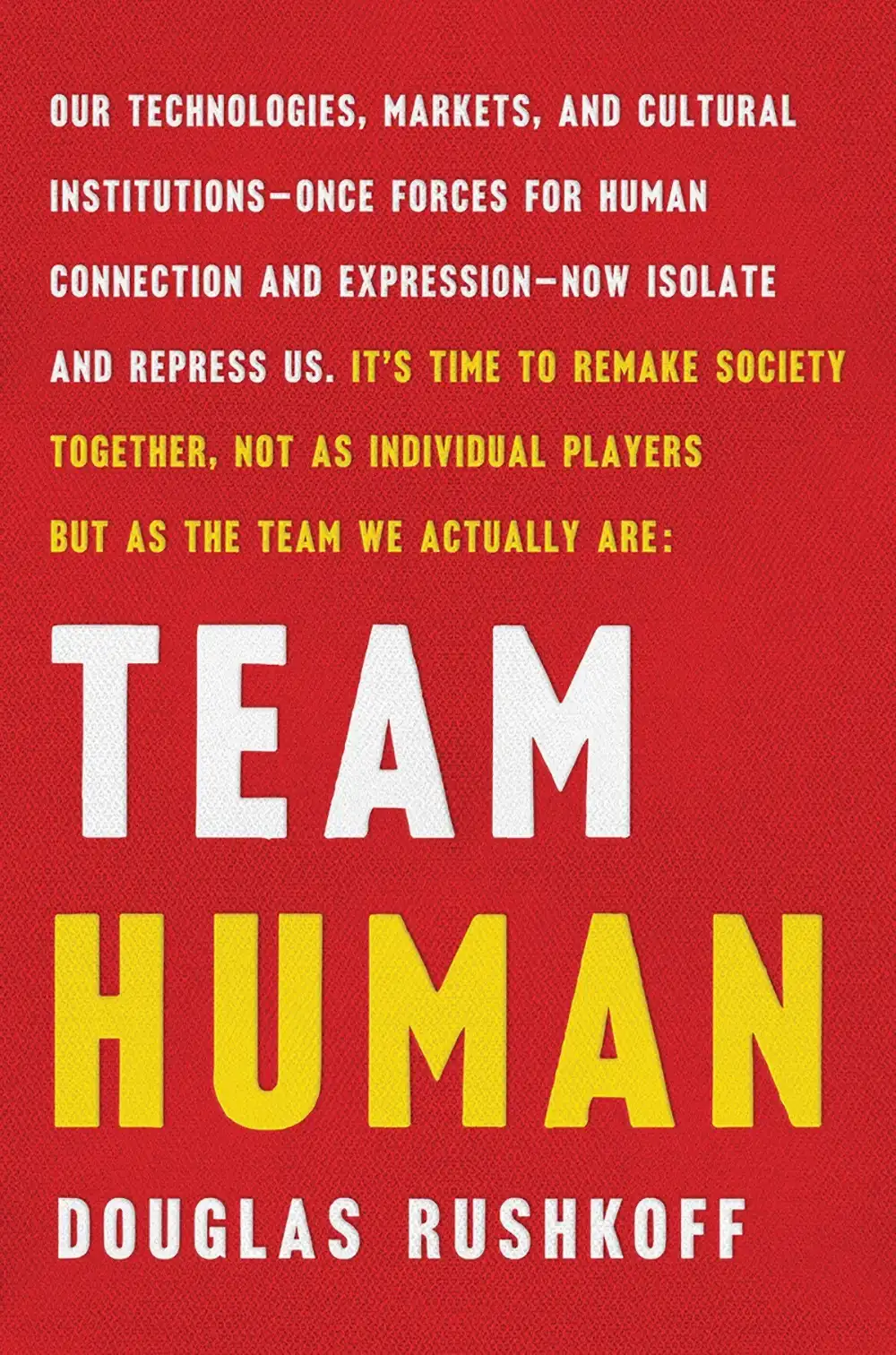
Team Human by Douglas Rushkoff: Complete summary with 25 key insights & quotes. Understand our digital crisis and how to reclaim genuine human connection.
Douglas Rushkoff’s “Team Human” stands as one of the most important books of our digital era—a comprehensive diagnosis of how technology, economics, and institutions have systematically undermined human connection and autonomy, coupled with a practical roadmap for resistance and renewal.
Published in 2019, “Team Human” emerged from Rushkoff’s podcast of the same name and distills decades of his work at the intersection of technology, media, and culture. Unlike typical tech criticism that focuses on specific platforms or problems, Rushkoff reveals the deeper patterns—the antihuman agenda embedded in our systems—and offers a framework for consciously opposing it.
This complete summary explores the 25 most critical insights from “Team Human,” each supported by direct quotes from the book, to give you a comprehensive understanding of Rushkoff’s argument and its implications for how we live, work, and connect in the digital age.
Understanding the Book’s Core Premise
Before diving into specific insights, it’s essential to grasp Rushkoff’s foundational argument. He opens with a stark observation about our current moment:
“Autonomous technologies, runaway markets, and weaponized media seem to have overturned civil society, paralyzing our ability to think constructively, connect meaningfully, or act purposefully.”
But immediately after diagnosing the crisis, he offers hope: “It doesn’t have to be this way.” This tension between urgent problem and possible solution animates the entire book.
Rushkoff isn’t arguing for rejection of technology or return to some idealized past. Instead, he’s calling for conscious, collective intervention in systems that have been designed—intentionally or not—to undermine human flourishing. The book’s title itself signals the solution: we must act as Team Human, not as isolated individuals.
The 25 Essential Insights
Insight 1: Being Human Is Fundamentally Social
Rushkoff establishes immediately that humans are not autonomous individuals who occasionally cooperate—we’re fundamentally social beings who cannot be fully human alone.
“Being human is a team sport. We cannot be fully human alone. Anything that brings us together fosters our humanity. Likewise, anything that separates us makes us less human, and less able to exercise our individual or collective will.”
This biological reality undergirds everything that follows. When systems isolate us, they’re not just making us lonely—they’re attacking our fundamental nature. The loneliness epidemic, rising suicide rates, and pervasive meaninglessness are predictable outcomes of systematic disconnection, not personal failures or inevitable modern conditions.
Insight 2: Social Connection Is Literally Life or Death
Our need for connection isn’t psychological preference—it’s biological imperative, processed by the same brain regions that handle physical survival.
“Our nervous systems learned to treat our social connections as existentially important—life or death. Threats to our relationships are processed by the same part of the brain that processes physical pain.”
This means social isolation isn’t just unpleasant—it’s experienced by your nervous system as an acute threat to survival. Understanding this helps explain why disconnection feels so devastating and why we’re so vulnerable to platforms that promise connection while delivering isolation.
Insight 3: There’s an Antihuman Agenda Embedded in Our Systems
Rushkoff’s most provocative claim is that the problems we’re experiencing aren’t accidental—they result from systems deliberately designed to separate and control us.
“There’s a reason for our current predicament: an antihuman agenda embedded in our technology, our markets, and our major cultural institutions, from education and religion to civics and media. It has turned them from forces for human connection and expression into ones of isolation and repression.”
This isn’t conspiracy theory but documented history. Throughout the book, Rushkoff traces how institutions and technologies that began as tools for human benefit systematically become mechanisms of control and extraction—from written language to social media platforms.
Insight 4: Evolution Favors Cooperation Over Competition
Contrary to the “survival of the fittest” narrative often used to justify cutthroat capitalism, evolutionary success depends primarily on cooperation, not competition.
“Evolution is every bit as much about cooperation as competition. Our very cells are the result of an alliance billions of years ago between mitochondria and their hosts. Individuals and species flourish by evolving ways of supporting mutual survival.”
This biological reality undermines the entire philosophical foundation of zero-sum capitalism. When we organize society around competition and individual survival, we’re working against our evolutionary heritage, not expressing it.
Insight 5: Human Brains Evolved for Social Complexity
Our most distinctive feature as a species isn’t superior tool use or intelligence—it’s our capacity for complex social organization.
“The most direct benefit of more neurons and connections in our brains is an increase in the size of the social networks we can form. Complicated brains make for more complex societies.”
We evolved bigger brains primarily to handle larger social groups and more intricate relationships. This means that when modern systems undermine our social connections, they’re attacking the very capacity that makes us human.
Insight 6: Language Created Both Connection and Deception
Every major communication technology offers both promise and peril. Language itself exemplifies this pattern.
“Language gave humans a big advantage over our peers, and allowed us to form larger and better organized groups… But language also had the reverse effect. Before language, there was no such thing as a lie.”
This dual nature characterizes every subsequent communication technology. Writing enabled record-keeping but was first used primarily to track slaves. Printing promised literacy but was monopolized by monarchs. Understanding this pattern helps us navigate digital technology’s similar trajectory.
Insight 7: Media Revolutions Follow Predictable Patterns
Throughout history, new media emerge promising democratization but are quickly captured by existing power structures.
“With computers came the potential to program. Thanks to online networks, the masses gained the ability to write and publish their own blogs and videos—but this capability, writing, was the one enjoyed by the elites in the prior revolution. Now the elites had moved up another level, and were controlling the software through which all this happened.”
This pattern reveals why digital technology, despite early promise, has concentrated rather than distributed power. The masses gain yesterday’s elite capability while elites monopolize today’s control mechanisms.
Insight 8: Social Media Turned Users Into Products
The transformation of the internet from peer-to-peer connection tool to extraction mechanism happened through a specific business model shift.
“What people couldn’t or wouldn’t pay for with money, we would now pay for with personal data. But something larger had also changed. The platforms themselves were no longer in the business of delivering people to one another; they were in the business of delivering people to marketers. Humans were no longer the customers of social media. We were the product.”
This reversal changes everything about how platforms operate. They’re not trying to serve users’ interests in connection—they’re trying to serve users to advertisers. User wellbeing and platform profit are in fundamental opposition.
Insight 9: Digital Connection Isn’t Biologically Real
Despite appearing to connect us, digital communication fails to activate the biological bonding mechanisms that create actual relationship.
“We cannot truly relate to other people online—at least not in a way that the body and brain recognize as real… All those painstakingly evolved, real-world physical and chemical processes are what enable and reinforce our social connection and coherence, and form the foundations for the societies that we eventually built.”
This explains why people feel lonely despite constant digital interaction. Your nervous system knows the difference between real connection and simulation, even if you can’t articulate why digital interaction feels hollow.
Insight 10: The Attention Economy Weaponizes Psychology
Platform designers deliberately employ psychological manipulation tactics to capture and monopolize attention.
“Instead of designing technologies that promote autonomy and help us make informed decisions, the persuasion engineers in charge of our biggest digital companies are hard at work creating interfaces that thwart our cognition and push us into an impulsive state where thoughtful choices—or thought itself—are nearly impossible.”
These aren’t accidental design choices but intentional applications of behavioral psychology, borrowed from casino design and decades of research on creating compulsive behavior. The goal is keeping users distracted, anxious, and engaged regardless of cost to their wellbeing.
Insight 11: Algorithms Make Us Less Human
Rather than serving users, algorithms shape users to be more predictable and profitable.
“Algorithms use our past behavior to lump us into statistical groups and then limit the range of choices we make moving forward. If 80 percent of people in a particular big-data segment are already planning to go on a diet or get divorced, that’s fine. But what of the other 20 percent? What were they going to do instead?”
This systematic elimination of anomalous behavior makes us less diverse, less interesting, and less human. Our irregular edges—the unpredictable choices and surprising interests—get filed off in favor of conformity to algorithmic expectations.
Insight 12: We Become Dumber When Using Digital Technology
The cognitive impact of constant digital engagement isn’t subtle—it’s measurable and significant.
“We now know, beyond any doubt, that we are dumber when we are using smartphones and social media. We understand and retain less information, comprehend with less depth, and make decisions more impulsively than we do otherwise.”
This isn’t a character flaw but a predictable result of how digital environments fragment attention and undermine sustained focus. The platforms profit from this cognitive degradation because impulsive, distracted users are easier to manipulate.
Insight 13: Mechanomorphism Makes Us Imitate Machines
Just as we once anthropomorphized machines by projecting human qualities onto them, we now mechanomorphize ourselves by adopting machine qualities as ideals.
“When autonomous technologies appear to be calling all the shots, it’s only logical for humans to conclude that if we can’t beat them, we may as well join them… It’s not just treating machines as living humans; it’s treating humans as machines.”
This manifests in our language about “optimizing” ourselves, measuring worth through metrics, and striving for efficiency over meaning. We’re unconsciously accepting machines’ values—speed, efficiency, predictability—while abandoning distinctly human ones.
Insight 14: Capitalism Requires Perpetual Growth
Modern capitalism isn’t just one possible economic system—it’s specifically designed to extract value from people and places while concentrating wealth at the top.
“That growth mandate remains with us today. Corporations must grow in order to pay back their investors. The companies themselves are just the conduits through which the operating system of central currency can execute its extraction routines.”
This endless growth requirement explains why corporations destroy the very markets they depend on, why environmental sustainability is incompatible with shareholder capitalism, and why workers’ conditions continually deteriorate even as productivity increases.
Insight 15: Platform Capitalism Accelerates Extraction
Digital platforms represent capitalism’s most efficient extraction mechanism yet.
“Digital businesses work the same way as their extractive forebears. When a big box store moves to a new neighborhood, it undercuts local businesses and eventually becomes the sole retailer and employer in the region… A digital business does the same thing, only faster.”
Platforms extract maximum value while externalizing costs—drivers provide their own vehicles, content creators provide free labor, users provide data and attention—while the platform captures profit and moves to the next market once extraction is complete.
Insight 16: The Wealthy Are Planning to Escape
Rather than addressing the problems their extractive practices create, the ultra-wealthy are investing in personal escape plans.
“Some of the most farsighted tech billionaires are already investing in plan B. Instead of undoing the damage, reforming their companies, or restoring the social compact, they’re busy preparing for the apocalypse.”
This “insulation equation”—calculating how much wealth is needed to survive societal collapse—reveals the moral bankruptcy of a system where those causing harm plan to escape consequences while everyone else suffers them.
Insight 17: Transhumanism Is an Evacuation Plan, Not Enhancement
Silicon Valley’s obsession with life extension and consciousness uploading isn’t about improving human life—it’s about escaping it.
“Transhumanists hope to transcend or at least improve upon biological existence. Some want to use technology to live forever, others to perform better, and still others to exit the body and find a better home for consciousness… This is not human enhancement—it’s human evacuation.”
This philosophy explains why so much technology seems designed to undermine rather than support human flourishing. If the goal is transcending humanity, then current human needs and wellbeing matter less than progress toward post-human goals.
Insight 18: Consciousness Isn’t Computable
Despite transhumanist fantasies, consciousness can’t simply be uploaded to computers because it depends on quantum processes that aren’t computable.
“Consciousness is based on totally noncomputable quantum states in the tiniest structures of the brain, called microtubules. There are so many billions of these microtubules, and then so many active, vibrating sites on each one, that a machine harnessing every computer chip ever made would wither under the complexity of one human brain.”
This scientific reality undermines the entire transhumanist project. Consciousness isn’t information processing that can be replicated digitally—it’s a fundamentally different phenomenon that requires biological substrate.
Insight 19: Paradox Is What Makes Us Human
Unlike machines that require binary certainty, humans thrive in ambiguity and paradox.
“Team Human has the ability to tolerate and even embrace ambiguity. The stuff that makes our thinking and behavior messy, confusing, or anomalous is both our greatest strength and our greatest defense against the deadening certainty of machine logic.”
This capacity for holding contradictory truths, navigating uncertainty, and finding meaning in paradox is uniquely human. Cultivating it is how we maintain our humanity against systems that demand binary simplicity.
Insight 20: We’re Living in a Potential Renaissance
Despite the crisis, Rushkoff sees possibility for fundamental positive transformation.
“Are we in the midst of a renaissance? Might the apparent calamity and dismay around us be less the symptoms of a society on the verge of collapse than those of one about to give birth?”
Renaissance means retrieval—bringing forward values lost in previous eras. Our current moment offers the opportunity to retrieve solidarity, mutual aid, and collective wellbeing while retaining modern individuality and critical thinking.
Insight 21: Solidarity Begins With Place
Abstract global connection matters less than concrete local community.
“Solidarity begins with place. While it’s tempting to rally around the emotionally charged issues of the mainstream media, they tend to be abstract, polarizing, and unconnected to people’s lived experience.”
Place-based community has resilience that purely interest-based digital communities lack. When crisis hits, proximity matters. The people nearby can actually help, experience similar challenges, and have ongoing incentive to work through conflicts.
Insight 22: Face-to-Face Interaction Is Non-Negotiable
Physical presence isn’t optional or merely preferred—it’s biologically required for genuine bonding.
“At least television happened in public. The enormity of the audience was the source of its power, but also its regulating force… In contrast, social media messages may cost pennies or nothing at all, are seen only by the individuals who have been targeted, and are placed by bots with no qualms about their origins or content.”
The shift from mass media to individually targeted algorithmic feeds removes even the minimal social accountability of broadcast era. We’re now isolated in personalized reality tunnels, making collective resistance nearly impossible.
Insight 23: Resistance Requires Collective Action
Individual solutions aren’t sufficient—we need coordinated collective response.
“It’s time we reassert the human agenda. And we must do so together—not as the individual players we have been led to imagine ourselves to be, but as the team we actually are. Team Human.”
This framing rejects both the myth of atomized individualism and the powerlessness it produces. We have agency, but only collectively. The systems arrayed against human flourishing are coordinated—our response must be equally coordinated.
Insight 24: Technology Can Serve Human Purposes
The book isn’t anti-technology—it’s about consciously directing technology toward human ends.
“Human beings can intervene in the machine. That’s not a refusal to accept progress. It’s simply a refusal to accept any particular outcome as inevitable… Team Human doesn’t reject technology. Artificial intelligence, cloning, genetic engineering, virtual reality, robots, nanotechnology, bio-hacking, space colonization, and autonomous machines are all likely coming, one way or another. But we must take a stand and insist that human values are folded into the development of each and every one of them.”
This pragmatic stance acknowledges technological development while insisting on human agency in shaping it. We don’t reject tools—we reject letting tools determine our values and purposes.
Insight 25: You Are Not Alone
The book’s ultimate message combines diagnosis of isolation with reminder of fundamental connection.
“You are not alone. None of us are. The sooner we stop hiding in plain sight, the sooner we can avail ourselves of one another. But we have to stand up and be seen… It’s time for us to rise to the occasion of our own humanity. We are not perfect, by any means. But we are not alone. We are Team Human.”
This declaration serves as both comfort and call to action. The isolation we feel is manufactured by systems that profit from it. Connection is both possible and necessary. But we must actively choose it and build structures that support it.
The Book’s Structure and Organization
“Team Human” is organized into 100 short, numbered sections grouped into thematic chapters. This structure allows Rushkoff to build his argument incrementally, with each section offering a discrete insight that connects to the larger whole.
The main sections include:
Team Human – Establishes the core premise about human sociality and the antihuman agenda Social Animals – Explores evolutionary biology and what makes humans fundamentally social Learning to Lie – Examines how communication technologies can be weaponized Figure and Ground – Introduces the concept of reversed priorities and hidden agendas The Digital Media Environment – Analyzes how digital platforms manipulate behavior Mechanomorphism – Explores how we’re adopting machine values Economics – Dissects platform capitalism and extractive business models Artificial Intelligence – Challenges AI supremacy narratives From Paradox to Awe – Recovers distinctly human capacities Spirituality and Ethics – Addresses meaning and values Natural Science – Examines our relationship with nature Renaissance Now – Proposes retrieval and renewal Organize – Offers practical steps for collective action You Are Not Alone – Concludes with the call to find others and act
This progression moves from diagnosis through analysis to prescription, giving readers both understanding of the problem and pathways toward solution.
Who Should Read Team Human
“Team Human” is essential reading for:
Anyone feeling isolated despite constant digital connection. If you’re experiencing the paradox of being more “connected” than ever while feeling more alone, this book explains why and offers paths forward.
Men struggling with friendship and community. The book’s insights about embodied connection and collective purpose directly address the male loneliness epidemic.
Technology workers questioning their industry’s impact. If you’re building digital products and wondering about unintended consequences, Rushkoff provides the framework for thinking critically about technology’s human impact.
People seeking alternatives to extractive capitalism. The book explores cooperative economics, local community, and mutual aid as practical alternatives to platform capitalism.
Anyone concerned about losing autonomy to algorithms. If you’ve noticed your thoughts, behaviors, and choices becoming more predictable and constrained, this book explains the mechanisms behind that loss of agency.
Parents worried about technology’s impact on children. Understanding how platforms manipulate attention and undermine development helps parents make better choices about their kids’ digital engagement.
Activists and organizers. The book provides both analysis of why collective action is difficult in digital environments and strategies for building real solidarity.
Critical Reception and Impact
Since publication, “Team Human” has been widely recognized as one of the most important critiques of digital capitalism and technological determinism. Unlike purely technical critiques that focus on specific platforms or features, Rushkoff’s work traces the deeper patterns and embedded assumptions that make antihuman outcomes predictable.
The book has influenced discussions about:
- Platform regulation and antitrust action against tech monopolies
- The ethics of persuasive design and attention engineering
- Alternative economic models including platform cooperatives
- Digital wellbeing movements and conscious technology use
- The importance of place-based community and face-to-face connection
Critics have praised Rushkoff’s ability to make complex systems thinking accessible while maintaining intellectual rigor. The book combines evolutionary biology, neuroscience, economics, media theory, and cultural criticism into a coherent framework that empowers readers to understand their experience and take action.
Practical Applications
Beyond analysis, “Team Human” offers concrete guidance:
For individuals: Disable notifications. Prioritize face-to-face interaction. Create phone-free zones. Join local organizations. Build real community through consistent physical presence.
For families: Establish boundaries around digital devices. Prioritize shared meals and conversation. Engage with neighbors and local community rather than purely digital networks.
For businesses: Consider whether growth serves purpose or whether subsidiarity makes more sense. Explore cooperative ownership models. Prioritize worker wellbeing over shareholder returns.
For communities: Create regular gathering spaces. Support local businesses and circular economies. Build mutual aid networks. Engage in local governance.
For society: Regulate platform monopolies. Support alternatives to extractive capitalism. Invest in public spaces and infrastructure for face-to-face interaction. Reshape education to prioritize human development over job training.
Related Reading
Readers who find “Team Human” valuable should also explore:
- “Present Shock” by Douglas Rushkoff – His earlier work on how always-on digital culture fragments time and attention
- “Life Inc.” by Douglas Rushkoff – Explores how corporatism colonized everyday life
- “The Age of Surveillance Capitalism” by Shoshana Zuboff – Detailed analysis of the business model extracting value from human behavior
- “Digital Minimalism” by Cal Newport – Practical guide to conscious technology use
- “The Attention Merchants” by Tim Wu – History of the attention economy
- “Throwing Rocks at the Google Bus” by Douglas Rushkoff – Explores alternatives to growth-based capitalism
- “Bowling Alone” by Robert Putnam – Classic analysis of American social decline
Final Assessment
“Team Human” succeeds as both diagnosis and prescription. Rushkoff doesn’t just identify what’s wrong—he explains why it’s wrong, how it got this way, and what we can do about it. The book combines intellectual rigor with emotional resonance, making complex systems thinking accessible while never oversimplifying.
Most importantly, it offers hope without false comfort. The situation is serious, but it’s not hopeless. Change is possible, but only through conscious, collective effort. We can’t optimize or hack our way out of a fundamentally social problem—we have to show up for each other, build real community, and collectively resist systems designed to keep us apart.
The book’s greatest strength is showing that individual therapeutic responses—meditation apps, digital detoxes, self-care—while potentially helpful, are insufficient to address systematically produced isolation. We need collective solutions to collective problems. We need to be Team Human.
How to Read Team Human
For maximum benefit:
- Read it physically, not digitally. The medium matters. Reading a physical book creates different neural engagement than screen reading.
- Discuss it with others. The book’s message about collective action starts with collective processing. Form a reading group or discuss sections with friends.
- Take notes on what resonates. Which insights hit hardest? Which patterns do you recognize in your own life?
- Identify one concrete action. Don’t try to change everything at once. Pick one specific practice—regular face-to-face gatherings, reduced platform dependence, local engagement—and commit to it.
- Return to it periodically. The book rewards rereading as you gain experience with its practices. Insights that seemed abstract initially become concrete as you work with them.
Conclusion: The Choice Before Us
“Team Human” ultimately presents a choice: will we accept the current trajectory toward increasing isolation, algorithmic control, and extractive economics? Or will we consciously intervene to create something different—more connected, more autonomous, more human?
The book makes clear that the choice is ours, but only if we make it collectively. Individual resistance, while necessary, isn’t sufficient. We need coordinated, collective action to build alternatives and oppose systems designed to keep us apart.
As Rushkoff reminds us throughout: “Find the others.” This simple directive contains the entire prescription. Build real community. Show up physically. Create mutual aid networks. Prioritize face-to-face connection. Resist isolation in all its forms.
The systems arrayed against human flourishing are powerful, sophisticated, and well-funded. But they have one critical weakness: they depend on our compliance. When we choose connection over isolation, solidarity over competition, and collective wellbeing over individual optimization, we reclaim our power as Team Human.
The crisis is real. The manipulation is documented. The extraction is ongoing. But the outcome isn’t predetermined. We have agency—if we exercise it together.
You are not alone. None of us are. It’s time to act like it.
Frequently Asked Questions About Team Human
What is the main message of Team Human? The core message is that being human is fundamentally social, that modern systems systematically undermine human connection for profit and control, and that we must consciously work together to resist these forces and build alternatives that support human flourishing.
Is Team Human anti-technology? No. Rushkoff isn’t opposed to technology itself but to the antihuman values embedded in how current technologies are designed and deployed. He argues for consciously directing technology toward human purposes rather than accepting any particular technological outcome as inevitable.
Who is Douglas Rushkoff? Douglas Rushkoff is a media theorist, documentarian, and author of numerous books about technology, media, and culture including “Present Shock,” “Life Inc.,” and “Throwing Rocks at the Google Bus.” He’s been analyzing digital culture since the 1990s and teaches media theory at CUNY.
What does “antihuman agenda” mean? Rushkoff uses this term to describe systems and technologies designed in ways that undermine human connection, autonomy, and flourishing—whether intentionally or as predictable side effects of other priorities like profit maximization or behavioral control.
How long is Team Human? The book is approximately 200 pages, organized into 100 short numbered sections grouped into thematic chapters. It’s designed for accessibility—dense with ideas but readable in a few sittings.
Is there a Team Human podcast? Yes. The book grew out of Rushkoff’s podcast of the same name, which features conversations with thinkers, activists, and creators about maintaining humanity in the digital age. The podcast continues independently of the book.
Related posts:
 Douglas Rushkoff’s Team Human: A Complete Guide to Staying Human in the Digital Age
 Platform Capitalism: How Digital Monopolies Extract Value From Your Life
 Surveillance Capitalism Explained: Why Your Data Is So Profitable
 Why You Feel Lonely Despite 1,000 Friends: The Truth About Social Media Design
 Why Video Calls Feel Exhausting: The Science Behind Digital Communication Fatigue