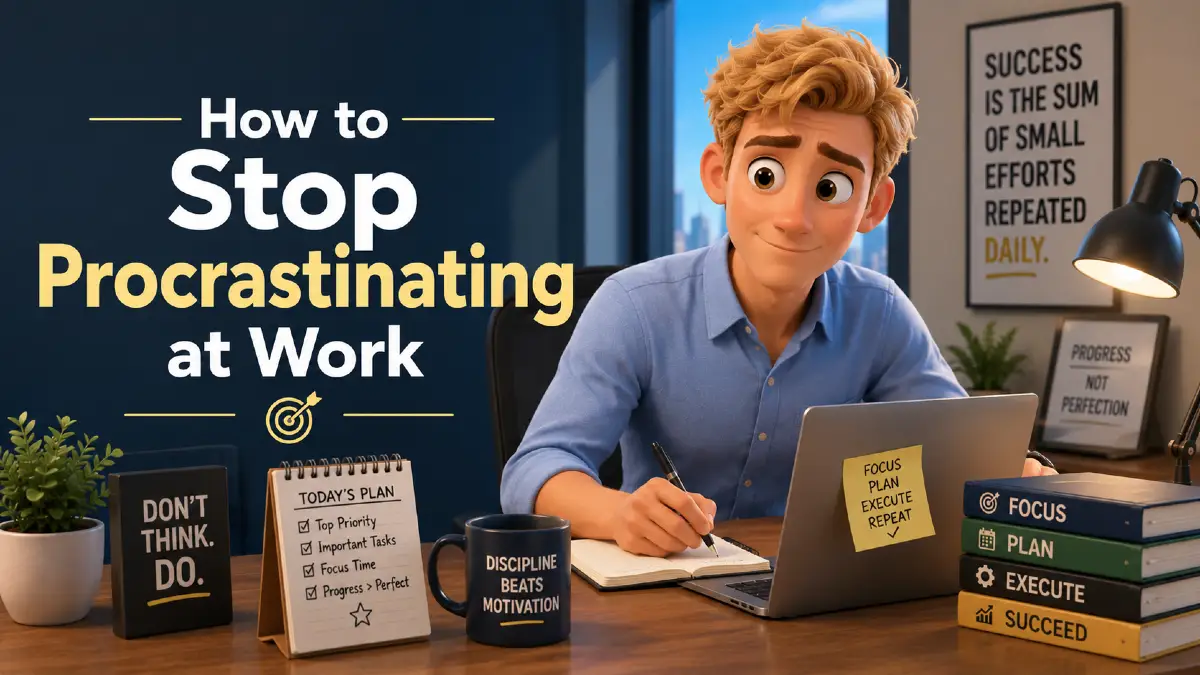
You don’t procrastinate at work because you’re lazy, badly organised, or weak-willed — you procrastinate because your unconscious mind has identified the task as emotionally unpleasant and is doing you a quick favour by getting you to do something else. Drawing on clinical psychologist Guy Winch’s book Mind Over Grind, this guide explains why the standard productivity advice (break it down, time-box it, eat the frog) misses the actual mechanism — and the two-part reframe Winch teaches his clients that does fix it. By the end you’ll know how to install the move in your own week and stop saddling Next-Week-Guy with the work Monday-You keeps avoiding.
Tony, a six-foot-four trader in clinical psychologist Guy Winch’s practice, had a make-or-break meeting the next day. A scheming colleague had set it up to publicly accuse him of bullying a junior trader. Tony had role-played the meeting in therapy. He had the points he needed to make. The one thing he had to do was prepare — really prepare — for an hour the night before.
He didn’t.
He opened his laptop, looked at his calendar, told himself preparing would “take time away from the real work he got paid to do,” went to bed early, and got to the office the next morning planning to review his notes. But once he got in he got caught up in trading and ordinary tasks. Before he knew it, the meeting had started. He walked in unprepared, lost his cool, and damaged his career.
In his 2026 book Mind Over Grind: How to Break Free When Work Hijacks Your Life, Winch is clear about what happened in that one quiet hour the night before: “Procrastination is not about avoiding obnoxious tasks; it is about avoiding the unsettling emotions those tasks evoke, and it usually happens with our unconscious at the helm.”
That sentence is doing a lot of work. Most professional men have been told for years that procrastination is a time-management problem, or a discipline problem, or a phone problem. It’s none of those. It’s an emotion problem your unconscious is “solving” the moment it sees the chance — and until you understand the actual mechanism, you’re going to keep losing battles you should be winning.
This article unpacks why you procrastinate at work, why the standard advice doesn’t fix it, and the two-part reframe Winch teaches his clients that does.
How to stop procrastinating at work — the short version
Before the deep dive:
- Stop calling it laziness or bad time management. It’s emotional avoidance. Your unconscious is giving you fast relief from a task that feels unpleasant.
- The “break it into small steps” advice fails most of the time because it doesn’t change the emotion driving the avoidance.
- Reframe 1 — Nuisance: Train yourself to call obnoxious tasks “nuisances” and dispatch them the way you’d swat a fly. Nuisances don’t get postponed; they get handled.
- Reframe 2 — Build a relationship with your future self. Most men treat Next-Week-Guy like a stranger and dump work on him without guilt. Stop doing that. Thank Yesterday-Guy when he comes through.
- Run both reframes for two weeks. They sound silly. They work because they speak to the unconscious in the only language it accepts.
Why most procrastination advice doesn’t work
Open any popular article on how to stop procrastinating at work and you’ll find the same playbook: break the big task into small steps, set deadlines for each piece, use a Pomodoro timer, eat the frog first thing in the morning, find an accountability partner, reward yourself for finishing.
None of this is wrong. Most of it doesn’t address what’s actually broken.
These tactics work on the assumption that the problem is task size, task ambiguity, or insufficient external pressure. Sometimes that’s true. But for most chronic professional procrastination, the real driver is something else: the task is emotionally unpleasant — anxiety-provoking, conflict-laced, identity-threatening, or just plain boring in a way that makes your unconscious want out — and no amount of small-stepping changes that emotional charge.
You can break preparing for an ambush meeting into ten beautifully Pomodoro’d 25-minute chunks. Your unconscious still doesn’t want to sit with the anxiety those chunks generate. So it offers you a steady supply of very reasonable-sounding justifications for doing something else instead, and you bite, every time.
Winch describes the mechanism precisely:
“Every time Tony had an opportunity to prepare for the meeting, his stress spiked, and his unconscious mind swooped in to offer relief by getting him to do something else instead. He justified the avoidance by reframing efforts to prepare for the meeting as doing what Scar wanted or taking his focus away from his work.”
That word — reframing — is the tell. Your unconscious is genuinely smart about generating excuses your conscious mind will accept. The justifications feel plausible. They feel like wise decisions. They feel like prioritisation. They are none of those things. They are emotional relief, dressed up in a suit and tie.
“The human brain might be the most brilliant machine in the universe,” Winch writes, “but it requires adult supervision.”
Why you procrastinate at work (the real mechanism)
Two facts about the unconscious mind that, once you understand them, make procrastination’s whole game obvious.
Fact 1: Your unconscious prefers fast emotional relief over long-term consequences. When a task is stressful, your unconscious doesn’t weigh the cost of putting it off — it can’t; that’s a conscious-mind function. It just grabs the closest distraction. Email. Slack. A meeting that didn’t need to happen. The cleaning of a desk that didn’t need cleaning. “Our unconscious mind,” Winch writes, “excels at using our intelligence ‘against us’ by manufacturing compelling excuses and justifications to get us to do the not-so-wise thing.”
Fact 2: The cost compounds invisibly. “The real problem with procrastination,” Winch writes, “is not the single delay but the accumulation of stress it creates. Putting off a stressful task during an already pressured workday might seem reasonable in the moment. But that task will then hover in the back of our mind throughout the day, the pressure to complete it mounting every hour.”
The thing you avoided at 11am doesn’t just disappear. It occupies real estate in your mental bandwidth all afternoon. It bothers you in the shower. It wakes you at 3am. It puts a low-grade tax on every other task you do. By the time you finally tackle it the next morning, you’ve paid in stress, sleep, focus and mood roughly five times what the task itself would have cost if you’d done it immediately.
In other words: you don’t save time by procrastinating. You spend much more time on the anticipation of the task than the task itself would have taken.
Once you’ve internalised that, you have a real motivation to fix it. Now to the actual fix.
Reframe 1 — Call it a nuisance
The first move sounds embarrassingly simple. It works precisely because it bypasses your conscious mind and hits the unconscious in the only register it accepts.
“What determines how stressful and disruptive a situation will be is how we frame that situation to ourselves,” Winch writes. “If we framed obnoxious tasks in less threatening ways, the automatic urge to avoid them would be weaker and easier to overcome.”
The catch: you can’t just tell yourself the task isn’t stressful. Your unconscious will reject the message. It already knows what kind of task it is. The trick is to acknowledge that it’s unpleasant while demoting it from a threat to a minor irritation.
“To get around this limitation,” Winch writes, “we need to frame stressful tasks in ways that preserve their unpleasant quality yet make us more motivated to tackle them — by thinking of them as nuisances.”
Think about what you do with actual nuisances. A fly buzzing around the kitchen. An itchy underwear tag. A pebble in your shoe. You don’t put any of these on your to-do list. You don’t schedule a productivity block for the fly. You handle it immediately, almost reflexively, because the cost of not handling it is higher than the effort to deal with it.
Winch’s instruction: “When you face an obnoxious task, train yourself to flag it as one of the unpleasant ones and say to yourself: What a nuisance. Let’s get it out of the way.”
That’s the whole technique. Say it in your head. Say it out loud if you can. You’re not pretending the task is pleasant. You’re stripping it of its threat status — moving it from something my unconscious must protect me from to something I dispatch on contact.
This works particularly well for the small, recurring, mildly unpleasant tasks that quietly soak hours of your week: the difficult email you’ve been putting off for three days, the call you’ve been “meaning to make all morning,” the report draft you keep meaning to start, the conversation with your manager you keep mentally rehearsing without ever scheduling. Each of these, by itself, is a small fight. Each of them, run through the nuisance reframe, takes about half the energy you’ve been spending circling it.
Reframe 2 — Have a relationship with your future self
The second move is the one most professional men have never been told about. It works on a counterintuitive piece of psychology: most of us treat our future selves as strangers.
Winch summarises the science:
“Studies found that we tend to think of our future selves as strangers, which is why we do things that are harmful to that future version of us (e.g., smoking) and fail to do things that would be helpful to us in the future (e.g., saving money).”
The clearest illustration is a study he cites: participants were told they’d have to drink a disgusting brew to get credit for an experiment, and they had to commit to how much they’d drink. Students who were told they’d drink it that day committed to two tablespoons. Students committing their future selves chose half a cup — roughly the same amount they were willing to commit a stranger to drink.
Your future self, in your unconscious mind, is a stranger. Which means when you put off a difficult task tonight, you are not really putting it off — you are handing it off to a stranger whose welfare you don’t really feel responsible for. Of course you do it. You’d hand it off to anyone.
The fix: build an actual relationship.
Winch does this, by his own admission, in a way that sounds ridiculous and is also remarkably effective:
“When I catch myself about to postpone an unpleasant task, I say to myself, That’s going to make next week more difficult for Next-Week-Guy, don’t saddle him with that, or Tomorrow-Guy will be very grateful if you did this for him now. I also make sure to thank Yesterday-Guy or Last-Week-Guy when the next day or week arrives, and the task I would have dreaded doing is already done.”
You can almost feel yourself rolling your eyes at this on first read. Stay with it. The mechanism is doing two things:
It personifies the future self. Once Next-Week-Guy has a name — your name, with a week-stamp on it — he stops being an abstraction. He’s a guy. He’s a guy who’s going to have a worse Tuesday because you skipped this thing tonight. You start feeling something for him. The avoidance gets more expensive emotionally.
It rewards the past self. This part is the secret weapon. Most productivity systems are loaded with self-criticism for what you didn’t do. Winch’s frame builds gratitude into the system. When Wednesday-You sits down to a clear desk because Monday-You actually wrote that report — Wednesday-You is supposed to thank Monday-You. Out loud. “Thank you, Monday-Guy. That was huge.” You feel ridiculous. You also feel good. Your unconscious files away the experience as being kind to my past self pays off — and the next time you’re tempted to dump on Next-Week-Guy, that file is on the table.
Winch has been running this on himself for years and says it has reduced his own procrastination dramatically. The science is the same science that drives long-term saving, exercise adherence, and most other “delayed gratification” wins: people who feel connected to their future self make better decisions for him.
How to install this in your own week
You can run this whole framework starting tomorrow morning.
- Pick your “Next-Week-Guy” name now. Some men prefer the day-tag (Monday-Guy, Friday-Guy). Some prefer week-tags. Pick what sounds right in your own head. It has to feel natural enough to say to yourself.
- Day 1: One nuisance. Identify one small task you’ve been circling and run the reframe out loud. “What a nuisance. Let’s get it out of the way.” Dispatch it within five minutes. That’s the whole exercise for day one.
- Day 2–3: Three nuisances per day. Whenever you catch yourself starting to circle a small task, label it as a nuisance and handle it. The labelling is the move; the dispatch follows.
- Day 4: First Next-Week-Guy save. When you catch yourself about to push something to “tomorrow,” say it: “Don’t saddle Next-Week-Guy with that.” Decide in that moment whether the task is genuinely better tomorrow or whether you’re just transferring it to a stranger.
- Day 5: First thank-you. When you sit down to a clear desk because of something Yesterday-You actually finished, say thank you. Out loud. Yes, even in the office. (Mouth it if you have to.)
- Week 2: Use the framework on a real, hard avoided task. The conversation, the email, the conflict, the difficult report. Run both reframes. “What a nuisance. Let me get it out of the way.” And: “Next-Week-Guy will be deeply grateful if I do this tonight.”
By the end of week two, the corrections will start to become automatic. The procrastination loop won’t disappear — it’ll fire — but you’ll catch it earlier. By month three, your average response time on small unpleasant tasks will have dropped from days to minutes, and the bigger ones will stop accumulating in the dark corners of your week.
The bigger picture
Procrastination is not your flaw. It’s a default behaviour of every human unconscious mind. “The human brain might be the most brilliant machine in the universe,” Winch writes, “but it requires adult supervision.” You, the conscious adult, are the supervisor.
The two reframes — nuisance and future-self — work because they translate good adult judgment into a language your unconscious actually responds to. They’re not about willpower, time-management, or discipline. They’re about giving your unconscious a richer emotional map so it stops protecting you from tasks that don’t actually need protecting against.
The men who run this framework consistently get back five to ten hours a week of mental real estate that was previously occupied by anticipation, dread, guilt, and 3am wake-ups about the email they didn’t send. That’s not a productivity gain. That’s a life-quality gain.
Be kind to Next-Week-Guy. He’s the same guy as you, and he has things he’d rather be doing on Tuesday than cleaning up after Monday-You.
Source: Guy Winch, Mind Over Grind: How to Break Free When Work Hijacks Your Life (Simon & Schuster, 2026). All quoted passages from Winch are drawn from the book.

Related posts:
 The Unconscious Mind and Creativity: Where Your Best Ideas Actually Come From
 How to Stop Thinking About Work at Night: A Psychologist’s 3-Step Protocol
 Mind Over Grind Book Summary: Guy Winch’s Field Manual for Men Whose Work Has Quietly Taken Over
 How to Stay Calm Under Pressure at Work: A Psychologist’s Real Method
 How to Stop the Sunday Scaries: A Psychologist’s Counter-Move That Actually Works