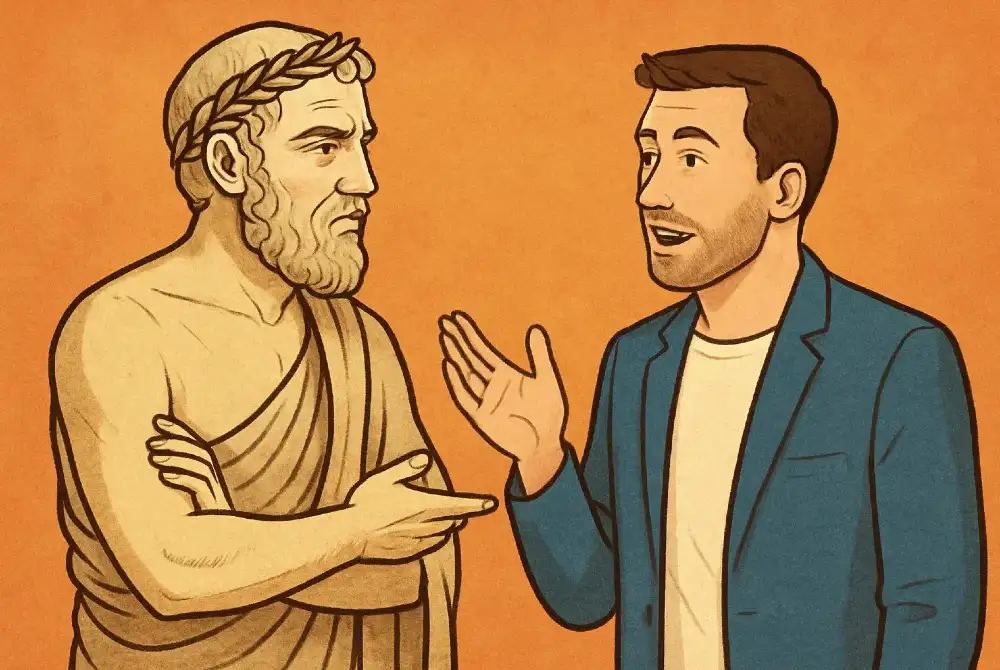
The same event can destroy one person while making another stronger. A business failure can end one entrepreneur’s career while launching another toward greater success. A rejection can crush one artist’s spirit while motivating another to create their masterpiece. What makes the difference? Not the event itself, but how it’s perceived.
In “The Obstacle is the Way,” Ryan Holiday explores how our perception—the way we see and interpret events—is often more important than the events themselves. Drawing from Stoic philosophy and countless historical examples, Holiday demonstrates that mastering perception is the first and most critical step in turning any obstacle into an advantage.
Understanding the Stoic View of Perception
The ancient Stoics recognized something revolutionary about human psychology: we’re not disturbed by things, but by our views of things. This insight, articulated by the philosopher Epictetus two thousand years ago, remains just as powerful today.
Consider what happens when you encounter an obstacle. Your mind doesn’t simply record the facts—it immediately layers judgment, interpretation, emotion, and meaning onto what happened. Someone cuts you off in traffic, and within milliseconds, your mind has constructed an entire narrative about their character, their disrespect, and what it means about the world.
But here’s the crucial insight: that narrative isn’t reality. It’s your perception of reality. And perception, unlike external events, is something you can control.
Marcus Aurelius, the Roman emperor who ruled during plague, war, and constant betrayal, understood this deeply. He wrote in his personal journal, “Choose not to be harmed—and you won’t feel harmed. Don’t feel harmed—and you haven’t been.” This isn’t denial or delusion. It’s recognizing that the story you tell yourself about what happened shapes your experience more than the event itself.
The Difference Between Facts and Interpretation
Holiday emphasizes a critical distinction in his book: separating objective reality from our emotional interpretation of that reality. This separation is the foundation of powerful perception.
When something goes wrong, most people immediately conflate fact with interpretation. They lose their job and immediately conclude, “I’m a failure.” A relationship ends and they decide, “I’m unlovable.” A project fails and they determine, “I’m not talented enough.”
None of these conclusions are facts—they’re interpretations. The facts are simply: a job ended, a relationship concluded, a project didn’t work. Everything else is a story, and stories can be rewritten.
Thomas Edison’s laboratory burned down when he was in his sixties, destroying millions of dollars worth of equipment and decades of work. The fact: the lab burned down. Edison’s interpretation? “Thank goodness all our mistakes were burned up. Now we can start fresh.” His perception transformed a potential career-ending disaster into an opportunity for innovation.
Practicing Objective Perception in Daily Life
Developing objective perception isn’t about becoming emotionless or disconnected from reality. It’s about seeing reality more clearly by stripping away the unhelpful layers of judgment and catastrophizing that we automatically add.
Holiday suggests a simple but powerful practice: when you encounter an obstacle, first describe it in the most objective, factual terms possible. Imagine you’re a scientist observing the situation from outside. What actually happened, devoid of emotional interpretation?
“I didn’t get the promotion” is a fact. “I’m not good enough and will never advance in my career” is interpretation. “She didn’t respond to my message” is a fact. “She hates me and I’m socially awkward” is interpretation. Learning to distinguish between these two is transformative.
The Stoics practiced this constantly. They called it “stripping things back to their bare truth.” When Marcus Aurelius looked at fancy robes, he reminded himself they were just sheep’s wool dyed with shellfish blood. When he viewed expensive wine, he saw fermented grape juice. This wasn’t cynicism—it was clarity.

Reframing: Changing the Frame Changes the Picture
Once you’ve separated fact from interpretation, you can begin the practice of deliberate reframing. This is where perception becomes a superpower. The same situation, viewed through a different frame, becomes a completely different experience.
Holiday shares the story of Rubin “Hurricane” Carter, a boxer wrongfully imprisoned for nineteen years for murders he didn’t commit. Carter could have framed his situation as an unendurable injustice (which it objectively was). Instead, he chose to view his cell as a monastery and his time as an opportunity for education and self-development.
He read voraciously, studied law, and ultimately helped engineer his own legal vindication. His perception didn’t change the facts of his imprisonment, but it changed everything about his experience and his outcome. The obstacle of wrongful incarceration became the path to wisdom, strength, and eventual freedom.
This isn’t about pretending bad things are good. It’s about finding the useful frame—the perspective that empowers action rather than paralysis, growth rather than decay, meaning rather than meaninglessness.
The Present Moment: Where Perception Lives
Holiday emphasizes that perception works best when focused on the present moment. The Stoics were adamant about this: stay focused on what is, not what was or what might be.
When we catastrophize about the future or ruminate about the past, we’re no longer dealing with reality—we’re dealing with fiction. Our perception becomes distorted by imagination, and that distortion creates suffering.
Consider how often your obstacles are made worse by time-traveling mentally. You’re not just dealing with the actual challenge in front of you; you’re also dealing with your fears about where this might lead and your regrets about what got you here. No wonder obstacles feel overwhelming—you’re fighting on three fronts instead of one.
The Stoic practice is to bring your perception back to this moment. What is actually happening right now? Not what might happen, not what happened before—what is true in this present moment? Usually, when we focus purely on the present, the obstacle shrinks to a manageable size.
Your Emotions Don’t Have to Control Your Perception
One of the most powerful lessons in “The Obstacle is the Way” is that emotions are natural, but they don’t have to dictate our perception. The Stoics didn’t advocate for emotionlessness—they advocated for not being controlled by emotions.
When something bad happens, you will feel emotions. Fear, anger, disappointment, grief—these are human responses. The question is: will you let those emotions shape your perception, or will you acknowledge them while maintaining clear sight of reality?
Holiday describes this as the difference between reacting and responding. Reacting is what happens when emotion controls perception: you lash out, make impulsive decisions, or spiral into catastrophizing. Responding is what happens when you feel the emotion but maintain clarity about reality: you take thoughtful action aligned with your goals and values.
The practice is simple but not easy: pause between stimulus and response. Feel what you feel, but before acting or deciding what something means, create space. Ask yourself: what is actually true here? What would a clear-headed person see in this situation? What opportunity might exist that emotion is blinding me to?
Learning From Historical Masters of Perception
Throughout history, the most successful individuals have been masters of perception. They’ve looked at the same obstacles everyone else faces and seen them differently.
When Theodore Roosevelt was a sickly, weak child, his father told him, “You have the mind, but you have not the body, and without the help of the body the mind cannot go as far as it should. You must make the body.” Rather than seeing his physical weakness as a permanent limitation, young Roosevelt perceived it as a problem to be solved. His perception drove action—years of rigorous physical training—that transformed his health and ultimately his life’s trajectory.
When Amelia Earhart faced the obstacle of being a woman in a male-dominated field, she didn’t perceive it as an insurmountable barrier. Instead, she saw how the novelty of a female pilot could generate publicity and opportunity. Her perception of the obstacle helped her leverage it for advancement.
Holiday fills his book with similar examples, each illustrating the same principle: perception is a choice, and that choice determines whether an obstacle stops you or propels you forward.
Developing Your Perception Muscles
Like any skill, perception improves with practice. Holiday suggests several practical exercises for developing this capability.
First, practice observing your thoughts. When something goes wrong, notice the immediate stories your mind creates. Don’t judge these thoughts—simply observe them. This creates distance between you and your automatic interpretations, giving you the space to choose different perceptions.
Second, deliberately practice alternative interpretations. For every obstacle, force yourself to generate at least three different ways of seeing it. One might be catastrophic, one might be neutral, and one might be opportunistic. This exercise trains your mind to recognize that multiple perceptions are always available.
Third, study examples of powerful perception in action. Read biographies of people who overcame significant obstacles. Notice how they thought about their challenges. What perceptions enabled their perseverance and success?
Finally, journal about your own experiences with perception. Document times when changing your view changed your experience. Build evidence for yourself that perception is powerful and within your control.
The Limitations and Realities of Perception Work
Holiday is careful not to oversell perception as a magic solution. Changing how you see something doesn’t always change the thing itself. Sometimes obstacles are genuinely difficult, painful, or tragic. The Stoic approach isn’t denial—it’s finding the most useful way to engage with reality as it is.
There’s a crucial difference between healthy reframing and toxic positivity. Toxic positivity denies legitimate pain and difficulty. Healthy reframing acknowledges the challenge while refusing to add unnecessary suffering through catastrophizing or helplessness.
When Marcus Aurelius faced the betrayal of his most trusted general, he didn’t pretend it wasn’t painful or dangerous. He acknowledged the reality fully. But he chose to see it as an opportunity to practice forgiveness and demonstrate leadership, rather than simply as a personal attack that justified revenge.
That’s the goal: not to feel nothing, but to see clearly and choose responses that serve you rather than harm you. Your perception can’t prevent obstacles, but it can prevent obstacles from defeating you.
Perception as Daily Practice
The most important insight Holiday shares is that powerful perception isn’t a one-time shift—it’s a daily practice. The Stoics knew this, which is why Marcus Aurelius wrote his journal entries constantly, reminding himself of these principles every day.
You won’t master perception by reading about it once. You’ll master it by practicing it repeatedly, in small situations and large ones. Every traffic jam, every rude comment, every disappointment is an opportunity to practice seeing clearly and choosing your interpretation deliberately.
Over time, this practice rewires your default responses. What once would have thrown you into panic or despair becomes simply another situation to navigate. What once seemed like devastating obstacles become interesting problems to solve.
Conclusion: The First and Most Powerful Discipline
Ryan Holiday structures “The Obstacle is the Way” around three disciplines: perception, action, and will. He places perception first for a reason—it’s the foundation everything else builds on. How you see your obstacles determines whether you take effective action and whether you have the will to persevere.
Master your perception, and you’ve taken the first and most important step toward turning any obstacle into advantage. You can’t control what happens to you, but you maintain complete control over what it means and how you respond.
The obstacle in front of you right now—whatever it may be—is waiting for your perception to shape it. Will you see it as an insurmountable barrier or an opportunity to grow? Will you let your immediate emotional reaction define reality, or will you practice the Stoic discipline of clear sight?
Your perception is your power. Use it wisely, and the obstacle becomes the way.
Everything You Need to Know About Ryan Holiday’s “The Obstacle Is the Way” (Complete Book Guide)
Related posts:
 Everything You Need to Know About Ryan Holiday’s “The Obstacle Is the Way” (Complete Book Guide)
 12 Daily Stoic Exercises to Build Unshakeable Resilience and Mental Strength
 From Ancient Philosophy to Modern Success: How Stoicism Solves Today’s Problems
 How Stoicism Turns Obstacles Into Opportunity: Lessons From The Obstacle Is the Way
 The Real Stories Behind Stoic Philosophy: People Who Transformed Devastating Setbacks Into Victory