When filmmaker and photographer Peter McKinnon calls something “the greatest thing I’ve bought in 2025,” it demands attention. The item in question isn’t a camera, lens, or cutting-edge tech gadget—it’s the Peg & Awl Sendak Artist Roll, a waxed canvas pencil case that has become an indispensable part of his everyday carry.
In a world drowning in tactical organizers and sterile nylon pouches, the Sendak stands apart. This isn’t just another way to carry your pens. It’s a philosophy about how creative tools should be transported, accessed, and experienced. McKinnon’s passion for this seemingly simple roll reveals something deeper about the relationship between craftspeople and the objects they choose to surround themselves with.
What Makes the Sendak Different from Every Other Pen Roll
The Sendak Artist Roll solves a problem most people don’t realize they have until they find the solution. For years, McKinnon transferred his creative essentials from bag to bag, never quite finding the perfect system. Pens would scatter. Notebooks would bend. The small treasures that fuel creative work—a favorite fountain pen, a vintage pencil, a journal with the right paper—deserved better than being tossed into backpack pockets.
The Sendak changed everything. McKinnon describes it as checking “every box for me across multiple interests.” This isn’t hyperbole from an enthusiastic reviewer. This is a working creative professional who has tried countless organizational systems and finally found one that works.
At its core, the Sendak is a roll-up organizer made from waxed canvas and vegetable-tanned leather. It features sixteen pencil-sized pockets, four inside flap pockets, two large exterior pockets, and one zippered pouch. But these specs don’t capture what makes it special. The genius lies in how these elements work together to create a system that’s both highly functional and deeply satisfying to use.
The waxed canvas construction is the first thing you notice. Unlike the smooth, synthetic feel of modern organizers, waxed canvas has texture and weight. It feels substantial in your hands, like something built to last decades rather than seasons. The fabric is water-repellent without being plastic, durable without being rigid. McKinnon notes that the patina developing on the back of his Sendak creates “a vibe”—the kind of weathered character that only comes from genuine use.
Why Waxed Canvas Matters More Than You Think
The choice of waxed canvas isn’t just aesthetic. This material has a five-century history dating back to sailors who needed sails that could withstand brutal maritime conditions. They discovered that treating canvas with oil made it water-resistant and more durable. Modern waxed canvas builds on this tradition, using paraffin or beeswax to create a fabric that resists water, ages beautifully, and develops unique character over time.
McKinnon points out something crucial: “It is so hard to find products sometimes that both meet an aesthetic and are equally useful. Those two things sometimes don’t come hand in hand.” The Sendak achieves this rare balance. It looks like something you’d find in a craftsman’s workshop from another era, yet it functions flawlessly in contemporary creative work.
The patina that develops on waxed canvas is one of its defining features. Unlike synthetic materials that deteriorate with age, waxed canvas improves. Each fold, each scuff, each mark from daily use adds to the story the material tells. The creases from being rolled and unrolled hundreds of times create patterns unique to how you use it. Areas that receive more handling darken slightly as the wax redistributes. The result is a one-of-a-kind piece that reflects your creative journey.
This aging process matters because it creates an emotional connection to the object. You’re not replacing this organizer every year or two. You’re building a relationship with it. McKinnon says he would be “distraught” if he lost his Sendak—strong language for what some might dismiss as just a pencil case.
The Intelligent Design That Makes Daily Use Effortless
The Sendak’s design reveals itself through use. At first glance, it might seem like just another tool roll. But the thoughtful details become apparent once you start filling it with your creative essentials.
The protective flap is one example of this intelligence. When you roll up the Sendak, this flap covers all the pens and pencils, creating a barrier between items. McKinnon emphasizes why this matters: “Nothing should touch anything else that’s in here. I do want to protect and I do want to take care of and I don’t want them to get ruined.” This simple design choice prevents the annoying sound and potential damage of pens rattling against each other during transport.
The variety of pocket sizes accommodates different needs. The sixteen pen-sized slots are perfect for fountain pens, mechanical pencils, and markers. But the interior includes wider pockets and slimmer ones, allowing you to organize by tool type or usage frequency. The two large exterior pockets fit notebooks perfectly—McKinnon slides his Field Notes journal into one with a satisfaction that’s almost meditative. The fit is so precise it seems like Peg & Awl designed the Sendak specifically for Field Notes dimensions.
The zippered pouch becomes a treasure chest for the small items that make creative work personal. McKinnon uses his to carry a vintage aspirin tin filled with cards he’s typed quotes onto, fountain pen cleaning cloths, a brass tape measure, lead for his mechanical pencil, and a challenge coin from his company Pete’s Pirate Life. These aren’t necessities in the traditional sense, but they’re essential to how he experiences his creative practice.
The Adjustable Strap: A Deceptively Important Feature
The leather strap that secures the Sendak deserves special attention. McKinnon calls the Sendak a “shape shifter” because this strap adjusts to accommodate varying amounts of contents. You can pack it with just a few essentials for a streamlined profile, or stuff it full of notebooks, pens, and accessories for a full creative kit.
This adjustability matters more than it might seem. Many organizers force you to choose between too much space (creating rattling and disorganization) or too little (leaving items at home). The Sendak adapts to your needs on any given day. Heading to a coffee shop for focused writing? Pack light. Going on a trip where you might want multiple creative options? Fill it to capacity.
The leather strap itself will develop its own patina over time, darkening and softening with use. The antique steel buckle adds to the vintage aesthetic while providing secure closure. Even when fully packed, the Sendak stays compressed and organized.
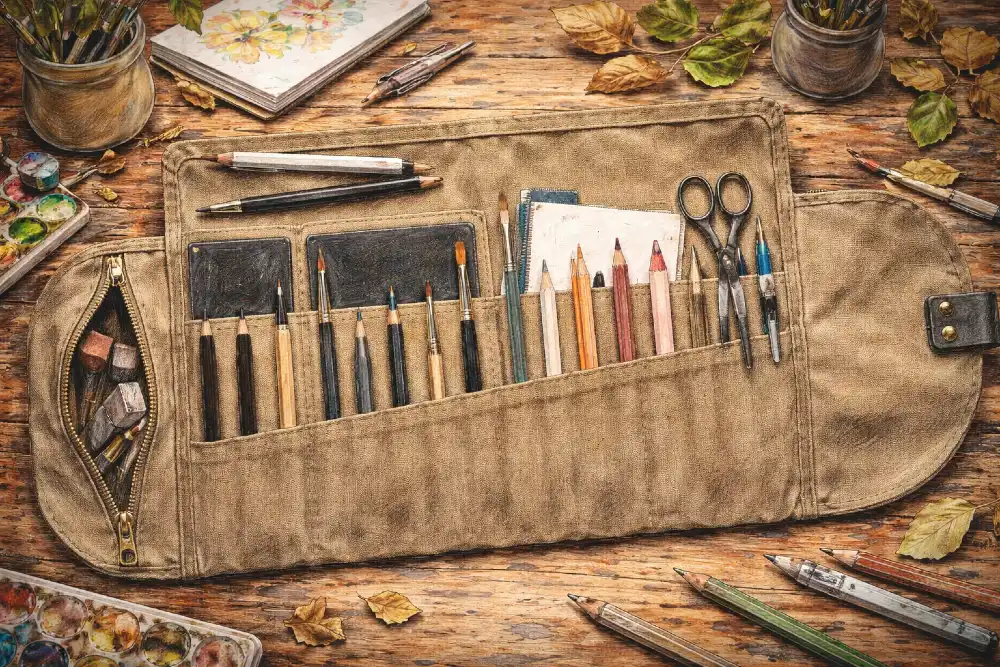
How a Filmmaker Uses the Sendak: Inside Peter McKinnon’s Setup
McKinnon’s Sendak loadout reveals how this organizer serves a working creative professional. His setup includes:
Fountain Pens: Three carefully chosen pens, including a Twsbi Eco extra fine point that he praises for both its sound (“it sounds as if it’s carving and cutting into the paper”) and its ability to reveal handwriting mistakes that help him improve. He takes his handwriting seriously enough to practice with workbooks, and the Sendak protects these valued tools.
Everyday Pens: A collection of Uniball Signo DX pens in black and blue, plus a Pentel Slicci 0.25mm for ultra-fine work. These workhorse pens handle quick notes and daily writing.
Micron Pens: Three ultra-fine felt-tip markers (sizes 005, 01, and 02) for detailed drawing work on small cards. McKinnon pairs these with his father’s magnifying glasses to create miniature artwork he leaves for people to find.
Brush Pens: Three Pentel brush pens in red, green, and yellow for color-coding his to-do lists. Completed tasks get green marks, incomplete ones get red, and items in progress get yellow.
Specialty Items: A gold Sharpie for signing business cards, a straightedge for dividing pages, a Japanese knife gifted by a friend, and a date stamp for his daily task lists.
Journals: A Leuchtturm1917 graph paper journal fits perfectly in one of the large back pockets, while a Field Notes notebook slots into the other side pocket. The fit is so precise it brings McKinnon visible satisfaction every time he demonstrates it.
This isn’t a random collection. Each item has been chosen for specific purposes and together they create a complete creative system. The Sendak keeps everything organized, protected, and instantly accessible.
The Ritual of Opening and Closing: Why Physical Interaction Matters
There’s something meditative about how McKinnon describes using the Sendak. He doesn’t just grab pens—he unrolls the entire package with visible pleasure. The ritual of loosening the leather strap, unfolding the canvas, and revealing the organized contents becomes part of the creative process.
This physical interaction matters in an increasingly digital world. The Sendak requires you to be present. You can’t mindlessly grab it while scrolling your phone. You have to set it down, unroll it, and consciously select your tools. This micro-ritual creates a transition into creative work.
When you’re done, rolling it back up provides closure. The act of organizing everything back into its designated spots, folding the protective flap, and securing the strap signals the end of a creative session. These small rituals add structure and intentionality to creative practice.
McKinnon notes that people always ask him about the Sendak when he pulls it out in public. “What is that thing?” is the universal response, followed immediately by “Link me.” This isn’t surprising. In a cafe full of people using laptops and phones, the sight of someone unrolling a waxed canvas organizer filled with carefully chosen pens creates a stark contrast. It signals that creative work can be both high-quality and deeply personal.
Comparing the Sendak to Alternative Organizers
The market offers countless ways to organize creative tools, from simple zippered pouches to complex tactical organizers. How does the Sendak compare?
Versus Tactical Nylon Organizers: Products like the Maxpedition Fatty or Condor Pocket Pouch offer similar functionality at lower price points. They’re durable, well-designed, and practical. But they lack the aesthetic appeal and aging characteristics of the Sendak. Tactical organizers look the same after five years of use as they did on day one. The Sendak tells a story through its patina.
Versus Leather Rolls: High-end leather tool rolls offer similar aging properties and can be equally beautiful. However, they typically cost 20-50% more than the Sendak while being heavier and less water-resistant. Leather also requires more maintenance to prevent drying and cracking.
Versus Simple Pencil Cases: Standard zippered pencil cases are cheaper and lighter, but they offer minimal organization. Everything dumps into one space, requiring you to dig through contents to find what you need. They also lack the durability and water resistance of the Sendak.
Versus Tech Organizers: Products like the Bellroy Tech Kit or Aer Cable Kit excel at organizing electronic accessories but aren’t designed for pens, pencils, and notebooks. They solve different problems for different users.
The Sendak occupies a unique position. It’s more expensive than budget options but less costly than premium leather alternatives. It offers superior organization to simple cases while maintaining a classic aesthetic that tactical gear can’t match. For creative professionals who value both function and form, it hits an ideal balance.
The Investment Question: Is the Sendak Worth $200?
McKinnon addresses the price directly, noting the Sendak costs around $200-250. This isn’t impulse-purchase territory for most people. Is it worth it?
The answer depends on how you value your creative tools and practice. If you view pens as disposable commodities you grab from office supply stores, the Sendak is overkill. But if you’ve invested in quality fountain pens, carefully selected notebooks, and tools that matter to your creative work, the Sendak makes sense.
Consider the longevity. Waxed canvas products from quality makers like Peg & Awl and Filson regularly last decades with basic care. Divide $200 by twenty years of daily use and you’re looking at ten dollars per year. Compare this to replacing a cheap organizer every year or two and the math changes.
But the real value isn’t purely economic. It’s about the experience of using well-made things. McKinnon says the Sendak is “as equally handy and necessary as my camera.” For a professional filmmaker, that’s high praise. It’s become part of his essential kit—something he considers irreplaceable.
The investment also includes intangibles: the satisfaction of opening a beautifully organized roll, the pride in carrying something handmade rather than mass-produced, the connection to craft tradition through waxed canvas and leather, and the way it elevates everyday creative work into something more intentional.
Peg & Awl: The Company Behind the Craft
Understanding Peg & Awl helps explain why the Sendak is special. This isn’t a corporation churning out thousands of units. Peg & Awl is a small, family-run operation based in Pennsylvania that focuses on handmade goods using traditional materials.
They source vintage fabrics, old military gun slings, quilt blocks from the 1800s, and other unique materials to create one-of-a-kind pieces. Even their mass-produced items like the Sendak maintain a handcrafted quality that sets them apart from factory goods.
The company’s philosophy aligns with a growing movement toward intentional consumption. Rather than buying cheap, disposable products, they advocate for investing in well-made items that last and improve with age. This approach is sustainable, both environmentally and psychologically.
Peg & Awl also offers customization options, including laser engraving on the leather strap. This allows you to personalize your Sendak with initials or a name, further cementing its status as a treasured possession rather than just another organizer.
The Mini Sendak: A More Compact Alternative
For those who want the Sendak experience with a smaller footprint, Peg & Awl offers the Mini Sendak. This compact version maintains the same quality materials and construction while reducing size and weight.
The Mini Sendak features eight pen pockets instead of sixteen, two inside flap pockets, and one zippered pouch. It’s perfect for minimalists or as a travel companion when you don’t need your full creative arsenal. The smaller size also makes it easier to slip into bags that might not accommodate the full-size version.
Reviews suggest the Mini Sendak excels as a everyday carry option for those who want quality organization without bulk. It fits in messenger bags, backpacks, and even larger purse-style bags while keeping essentials accessible and protected.
Care and Maintenance: Making Your Sendak Last Decades
One of the Sendak’s strengths is how little maintenance it requires. The waxed canvas naturally repels water and dirt, meaning you won’t need to clean it frequently. Scuffs and marks add character rather than detracting from appearance.
For basic care:
Cleaning: Spot clean with a damp cloth when needed. Avoid harsh detergents or machine washing, which can damage the wax coating. The water-repellent properties mean most dirt and dust can be brushed or wiped away easily.
Re-waxing: Over time, the wax coating will thin in high-use areas. McKinnon mentions he could rewax his Sendak to strengthen the water-repellent properties or enhance the patina, but notes it’s not necessary for his use case since it’s never exposed to rain.
If you do want to rewax, canvas wax products from companies like Otter Wax or Fjallraven are designed for this purpose. Apply the wax, work it into the fabric with your hands or a hairdryer on low heat, and let it cure for twenty-four hours.
Storage: Keep your Sendak in a cool, dry place when not in use. The material breathes naturally, so avoid plastic storage containers that might trap moisture.
Leather Care: The vegetable-tanned leather strap will darken and soften over time. If it becomes dry, a small amount of leather conditioner will keep it supple. Most users find this unnecessary, as natural oils from handling keep the leather in good condition.
The beauty of waxed canvas is that it actually looks better with use. Unlike products that require constant maintenance to prevent deterioration, the Sendak improves through the normal wear and tear of creative work.
Beyond Organization: The Sendak as Creative Philosophy
McKinnon’s enthusiasm for the Sendak reveals something deeper than appreciation for a well-designed product. It represents a philosophy about creative work and the tools we use.
He says: “If you enjoy the instruments that you play, the gear that you use, if you just look at them and admire them for how they’re made or what they stand for or who gave them to you, it makes the task that they enable you to do just so much better, so much more joyful.”
This is the heart of why the Sendak matters. It’s not just about organization or weather resistance or durability, though it excels at all those things. It’s about the experience of using tools that bring joy. It’s about the daily ritual of unrolling canvas and selecting the right pen. It’s about the tangible connection to craft tradition through materials that have served artisans for centuries.
The Sendak makes creative work more intentional. When your tools are scattered across desk drawers or buried in backpack pockets, creativity becomes haphazard. You make do with whatever’s handy. But when everything has its place in a beautifully organized roll that you can grab and go, creative work becomes possible anywhere.
McKinnon describes the Sendak as essential to his everyday carry, right alongside his camera. For a visual creator, that’s profound. The camera captures the images, but the Sendak holds the tools for planning, organizing, journaling, and making the small creative acts that support larger projects.
Who Should Buy the Sendak?
The Sendak isn’t for everyone, and that’s okay. It’s specifically designed for people who:
Value quality tools: If you’ve invested in fountain pens, quality notebooks, or carefully selected creative instruments, the Sendak provides organization worthy of those tools.
Work in multiple locations: Coffee shops, studios, offices, outdoors—the Sendak adapts to different environments while keeping everything organized and protected.
Appreciate craft and tradition: Those who connect with handmade goods, natural materials, and products that age beautifully will love the Sendak’s aesthetic and construction.
Practice daily creative work: Writers, artists, designers, filmmakers, and anyone who uses analog tools regularly will benefit from the Sendak’s organization and accessibility.
Want something that lasts: People tired of replacing cheap organizers every year or two will appreciate a product designed to last decades.
The Sendak is less suited for those who primarily work digitally, rarely use pens or pencils, prefer minimal bulk in their everyday carry, or aren’t willing to invest in a premium organizer.
Alternative Uses Beyond Art and Writing
While designed for artists, the Sendak’s versatility supports various applications:
Photography: Store lens cleaning supplies, memory cards, batteries, and small tools in an organized, dust-free environment.
Knitting and Needlework: Keep needles, scissors, measuring tapes, and other small tools accessible and organized.
Calligraphy: Perfect for protecting nibs, inks, and specialty pens while providing space for practice paper.
Urban Sketching: Carry pencils, pens, and a small sketchbook for on-location drawing sessions.
Everyday Organization: Use it for charging cables, earbuds, adapters, and other daily tech accessories.
Travel: Organize grooming supplies, medications, or other small items that need protection and organization.
The core strength—multiple pocket sizes with protective construction—makes the Sendak adaptable to whatever you need to carry.
The Experience of Receiving and Using a Sendak
McKinnon’s description of using the Sendak daily reveals the satisfaction that comes from well-designed products. Every time he opens it, the organization and quality are immediately apparent. Every time someone sees it, they ask about it. Every time he rolls it up, there’s a sense of completion.
These small moments of satisfaction accumulate over time. Days become weeks, weeks become months, and the Sendak becomes inseparable from creative practice. It’s there for morning journaling sessions. It travels to meetings. It sits on the desk during filming prep. It goes home every night and returns every morning.
The patina developing on the canvas tells this story. Each crease marks a rolling and unrolling. Each scuff represents a trip in a bag or car. The darkening in certain areas shows where hands grip it most frequently. These marks aren’t damage—they’re a record of creative work done.
This is what separates the Sendak from disposable organizers. It doesn’t just hold your tools. It becomes part of your creative identity. When you see it, you’re reminded of the projects completed, ideas captured, and moments of inspiration documented with the tools it protects.
Final Thoughts: Why the Sendak Matters
The Peg & Awl Sendak Artist Roll succeeds because it solves a real problem beautifully. Creative professionals need to carry tools across multiple contexts while keeping them organized, protected, and accessible. Most solutions compromise on organization, durability, aesthetics, or all three. The Sendak refuses to compromise.
Waxed canvas and vegetable-tanned leather create a product that improves with age rather than deteriorating. Thoughtful pocket design accommodates various tools while keeping them separated and protected. Adjustable closure adapts to different loads while maintaining security. Handmade construction ensures quality that mass production can’t match.
But the real success is harder to quantify. It’s the satisfaction of using well-made things. It’s the connection to craft tradition. It’s the daily ritual that adds intentionality to creative work. It’s the conversation starter that connects you with other people who value quality and craftsmanship.
Peter McKinnon’s description of the Sendak as “the greatest thing I’ve bought in 2025” reflects genuine enthusiasm from someone who has access to countless products. His choosing to make a video about a pencil case—and doing so with such obvious joy—reveals how meaningful the right tool can be.
For creative professionals tired of makeshift organization, the Sendak offers a better way. It won’t make you a better artist or writer, but it will make the process more enjoyable, more organized, and more intentional. And sometimes, that’s exactly what creative work needs.
Related posts:
 Ridge Wallet Review (2026): Is the Minimalist Metal Wallet Actually Worth It?
 The Canvas Strategy Explained (Ego Is The Enemy by Ryan Holiday)
 The Creative Process Explained: From Ideas to Finished Work
 Our Place Titanium Pro Cookware Set: Andrew Huberman’s Recommended PFAS-Free, NoCo® Technology Cookware Revolution
 Momentous Supplements Review 2026: The Science-Backed Brand Trusted by NFL Teams and Andrew Huberman