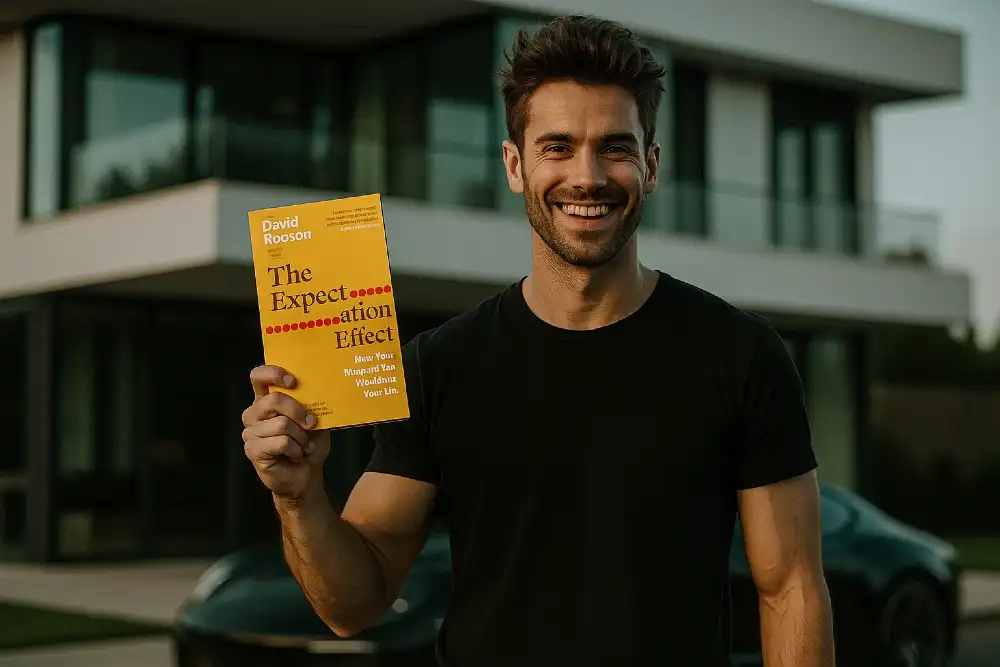
Complete summary of The Expectation Effect by David Robson: 33 research-backed takeaways on how your beliefs literally change your biology, health, and performance.
If you’ve heard about “The Expectation Effect” by David Robson but want to understand the key insights before committing to the full book—or if you’ve read it and want a comprehensive reference guide—this is for you.
After analyzing hundreds of studies spanning decades of research, Robson reveals a fundamental truth: your expectations about what you’re experiencing directly shape your body’s physiological responses. Not metaphorically. Through measurable biological mechanisms.
Here are 33 essential takeaways that will change how you think about your mind, body, and potential.
FOOD & METABOLISM
1. Your hunger depends more on what you believe you ate than what you actually ate
The Research: Alia Crum’s Yale study gave participants identical 380-calorie milkshakes. Half received “indulgent shake” labels claiming 620 calories. Half received “sensible shake” labels claiming 140 calories. The “indulgent” label triggered a steep drop in ghrelin (hunger hormone); the “sensible” label barely changed ghrelin levels at all—despite identical caloric content.
Key Quote: “For the purposes of our satiety, we consumed as many calories as we thought we did.”
2. “Healthy” food labels actually make you hungrier
The Research: Participants who ate a chocolate bar labeled “healthy” ended up hungrier than those who ate nothing at all. Deprivation language (“fat-free,” “low-carb,” “lite”) creates psychological and physiological deprivation states.
Key Insight: Stop seeing “healthy” and “pleasurable” as opposites. Describe nutritious food by what it IS (“thick, creamy Greek yogurt with fresh berries”), not what it ISN’T.
3. The “diet mindset” is a self-fulfilling prophecy
The Research: When you believe you’re eating “diet food,” your body responds with: higher ghrelin levels, faster gut emptying, more intense cravings, and reduced metabolic rate—regardless of actual calories consumed.
Key Quote: “A ‘healthy’ chocolate bar made people hungrier than eating nothing at all.”
EXERCISE & PHYSICAL ACTIVITY
4. Believing everyday activities count as exercise changes your body
The Research: Hotel maids who learned their daily work qualified as vigorous exercise lost weight and lowered blood pressure from elevated to normal in 4 weeks—without changing a single habit. Control groups doing identical work without the new perspective showed no changes.
Key Quote: “For some of the most important health outcomes, our bodies appear to conform to our expectations.”
5. Your perception of fitness predicts mortality more than actual fitness
The Research: Study of 60,000+ people over 21 years found “perceived physical activity” predicted mortality risk even after controlling for actual exercise measured by accelerometers. People with pessimistic views of their fitness were up to 71% more likely to die—regardless of actual activity levels.
Key Insight: Non-complaining bad sleepers (who don’t worry about insufficient sleep) are healthier than complaining good sleepers (who sleep fine but worry about it).
6. Everyday movement IS exercise when you recognize it as such
The Research: Vacuuming for 15 minutes burns 50 calories (moderate exercise). Moving furniture: 5.8 METs (moderate-to-vigorous). Playing with children: 5.8 METs. Dancing: 7.8 METs (vigorous). One-third of English public transport users already meet governmental guidelines just from commuting.
Key Quote: “The non-complaining bad sleepers are remarkably free of ill effects.”
STRESS & ANXIETY
7. Viewing stress as enhancing makes it enhancing
The Research: Navy SEALs with positive attitudes toward job stress showed greater persistence and enhanced performance in special warfare training. German doctors/teachers who saw anxiety as “energy for problem-solving” were much less likely to suffer emotional exhaustion over the following year.
Key Quote: “We can tell it what to do—and we do that through these appraisal processes.”
8. Stress beliefs predict mortality independent of actual stress levels
The Research: Study of ~30,000 people over 8 years: High stress + belief stress is harmful = 43% increased death risk. High stress + belief stress is NOT harmful = LOWEST mortality risk in entire study (lower than people with little stress). If causal, would rank as 15th leading cause of death in US.
Key Insight: “Worry about poor sleep is a stronger pathogen than poor sleep.”
9. Your cardiovascular system responds differently based on stress appraisal
The Research: “Threat” appraisal (stress is debilitating) = racing heart + constricted blood vessels (cardiovascular disease risk). “Challenge” appraisal (stress is enhancing) = racing heart + dilated blood vessels (similar to exercise, energizing). Different hormone profiles: enhancing mindset produces muted cortisol, increased beneficial DHEAS and testosterone.
Key Quote: “The more you fear not falling asleep, the more the mind begins to race just before bed, and the harder it is to actually drop off.”
SLEEP QUALITY
10. Worrying about sleep creates more problems than actual sleep loss
The Research: 10% of people are “complaining good sleepers” (believe they’re sleep-deprived but objectively aren’t)—they suffer fatigue, poor concentration, depression, anxiety. 16% are “non-complaining bad sleepers” (get <7 hours but don’t worry)—remarkably free of ill effects. Blood pressure effects of insomnia only occur in “complaining bad sleepers.”
Key Quote from researcher Kenneth Lichstein: “Worry about poor sleep is a stronger pathogen than poor sleep.”
11. Sham sleep feedback affects next-day performance as much as actual sleep
The Research: Scientists gave participants false feedback about sleep quality. Those who believed their sleep was poor struggled with mental tasks the next day. Those who believed their sleep was excellent performed sharply—regardless of actual sleep quality.
Key Insight: “For the purposes of your next-day performance, you slept as well as you think you did.”
12. Dysfunctional sleep beliefs are more damaging than insomnia itself
The Research: Beliefs like “I cannot function without a good night’s sleep,” “Insomnia is destroying my life,” and “One bad night will disturb my whole week” create self-fulfilling prophecies. People taught to challenge these beliefs enjoy better sleep quality, relieved fatigue, and fewer depressive symptoms.
Key Quote: “The placebo effect can account for about 50% of the success of sleeping pills.”
AGING & LONGEVITY
13. Positive aging attitudes add 7.5 years to your life
The Research: Becca Levy’s Baltimore Longitudinal Study: People with positive self-perceptions of aging lived 7.5 years longer than those with negative views—more than the effect of lowering cholesterol (4 years). Attitudes measured at age 36 predicted cardiovascular disease risk 38 years later, controlling for obesity, smoking, and family history.
Key Quote: “High blood cholesterol levels are thought to reduce the average life expectancy by up to four years—much less than the seven-and-a-half-year reduction caused by taking a dim view of our future health.”
14. Your aging beliefs physically alter your brain
The Research: People with negative aging views showed markedly increased beta-amyloid plaques and tau tangles (Alzheimer’s hallmarks) plus pronounced hippocampus damage. For APOE ε4 carriers (high Alzheimer’s risk gene), positive expectations halved dementia risk—essentially eliminating the genetic risk factor.
Key Insight: “People’s expectations became inscribed all over their brain.”
15. Cellular aging responds to aging expectations
The Research: People with negative aging expectations have shorter telomeres (protective chromosome caps). Cortisol rises ~40% from age 50-80 with negative attitudes; decreases 10% with positive attitudes. Heightened inflammation from negative beliefs contributes to increased death risk over subsequent years.
Key Quote: “The length of our telomeres can vary between people of the same chronological age, depending on lifestyle factors, including inflammation and stress.”
16. When you believe “old” begins determines when decline begins
The Research: Whitehall study: People who believed old age began at 60 or younger were ~40% more likely to develop coronary heart disease than those who believed middle age finished at 70+. Lower subjective age (how old you feel inside) predicts better physical and mental health across thousands of participants.
Key Quote: “You are, to a surprising degree, as young as you feel.”
PAIN & MEDICAL TREATMENT
17. Brand-name placebos match real painkillers’ effectiveness
The Research: Placebo Nurofen (from slick branded package) was so powerful it matched effects of actual painkillers. Generic-labeled placebos were significantly less effective—despite being identical sugar pills. Price matters too: “expensive” label doubled placebo benefits vs. “cheap” label.
Key Insight: “The prediction machine relies on many different cues to determine its expectations.”
18. Changing a pill’s appearance creates massive nocebo effects
The Research: New Zealand Eltroxin case: GlaxoSmithKline changed thyroid medication from yellow to white (identical active ingredient). Result: 2,000-fold increase in adverse event reports (14 reports in 30 years → 1,400 in 18 months). Media amplification strengthened nocebo effects.
Key Quote: “The drug hadn’t changed. The expectations had.”
19. Open-label placebos work without deception
The Research: Cláudia Carvalho’s Portuguese study: Chronic back pain patients received bottles clearly labeled “placebo pills, take twice a day.” Explicitly told pills contained no active ingredient. Still experienced significant pain relief that persisted over 5-year follow-up.
Key Insight: You don’t need to believe the pill has chemical properties—just understand that your brain can trigger healing responses when it expects treatment.
20. Surgery benefits often come from expectations, not the procedure
The Research: Heart stent vs. sham surgery study (The Lancet 2017): Both groups showed equal improvement in physical activity. Benefits of actual stent over sham surgery too small to be statistically significant. Placebo adherers (who faithfully took dummy pills) were half as likely to die vs. non-adherers.
Key Quote: “Much of the benefit appeared to come from patients’ expectations of improvement rather than the physical change to the heart’s plumbing.”
INTELLIGENCE & LEARNING
21. Teacher expectations cause IQ gains up to 69 points
The Research: Rosenthal & Jacobson’s Pygmalion study: Random students labeled “bloomers” gained 15.4 IQ points (grade 1) and 9.5 points (grade 2) more than classmates. Violet: +37 points. Mario: +69 points—from nothing but enhanced teacher expectations subtly communicated through daily interactions.
Key Quote: “Teachers seem to have subtly communicated their beliefs through daily interactions, which, in turn, led the children themselves to take a more positive view of their own abilities.”
22. Stereotype threat reduces performance by 30% instantly
The Research: Simply asking “What is your race?” on demographic survey before difficult test caused Black Stanford students to solve ~30% fewer problems. When test framed as “diagnostic of ability” vs. “nondiagnostic,” massive performance gaps appeared—despite identical SAT scores.
Key Insight: Awareness of stereotypes is enough—you don’t need to believe them. The cognitive load from worry consumes working memory needed for the task.
23. Growth mindset predicts success more than initial ability
The Research: Carol Dweck: People who believe abilities are malleable progress faster than those who believe abilities are fixed. People with anxiety/depression benefit more from CBT when they have growth mindsets. Simply teaching about neuroplasticity improves outcomes.
Key Quote: “The brain’s wiring is constantly changing—it strengthens some connections and prunes others, and sometimes adds whole new networks in response to your circumstances.”
24. Brain training apps work through expectations, not cognitive exercise
The Research: When properly controlled for expectations, brain training IQ gains largely disappeared. Benefits came from believing you’re training intelligence rather than the games themselves. Many studies recruited participants with ads explicitly mentioning “brain training experiment”—creating strong expectation effects.
Key Insight: You’re not training your brain’s muscles; you’re shifting beliefs about cognitive capacity.
WILLPOWER & SELF-CONTROL
25. Willpower is unlimited if you believe it’s unlimited
The Research: Veronika Job’s studies: People with “limited” willpower beliefs experience ego depletion after demanding tasks. People with “non-limited” beliefs show NO depletion—performance remains consistent or improves. Longitudinal data: non-limited beliefs predict better grades, less procrastination, better therapy adherence.
Key Quote: “Ego depletion: Is it all in your head? Implicit theories about willpower affect self-regulation.”
26. Cultural beliefs create reverse ego depletion
The Research: Indian participants with non-limited mindsets (from cultural traditions emphasizing mental discipline strengthening through practice) showed REVERSE ego depletion—performance improved after demanding self-control tasks. Traditional yoga practices built on assumption concentration exercises strengthen rather than deplete.
Key Insight: Same biological human, different cultural context, radically different physical reality based on culturally transmitted expectations.
27. Your brain’s “internal accountant” parcels out energy based on beliefs
The Research: If you believe resources are limited, brain operates stingily—reducing glucose consumption after effort. If you believe resources are unlimited, brain releases whatever you need. Both groups’ physiological changes are real—difference is what beliefs tell brain to do with available resources.
Key Quote: “The prediction machine is acting like an accountant, parcelling out our resources.”
28. Glucose effects depend entirely on willpower mindset
The Research: Job found glucose/lemonade only helps people with limited mindsets. Those with non-limited beliefs maintain performance regardless of sugar intake. Even rinsing mouth with sugar water (then spitting out) improves performance—before glucose can reach brain. Signal to “internal accountant” that fuel is available.
Key Insight: Danielle Steel’s 179 books and 20-hour workdays aren’t superhuman—they’re what’s possible when your internal accountant isn’t artificially restricting energy.
EMOTIONS & WELL-BEING
29. Accepting negative emotions reduces their harmful effects
The Research: People who accept negative emotions without judging them as signs of personal weakness show lower anxiety, depression, and better overall psychological health. Trying to suppress emotions increases their intensity and duration. Emotional acceptance predicts better life satisfaction across multiple studies.
Key Quote: “Accepting the bad with the good allows us to channel feelings more effectively and recover more quickly once they have served their purpose.”
30. Your expectations about anger determine whether it helps or hurts
The Research: When told anger could be useful for a negotiation task, frustrated participants successfully turned emotions to their advantage and performed significantly better than calm participants. In action-based computer games, angry participants killed twice as many enemies when told anger was useful vs. when told cool head was necessary.
Key Insight: Recognizing negative emotions’ potential value allows you to channel them effectively rather than being controlled by them.
31. Happiness expectations can make you less happy
The Research: Cultures that place extreme emphasis on happiness (US) show higher rates of depression and dissatisfaction. People who expect to feel happy all the time experience disappointment and rumination when normal negative emotions arise. Accepting emotions as they come predicts better well-being than chasing constant positivity.
Key Quote: “The paradox of happiness: the more you chase it, the more elusive it becomes.”
PRACTICAL WISDOM
32. Small mindset interventions create large long-term effects
The Research: Four weekly sessions of subliminal positive aging words improved elderly mobility more than 6 months of exercise. Reading one article about “biology of unlimited willpower” immediately improved performance under workload. Teaching students about stereotype threat reduced its effects.
Key Insight: Brief exposure to new perspectives can shift deeply ingrained beliefs when paired with experiential evidence.
33. Your beliefs are the reality you’ll experience tomorrow
The Research: Across all domains—food, exercise, stress, sleep, aging, pain, intelligence, willpower—expectations create self-fulfilling prophecies through measurable biological mechanisms: hormone release, gene expression, cardiovascular responses, neural activity, cellular aging, immune function.
Key Quote from Alia Crum: “Our minds aren’t passive observers simply perceiving reality as it is; our minds actually change reality. In other words, the reality we will experience tomorrow is in part a product of the mindsets we hold today.”
The Bottom Line
“The Expectation Effect” isn’t about positive thinking or manifestation. It’s about understanding how your brain’s predictions coordinate your body’s responses—and learning to engineer those predictions deliberately.
You can’t think yourself into perfect health, unlimited intelligence, or eternal youth. Genetics matter. Environment matters. Systemic factors matter.
But within those constraints, your expectations create enormous variability in outcomes.
The hotel workers who lost weight didn’t imagine it. Their bodies responded to new information about what their labor meant.
The students whose teachers expected excellence didn’t imagine IQ gains. Their brains responded to subtle cues that changed engagement.
The elderly with positive aging attitudes didn’t imagine 7.5 extra years. Their reduced inflammation and protected brains created actual longevity.
Your beliefs about your experience directly shape the biological reality of that experience.
Not through magic. Through measurable mechanisms that science is only now beginning to fully understand.
Choose your expectations carefully.
They’re not just thoughts. They’re instructions your body is waiting to follow.
FAQ SECTION
Q: Where can I buy “The Expectation Effect” by David Robson?
A: “The Expectation Effect: How Your Mindset Can Change Your World” is available at all major book retailers including Amazon, Barnes & Noble, and independent bookstores. Published by Henry Holt and Company (2022). Also available as audiobook and ebook formats.
Q: Is this summary a replacement for reading the full book?
A: No. These 33 takeaways provide an overview of key findings, but the full book includes: detailed study methodologies, important caveats and limitations, specific intervention protocols, cultural and historical context, ethical discussions, and comprehensive evidence. If these insights intrigue you, the complete book offers depth and practical guidance this summary can’t match.
Q: What’s the single most important takeaway from “The Expectation Effect”?
A: Your brain operates as a “prediction machine” that coordinates bodily responses based on expectations—not just after observing what happens, but by creating what happens through measurable biological mechanisms (hormones, gene expression, cardiovascular changes, neural activity). This means your beliefs about experiences directly shape the physiological reality of those experiences across virtually all domains of health and performance.
Q: How is this different from “The Secret” or manifestation thinking?
A: Critically different. Robson documents specific biological pathways through which expectations about CURRENT experiences affect physiological outcomes (ghrelin responding to food beliefs, cardiovascular responses to stress appraisals, etc.). This is not about “attracting” distant events through thoughts—it’s about how beliefs shape your body’s interpretation of present circumstances through real biology, not mysticism.
Q: Can I change my expectations if I’ve held negative beliefs my whole life?
A: Yes. Studies show even brief interventions can shift beliefs: subliminal positive words (four sessions) improved mobility, reading one article about unlimited willpower immediately enhanced performance, learning about stereotype threat reduced its effects. Deeply ingrained beliefs take longer, but starting with small challenges that provide contrary evidence (functioning well despite poor sleep, having energy after demanding task) can shift expectations relatively quickly—weeks to months, not years.
Related posts:
 Does Believing You’re Old Make You Old: How Aging Expectations Change Your Biology
 David Robson’s Expectation Effect: The Science Behind Mind-Body Connection
 Can You Function on Bad Sleep? Why Your Belief Matters More Than Your Hours
 The Importance of Sleep for Success (Why Discipline Depends on Rest)
 Hume Band Review: Does This Stress-Tracking Wearable Actually Work?