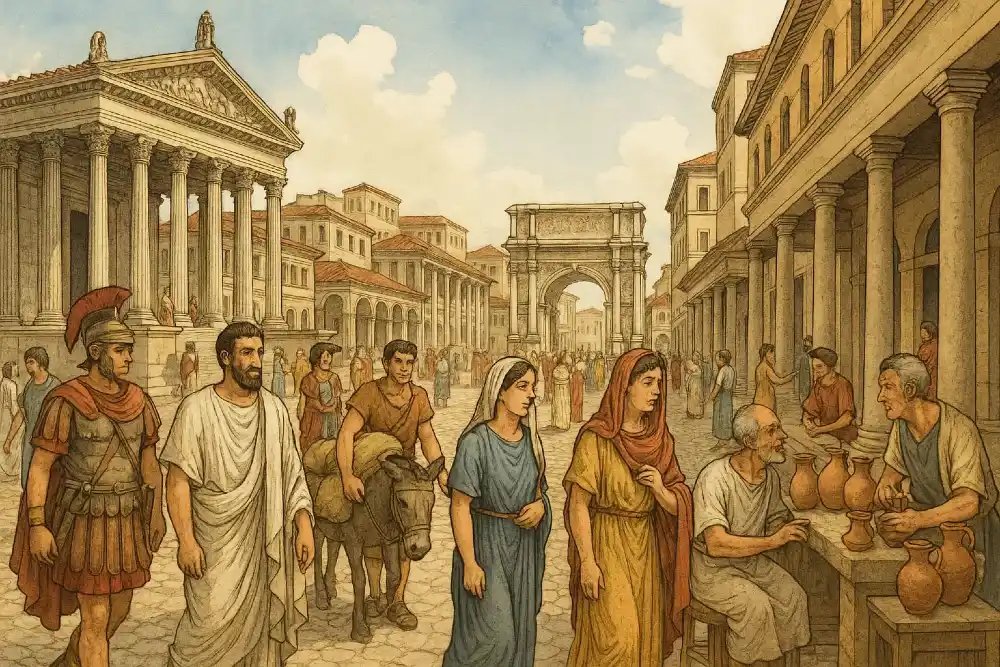
When most people think of societal collapse, they picture Rome. The fall of the Western Roman Empire stands as Western civilization’s archetypal collapse story—mighty legions defeated, marble monuments crumbling, literacy declining, and the light of classical learning dimming. Yet as Luke Kemp reveals in “Goliath’s Curse: The History and Future of Societal Collapse,” Rome’s collapse proves far more complex and paradoxical than conventional narratives suggest. Understanding why Rome’s legacy endured while other civilizations vanished offers crucial insights into the nature of collapse itself.
Two Cities, Two Fates
Kemp opens his discussion of collapse by contrasting Rome with Cahokia, the first great city of North America. Both were centers of powerful, complex societies. Both experienced dramatic collapses. Yet their post-collapse fates diverged dramatically.
Cahokia, located near modern St. Louis along the Mississippi River, grew to house 10,000 to 15,000 people around 1050-1100 CE. Its flat-topped pyramids rivaled Mesoamerican architecture. Its social hierarchy featured a priestly ruling class who conducted human sacrifices to legitimize their power. Within just over a century of its peak, Cahokia’s population halved. Another century later, the entire region—once filled with similar pyramid-centered settlements—had been abandoned.
The abandonment proved so complete that indigenous peoples in the area developed no oral traditions about Cahokia. They called the region “the Vacant Quarter” and avoided it. This pioneering experiment in North American state-building was over, never to be resurrected. The civilization simply vanished from memory.
Rome’s story unfolded differently. The city’s population plummeted from around one million to 30,000. The Western Roman Empire fragmented into competing kingdoms. Infrastructure decayed. Long-distance trade diminished. Literacy declined, though it never disappeared entirely. Yet Rome the city survived, eventually recovering to become modern Italy’s capital with 2.8 million inhabitants.
More importantly, Roman culture, institutions, law, and prestige persisted across subsequent centuries. The Eastern Roman Empire, headquartered in Constantinople, continued for another thousand years. Dozens of kingdoms claimed Roman heritage. Germanic tribes who conquered western provinces didn’t destroy Roman institutions so much as try to appropriate them. The Catholic Church preserved Latin language and learning. Roman law influenced European legal systems. Roman architectural styles inspired buildings worldwide.
What Makes Some Collapses Terminal?
Why did Cahokia vanish while Rome endured? Kemp identifies several factors determining whether collapsed civilizations leave lasting legacies or disappear entirely.
Geography and environment play crucial roles. Rome occupied the Mediterranean world’s geographic center, positioned at crossroads of trade routes connecting Europe, Africa, and Asia. Even after the Western Empire fell, the city’s location maintained strategic importance. Cahokia, despite its Mississippi River position, sat in a region where centralized states faced persistent challenges. The surrounding environment enabled mobile alternatives to settled agriculture, making state control harder to maintain.
The nature of collapse itself matters enormously. Rome experienced gradual fragmentation over several centuries rather than sudden catastrophic destruction. The Western Empire didn’t collapse overnight. Instead, it transformed through a long process of territorial loss, political fragmentation, and institutional evolution. This gradual process allowed cultural continuity even as political structures changed.
Cahokia’s collapse appears more abrupt and complete. Archaeological evidence suggests rapid abandonment within a few generations. Such sudden collapses more thoroughly disrupt cultural transmission. When populations scatter quickly, institutions disappear, and knowledge preserves in oral traditions only if collapse survivors choose to remember.
Cultural factors prove equally important. Rome had developed extensive written records, monumental architecture, and institutional frameworks that could survive political collapse. Christian monasteries preserved Roman texts. Germanic kingdoms adopted Roman administrative practices. Even barbarian conquerors admired Roman culture enough to maintain elements while adding their own traditions.
Cahokia left no written records. Its monumental architecture, while impressive, used earth rather than stone. Without maintenance, earthen mounds erode more rapidly than marble buildings. When Cahokia’s population dispersed, no institutions remained to preserve its cultural achievements or transmit its history to subsequent generations.
The Eastern Empire’s Thousand-Year Reign
Kemp emphasizes that Rome didn’t fully collapse—only its western half did. The Eastern Roman Empire, which historians later termed the Byzantine Empire, continued thriving for another millennium. Based in Constantinople, it remained a major Mediterranean power until the Ottoman conquest in 1453.
This Eastern continuity fundamentally changes the collapse narrative. While Western Europe experienced what historians call the “Dark Ages”—a period of reduced literacy, urbanization, and central authority—the Byzantine Empire preserved Roman legal traditions, administrative structures, and classical learning. Greek-speaking Byzantine scholars studied ancient philosophy, maintained libraries, and produced new works building on Roman foundations.
The Byzantine Empire’s survival demonstrated that Roman institutions and culture possessed genuine resilience beyond the Western Empire’s political structure. This continuity meant Roman civilization never truly died. It transformed, adapted, and persisted in modified forms.
Why Elites Suffer Most From Collapse
One of Kemp’s most important insights concerns who actually suffers when civilizations collapse. Conventional collapse narratives focus on elite perspectives—emperors losing thrones, senators fleeing barbarians, philosophers lamenting lost learning. Yet ordinary people’s experiences often differed dramatically.
Roman collapse devastated aristocratic families who lost properties, political power, and social status. Urban elites dependent on long-distance trade and centralized government faced catastrophic disruption. Specialized craftsmen serving wealthy patrons lost markets for luxury goods. Bureaucratic administrators trained in law and letters found their skills suddenly less valuable.
However, the average farmer in Gaul or Iberia may have experienced collapse quite differently. Without Roman tax collectors extracting grain and money, agricultural producers could consume more of their own production. Without military conscription, young men stayed home to farm rather than dying in distant wars. Without imperial administrators, local communities gained autonomy to manage their own affairs.
Kemp notes that some populations actively abandoned states that exploited them. The “Vacant Quarter” around Cahokia may reflect intentional avoidance of state-based organization after experiencing its costs. People voted with their feet, choosing mobile, egalitarian alternatives over hierarchical settlements that demanded tribute and human sacrifice.
This perspective reframes collapse from universal catastrophe to selective transformation. Systems that primarily served elite interests often fell harder on elites when they failed. For populations who bore the burdens of empire without receiving proportional benefits, collapse could bring relief more than disaster.
The Question of Progress and Decline
Rome’s collapse became central to Western narratives about progress and decline. Enlightenment thinkers saw classical Rome as a high point of rational civilization, with its fall ushering in medieval darkness. Nineteenth-century historians like Edward Gibbon famously chronicled Rome’s decline, attributing it to moral decay, barbarian invasions, and Christianity’s rise.
Modern scholarship has substantially revised this narrative. The “Dark Ages” weren’t uniformly dark. Technological innovations appeared during this period—heavy plows, three-field crop rotation, water mills. Many regions maintained or even improved agricultural productivity. Germanic kingdoms created sophisticated legal codes. Art and literature flourished in different forms than classical antiquity.
More fundamentally, Kemp challenges whether Rome’s political collapse represented genuine civilizational decline. The empire had enabled remarkable achievements in law, engineering, literature, and governance. Yet it also perpetuated slavery, brutal military conquests, and massive inequality. Roman prosperity relied on extracting resources from conquered provinces and exploiting enslaved populations. Imperial Rome’s grandeur came at tremendous human cost.
When measuring decline or progress, whose experience counts? For Roman senators losing villas and political offices, collapse meant catastrophe. For enslaved agricultural workers in those villas, or conquered peoples bearing heavy taxation, the empire’s fall may have improved daily conditions. Civilization’s end for elites didn’t necessarily mean decline for everyone.
Legacy, Emulation, and Translatio Imperii
Rome’s greatest survival came through emulation. Medieval and early modern kingdoms sought to claim Roman heritage, a process historians call translatio imperii—the transfer of imperial authority. Charlemagne crowned himself Roman Emperor in 800 CE. The Holy Roman Empire claimed descent from Roman political traditions. Byzantium explicitly continued Roman institutions. Even the Russian term “Czar” derives from “Caesar.”
This emulation preserved and transmitted Roman culture across centuries. Latin remained Western Europe’s learned language into early modernity. Roman law influenced European legal systems. Classical texts preserved in medieval monasteries enabled later Renaissance rediscoveries. Architectural styles mimicked Roman models.
The contrast with Cahokia proves stark. No successor kingdoms claimed Cahokian heritage. No indigenous empires sought to revive its institutions. Its collapse left no written records for later generations to study or emulate. Unlike Rome’s gradual transformation allowing cultural transmission, Cahokia’s rapid abandonment meant its traditions largely died with it.
Collapse as Transformation Rather Than Ending
Modern historians increasingly view Rome’s “fall” as transformation rather than simple collapse. The Western Empire didn’t disappear so much as fragment and evolve. Germanic kingdoms inherited Roman institutions while adding new elements. The Catholic Church maintained organizational structures and learning. Trade networks persisted at reduced scales. Latin evolved into Romance languages still spoken today.
This transformation perspective matters for understanding modern collapse risks. If Rome—Western civilization’s canonical collapse—actually represented gradual transformation with significant continuity, perhaps other collapses should be understood similarly. Systems change, institutions evolve, some elements disappear while others persist. Collapse becomes a process of transformation rather than binary ending.
Yet this optimistic interpretation has limits. While Roman culture survived, millions of individuals experienced the empire’s fragmentation as catastrophic. People died in warfare, famines, and epidemics accompanying collapse. Urban populations declined dramatically. Technological capabilities were lost and took centuries to recover. That later societies preserved elements of Roman culture didn’t prevent immense suffering during the transition period.
What Rome Teaches About Resilience
Rome’s mixed collapse story offers several lessons for modern civilization. Cultural achievements embedded in written records, monumental architecture, and institutions proved more resilient than political structures. Gradual transformation allowed more continuity than rapid catastrophe. Geographic advantages helped Rome’s legacy endure. Multiple centers of power—the Eastern Empire, the Church, Germanic kingdoms—preserved different aspects of Roman civilization.
Perhaps most importantly, Rome demonstrates that collapse needn’t be permanent or total. Civilizations can fragment politically while maintaining cultural continuity. They can experience severe setbacks while preserving knowledge and institutions for future recovery. The relationship between political collapse and civilizational decline proves far more complex than simple narratives suggest.
Yet Rome also warns against complacency. The Western Empire’s transformation took centuries and caused enormous suffering. Not everyone benefited from continuity—many elements of Roman achievement were genuinely lost. And Cahokia reminds us that not all collapsed civilizations leave legacies. Under certain circumstances, complex societies can vanish with remarkable completeness.
As Kemp argues in “Goliath’s Curse,” Rome’s enduring legacy shouldn’t reassure us that modern collapse would be similarly manageable. We face challenges—climate change, nuclear weapons, artificial intelligence—that ancient empires never confronted. Our greater complexity may make transformation harder, not easier. Learning from Rome means understanding both how civilizations can survive collapse and how they can fail to do so.
25 Key Takeaways From Luke Kemp’s Book Goliath’s Curse
Related posts:
 25 Key Takeaways From Luke Kemp’s Book Goliath’s Curse
 Why Every Great Civilization Eventually Falls: Lessons from Goliath’s Curse by Luke Kemp
 From Maya to Rome: How Environmental Degradation Triggers Societal Collapse (Goliath’s Curse by Luke Kemp)
 Why Extreme Inequality Destroys Civilizations: The Goliath’s Curse Explained
 The Year Civilization Collapsed: What Ancient Collapse Teaches Modern Civilization