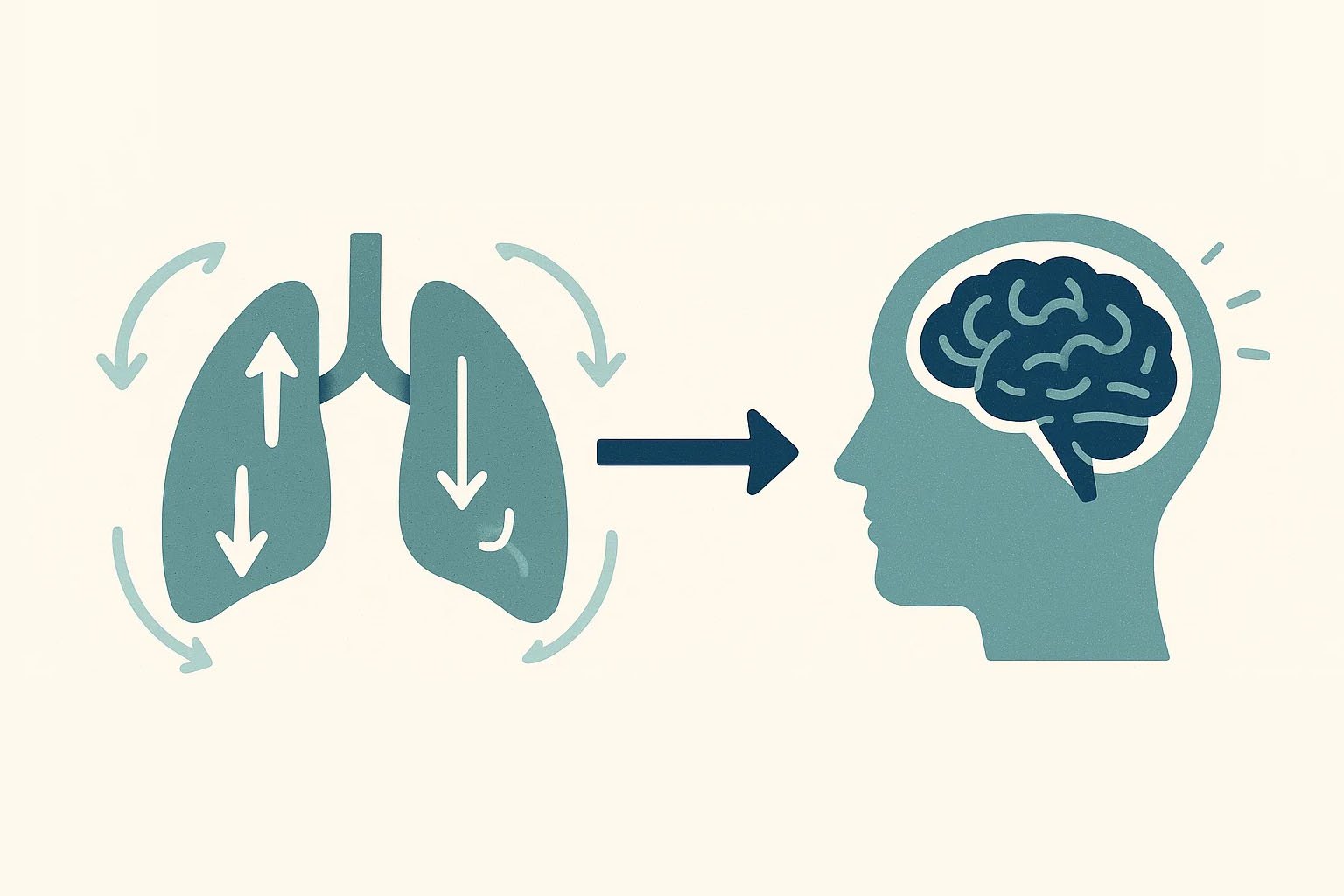
Understanding the Profound Connection Between Your Breath and Your Brain
Every breath you take does more than just keep you alive—it actively shapes your mental state, influences your emotions, and can even rewire your brain’s response to stress and anxiety. According to pioneering neuroscientist Dr. Jack Feldman, one of the world’s leading experts on respiratory neuroscience, the relationship between breathing and brain function runs far deeper than most people realize.
The Brain’s Breathing Control Center: Where It All Begins
The Pre-Bötzinger Complex
Deep in your brainstem lies a small cluster of just a few thousand neurons called the pre-Bötzinger complex. This tiny region, located above the spinal cord, is responsible for generating every single breath you take—approximately 20,000 times per day.
“Every breath begins with neurons in this region beginning to be active,” explains Dr. Feldman. These neurons send signals to your diaphragm and the muscles between your ribs, orchestrating the intricate dance of inhalation and exhalation that keeps you alive without conscious thought.
Why You Sigh Every Five Minutes (And Why It Matters)
The Physiological Sigh: Your Body’s Built-In Reset Mechanism
One of the most fascinating discoveries in respiratory science is the physiological sigh—a spontaneous deep breath that occurs approximately every five minutes, whether you’re aware of it or not.
Why does this happen?
Your lungs contain 400-500 million tiny air sacs called alveoli. These microscopic structures have a tendency to collapse over time, reducing your lung’s ability to absorb oxygen. A normal breath isn’t powerful enough to re-open these collapsed alveoli, but a deep sigh is.
“If you lie down in a quiet room and just breathe normally, you’ll find that every couple of minutes you’re taking a deep breath and you can’t stop it,” says Dr. Feldman. “It just happens.”
Clinical Applications
This discovery has life-saving implications. In the early days of mechanical ventilation for polio patients, mortality rates were concerningly high—until doctors realized they needed to include periodic “super breaths” to mimic natural sighing. Once ventilators were programmed to deliver these larger breaths every few minutes, mortality rates dropped significantly.
How Breathing Patterns Change Your Emotional State
Four Pathways From Breath to Brain
Dr. Feldman identifies multiple mechanisms through which breathing influences your mental state:
1. Olfactory Signals The rhythmic movement of air through your nose creates respiratory-modulated signals in the olfactory bulb, which has extensive projections throughout the brain affecting emotion and cognition.
2. Vagus Nerve Activity The vagus nerve—a major communication highway between your body and brain—responds to the mechanical expansion and relaxation of your lungs. This nerve has proven so powerful that electrical stimulation of it can provide relief for refractory depression.
3. Carbon Dioxide Levels Your CO2 levels fluctuate with each breath and significantly impact brain function. Dr. Alicia Meuret has demonstrated that anxious patients who hyperventilate can find relief by training themselves to breathe slower, restoring normal CO2 levels.
4. Voluntary Control Signals When you consciously control your breathing, signals originate in your motor cortex and send “collaterals” to other brain regions, potentially influencing emotional circuits.
Groundbreaking Research: Teaching Mice to “Meditate”
The Slow-Breathing Study
In a remarkable experiment, Dr. Feldman’s team trained mice to breathe slowly—reducing their breathing rate by a factor of 10—for 30 minutes daily over four weeks. The results were striking:
When these “meditative mice” were subjected to standard fear conditioning tests, they froze significantly less than control animals—showing a reduction in fear response comparable to direct manipulation of the amygdala (the brain’s fear center).
Why this matters for humans:
“My mice don’t believe in the placebo effect,” notes Dr. Feldman. “If we could show this bonafide effect in mice, it is convincing in ways that no matter how many human experiments you did, the control for the placebo effect is extremely difficult.”
This provides hard scientific evidence that breath work isn’t just psychological—it creates real, measurable changes in brain circuits related to fear and anxiety.
Practical Breath Work: What Actually Works
Box Breathing: A Simple, Science-Backed Technique
Dr. Feldman himself practices box breathing for 5-20 minutes daily, particularly when feeling mentally fatigued:
- Inhale: 5 seconds
- Hold: 5 seconds
- Exhale: 5 seconds
- Hold: 5 seconds
- Repeat
“I find I get tremendous benefit by relatively short periods between five and maybe 20 minutes of doing box breathing,” he explains. “I will often interrupt my day to take five or 10 minutes, especially after lunch when performance typically declines.”
The Key Principle: Disrupting Negative Circuits
Think of depression or anxiety as neural activity circulating in specific brain circuits. As these signals repeat, they strengthen—eventually becoming so powerful that you can’t break free.
Breath work provides a gentler alternative to treatments like electroconvulsive therapy:
“If breathing is playing some role in this circuit and now instead of doing a one-second shock, I do 30 minutes of disruption by doing slow breathing, those circuits begin to break down a little bit,” explains Dr. Feldman. “It’s like walking around on a dirt path. You build a rut so deep you can’t get out of it. Breathing is filling in the rut bit by bit to the point that you can climb out.”
The Minimum Effective Dose
How Much Breath Work Do You Need?
One of the most important questions for practical application: How much is enough?
Based on Dr. Feldman’s mouse studies, 30 minutes daily produced measurable changes in fear response after four weeks. However, he personally finds benefits from sessions as short as 5-10 minutes.
Dr. Feldman’s advice to beginners: “I tell my friends: look, just try it five or 10 minutes, see if you feel better, do it for a few days. If you don’t like it, stop. But it doesn’t cost anything, and invariably they find it’s helpful.”
Beyond Breathing: The Magnesium Connection
Magnesium Threonate for Cognitive Function
In a fascinating tangent, Dr. Feldman discusses his interest in magnesium threonate (Mg-L-threonate), a form of magnesium that crosses the blood-brain barrier more effectively than standard supplements.
The research:
- Increases long-term potentiation (LTP)—the strengthening of neural connections crucial for learning and memory
- In a double-blind, placebo-controlled study, patients with mild cognitive decline showed an 8-year improvement in cognitive age after three months (compared to 2 years for placebo)
- May improve sleep quality and physical alertness
Dr. Feldman himself takes half the recommended dose after measuring his blood magnesium levels: “At my age, I’m not looking to get smarter. I’m looking to decline more slowly.”
How Breathing Connects to Everything
The Respiratory-Brain Network
Your breathing rhythm synchronizes with numerous physiological processes:
- Heart rate: Slows during exhalation (respiratory sinus arrhythmia)
- Pupil dilation: Oscillates with respiratory cycle
- Fear response: Modulated by breathing patterns
- Cognitive circuits: Influenced by respiratory rhythm
“Almost everything,” Dr. Feldman states when asked what functions coordinate with breathing. This pervasive influence explains why breath work can have such wide-ranging effects on mental and physical health.
The Evolutionary Advantage: Why Mammals Breathe Differently
The Diaphragm’s Game-Changing Role
Mammals are unique among vertebrates in possessing a diaphragm—a mechanically efficient muscle that enables us to pack a massive surface area into our lungs.
The numbers are staggering:
- Humans have 400-500 million alveoli
- This creates a membrane “a third the size of a tennis court” inside your chest
- The diaphragm can expand this enormous surface by moving just 2/3 of an inch
This efficiency enabled the evolution of larger, more oxygen-demanding brains. “Without a diaphragm, you’re an amphibian,” notes Dr. Feldman. The diaphragm was a key step in the ability to develop the large brains characteristic of mammals.
Practical Takeaways: Implementing the Science
Start Your Breath Work Practice Today
- Begin with 5-10 minutes daily of box breathing (equal counts for inhale, hold, exhale, hold)
- Use breath work strategically during afternoon energy dips or stressful moments
- Be consistent: The mouse studies showed effects after four weeks of daily practice
- Pay attention to your natural sighs—they’re your body’s wisdom at work
- If experiencing anxiety or hyperventilation, focus on slowing your breath to normalize CO2 levels
The Bottom Line
The science is clear: breathing is not just about oxygen exchange—it’s a powerful tool for influencing your mental state, managing anxiety, and potentially rewiring fear circuits in your brain. With no cost, no side effects, and proven mechanisms of action, breath work deserves a place in everyone’s mental health toolkit.
As Dr. Feldman demonstrates through his own practice and cutting-edge research, taking control of your breath may be one of the simplest yet most profound ways to take control of your mental well-being.
References:
- Huberman Lab Essentials: Breathing for Mental & Physical Health & Performance featuring Dr. Jack Feldman
- Research on the pre-Bötzinger complex and respiratory rhythm generation
- Studies on magnesium threonate and cognitive function
- Vagal nerve stimulation research for depression
Related posts:
 Deida’s Breath-work Practice for Masculine Presence and Power (The Way of the Superior Man)
 Breaking the Anxiety Loop: Why Mindfulness Works When Thinking Fails
 The Body-Mind Connection: Why Choosing Health Is Essential for Overcoming Anxiety
 Mental Wealth: How to Build Clarity in an Age of Infinite Distraction
The 6 Daily Choices That Eliminate Anxiety: Dr. John Delony’s Complete Framework
Mental Wealth: How to Build Clarity in an Age of Infinite Distraction
The 6 Daily Choices That Eliminate Anxiety: Dr. John Delony’s Complete Framework