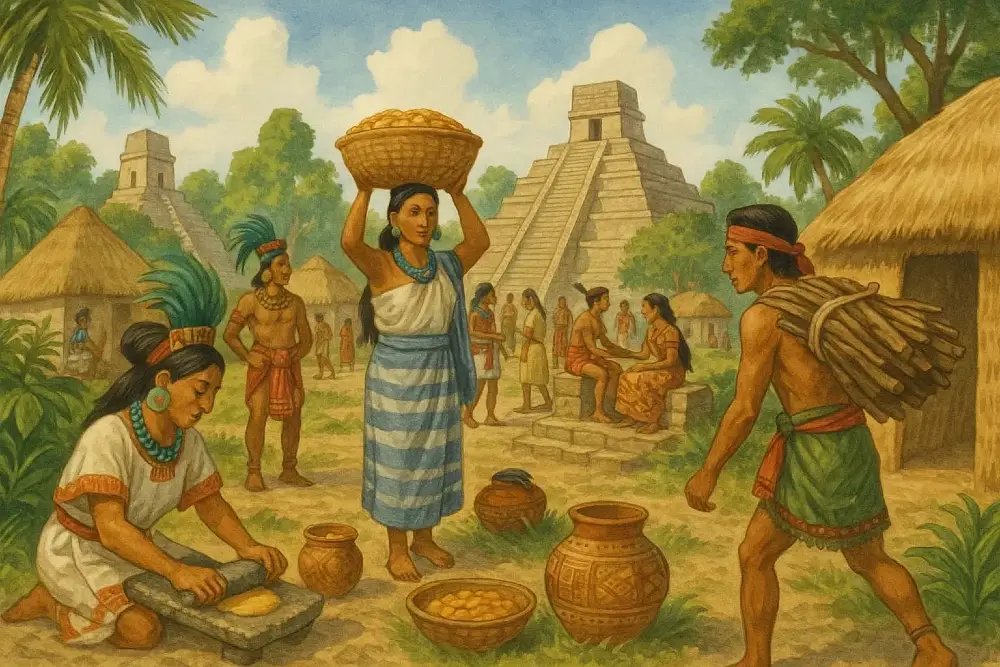
When civilizations fall, we often blame human factors—bad leaders, moral decay, military defeats, or internal conflicts. Yet as Luke Kemp demonstrates in “Goliath’s Curse: The History and Future of Societal Collapse,” environmental stresses frequently play decisive roles in collapse scenarios. Drought, resource depletion, ecological degradation, and climate shifts have toppled empires throughout history. Understanding these environmental triggers proves essential for grasping both past collapses and present dangers.
The Maya Collapse and the Drought Connection
Few historical collapses illustrate environmental factors more clearly than the Maya civilization’s trajectory. The Maya built sophisticated city-states throughout Mesoamerica’s tropical forests, developing advanced mathematics, astronomy, writing, and architecture. Cities like Tikal and Copán housed tens of thousands of residents in stone palaces and pyramid temples.
Then, between roughly 800 and 1000 CE, the Maya civilization experienced what archaeologists call the Terminal Classic collapse. Major cities were abandoned. Populations declined dramatically. Construction ceased. The densely populated heartland regions became sparsely inhabited. This occurred not once but repeatedly—the Maya experienced multiple collapse cycles across different periods and regions.
For decades, researchers debated causes. Some suggested warfare between competing city-states. Others pointed to environmental degradation from intensive agriculture. Many noted evidence of social upheaval and elite competition. Yet a critical factor emerged from paleoclimate research: severe drought.
Kemp describes how analysis of sediment cores, cave formations, and other climate proxies revealed multiple drought periods coinciding with Maya collapses. These weren’t brief dry spells but sustained mega-droughts lasting decades. During these periods, rainfall dropped substantially below normal levels, stressing agricultural systems dependent on seasonal precipitation.
Maya agriculture relied heavily on maize, requiring adequate water during growing seasons. When droughts struck, crop yields declined. Food stores depleted. Populations faced malnutrition and hunger. The elaborate political systems and trade networks that characterized Maya civilization depended on agricultural surplus to support urban populations, artisans, priests, and rulers. Without sufficient food production, the entire system became unsustainable.
The relationship between drought and collapse wasn’t simple or deterministic. Some Maya cities survived droughts that destroyed neighbors. Regions with better water management—natural cenotes, reservoirs, or agricultural techniques suited to dry conditions—weathered droughts more successfully than areas lacking such adaptations.
This demonstrates an important principle: environmental stress doesn’t automatically cause collapse. Rather, it interacts with social, political, and technological factors. Societies better prepared for environmental challenges—through infrastructure, governance, knowledge, and social cohesion—survive stresses that overwhelm less resilient neighbors.
Agricultural Intensification and Environmental Degradation
Many civilizations collapsed not from sudden climate shifts but from gradual environmental degradation resulting from their own agricultural practices. As populations grew and demands increased, societies intensified agriculture through deforestation, irrigation expansion, and shortened fallow periods. These strategies boosted short-term productivity while undermining long-term sustainability.
The Akkadian Empire of Mesopotamia, one of history’s first major empires, provides a stark example. Flourishing around 2300 BCE in modern Iraq, the Akkadian state controlled extensive territories and urban centers. Its agriculture depended on sophisticated irrigation systems channeling water from the Tigris and Euphrates rivers to fields.
Over time, irrigation caused soil salinization—salt accumulation making land infertile. Water evaporating from irrigated fields leaves salt behind. As salinization progressed, crop yields declined. Farmers responded by expanding irrigation to new lands, spreading the problem. Eventually, once-productive regions became too salty for agriculture.
Kemp notes that ancient texts document declining wheat harvests replaced by more salt-tolerant barley, then barley yields declining as salinization intensified. The empire’s agricultural base eroded through practices that initially seemed successful. Combined with drought and political instability, environmental degradation contributed to the Akkadian Empire’s collapse around 2200 BCE.
Similar patterns appear throughout history. Deforestation for agriculture, fuel, and construction removed protective forest cover. Without tree roots holding soil, erosion accelerated. Mediterranean hillsides stripped of forests became bare rock. Chinese landscapes experienced severe erosion from agricultural expansion. Polynesian societies deforested islands for agriculture and monument building, eliminating resources needed for boat construction and fishing.
The Intermediate Disturbance Hypothesis
Not all environmental challenges cause collapse. Kemp discusses the “intermediate disturbance hypothesis”—the idea that moderate environmental stresses can enhance societal resilience while extreme stresses or complete absence of challenges create vulnerabilities.
Societies facing periodic moderate challenges—occasional droughts, floods, or crop failures—develop adaptive strategies. They build grain storage for lean years. They diversify food sources. They develop social institutions for sharing resources during hardships. They maintain knowledge about managing crises. These adaptations prepare them for future challenges.
Societies experiencing either constant stability or overwhelming disasters lack such preparation. Those never facing environmental stress don’t develop resilience mechanisms. They optimize for efficiency rather than robustness. When serious challenges eventually arrive—as they inevitably do—these societies lack adaptive capacity. Conversely, societies facing catastrophic environmental disasters beyond any adaptive capacity simply collapse regardless of preparation.
This principle suggests that moderate environmental variability builds civilizational resilience while extremes undermine it. The challenge for modern civilization involves preparing for environmental changes—particularly climate change—that exceed historical variability ranges. We’re entering conditions outside our species’ experience, making past adaptations potentially inadequate.
Roman Climate and the Late Antique Little Ice Age
Rome’s complex collapse story includes significant environmental components often overshadowed by military and political factors. The Roman Empire’s peak prosperity occurred during the Roman Warm Period (roughly 250 BCE to 400 CE), characterized by warm, stable climate conditions favoring agriculture.
This climatic optimum enabled productive farming across the Mediterranean and Europe. Abundant harvests supported large urban populations and military forces. Trade networks flourished. The empire’s infrastructure—roads, aqueducts, ports—facilitated resource distribution, helping balance regional shortages.
After 400 CE, climate shifted toward what paleoclimatologists call the Late Antique Little Ice Age. Temperatures cooled. Growing seasons shortened. Agricultural productivity declined, particularly in northern provinces. This climatic deterioration coincided with Rome’s most severe crisis period—the fifth and sixth centuries witnessing territorial losses, economic contraction, population decline, and political fragmentation.
Kemp cautions against climate determinism—Rome’s problems weren’t solely environmental. But climate changes compounded political and military challenges. Lower agricultural yields reduced tax revenues when the empire needed maximum resources to defend borders. Cooler temperatures may have driven nomadic peoples southward, increasing pressure on Roman frontiers. Food shortages contributed to instability and made recovering from other setbacks harder.
The Justinian Plague of 541-549 CE killed millions, arriving during this climatic deterioration. While the plague itself wasn’t climate-caused, environmental stress likely increased vulnerability and hampered recovery. Weakened populations struggling with reduced food production faced greater mortality and rebuilding difficulties.
Volcanic Eruptions and Civilizational Stress
Sometimes environmental catastrophes strike with little warning. Massive volcanic eruptions can disrupt climate globally through ash and sulfur dioxide ejected into the atmosphere, blocking sunlight and cooling temperatures for years.
The eruption of Mount Tambora in 1815 caused the “Year Without a Summer” in 1816. Crop failures across Europe and North America led to food shortages, price increases, and social unrest. This occurred during relatively modern times with global trade networks and diversified economies. Ancient societies with less resilience faced even greater challenges from volcanic climate disruption.
Several historical collapses correlate with major eruptions. The Late Bronze Age collapse period experienced significant volcanic activity. While not the sole cause, volcanic cooling could have exacerbated the agricultural stresses and social disruptions characterizing that collapse episode.
Kemp points out that volcanic eruptions represent low-probability, high-impact events that complex societies struggle to prepare for. Modern civilization remains vulnerable. A Tambora-scale eruption today would disrupt global food systems, potentially triggering international conflicts over scarce resources. Current just-in-time supply chains and globally integrated food markets create efficiency but also vulnerability to such shocks.
Resource Depletion and Carrying Capacity
Environmental collapse stories often involve exceeding carrying capacity—the population size an environment can sustainably support. As civilizations grow, they require increasing resources: food, water, fuel, and materials. If extraction rates exceed regeneration rates, resources deplete and carrying capacity declines.
Easter Island provides a famous, though debated, example. Polynesian settlers arrived on this remote Pacific island around 1200 CE, finding a landscape covered with palm forests. The population grew, building massive stone statues (moai) and developing a complex society.
Over subsequent centuries, islanders cut down forests for agriculture, fuel, and transporting stone statues. Without trees, soil eroded. Crop yields declined. The palms that had provided materials for fishing boats and ocean-going canoes disappeared. When Europeans arrived in the 18th century, they found a deforested island with a population much smaller than archaeological evidence suggested had lived there previously.
Traditional narratives portrayed Easter Island as ecological collapse from deforestation. Recent scholarship complicates this picture, noting that European contact introduced diseases and enslavement that devastated the population. The role of rats brought by Polynesian settlers in destroying palm seeds remains debated. Nevertheless, deforestation clearly contributed to environmental degradation that constrained the island’s population.
The Easter Island story resonates as a metaphor for Earth as a whole—a finite system where resource depletion and environmental degradation could undermine civilization. Kemp notes both the power and limitations of this metaphor. Unlike island societies, global civilization can develop technologies like renewable energy that don’t deplete resources. Yet we also face planetary boundaries—limits to greenhouse gas emissions, biodiversity loss, nitrogen loading, and other environmental impacts before triggering catastrophic changes.
Environmental Determinism vs. Human Agency
A critical question emerges: do environmental factors determine civilizational fates, or do human choices and adaptations matter most? Kemp argues for a middle position rejecting both environmental determinism and pure social constructivism.
Environmental conditions create opportunities and constraints. Favorable climates, abundant resources, and stable conditions enable civilizational growth. Droughts, depleted soils, and climate shifts stress societies. Yet human responses to these conditions vary enormously. Some societies develop innovations overcoming environmental challenges. Others collapse when facing similar stresses.
The difference lies in social factors: governance quality, social cohesion, technological capabilities, cultural knowledge, and institutional resilience. Well-governed societies with effective institutions can manage environmental stresses that overwhelm dysfunctional neighbors. Societies maintaining traditional ecological knowledge about sustainable resource management avoid degradation afflicting societies pursuing short-term extraction.
This interaction between environment and society means that environmental stress reveals existing social vulnerabilities rather than creating them from nothing. A drought that causes one civilization to collapse might prompt adaptive innovations in another. The key variables include whether elites prioritize long-term sustainability over short-term extraction, whether institutions enable collective action for resource management, and whether knowledge about environmental constraints remains accessible.
Implications for the Present
The environmental factors in historical collapses carry urgent warnings for modern civilization. Climate change represents environmental stress vastly exceeding anything in human history. We’re not facing regional droughts or localized deforestation but global atmospheric changes affecting everywhere simultaneously.
Unlike past societies that could migrate to unaffected regions, modern civilization has nowhere to go. Unlike ancient populations numbered in thousands or millions, we number in billions. Unlike subsistence farmers producing food locally, we depend on global supply chains and industrial agriculture vulnerable to climate disruption.
Yet we also possess advantages ancient societies lacked. Modern science understands environmental systems better than past civilizations could. Technology offers tools for adaptation—renewable energy, efficient agriculture, climate modeling. Global communication enables coordination unprecedented in history. Democratic institutions (where they exist) allow populations to demand environmental protection.
The question becomes whether we’ll apply knowledge and capabilities quickly enough. Climate tipping points approach. Biodiversity collapses. Soils degrade. Aquifers deplete. As Kemp argues, we’re conducting a planetary-scale experiment while lacking certainty about outcomes. Historical collapses from environmental stress suggest caution. The speed and scale of modern changes suggest urgency.
Understanding how environment and society interact in historical collapses doesn’t provide simple blueprints for avoiding modern collapse. But it reveals patterns: the danger of short-term optimization undermining long-term sustainability, the importance of maintaining resilience even during prosperous times, the need for governance prioritizing collective welfare over elite extraction, and the reality that environmental constraints ultimately limit civilizational growth.
“Goliath’s Curse” uses environmental history not to excuse human responsibility but to clarify challenges we face. The Maya didn’t cause the droughts that stressed their civilization, but their political and social structures determined whether they could survive those droughts. We’re causing climate change, but our institutions and choices will determine whether we adapt successfully or collapse. Learning from environmental factors in past collapses might help us avoid becoming another cautionary tale.
25 Key Takeaways From Luke Kemp’s Book Goliath’s Curse
Related posts:
 25 Key Takeaways From Luke Kemp’s Book Goliath’s Curse
 Could Civilization Rebuild After Collapse? The Terrifying Rungless Ladder Theory (Goliath’s Curse by Luke Kemp)
 Why Early Farmers Had Shorter Lives Than Hunter-Gatherers
 Why Every Great Civilization Eventually Falls: Lessons from Goliath’s Curse by Luke Kemp
 AI, Climate Change, and Nuclear War: The New Collapse Threats Ancient Empires Never Faced (Goliath’s Curse by Luke Kemp)