Why Ego is the Enemy Matters More Than Ever
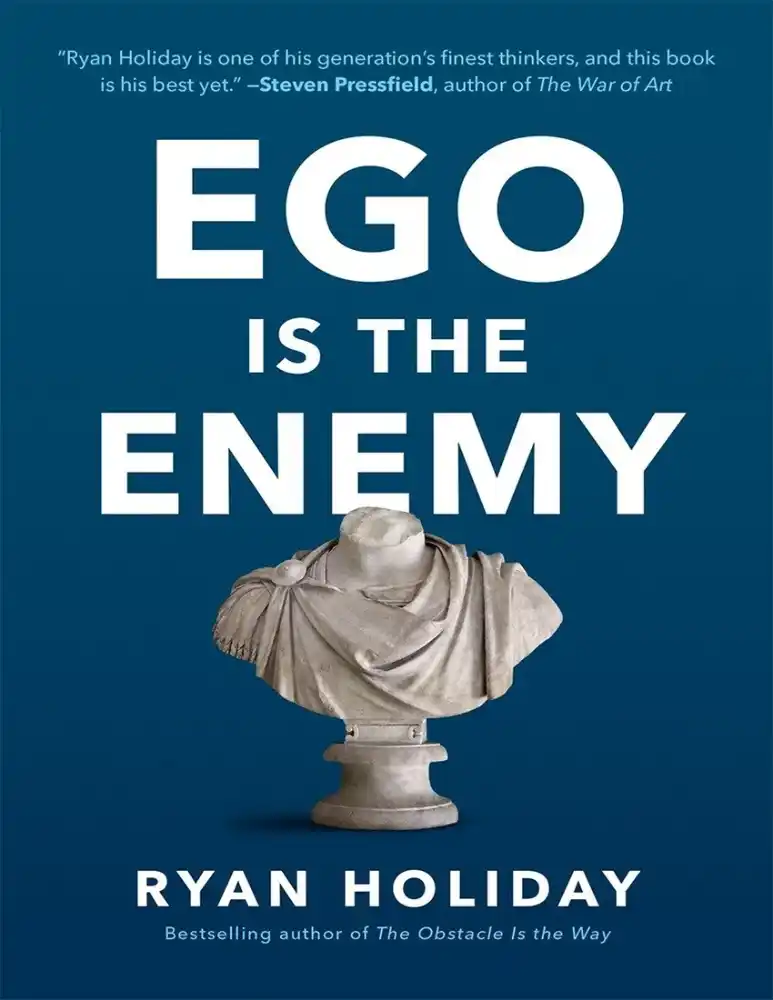
If you’re searching for insights from Ryan Holiday‘s transformative book “Ego is the Enemy,” you’ve come to the right place. This comprehensive guide breaks down the 25 most powerful lessons from Holiday’s modern stoic masterpiece, complete with direct quotes and actionable wisdom.
Ryan Holiday defines ego as “an unhealthy belief in our own importance. Arrogance. Self-centered ambition.” This isn’t just another self-help book—it’s a practical philosophy for anyone aspiring to greatness, managing success, or recovering from failure.
Part I: ASPIRE – Conquering Ego Before You Succeed
1. Talk Is the Enemy of Action
One of the most profound insights in “Ego is the Enemy” is how talking about our goals actually undermines our ability to achieve them.
Key Quote: “Talk depletes us. Talking and doing fight for the same resources. Research shows that while goal visualization is important, after a certain point our mind begins to confuse it with actual progress.”
Holiday uses the example of author Upton Sinclair, who wrote a book about being governor before he won the election—and subsequently lost all motivation to actually campaign. The lesson? Keep your mouth shut and your head down. Social media has made this harder than ever, but the principle remains: silence is strength.
Action Step: Stop broadcasting your intentions on social media. Channel that energy into actual work.
2. To Be or To Do? Choose Your Path Wisely
This chapter presents one of the book’s most challenging questions: Do you want to be someone, or do you want to do something meaningful?
Key Quote: “In this course, it is not ‘Who do I want to be in life?’ but ‘What is it that I want to accomplish in life?’ Setting aside selfish interest, it asks: What calling does it serve?”
Holiday tells the story of John Boyd, a military strategist who chose impact over recognition. He died relatively unknown as a colonel, despite revolutionizing military theory. Boyd could have had fame and higher rank, but he chose substance over status.
Action Step: Write down whether you’re chasing titles and recognition, or actual meaningful work. Be brutally honest.
3. Become a Student for Life
Kirk Hammett joined Metallica and immediately hired a guitar teacher. That’s the mindset of greatness.
Key Quote: “The power of being a student is not just that it is an extended period of instruction, it also places the ego and ambition in someone else’s hands. There is a sort of ego ceiling imposed—one knows that he is not better than the ‘master’ he apprentices under.”
Holiday emphasizes that the pretense of knowledge is our most dangerous vice. When we think we already know everything, learning grinds to a halt. Hammett could have coasted on his talent, but instead he sought rigorous instruction from Joe Satriani, becoming one of metal’s greatest guitarists.
Action Step: Find someone better than you and learn from them. Put yourself in rooms where you’re the least knowledgeable person.
4. Don’t Be Passionate—Be Purposeful
This counterintuitive lesson challenges the modern obsession with passion.
Key Quote: “Passion typically masks a weakness. Its breathlessness and impetuousness and franticness are poor substitutes for discipline, for mastery, for strength and purpose and perseverance.”
Holiday argues that passion is form over function. It’s what amateurs have. Professionals have purpose, direction, and a clear understanding of what they want to accomplish. Passion can lead you astray; purpose keeps you on track.
Action Step: Replace “I’m passionate about X” with “My purpose is to accomplish Y.” Notice how the latter forces clarity.
5. Follow the Canvas Strategy
Early in your career, make others look good. Clear the path for people above you.
Key Quote: “Find canvases for other people to paint on. Be an anteambulo. Clear the path for the people above you and you will eventually create a path for yourself.”
This means being willing to do the thankless work—the grunt work that helps others shine. Holiday explains that Bill Belichick spent years breaking down game film for other coaches. That apprenticeship built the foundation for his later success as one of football’s greatest coaches.
Action Step: Look for ways to make your boss, mentor, or team leader more effective. Create value without needing credit.
6. Restrain Yourself from Early Pride
Success in the early stages is dangerous because it feels like vindication.
Key Quote: “Ego needs honors in order to be validated. Confidence, on the other hand, is able to wait and focus on the task at hand regardless of external recognition.”
Holiday warns against the “disease of early pride.” When we achieve our first taste of success, ego tells us we’ve arrived. But we haven’t. We’re just getting started. This false confidence can derail everything.
Action Step: When you achieve a milestone, resist the urge to celebrate publicly. Instead, ask: “What’s next? What can I learn?”
7. Get Out of Your Own Head
Self-absorption is a creativity killer.
Key Quote: “Detachment is a sort of natural ego antidote. It’s easy to be emotionally invested and infatuated with your own work. Any and every narcissist can do that. What is rare is not raw talent, skill, or even confidence, but humility, diligence, and self-awareness.”
When we’re consumed with our own narrative, we lose perspective. We can’t see opportunities, we can’t learn from feedback, and we can’t connect with others. Getting out of your head means cultivating the ability to see yourself objectively.
Action Step: Practice viewing your work as an outside observer would. What would they see that you’re missing?
8. Work, Work, Work
There’s no substitute for putting in the hours.
Key Quote: “We will learn that though we think big, we must act and live small in order to accomplish what we seek. Because we will be action and education focused, and forgo validation and status, our ambition will not be grandiose but iterative—one foot in front of the other.”
Holiday emphasizes that while others are talking, posturing, and seeking validation, you should be working. Not frantically, but steadily. The craftsman doesn’t need applause; the work itself is the reward.
Action Step: Track your actual productive hours this week. Are you working or just looking busy?
Part II: SUCCESS – Managing Ego When You’ve Made It
9. Always Stay a Student (Even at the Top)
Genghis Khan conquered the world not through brute force alone, but through relentless learning.
Key Quote: “Genghis Khan was not born a genius. Instead, as one biographer put it, his was ‘a persistent cycle of pragmatic learning, experimental adaptation, and constant revision driven by his uniquely disciplined and focused will.’ He was the greatest conqueror the world ever knew because he was more open to learning than any other conqueror has ever been.”
Success doesn’t mean you stop learning. In fact, the opposite is true. As John Wheeler observed: “As our island of knowledge grows, so does the shore of our ignorance.” Every new level brings new challenges requiring new knowledge.
Action Step: What’s one skill or knowledge area where you’re currently weak? Start learning it today.
10. Don’t Tell Yourself a Story
We’re all master storytellers—especially when it comes to our own narrative.
Key Quote: “With success comes the temptation to tell oneself a story, to round off the edges, to cut out your lucky breaks and add a certain mythology to it all.”
Holiday warns that we start believing our own PR. We edit out the failures, the help we received, the lucky breaks. We create a narrative where our talent and will were the only factors. This mythology makes us fragile because it’s built on lies.
Action Step: Write out your success story, then rewrite it including all the luck, help, and failures. Be honest.
11. What’s Important to You?
Success without purpose is empty.
Key Quote: “Man is pushed by drives, but he is pulled by values. Ruled by or ruling? Which are you? Without the right values, success is brief.”
Holiday uses the example of Howard Hughes, who had everything but died miserable and alone. Hughes had no values to guide him, only appetite. He accumulated wealth and fame but wasted his potential because he lacked direction beyond ego gratification.
Action Step: List your actual values (not what you think they should be). Do your daily actions reflect them?
12. Entitlement is the Enemy
Feeling entitled is the fastest way to lose what you’ve earned.
Key Quote: “Here we are having accomplished something. After we give ourselves proper credit, ego wants us to think, I’m special. I’m better. The rules don’t apply to me.”
Entitlement makes us rigid, prevents adaptation, and alienates allies. When we feel entitled to success, we stop doing the work that earned it in the first place. Holiday explains that this is when empires collapse from within.
Action Step: List three things you feel entitled to. Challenge whether you’ve truly earned them or just gotten comfortable.
13. Managing Yourself
The higher you climb, the more you must manage your own psychology.
Key Quote: “The worst disease which can afflict business executives in their work is not, as popularly supposed, alcoholism; it’s egotism. Whether in middle management or top management, unbridled personal egotism blinds a man to the realities around him.”
This quote from CEO Harold Geneen illustrates how ego becomes more dangerous with success. As power grows, so does the need for self-management. Without it, we begin living in a fantasy world of our own creation.
Action Step: Create systems to get honest feedback regularly. Who tells you the truth, even when it hurts?
14. Beware the Disease of Me
Pat Riley identified “the disease of me” in championship teams—when individual ego destroys collective success.
Key Quote: “The goal—”
Riley observed that after winning a championship, players often start prioritizing personal stats, contract negotiations, and media attention over team success. The same disease infects successful businesses, nonprofits, and creative collaborations.
Action Step: Are you prioritizing your personal brand over your team’s mission? Be honest.
15. Meditate on the Immensity
Understanding our smallness is paradoxically empowering.
Key Quote: “It’s possible to bask in both your relevance and irrelevance to the cosmos. When I look up in the universe, I know I’m small, but I’m also big. I’m big because I’m connected to the universe and the universe is connected to me.”
Holiday argues that ego makes us feel like the center of the universe. But when we contemplate our place in history and the cosmos, ego becomes impossible. This isn’t depressing—it’s liberating. It frees us from the prison of self-importance.
Action Step: Go somewhere that makes you feel small—a mountain, an ocean, a historic site. Let that perspective sink in.
16. Maintain Your Sobriety
Angela Merkel embodies the power of staying clearheaded amid success.
Key Quote: “The ego tells us we’re invincible, that we have unlimited force that will never dissipate. But that can’t be what greatness requires—energy without end?”
Merkel’s success comes from being the opposite of what we expect from a powerful leader. She’s measured, patient, and rational. Holiday explains that sobriety—mental clarity and emotional balance—is essential for sustained success. While others burn out or implode, the sober endure.
Action Step: What’s one area where you’re “intoxicated” by ego, power, or recognition? How can you bring sobriety to it?
17. The Danger of Success Stories
We love to hear about overnight success, but those stories are always incomplete.
Key Quote: “We intuit a causal relationship that isn’t there. We assume the symptoms of success are the same as success itself—and in our naiveté, confuse the by-product with the cause.”
Holiday warns that we see the swagger and confidence of successful people and think those traits caused their success. In reality, confidence often comes after success, not before. Imitating the wrong things leads to failure.
Action Step: Study someone you admire. Look for what they did before the success, not after.
Part III: FAILURE – Building Strength Through Adversity
18. Alive Time or Dead Time?
Malcolm X faced a choice in prison: become bitter or become better.
Key Quote: “According to Greene, there are two types of time in our lives: dead time, when people are passive and waiting, and alive time, when people are learning and acting and utilizing every second.”
Malcolm X chose alive time. He educated himself, read philosophy and history, and emerged transformed. Every setback offers this same choice. Will you wait passively for circumstances to change, or will you use the time to grow?
Action Step: Identify one area where you’re currently in “waiting mode.” How can you make it alive time?
19. The Effort is Enough
We can’t control outcomes, but we can control our effort.
Key Quote: “Think of what you have been putting off. Issues you declined to deal with. Systemic problems that felt too overwhelming to address. Dead time is revived when we use it as an opportunity to do what we’ve long needed to do.”
Holiday teaches that if we tie our self-worth to results, we’re setting ourselves up for misery. Some of history’s greatest figures failed repeatedly. What mattered was that they gave their best effort regardless of outcome.
Action Step: Redefine success for one current project: not by the outcome, but by the quality of effort you give.
20. Fight Club Moments
Sometimes we need to hit rock bottom to rebuild correctly.
Key Quote: “Failure and adversity are relative and unique to each of us. Almost without exception, this is what life does: it takes our plans and dashes them to pieces. Sometimes once, sometimes lots of times.”
Holiday explains that failure can be a gift—it destroys the false version of ourselves and forces us to rebuild on truth. Like the narrator in Fight Club hitting himself, sometimes we need to break our own illusions.
Action Step: What illusion about yourself has failure recently shattered? What truth is left standing?
21. Draw the Line
Failure doesn’t define you—how you respond does.
Key Quote: “Humble and strong people don’t have the same trouble with these troubles that egotists do. There are fewer complaints and far less self-immolation. Instead, there’s stoic—even cheerful—resilience.”
Holiday teaches that ego makes us fragile because it ties our identity to external validation. When we fail, ego tells us we’re worthless. But if our identity is rooted in character and effort, failure is just data, not judgment.
Action Step: Write down three recent failures. For each one, identify what you learned versus what ego told you it meant.
22. Maintain Your Own Scorecard
Bill Walsh went 2-14 his first year as head coach. The next year? Also 2-14. But he saw progress others didn’t.
Key Quote: “What both Graham and Walsh were doing was adhering to a set of internal metrics that allowed them to evaluate and gauge their progress while everyone on the outside was too distracted by supposed signs of failure or weakness.”
External validation is fickle. Holiday argues we need internal metrics—standards we control—to evaluate our progress. Walsh knew his team was improving even though the record didn’t show it yet. Two years later, they won the Super Bowl.
Action Step: Create three internal metrics for your current project that measure progress regardless of external results.
23. Always Love (Even When You Fail)
Katharine Graham could have become bitter when thrust into leadership unprepared. Instead, she chose love—love for the work, the mission, the people.
Key Quote: “What did Graham need through all this? Not swagger. Not bluster. She needed to be strong. She needed confidence and a willingness to endure. A sense of right and wrong. Purpose. It wasn’t about her.”
Holiday emphasizes that love isn’t soft or weak. It’s the most powerful force for persistence. When you love what you do and why you do it, ego becomes irrelevant. You continue because it matters, not because it validates you.
Action Step: Reconnect with why you started your current path. Not for recognition, but for the work itself.
24. Aspire to Become Who You Are
Success isn’t about becoming someone else—it’s about becoming your truest self.
Key Quote: “As Goethe once observed, the great failing is ‘to see yourself as more than you are and to value yourself at less than your true worth.'”
Ego makes us overestimate our present while undervaluing our potential. Holiday teaches that the goal isn’t grandiose self-belief, but accurate self-assessment. Know your current limitations, but also recognize your capacity for growth.
Action Step: List five of your actual strengths and five areas for growth. Be ruthlessly honest about both.
25. Ego is the Enemy at Every Stage
This is the ultimate lesson—ego doesn’t disappear when you succeed or fail. It adapts.
Key Quote: “Wherever you are, whatever you’re doing, your worst enemy already lives inside you: your ego.”
Holiday structures the book around three stages: Aspire, Success, and Failure. Why? Because ego attacks us differently at each stage. When aspiring, it makes us talk instead of work. In success, it makes us complacent and entitled. In failure, it makes us bitter and defensive.
Action Step: Identify which stage you’re in right now. How is ego showing up for you? What’s one action you can take today to counteract it?
Conclusion: The Ongoing Battle
“Ego is the Enemy” isn’t a one-time lesson—it’s a lifetime practice. Ryan Holiday draws on Stoic philosophy, historical examples, and modern psychology to show that ego is always present, always whispering, always ready to undermine us.
The book’s power lies in its simplicity: Be humble in your aspirations. Be gracious in your success. Be resilient in your failures.
As Holiday writes in his prologue, he had “EGO IS THE ENEMY” tattooed on his right forearm—a daily reminder that the battle never ends. The question isn’t whether you’ll struggle with ego, but whether you’ll recognize it and choose to fight it.
Key Themes from Ego is the Enemy:
- Silence over talk: Stop broadcasting and start doing
- Learning over knowing: Always remain a student
- Purpose over passion: Choose meaningful work over excitement
- Humility over arrogance: Recognize your smallness and your connection to something larger
- Internal metrics over external validation: Build your own scorecard
- Character over narrative: Be someone rather than seem like someone
- Alive time over dead time: Use every moment to grow
Who Should Read Ego is the Enemy?
This book is essential for:
- Entrepreneurs building businesses
- Athletes pursuing excellence
- Artists and creators developing their craft
- Leaders managing teams
- Anyone experiencing success and wanting to sustain it
- People recovering from failure and looking to rebuild
- Young professionals early in their careers
Final Thoughts
Ryan Holiday’s “Ego is the Enemy” stands alongside his other modern Stoic classics like “The Obstacle is the Way” and “Stillness is the Key” as essential reading for anyone pursuing meaningful work. It’s not motivational—it’s philosophical. It doesn’t pump you up; it sobers you up.
The 25 takeaways outlined in this article only scratch the surface of the book’s wisdom. Each chapter contains stories, quotes, and insights that deserve deep reflection. But if you take away only one thing, let it be this: Your ego is not your amigo. It’s the enemy of everything you want to accomplish.
So what are you going to do about it?
Related posts:
 Complete Guide to Ego is the Enemy: Ryan Holiday’s Blueprint for Defeating Self-Sabotage
 The Let Them Theory by Mel Robbins: 25 Powerful Takeaways Explained
 Why the Smartest People Never Stop Being Students Through Life Long Learning
 Who is Ryan Holiday and His Impact on Philosophy
 Ridge Wallet Review (2026): Is the Minimalist Metal Wallet Actually Worth It?