
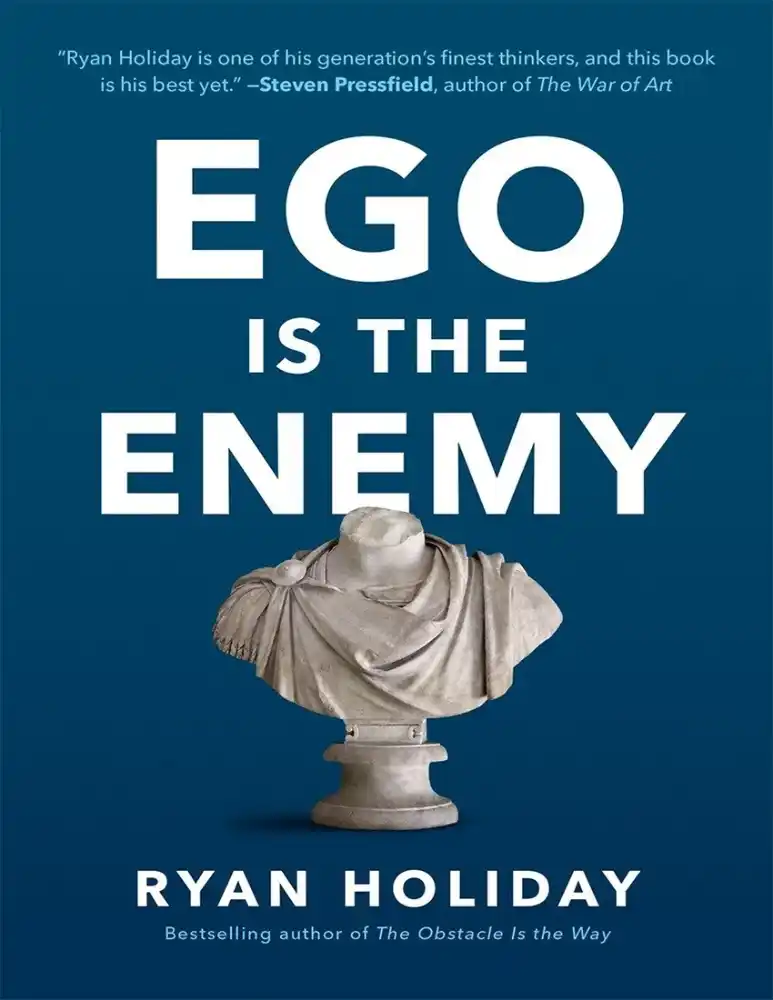
What happens when you do everything right and still lose? When you work harder than anyone, execute flawlessly, give your absolute best—and the world responds with failure, rejection, or indifference? Ryan Holiday’s “Ego is the Enemy” confronts this painful reality through the story of Belisarius, one of history’s greatest yet most forgotten military commanders, whose experience poses a question we all must answer: Can the work itself be enough when the rewards never come?
This isn’t a comfortable topic. We want to believe that hard work guarantees success, that excellence ensures recognition, and that doing the right thing brings appropriate rewards. But reality is more complex and often less fair. The question isn’t whether this is just—it clearly isn’t—but whether we can find peace and purpose regardless.
The Greatest General You’ve Never Heard Of
Holiday introduces us to Belisarius, the Byzantine Empire’s highest-ranking commander under Emperor Justinian. By age forty, he had saved Western civilization on at least three occasions, won brilliant victories across the known world, and recaptured territories that had been lost for generations.
His victories at Dara, Carthage, Naples, Sicily, and Constantinople were masterpieces of military strategy. With just a handful of bodyguards, he saved the throne when riots had grown so intense the emperor planned to abdicate. He defended Rome itself against barbarian hordes despite being undermanned and deprived of resources.
The magnitude of his achievements is staggering. He should be remembered alongside history’s greatest military minds—Alexander, Caesar, Napoleon. Yet most people have never heard his name.
Why? Because the paranoid emperor he served, Justinian, repeatedly suspected him of disloyalty, undermined his victories with foolish treaties, corrupted his historian to tarnish his reputation, and eventually stripped him of command, wealth, and according to legend, even his sight. The general ended his days reportedly begging in the streets—if not literally, then certainly metaphorically stripped of the honors he deserved.
The Outrage We Feel (And Belisarius Didn’t)
Holiday notes that historians, scholars, and artists have lamented this injustice for centuries. Like all fair-minded people, we’re outraged at the stupidity, ingratitude, and unfairness that this remarkable man endured.
But here’s what makes the story truly profound: We don’t hear Belisarius himself complaining. Not at the time, not at the end of his life, not even in private letters.
He could have seized the throne on numerous occasions—he had the loyalty of the military and the people. He was never even tempted. While Emperor Justinian fell victim to every vice of absolute power—control, paranoia, selfishness, greed—Belisarius remained remarkably free from these corruptions.
In his eyes, he was simply doing his job, fulfilling what he believed was his sacred duty. He knew he did it well. He knew he had done what was right. That was enough.
The Brutal Lesson of Control
The story forces us to confront a fundamental truth about life: we have minimal control over the ultimate rewards for our work. Belisarius could control his strategy, his leadership, his personal ethics, and his effort. He could not control whether his work would be appreciated, whether it would arouse suspicion, or whether a powerful dictator would treat him fairly.
This reality extends to virtually every domain of human achievement:
The activist may find their cause advances only so far before hitting immovable obstacles. They may be assassinated before their work is done.
The inventor might create something brilliant that languishes “ahead of its time,” only to see others credit for similar ideas decades later.
The artist could produce their best work to crickets and indifference, while lesser efforts by others receive acclaim.
The entrepreneur might build an excellent product that fails due to market timing, superior competitor resources, or simple bad luck.
The parent may do everything right and still watch their child struggle or fail.
According to society’s metrics—fame, wealth, recognition, obvious impact—these people failed. Should they have not bothered trying?
The Alternative to Disappointment
Ego would say yes. If we can’t control the outcome, if our work might not be rewarded, why invest the effort? Better to protect ourselves from disappointment by not trying so hard, not caring so much, not investing our full selves in endeavors that might not pan out.
Holiday argues this is precisely backward. The alternative isn’t giving up or going half-hearted—it’s changing what we consider success.
John Wooden, the legendary basketball coach, defined success as “peace of mind, which is a direct result of self-satisfaction in knowing you made the effort to do your best to become the best that you are capable of becoming.”
Notice what’s missing from that definition: winning, recognition, rewards, external validation. Success, properly understood, is internal and based entirely on factors within our control: Did we make the effort? Did we do our best? Did we become what we’re capable of becoming?
Marcus Aurelius, the Roman emperor and philosopher, put it more bluntly: “Ambition means tying your well-being to what other people say or do. Sanity means tying it to your own actions.”
The Freedom in Letting Go
Holiday suggests that paradoxically, the less attached we are to outcomes, the better we perform and the more likely good outcomes become. When we’re desperate for recognition, validation, or specific results, that desperation affects our decision-making and execution.
Performance anxiety is real. The pressure to succeed can undermine the very capabilities that made success possible. Athletes choke in big moments. Entrepreneurs make desperate moves when they can’t accept failure. Creators compromise their vision chasing external validation.
But when we focus on the process, on excellence for its own sake, on doing the work regardless of what comes next, we tap into a different kind of power. The work becomes its own reward, and ironically, this often produces better results than outcome obsession ever could.
The Diogenes Response
Holiday recounts the famous encounter between Alexander the Great and Diogenes, the Cynic philosopher. Alexander, the most powerful man in the world, approached Diogenes and asked what he could do for this notoriously poor man.
Diogenes, who was lying down enjoying the summer air, requested: “Stop blocking my sun.”
The message was clear: You’re not as important as you think. Your power doesn’t impress me. I have what matters—the sun, this moment, my peace—and you’re just in the way.
Robert Louis Stevenson later observed about this exchange: “It is a sore thing to have labored along and scaled arduous hilltops, and when all is done, find humanity indifferent to your achievement.”
Get ready for it, Holiday warns. Maybe your parents will never be impressed. Maybe your partner won’t understand. Maybe the investors won’t see the value. Maybe the audience won’t applaud. But we have to push through. We can’t let that be what motivates us.
The “Expectation Hangover”
One of ego’s most destructive patterns is what Holiday calls the “expectation hangover”—the assumption that effort and reward always correlate. Early in our careers or endeavors, we’re often praised and compensated for our work. This creates an unconscious expectation: do good work, receive recognition.
But this correlation is inconsistent at best. Sometimes excellent work goes unrewarded. Sometimes mediocre work receives disproportionate praise. Sometimes we do everything right and still lose.
The expectation hangover hits when reality violates our assumption that outcomes should match efforts. Ego can’t process this. It demands: “But I did everything right! I deserve better! This isn’t fair!”
All of which might be true but is also utterly irrelevant to the question of what we do next. Will we let disappointment poison our future efforts? Will we become bitter about doing good work because it wasn’t sufficiently rewarded? Or will we find a way to keep doing our best regardless?
The Three Questions
Holiday frames the challenge through three critical questions we must answer for ourselves:
Are we willing to work hard for something that can be taken away from us? If we’ll only invest effort when outcomes are guaranteed, we’ll never do anything significant. All meaningful work involves uncertainty.
Will we invest time and energy even if an outcome is not guaranteed? The most important projects are precisely those with uncertain outcomes. If success was guaranteed, everyone would do it and it wouldn’t be valuable.
With what motives are we willing to proceed? If our motive is outcome-dependent—fame, wealth, recognition—we’re vulnerable to disappointment and sabotage. If our motive is the work itself and the person it makes us, we’re antifragile.
The Practical Application
Holiday acknowledges this philosophy is difficult to maintain, particularly in a culture obsessed with outcomes, metrics, and recognition. But he offers practical strategies:
Define Personal Standards: Create clear criteria for success that you control completely. Did you prepare fully? Execute well? Maintain integrity? Learn from the experience?
Focus on Process Goals: Rather than “win the championship” or “make a million dollars,” set goals like “practice four hours daily” or “contact ten potential clients each week.” You control these entirely.
Celebrate Effort, Not Outcomes: Rewire your internal reward system to feel satisfaction from having given your best, regardless of results.
Seek Internal Validation: Develop the capacity to know when you’ve done good work, whether or not others recognize it. Trust your own assessment more than external feedback.
Let Results Be Extra: Treat recognition, rewards, and positive outcomes as bonuses rather than the point. The point is doing the work well. Everything else is gravy.
Belisarius’s Last Stand
Holiday returns to Belisarius at the story’s end. After being wrongly suspected, stripped of honors, and disgraced, he was eventually found innocent and restored—just in time to save the empire once more as an old man.
Except no, life isn’t a fairy tale. He was again wrongly suspected of plotting against the emperor. The Longfellow poem about our forgotten general depicts him at life’s end, impoverished and disabled, concluding with great strength:
“This, too, can bear;—I still
Am Belisarius!”
His identity, his self-worth, his peace—none of it depended on recognition or fair treatment. He knew who he was and what he’d done. That knowledge was sufficient.
The Ultimate Question
Holiday closes with the question we all must answer: Can you be satisfied knowing you did your best even when the world doesn’t acknowledge it? Can you find peace in your effort when results don’t match your work?
Because you will be unappreciated. You will be sabotaged. You will experience surprising failures. Your expectations will not be met. You will lose. You will fail.
The question isn’t whether this will happen—it definitely will. The question is whether you’ll let it break you or whether you’ll find strength in Belisarius’s example: the work was sacred, the effort was honest, the results are out of your hands.
Do your work. Do it well. Then let go. That’s all there needs to be.
The Liberation
What Holiday describes isn’t resignation or giving up on achievement. It’s liberation from the tyranny of outcome obsession. It’s freedom from ego’s need for constant validation and recognition.
When the effort itself is enough, we’re no longer hostage to others’ opinions, market conditions, or luck. We can do our best work without the anxiety that crushes performance. We can risk and fail without feeling like failures. We can create, build, and strive with the knowledge that whatever happens, we showed up fully.
This doesn’t guarantee success by conventional measures. But it guarantees something more valuable: the ability to live with integrity and purpose regardless of circumstances. That’s a success no one can take away.
Source: “Ego is the Enemy” by Ryan Holiday – A profound exploration of how to find meaning and peace when external validation fails to materialize.
Related posts:
 Complete Guide to Ego is the Enemy: Ryan Holiday’s Blueprint for Defeating Self-Sabotage
 Ego is the Enemy by Ryan Holiday: 25 Life-Changing Takeaways (Complete Summary & Review)
 Who is Ryan Holiday and His Impact on Philosophy
 Everything You Need to Know About Ryan Holiday’s “The Obstacle Is the Way” (Complete Book Guide)
 Ryan Holiday’s “Wisdom Takes Work”: Why Philosophy Only Matters When It’s Practiced