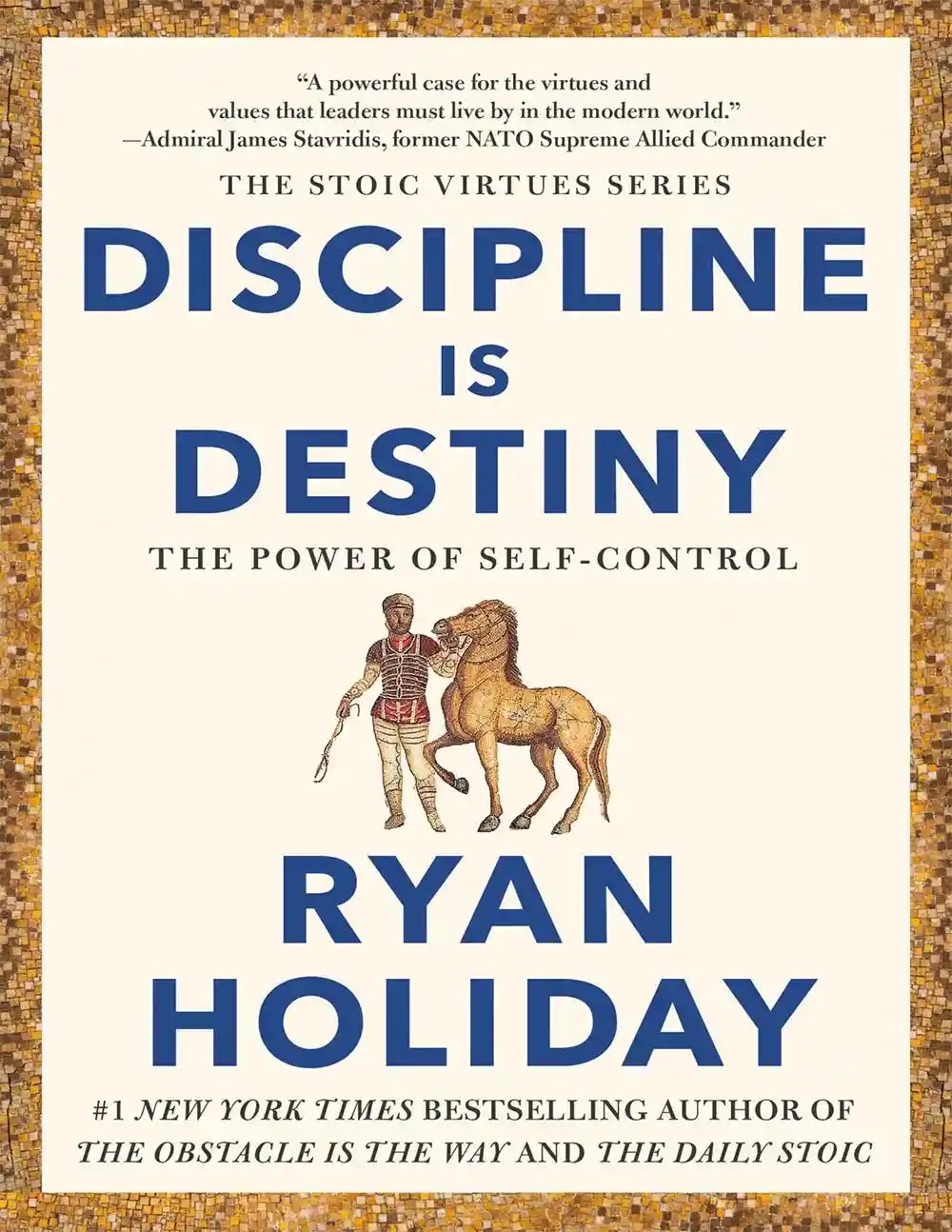
What separates those who achieve their potential from those who fall short? What allows some people to build extraordinary lives while others drift through mediocrity? According to Ryan Holiday‘s bestselling book Discipline Is Destiny: The Power of Self-Control, the answer is deceptively simple: self-discipline. This comprehensive guide explores the complete themes, lessons, and practical wisdom from Holiday’s powerful exploration of temperance, the second of the four cardinal virtues.
What Is Discipline Is Destiny About?
Discipline Is Destiny is the second book in Ryan Holiday’s four-part series on the cardinal virtues. While his first book in the series, Courage Is Calling, explored bravery and facing fear, this volume focuses entirely on temperance and self-control. Holiday argues that discipline is not restrictive or punishing. Rather, it is the path to freedom, excellence, and living a life of meaning.
The book is divided into three parts that mirror the Stoic framework of control:
The Exterior explores discipline of the body. This includes physical fitness, sleep, diet, waking early, managing energy, and how physical discipline builds mental strength.
The Inner Domain examines discipline of temperament. This covers managing emotions, developing focus, practicing patience, controlling anger, setting boundaries, and cultivating mental toughness.
The Magisterial investigates discipline of the soul. This section explores grace under pressure, service to others, maintaining principles under success, and how discipline elevates not just the individual but everyone around them.
Through hundreds of historical examples, philosophical insights, and practical applications, Holiday makes the case that discipline is destiny because how you control yourself determines what you become.
The Four Virtues Framework
Holiday grounds Discipline Is Destiny in the ancient framework of the four cardinal virtues: courage, temperance, justice, and wisdom. These virtues have been recognized across cultures for millennia as the foundation of the good life.
Temperance, the focus of this book, is often the most misunderstood virtue. Many people think of temperance as abstinence or deprivation. Holiday reframes it as self-control, discipline, and moderation. It is about mastering yourself so you can achieve your goals and maintain your values under any circumstances.
As Holiday explains, the four virtues are interconnected. You cannot have true courage without the discipline to act despite fear. You cannot practice justice without the self-control to resist self-interest. You cannot develop wisdom without the focus to learn and reflect. Discipline is the thread that connects all the virtues.
Key Themes and Lessons
Physical Discipline as Foundation: Holiday emphasizes that discipline begins with the body. How you treat your physical self sets the pattern for everything else. The person who cannot control their diet, exercise, or sleep schedule will struggle to control their emotions, finances, or career. Physical discipline is not vanity. It is the proving ground where you learn to do hard things.
The book draws heavily on Theodore Roosevelt’s concept of the strenuous life. Roosevelt transformed himself from a sickly child into one of history’s most energetic leaders through relentless physical discipline. Holiday uses this example to show that physical challenges forge mental toughness.
The Power of Small Habits: Discipline Is Destiny emphasizes that character is built through small, daily choices. The person who wakes up when their alarm rings rather than hitting snooze is practicing discipline. The person who goes to the gym despite not feeling like it is practicing discipline. These small victories accumulate into major character strengths.
Holiday cites the concept of marginal gains, popularized by the British cycling team. Tiny improvements in multiple areas compound into dramatic overall improvement. One percent better every day leads to being 37 times better over a year through compounding.
Managing Emotions and Impulses
A central theme throughout Discipline Is Destiny is emotional regulation. Holiday argues that the inability to control emotions is the source of most self-destructive behavior. Road rage, impulsive purchases, damaged relationships, career-ending outbursts. All stem from emotion overwhelming discipline.
The book provides numerous historical examples of people who maintained composure under extreme pressure. Marcus Aurelius governing Rome during plague and war. George Washington holding the Continental Army together during Valley Forge. Stockdale surviving years of torture in Vietnam. These individuals felt intense emotions but chose not to be controlled by them.
Holiday teaches the Stoic technique of pausing between stimulus and response. Something happens. You feel an emotion. Before acting, you pause and choose your response deliberately. This tiny gap is where discipline lives. It is where you exercise freedom.
Delayed Gratification and Patience
Perhaps no theme in Discipline Is Destiny is more relevant to modern life than delayed gratification. We live in an instant gratification culture where everything is available immediately. This makes the ability to wait for better rewards increasingly rare and valuable.
Holiday discusses the famous marshmallow test and its implications. Children who could delay eating one marshmallow to get two later had better life outcomes decades afterward. This was not about marshmallows. It was about impulse control and future orientation.
The book argues that every worthwhile achievement requires delayed gratification. Building a business. Developing a skill. Creating meaningful relationships. Getting in shape. All require sacrificing immediate pleasure for future rewards. The person who masters this skill has a massive advantage over those who cannot.
Focus and Attention
Holiday dedicates significant attention to the crisis of focus in modern life. With smartphones, social media, and constant connectivity, sustained attention has become nearly impossible for most people. Yet the ability to focus deeply on one thing is more valuable than ever.
The book introduces concepts like deep work, single-tasking, and protecting your attention from digital parasites. Holiday argues that your attention is your most precious resource. What you focus on determines your experience of life and what you accomplish.
Keep the main thing the main thing is a recurring theme. The disciplined person identifies what truly matters and protects that from encroachment by the merely urgent. They say no to good opportunities to say yes to great ones. They eliminate rather than optimize. They focus rather than scatter.
Boundaries and Saying No
A critical insight from Discipline Is Destiny is that discipline requires boundaries. You cannot say yes to your priorities unless you say no to everything else. The person without boundaries is enslaved to the demands and expectations of others.
Holiday discusses boundaries with time, boundaries with energy, boundaries with attention, and boundaries with yourself. He emphasizes that boundaries are not selfish. They are essential. You cannot serve others well if you do not first take care of yourself.
The book provides practical advice on setting and maintaining boundaries. How to say no without guilt. How to communicate limits clearly. How to deal with people who push against your boundaries. How to maintain boundaries even when it feels uncomfortable.
Grace Under Pressure
One of the most powerful sections of Discipline Is Destiny explores how disciplined people maintain composure during crisis. Holiday defines grace under pressure as the ability to think clearly and act honorably when circumstances would justify panic.
This is not about being emotionless or fearless. It is about refusing to let circumstances dictate your response. The person with grace under pressure feels fear but acts with courage. They feel anger but respond with measured judgment. They face uncertainty but maintain their principles.
Holiday uses Hemingway’s definition of courage as grace under pressure and applies it more broadly. True character is revealed not when things are easy but when everything is difficult. The disciplined person performs best precisely when pressure is highest because they have trained for those moments through daily practice.
Self-Compassion and Sustainability
A surprising and important theme in Discipline Is Destiny is self-compassion. Holiday argues that sustainable discipline requires kindness to yourself. The person who is relentlessly harsh with themselves eventually burns out or gives up.
This is not about lowering standards. It is about maintaining high standards in a sustainable way. It is about treating yourself as you would treat a good friend: with honest feedback and genuine support.
Holiday draws on Stoic wisdom about being tolerant with others and strict with yourself, but clarifies that strict does not mean cruel. You hold yourself accountable while extending grace for your humanity. You acknowledge failures without defining yourself by them. You demand excellence while accepting that growth takes time.
Historical Examples Throughout the Book
Holiday fills Discipline Is Destiny with compelling historical examples. Each chapter features people who embodied the principle being discussed:
Lou Gehrig playing 2,130 consecutive baseball games despite injuries and illness, demonstrating the discipline of showing up.
Queen Elizabeth II maintaining composure and service through decades of public scrutiny and personal challenges.
George Marshall sacrificing personal glory for the greater good, showing discipline in ego management.
Eisenhower managing his temper and making calculated decisions under enormous pressure during World War II.
These are not superhuman people. They are humans who developed discipline through practice and maintained it through consistency. Holiday shows that discipline is accessible to anyone willing to do the work.
Practical Applications
Discipline Is Destiny is not just philosophy. It provides practical guidance for developing self-discipline:
Start with physical discipline through exercise, proper sleep, and morning routines.
Practice delaying gratification in small ways daily.
Protect your attention through digital boundaries and focus practices.
Develop emotional regulation through pausing before reacting.
Set clear boundaries and practice saying no.
Maintain routines especially during difficult times.
Track progress and celebrate small wins.
Practice self-compassion while maintaining high standards.
Holiday emphasizes that discipline is built gradually. You do not become disciplined overnight. You become disciplined through thousands of small choices made consistently over time.
Why Discipline Is Destiny
The title captures Holiday’s central thesis: your level of self-discipline determines your destiny. Not in some mystical sense, but in a practical, cause-and-effect sense.
Discipline determines your health because it governs your diet, exercise, and sleep choices.
Discipline determines your career because it affects your work quality, focus, and persistence.
Discipline determines your relationships because it controls your emotional reactions and commitment.
Discipline determines your character because it shapes your choices when no one is watching.
Discipline determines your happiness because it allows you to pursue long-term fulfillment over short-term pleasure.
As Holiday writes, self-discipline is self-respect. When you do what you say you will do, when you honor commitments to yourself, when you control impulses and emotions, you are demonstrating that you value yourself and your future.
The undisciplined person is enslaved to their impulses, emotions, and circumstances. The disciplined person is free to pursue their goals and maintain their values regardless of circumstances. This is why discipline is destiny.
Connection to Stoic Philosophy
Like all of Holiday’s work, Discipline Is Destiny is grounded in Stoic philosophy, particularly the teachings of Marcus Aurelius, Epictetus, and Seneca. The Stoics believed that virtue, including temperance, was the only true good and the path to eudaimonia or human flourishing.
The book emphasizes core Stoic practices:
Focus on what you can control. Practice voluntary discomfort to build resilience. Maintain your principles regardless of outcomes. Treat obstacles as opportunities for virtue. Remember that you will die, so act accordingly.
Holiday makes these ancient practices accessible and relevant to modern life. He shows that Stoic discipline is not cold or harsh. It is warm and life-affirming. It is about living fully, deeply, and excellently.
Who Should Read This Book
Discipline Is Destiny is for anyone who wants to improve themselves and achieve their potential. Specifically, it speaks to:
People struggling with self-control in any area: diet, exercise, finances, time management, or emotions.
Leaders who need to maintain composure under pressure and model discipline for others.
Anyone feeling overwhelmed by modern distractions and seeking focus.
People who have achieved success but struggle to maintain it or feel controlled by it.
Those seeking a philosophical framework for self-improvement grounded in ancient wisdom.
Parents who want to model and teach discipline to their children.
Anyone interested in Stoic philosophy and its practical applications.
The book is written accessibly. You do not need philosophy background to understand it. Holiday translates ancient wisdom into modern language with contemporary examples.
Critical Reception and Impact
Discipline Is Destiny became an instant bestseller upon release, reaching the New York Times bestseller list and remaining there for months. It has been translated into dozens of languages and has sold hundreds of thousands of copies worldwide.
Readers praise the book for its practical wisdom, compelling examples, and accessible writing. It resonates particularly with people who feel overwhelmed by modern life and seek a framework for regaining control.
The book has been adopted by sports teams, military units, businesses, and schools as a guide to building discipline and character. Many readers report that it provided the catalyst they needed to make significant life changes.
Final Thoughts
Discipline Is Destiny is ultimately a book about freedom. Not freedom from rules or constraints, but freedom through them. The disciplined person is free to pursue their goals because they are not enslaved to their impulses. They are free to maintain their values because they are not controlled by circumstances. They are free to build the life they want because they have mastered themselves.
Ryan Holiday has created a comprehensive, practical, and inspiring guide to self-discipline grounded in ancient wisdom but perfectly suited to modern challenges. Whether you read it cover to cover or return to specific chapters as needed, Discipline Is Destiny provides the framework and motivation to take control of yourself and, therefore, your destiny.
The question the book leaves you with is simple but profound: Will you be disciplined, or will you drift? Will you control yourself, or will you be controlled? Will you shape your destiny, or will you be shaped by circumstances?
The choice, as always, is yours. Choose discipline.

Related posts:
 Who is Ryan Holiday and His Impact on Philosophy
 Ryan Holiday’s “Wisdom Takes Work”: Why Philosophy Only Matters When It’s Practiced
 Everything You Need to Know About Ryan Holiday’s “The Obstacle Is the Way” (Complete Book Guide)
 Why Physical Discipline Builds Mental Strength (Discipline Is Destiny by Ryan Holiday)
 How to Set Boundaries Without Guilt (Discipline Is Destiny by Ryan Holiday)