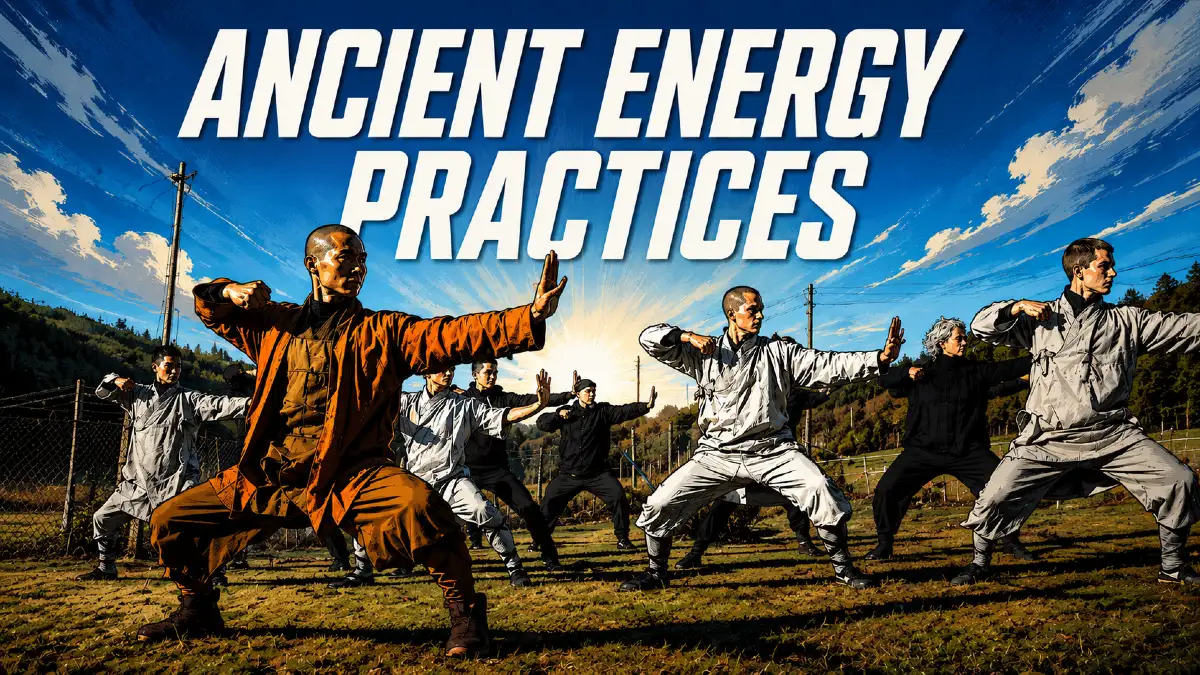
Modern men are sold a tired story: that real energy is something you grind out under a barbell or chug from an aluminum can. The truth is older, quieter, and far more efficient. From Tibetan inner-fire breathing to Japanese cold water rituals, these eight ancient energizing practices have been recharging warriors, monks, and sages for thousands of years—and they still work for the man behind the desk in 2026.
There is a strange irony in modern men’s health. We live in the most caffeinated, supplemented, and gym-saturated era in history, yet “low energy” has quietly become a defining male complaint of the decade. The standard prescriptions—another pre-workout, another HIIT class, another adaptogen blend—keep multiplying. So does the fatigue.
Ancient cultures understood something we have largely forgotten: energy is not a resource you burn through, it is a current you cultivate. Long before treadmills and testosterone clinics, men from the Himalayas to the Mediterranean built daily rituals to charge the nervous system, sharpen the mind, and keep the body resilient deep into old age. These weren’t workouts. They were operating systems for vitality.
The eight practices below come from Indian, Tibetan, Chinese, and Japanese traditions. None require a gym, equipment, or a supplement order. Most take ten to twenty minutes. All of them are still practiced today, in part because modern research keeps quietly confirming what monks and yogis claimed centuries ago—that breath, posture, touch, light, and cold can shift human physiology in profound ways.
This isn’t a list of esoteric curiosities. It’s a working menu. Pick one, practice it for a month, and you’ll feel why these methods outlasted every empire that ever produced them.
Why Ancient Energy Practices Still Work in the Modern Age
Across cultures, the language differs but the insight is the same. The Chinese call life force Qi. The Indians call it Prana. The Japanese call it Ki. The Greeks called it pneuma. Whatever the name, the underlying idea is that a man’s energy is not just calories converted to ATP—it is the interplay between breath, blood, nervous system, attention, and environment.
Modern physiology has begun to translate this. Slow, structured breathing demonstrably shifts the autonomic nervous system from sympathetic (fight-or-flight) toward parasympathetic balance, which is where sustainable energy actually lives. Brief cold exposure spikes norepinephrine, the catecholamine behind alertness and focus. Standing meditation realigns posture in ways that reduce the chronic muscular tension drain most men don’t even notice. Self-massage stimulates lymphatic flow and vagal tone. Aligning sleep with circadian light cues governs every major hormone in the male body, from cortisol to testosterone.
In other words, the ancients were not mystics fumbling toward truth. They were empiricists working with the only laboratory available: their own bodies, over generations. The result is a toolkit that bypasses the gym entirely and goes straight to the systems that generate energy in the first place.
The practices below are organized roughly from most accessible to most demanding. Read them all, then pick the one that meets you where you are.
The 8 Ancient Energizing Practices
1. Bhastrika Pranayama – The Bellows Breath (India)
If you only ever learn one ancient energizing practice, make it this one. Bhastrika, Sanskrit for bellows, is a rapid, forceful breath used in yogic traditions for thousands of years to ignite internal heat and flood the system with oxygen. Picture a blacksmith pumping air into a forge: the fire jumps. Bhastrika does the same thing to you.
In Light on Pranayama, the late B.K.S. Iyengar described prana as “the breath of life of all beings in the Universe.” That framing matters. Bhastrika is not a breathing exercise so much as a deliberate intake of life force. The mechanics are simple. Sit upright. Inhale forcefully through the nose, expanding the belly. Exhale with equal force, pulling the navel toward the spine. Both directions are active. Aim for one breath per second, ten to twenty rounds, then pause and breathe normally before repeating.
The effects are immediate. Most men report a flushed warmth, sharper vision, a quiet alertness that doesn’t crash like caffeine does. A 2021 NCBI study referenced widely in the yoga research literature linked regular pranayama practice to measurable cortisol reductions over a few weeks. That is meaningful for any man who lives in a state of low-grade stress.
A practical note: Bhastrika is stimulating, not sedating. Practice it on an empty stomach, ideally in the morning, and always close the session with a few minutes of slow breathing to avoid lightheadedness. Men with high blood pressure or heart conditions should consult a doctor first. Done correctly, two or three minutes of Bhastrika does what a double espresso pretends to do—without the half-life or the jitters.
2. Tummo – The Tibetan Inner Fire
Among the ancient energizing practices most associated with elite physical performance, none rivals Tummo. Developed by Tibetan Buddhist monks in the Himalayas, the practice combines visualization, breath retention, and isometric muscle engagement to generate measurable internal heat. Practitioners have famously been documented drying wet sheets draped over their bodies while sitting in subfreezing temperatures—a feat verified by Harvard researchers in the 1980s.
Most Westerners now encounter Tummo through Wim Hof’s adaptation of it, which has been studied for its influence on the autonomic nervous system, inflammation markers, and adrenaline response. But the original practice is older, deeper, and more contemplative. The aim was never to impress; it was to forge the kind of psychophysical resilience required for years of solitary meditation in the cold.
The simplified protocol begins with thirty to forty deep, full breaths—inhaling fully into the belly and chest, exhaling without force—followed by an exhaled breath hold for as long as comfortable, then a final deep inhale held for fifteen seconds. Repeat three rounds. During the hold, imagine a small flame at the navel growing brighter with each visualization.
What you’ll feel is unmistakable. Tingling extremities, a wave of warmth, an alert clarity that lingers long after the practice ends. Research consistently links this style of breathing to improved stress tolerance and faster recovery. Tummo deserves its place in any serious man’s morning toolkit—but treat it with respect. Practice seated, never in water, never while driving. The body is being asked to do something significant, and it deserves the right setting.
3. Baduanjin – The Eight Pieces of Brocade (China)
Created roughly 800 years ago and refined by Chinese physicians, soldiers, and Taoist masters, Baduanjin (“Eight Pieces of Brocade”) is a sequence of eight flowing movements designed to circulate Qi through the meridians, loosen the spine, and condition the organs. It looks gentle. It is not. The strength of Baduanjin is its surgical precision—each movement targets specific tissues, organs, and breath patterns.
A 2026 clinical trial covered by ScienceDaily found that adults with stage 1 hypertension who practiced Baduanjin saw blood pressure reductions comparable to brisk walking, with benefits holding for an entire year. No equipment, no gym, no impact. Just eight movements, fifteen minutes, done daily.
The full sequence includes movements with names that read like Taoist poetry: Holding Up the Heavens with Both Hands, Drawing the Bow to Shoot the Hawk, Separating Heaven and Earth, Wise Owl Gazes Backward. Each one combines breath, intention, and physical extension. Together they cover virtually every joint and major muscle group while emphasizing the slow, mindful movement that more or less defines internal Chinese martial arts.
For a modern man whose body is locked into a chair for eight hours, Baduanjin is a kind of corrective software update. It restores spinal mobility, calms the nervous system, and—because each movement is paired with intention—trains attention in a way most gym work never does. Tutorials are abundant on YouTube; a quality 10-minute walkthrough is enough to begin. The Brocade is a practice you can carry into your sixties, seventies, and beyond. That kind of longevity in a routine is rare, and worth taking seriously.
4. Zhan Zhuang – Standing Like a Tree (China)
The fourth entry on this list of ancient energizing practices is the strangest at first glance and the most profound on closer examination. Zhan Zhuang (pronounced “jan jong”) translates roughly as standing post or standing like a tree. You stand. That is it. The catch is that you stand with intention—knees soft, spine extended, arms held as if embracing a large invisible sphere—for ten to thirty minutes at a time.
Historians trace Zhan Zhuang back roughly 2,700 years. It was guarded as a secret weapon of Chinese martial arts until the early twentieth century. Masters of internal kung fu credited it with producing extraordinary stamina, structural strength, and what they called internal power. Modern teachers like Lam Kam-Chuen brought it to the West, where men in every demanding profession—from surgeons to special operations veterans—have quietly adopted it.
The mechanism is elegant. Holding a structurally precise posture under gravity forces the body to surface and release every habitual tension pattern you’ve collected over the decades. Tight psoas. Hunched shoulders. Locked jaw. As those patterns dissolve, energy that was being burned to maintain them is released. Practitioners describe the sensation, accurately, as feeling like a battery being recharged.
Begin with five minutes. Stand with feet shoulder-width apart, knees slightly bent, pelvis tucked, arms held in front of the chest as if hugging a tree. Breathe naturally. Notice tension. Let it go. The work is not in doing more; it is in doing less, more precisely. Zhan Zhuang is the rare practice that gets more powerful the older and more skeptical you become.
5. Abhyanga – Warm Oil Self-Massage (India)
The Ayurvedic tradition is unusually generous to busy men. Among its most accessible gifts is Abhyanga—a daily self-massage with warm oil, traditionally performed before bathing. The Charaka Samhita, one of Ayurveda’s foundational texts dating back over two thousand years, considers Abhyanga essential to a daily routine, not an indulgence. It’s worth reframing what massage means in this context. This isn’t a spa appointment. It’s a fifteen-minute act of nervous-system maintenance.
The practice is straightforward. Warm a few tablespoons of oil—sesame in winter, coconut in summer—until comfortably warm to the touch. Starting at the scalp and moving downward, apply the oil with long strokes on the limbs and circular motions over the joints and abdomen. Spend extra time on the feet and ears, both rich in nerve endings. Let the oil absorb for ten to fifteen minutes, then shower with warm water and minimal soap.
The benefits compound. Improved lymphatic drainage. Better sleep quality, since the practice activates parasympathetic recovery. Healthier skin and joints. Reduced anxiety. And, less obviously, a clearer sense of being embodied—of actually inhabiting the body you’re walking around in. Most men, after decades of treating their bodies as a transport system for their heads, find this surprisingly grounding.
The Sushruta Samhita explicitly links daily oil massage to longevity, vigor, and resistance to fatigue. Modern research has begun to support what the ancient texts asserted, particularly around circulation, vagal tone, and stress reduction. For the cost of a bottle of decent sesame oil, you get one of the most evidence-rich self-care practices ever invented.
6. Misogi – Cold Water Purification (Japan)
The Japanese Shinto tradition has practiced Misogi for over a thousand years. The original form involves standing under a cold waterfall, often a sacred one, while chanting and breathing rhythmically. The intent was spiritual purification—washing away accumulated stagnation and renewing the body’s connection to the world. The physiological side effects, it turns out, are exactly what modern men spend a fortune chasing through cold plunge tubs.
Cold water on the body triggers a cascade. Norepinephrine surges. Dopamine rises and stays elevated for hours. Brown adipose tissue activates. The vagus nerve is stimulated, improving the body’s recovery from stress. Misogi practitioners reported clarity, courage, and elevated mood as standard outcomes; modern science calls the same effects neurochemical and quietly catalogs the studies.
The everyday version of Misogi requires no waterfall. End your morning shower with two to three minutes of cold water. Start at the feet and work upward, breathing slowly and consciously throughout. The instinct will be to gasp and tense. Don’t. The whole practice is about choosing your response to discomfort—a small daily rehearsal for choosing your response to everything else.
There is a reason cold exposure has become the central ritual of figures from Wim Hof to Navy SEAL training. It works. But the Japanese framing is worth preserving: this is not a stunt or a flex. It is a practice of presence. Done as a daily ritual, Misogi quietly rebuilds the nervous system’s capacity to remain composed under stress. Few modern men have any practice that does that. This one costs nothing and takes three minutes.
7. Brahma Muhurta – The Pre-Dawn Awakening (India)
Of all the ancient energizing practices on this list, Brahma Muhurta is the easiest to dismiss and the most quietly transformative. The Vedic tradition identifies the ninety-six minutes before sunrise as the most potent window of the day. The name translates as the Creator’s hour. Wake during this window, the tradition teaches, and the entire architecture of your day changes.
There is more science behind this than skeptics expect. Cortisol naturally rises in the hours before dawn, priming the body for action. Exposure to early morning light within thirty minutes of waking calibrates the circadian rhythm, which downstream regulates testosterone secretion, dopamine sensitivity, sleep pressure, and metabolic rate. Wake at 7:30 with the sun already up, and you have already missed your body’s optimal hormonal launch sequence.
The traditional protocol is more nuanced than just wake up early. Rise around 4:30 to 5:30 a.m. Drink warm water. Spend the first hour without screens, in some combination of breathwork, gentle movement, and contemplation—several of the practices on this list fit naturally here. Then watch the sunrise. Sun exposure on the retinas at low solar angle triggers a powerful and clean cortisol awakening response, which is exactly what you want.
What men report after a few weeks is consistent: better sleep at night, more stable energy across the day, sharper morning focus, a sense of having reclaimed time that previously evaporated. Brahma Muhurta is the rare practice that costs nothing and quietly rebuilds the foundation underneath every other one.
8. Trataka – The Steady Gaze (India)
The final practice is the most underrated. Trataka—Sanskrit for to gaze steadily—is a yogic concentration practice in which you fix your eyes on a single point, traditionally a candle flame, without blinking for as long as possible. It sounds trivial. After two minutes, you discover it isn’t.
Trataka was traditionally used to prepare the mind for deeper meditation, to sharpen focus, and to cultivate the kind of unwavering attention that warriors, scholars, and craftsmen depended on. Modern attention is shredded by design—the average knowledge worker switches tasks every few minutes—and that fragmentation drains energy at a rate most men underestimate. Trataka is a direct counter-practice.
The protocol is simple. Sit upright in a dimly lit room. Place a candle at eye level, roughly an arm’s length away. Gaze at the flame without blinking until tears come. Close your eyes and watch the afterimage in the mind’s eye until it fades. Repeat for ten to fifteen minutes. With practice, both external and internal phases lengthen.
The benefits accrue in unusual places. Sharper focus during work. More restful sleep, since the practice trains the nervous system to settle. A subtle but real increase in what athletes call quiet eyes—the ability to look at a single thing without flinching toward distraction. In an attention economy designed to drain you, the man who can hold a gaze for ten minutes has a strange and undervalued kind of strength.
Building Your Own Ancient Energy Stack
Eight practices is more than any one man needs to begin. The mistake is to try to absorb the entire list. The better path is to choose two—one breath-based, one body-based—and practice them daily for thirty days before adding anything else.
A reasonable starter stack for most modern men: Bhastrika for three minutes upon waking, followed by Zhan Zhuang for five minutes, and Misogi for ninety seconds at the end of the morning shower. Total time investment: under ten minutes. Total cost: zero. Total impact, over a few weeks: usually significant enough that you stop wondering whether these old practices still work.
Across centuries and traditions, the message is consistent. Real masculine energy is not extracted from external sources. It is cultivated by changing the inputs—breath, posture, temperature, light, touch, attention—your body responds to. The gym has its place. So does coffee. But neither will ever do what these eight ancient energizing practices were specifically engineered to do, which is build a man who is awake, composed, and quietly powerful in his own life.
The wisdom is already there. It’s been there for two thousand years. All that’s left is to begin.
Related posts:
 Deida’s Breath-work Practice for Masculine Presence and Power (The Way of the Superior Man)
 Breathing and Mental Health: How Breath Changes the Brain
 RORRA Water Filtration System Review: How It Works and Who It’s For
 How Your Nervous System Decides Who’s Safe (And Why That Instinct Can Mislead You)
 Understanding Why Men Are Walking Away From Modern Dating and Relationships and The Rise of MGTOW movement