
Amazon used to be about getting you the best deal. Fast shipping, competitive prices, honest customer reviews—the company obsessed over customer satisfaction to the point where founder Jeff Bezos had executives read customer complaint emails in meetings.
That Amazon is dead. Today’s Amazon is a monopoly tollbooth extracting massive fees from sellers while delivering degraded search results, fake reviews, and inflated prices to consumers. The company that disrupted retail through customer obsession now survives through market dominance and anticompetitive practices that would have been illegal three decades ago.
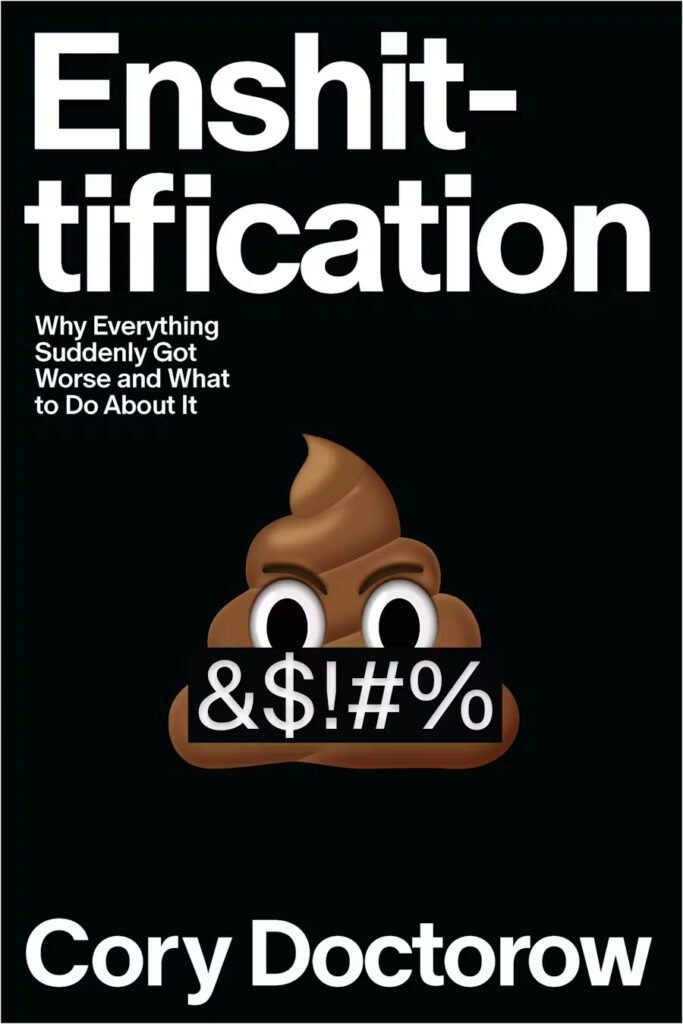
In Enshittification, Cory Doctorow dissects Amazon’s transformation from customer-first innovator to predatory middleman—a case study in how platforms exploit the very people they claim to serve.
Stage One: Obsessive Customer Focus Built the Empire
When Amazon launched in 1995, it solved a genuine problem: buying books was inconvenient. Physical bookstores had limited inventory. Finding specific titles required trips to multiple stores. Prices weren’t competitive.
Amazon offered vast selection, competitive prices, and the convenience of home delivery. The company lost money on most transactions initially, but that was the point—attract customers by offering unbeatable value, build market share, create customer loyalty.
Jeff Bezos famously kept an empty chair in meetings representing the customer. Every decision was evaluated against customer benefit. Would this make shopping easier? Would it save customers money? Would it increase selection or convenience?
This customer obsession was sincere—not because Bezos was altruistic, but because Amazon needed customers desperately. In a competitive market, Amazon had to be better than bookstores, better than competitors, better than any alternative. Customer satisfaction was the only path to growth.
The strategy worked spectacularly. Amazon expanded from books to everything. It built sophisticated recommendation engines. It pioneered one-click purchasing. It developed Amazon Prime, which locked customers into the ecosystem through prepaid shipping and later video streaming.
Stage Two: Weaponizing Sellers Against Customers
Once Amazon dominated online shopping, the game changed. The company shifted focus from serving customers to exploiting sellers—the third-party merchants who now account for over 60% of Amazon’s sales.
Amazon created Marketplace, inviting sellers to list products alongside Amazon’s own inventory. This seemed like a win-win: sellers got access to Amazon’s massive customer base, and customers got more selection. But Amazon controlled the platform, which meant it controlled the terms.
The fees started small. Amazon charged sellers a commission on each sale—reasonable compensation for providing the marketplace infrastructure. But the fees multiplied: referral fees, fulfillment fees, storage fees, advertising fees, return processing fees, subscription fees for professional selling accounts.
Today, Amazon takes close to 50% of every sale from third-party sellers. That’s not a marketplace commission—that’s highway robbery enabled by monopoly power.
But the fees are just the beginning. Amazon systematically degrades the customer experience to extract more money from sellers:
Rigged Search Results: Amazon’s search algorithm prioritizes products that pay for advertising over products that best match customer searches. The top results aren’t the best products or the best deals—they’re the products that paid the most for placement.
Forced Advertising: Sellers who don’t pay for ads see their products buried in search results, even if they offer better quality or lower prices than advertised products. Amazon has made advertising essentially mandatory for sellers to compete.
Captive Fulfillment: Amazon pressures sellers to use Fulfillment by Amazon (FBA), its in-house logistics service. Sellers who don’t use FBA lose the Prime badge and preferential placement in search results. But FBA fees keep rising, forcing sellers to pay Amazon for storage, packing, and shipping while Amazon uses that revenue to subsidize its own retail operations.
Data Exploitation: Amazon collects detailed sales data from third-party sellers—which products sell well, at what prices, to whom. Then Amazon uses that data to develop competing products under its Amazon Basics brand, essentially stealing successful ideas from sellers who depend on the platform.
Price Control: Amazon prohibits sellers from offering lower prices on other websites. If a seller lists a product cheaper elsewhere, Amazon punishes them by suppressing their listings, removing the Buy Box, or deleting the Prime badge. This keeps prices artificially high across the entire internet.
Stage Three: Extracting Everything While Delivering Garbage
By the 2020s, Amazon had consolidated enough power to squeeze everyone simultaneously—sellers, customers, and even advertisers.
For sellers, the platform became a debt trap. To compete, sellers must pay for advertising, use FBA, and accept Amazon’s rising fees. Many sellers operate at razor-thin margins or losses, gambling that volume will eventually bring profitability. Instead, Amazon captures all the profit through fees.
The Federal Trade Commission’s 2023 lawsuit against Amazon documented these practices in detail. The complaint describes how Amazon forces sellers to use FBA, inflates fees systematically, retaliates against sellers who price products lower elsewhere, and operates a “monopoly tollbooth” between businesses and customers.
For customers, the experience degraded in parallel. Amazon’s search results became unusable:
Sponsored Products Everywhere: The first page of search results is primarily ads—products that paid for placement rather than products that match your search. Finding the best product requires scrolling past paid placements designed to look like organic results.
Fake Reviews at Scale: Amazon’s review system—once a differentiator that helped customers make informed decisions—is now polluted with fake reviews, review bombing, and manipulation. Amazon profits from this chaos because it drives sellers to spend more on ads to stand out.
Declining Quality: Amazon’s algorithm optimizes for profit margin, not product quality. This incentivizes cheap knockoffs from overseas manufacturers who can undercut legitimate sellers, secure knowing that Amazon values fees over customer satisfaction.
Junk Ads and Recommendations: Your Amazon homepage fills with products you don’t want based on opaque algorithmic recommendations. The experience feels manipulative rather than helpful—because it is manipulative, designed to maximize Amazon’s revenue rather than serve your needs.
The Infrastructure Play: Owning the Roads, Not Just the Store
Doctorow emphasizes that Amazon’s monopoly power extends beyond retail. The company controls critical infrastructure that competing businesses depend on:
Amazon Web Services (AWS): Amazon’s cloud computing division hosts a massive percentage of the internet. Competing retailers often run their infrastructure on AWS, effectively paying Amazon to compete against Amazon.
Logistics Network: Amazon built a delivery infrastructure so extensive that even competitors sometimes use Amazon’s logistics services, paying their rival for the privilege of serving their own customers.
Smart Home Ecosystem: Amazon’s Echo devices and Alexa voice assistant create lock-in at the household level. Once you’ve invested in Amazon’s ecosystem, switching costs multiply—your smart lights, thermostats, and door locks all integrate with Alexa.
This vertical integration means Amazon controls multiple layers of the economy. It’s not just a retailer competing with other retailers—it’s the landlord collecting rent from retailers while also competing against them for sales.
Why This Matters: The Monopoly Tax on Everything
Amazon’s monopoly power imposes costs that extend far beyond inflated fees on sellers:
Higher Prices for Everyone: When Amazon charges sellers 50% fees, sellers must raise prices to survive. But Amazon’s price parity agreements prevent sellers from charging less elsewhere. Result: prices stay high across the entire internet, not just on Amazon.
Death of Small Business: Independent retailers can’t compete with Amazon’s infrastructure or absorb its fees. The result is consolidation—fewer businesses, less diversity, more power concentrated in Amazon’s hands.
Product Quality Decline: Amazon’s algorithm incentivizes cheap knockoffs over quality products. Legitimate manufacturers struggle to compete with overseas factories producing low-quality goods at prices that only make sense when paired with fake reviews and manipulated rankings.
Privacy Erosion: Amazon collects detailed data about your purchases, browsing behavior, voice commands (through Alexa), and even your body (through health-focused acquisitions). This data feeds algorithmic manipulation and creates barriers to competition.
The Antitrust Case: Amazon’s Playbook for Monopoly
The FTC’s lawsuit against Amazon identifies specific anticompetitive tactics:
Anti-Discounting Measures: Amazon punishes sellers who offer lower prices elsewhere, maintaining artificially high prices across the internet.
Exclusive Dealing: Amazon conditions access to its customer base on sellers using its expensive fulfillment services, blocking competition in logistics.
Self-Preferencing: Amazon uses data from third-party sellers to develop competing products, then promotes its own products over superior alternatives.
Degraded Search Quality: Amazon deliberately makes search results worse by inserting ads, knowing that degraded search results drive more advertising revenue even as they harm customers and honest sellers.
These aren’t innovative business strategies—they’re illegal monopolistic practices. The question is whether regulators will enforce the law or continue allowing Amazon to operate above it.
What Needs to Change: Breaking the Monopoly Tollbooth
Doctorow’s prescription for fixing Amazon requires aggressive policy intervention:
Structural Separation: Amazon shouldn’t be allowed to compete against sellers on its own marketplace. Either it’s a neutral platform or it’s a retailer, but not both. This would end the data exploitation and self-preferencing that crush third-party sellers.
Interoperability Requirements: Force Amazon to allow customers to shop across platforms, compare prices, and move their data to competitors. This would reduce lock-in and restore genuine price competition.
Ban Price Parity Agreements: Make it illegal for Amazon to prevent sellers from offering lower prices elsewhere. This would restore real price competition across the internet.
Regulate Fulfillment Services: Prevent Amazon from conditioning marketplace access on using Amazon’s logistics services. Sellers should be free to choose the most cost-effective fulfillment options without penalty.
Enforce Antitrust Law: Break up Amazon’s integrated empire. AWS shouldn’t subsidize below-cost selling in retail. Amazon’s logistics arm shouldn’t compete against independent shipping companies while also serving them as customers.
None of these interventions are radical. They’re basic applications of antitrust principles that governed markets for most of the 20th century—principles we abandoned during the Reagan era in favor of monopoly-friendly “consumer welfare” standards.
What You Can Do While Waiting for Policy Change
Policy change is essential, but individual action matters:
Shop Elsewhere When Possible: Support independent retailers, use competing platforms, and recognize that Amazon’s convenience comes at enormous hidden costs to sellers, workers, and market competition.
Pressure Companies to Stop Using Amazon Services: The more businesses depend on AWS or Amazon logistics, the stronger Amazon’s monopoly power becomes.
Support Antitrust Enforcement: Contact representatives about the FTC’s Amazon lawsuit. Make it clear that constituents care about monopoly power and market manipulation.
Document the Degradation: When you encounter fake reviews, manipulative search results, or price gouging, report it. Evidence of consumer harm strengthens the case for intervention.
Most importantly, reject the myth that Amazon’s dominance is inevitable or that the only alternative is worse service. Amazon got worse because monopoly power allowed it to stop serving customers and start extracting rents. Breaking that monopoly power would restore incentives to compete on quality, price, and service—the competition that made Amazon successful in the first place.
The everything store became a toll road because we let it. We can dismantle the tollbooth, but only if we demand that policymakers enforce the law.
Related posts:
 Ridge Wallet Review (2026): Is the Minimalist Metal Wallet Actually Worth It?
 Hume Band Review: Does This Stress-Tracking Wearable Actually Work?
 What Is Enshittification? The Pattern Destroying Every Platform You Love
 Momentous Supplements Review 2026: The Science-Backed Brand Trusted by NFL Teams and Andrew Huberman
 How Credit Card Regulations Could Accelerate Crypto Adoption