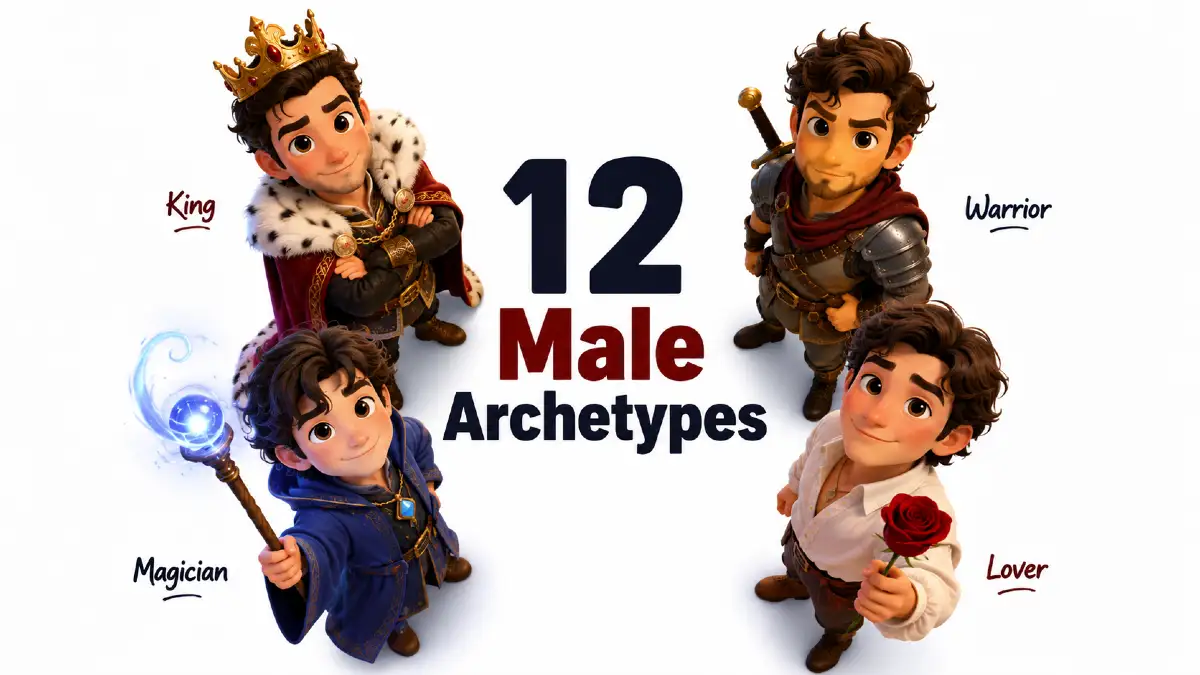
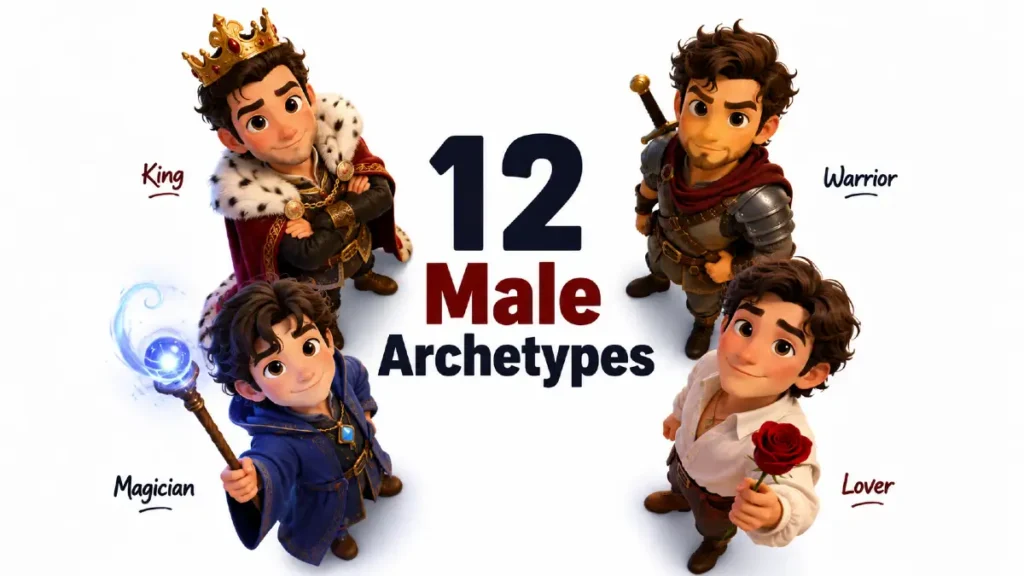
Most lists of “male archetypes” read like a horoscope. Pick your King, your Warrior, your Magician, your Lover, and now you know something about yourself. Close the tab.
That’s not what this is.
The framework below comes from Jungian analysts Robert Moore and Douglas Gillette, who spent years studying Carl Jung’s work on archetypes and built something more useful than a typology: a developmental map. Their argument, laid out in King, Warrior, Magician, Lover, is that every man carries four mature masculine archetypes inside him — and that almost none of us access them in their mature form. Instead, most men operate from boy psychology: exaggerated, defensive, incomplete versions of these same energies, split into two extremes each. Twelve patterns in total. Four destinations, eight detours.
This matters because it reframes the entire question. It’s not “which archetype are you.” It’s “which stage of each archetype are you currently living from — and what would it take to grow up into the version that isn’t compensating for something.”
That question has teeth. It’s also, if you’re honest with yourself while reading it, going to be uncomfortable in places. Good. Real masculinity requires the courage to face reality — a conscious man confronts the truth about himself even when it’s uncomfortable. This is that kind of article.
Here’s why the maturity framing matters more than a typology would. A typology tells you something true and then lets you off the hook — “I’m a Warrior type, that’s just who I am.” A developmental map does the opposite. It tells you where you are and implicitly asks what you’re going to do about it. One flatters you into staying still. The other invites you to move. If you’ve read our piece on the batman effect — how stepping outside yourself and adopting a more capable persona can build real discipline over time — you already understand the underlying mechanic here: naming the gap between where you are and where you could be is often the first real step in closing it.
Where the Framework Comes From
Carl Jung proposed that beneath our individual personalities sits a layer of the psyche shared across humanity — the collective unconscious — populated by recurring symbolic patterns he called archetypes. The Mother, the Hero, the Shadow, the Self. These aren’t personality types you’re assigned. They’re energies, roles, forces that show up in myth, religion, and dreams across every culture on earth because they represent something structural about how the human psyche organizes itself.
Moore and Gillette took Carl Jung’s broader theory and asked a narrower, more practical question: what are the core structures of mature masculine psychology, specifically? Their answer was four — King, Warrior, Magician, Lover — each governing a different function:
- The King governs order, blessing, and generative authority
- The Warrior governs action, discipline, and boundary
- The Magician governs knowledge, insight, and transformation
- The Lover governs feeling, connection, and vitality
Here’s the part that makes this a developmental framework instead of a static one: Moore and Gillette observed that boys don’t arrive at these mature forms automatically. Manhood, biologically, happens on its own. But psychological maturity is not automatic — and in cultures without real initiation (which describes most of the modern West), men get stuck accessing these four energies only in immature, defensive form. Each immature form splits into two poles: an active pole, where the energy is grandiose and inflated, and a passive pole, where it’s collapsed and disowned. This is sometimes called the bipolar shadow — not “shadow” as in evil, but shadow as in the part of the pattern you’re not consciously integrating.
Four archetypes. Two shadow poles each. Twelve patterns total.
Jung himself never laid out this exact twelve-part model — that synthesis belongs to Moore and Gillette, drawing on his broader theory of archetypes and individuation, the lifelong process of integrating unconscious material into conscious awareness. But the underlying logic is pure Jung: nothing you disown disappears. It just goes underground and runs your behavior from below the surface, usually in a more extreme and less examined form than it would if you’d simply owned it consciously in the first place. A man who never lets himself access healthy authority doesn’t become authority-free. He becomes either covertly controlling or chronically passive, because the King energy has to go somewhere. That’s the mechanism behind every shadow pole in this framework.
This lines up with something we’ve written about before — the way strength without self-awareness becomes domination, and strength without ethics becomes destruction — because that’s precisely what happens when a man is stuck in the active pole of any of these twelve. It’s also worth reading alongside our piece on meeting your parts through Internal Family Systems, because IFS and this framework are, functionally, describing the same internal landscape from two different traditions.
One more thing before we go archetype by archetype: this is not about picking a favorite. You have all twelve inside you, in some proportion, right now. The goal by the end of this isn’t to identify your archetype. It’s to identify where you’re stuck, and what maturity would look like from there.
1. The King: Order, Blessing, and the Weight of Responsibility
Mature: The King
The mature King is the organizing principle at the center of a man’s life. Not a monarch ruling over others — a man who has taken full ownership of his own kingdom: his choices, his household, his work, his integrity. The King’s core gift is blessing. He affirms the people around him. He creates order out of chaos without needing to dominate anyone to do it. He can hold both firmness and generosity in the same hand.
A man accessing King energy in its mature form doesn’t need to be in charge of anything external. He might be a father, a foreman, a solo founder, or a quiet presence in a friend group — what matters is that he has centered authority inside himself. This is the same territory we cover in self-discipline and leadership: real authority is a foundation you build, not a title you’re handed.
In practice, the mature King looks like this: he can absorb bad news without panicking the room. He gives credit generously because his sense of worth doesn’t depend on being the only source of it. He sets a standard and holds it consistently, so the people around him always know where they stand with him — which is, itself, a form of care. He says no without needing to justify it for twenty minutes. And critically, he can be wrong, admit it, and still hold the room, because his authority was never built on being infallible in the first place.
Active Shadow: The Tyrant
When King energy is grandiose and untethered from self-awareness, it becomes the Tyrant. The Tyrant needs to control outcomes, people, and narratives because his sense of self collapses the moment he isn’t the center of order. He mistakes domination for leadership. He can’t tolerate being questioned, because questioning threatens the fragile structure holding him together.
This is, almost word for word, what we describe in entitlement, control, and paranoia — the poisons that follow unchecked success. The Tyrant isn’t strong. He’s terrified, and control is his anesthetic.
You’ll recognize the Tyrant by how a room changes when he walks in — not with respect, but with caution. He micromanages because delegation feels like losing his grip on reality itself. He punishes disagreement, even mild disagreement, as though it were betrayal. Underneath the bravado is usually a man who was either given too much unearned power too young, or none at all, and is now overcorrecting in either direction.
Passive Shadow: The Weakling
The other pole looks like the opposite but comes from the same wound. The Weakling has abdicated his authority entirely. He won’t make decisions, won’t set direction, won’t take responsibility for the space he occupies — at home, at work, in a relationship. He isn’t humble. He’s absent. Somewhere along the way, he learned that claiming any authority was dangerous, so he stopped claiming any at all.
If this pole resonates, it’s worth reading locus of control: how to stop blaming others and take back your power — because the Weakling’s core belief is that his life is happening to him, not through him.
Watch for it in the small moments: letting a partner make every real decision and calling it “keeping the peace.” Deferring at work past the point where deference is useful, because a clear opinion feels like a liability. Saying “whatever you want” so often that the people around you no longer trust that you actually want anything. The Weakling often gets mistaken for an easygoing guy. He isn’t easygoing. He’s checked out of his own authority.
Growing the King
Maturing King energy usually means starting small: taking full ownership of one domain of your life without controlling the people in it. It also means examining your relationship with your own father, since so much of how men internalize (or fail to internalize) authority traces back there — our piece on coming to peace with your father is a useful starting point if that wound is active.
2. The Warrior: Discipline, Action, and the Line You Won’t Cross
Mature: The Warrior
The mature Warrior is not aggression. He’s the part of a man capable of decisive, disciplined action in service of something larger than his own ego — a cause, a family, a standard he’s set for himself. He can fight when fighting is necessary and stand down when it isn’t, and the difference between those two calls is his defining skill. He has boundaries and he holds them without apology.
This is the energy behind everything in our self-discipline mini-course — the Warrior is the part of you that does the hard thing on the day you don’t feel like it, because you decided, in advance, that you would.
Concretely: the mature Warrior trains even when motivation is gone, because he answers to a standard, not a mood. He can end a conversation, a friendship, or a business relationship cleanly when it’s no longer serving anyone, without needing to make the other person the villain first. He fights for people who can’t fight for themselves. He tells the truth even when a comfortable lie would be easier, because he’s decided that clarity matters more than being liked.
Active Shadow: The Sadist
Warrior energy running hot and unintegrated becomes cruelty. The Sadist uses aggression not in service of a boundary or a cause but to feel powerful at someone else’s expense — verbally, physically, or through cold domination in a relationship or a workplace. He’s addicted to the feeling of winning because losing, underneath it, feels like annihilation.
This can be loud — the boss who dresses down a subordinate in front of others — or quiet: the partner who wins every argument through sheer relentlessness rather than being right. Either version treats every interaction as a contest with a winner and a loser, because a draw, to the Sadist, feels indistinguishable from defeat.
Passive Shadow: The Masochist
The passive pole turns the aggression inward, or lets others turn it on him. The Masochist tolerates disrespect he shouldn’t. He stays in situations — jobs, relationships, friendships — that quietly grind him down, because some part of him believes he doesn’t deserve better, or that enduring pain is the price of being good. This overlaps heavily with what we’ve written about in nice guy syndrome: a man who’s disowned his own aggression usually ends up absorbing everyone else’s.
The Masochist often mistakes his own exhaustion for virtue. He’ll describe a relationship or a job that’s clearly costing him as “just how it is,” because setting a boundary would require accessing an aggression he’s spent years convincing himself he doesn’t have.
Growing the Warrior
Mature Warrior energy is built through small, repeated acts of discipline and boundary-setting — not through intensity, but through consistency. Our piece on bulletproof ways to set boundaries at work is a practical entry point, and working with anger instead of against it addresses the raw material both shadow poles are usually mismanaging.
3. The Magician: Insight, Knowledge, and the Power to Transform
Mature: The Magician
The Magician is the part of a man that sees clearly — patterns, systems, the truth underneath the surface of a situation — and uses that clarity to transform circumstances, teach others, or solve what looked unsolvable. He’s the strategist, the healer, the technician, the mentor. His power comes from understanding, not force.
The mature Magician holds knowledge with humility. He knows what he doesn’t know. He uses insight to illuminate, not to manipulate.
In daily life, this looks like a man who can explain a complicated situation clearly instead of hiding behind jargon or vagueness. He notices patterns in his own behavior — a recurring argument, a repeated career mistake — and names them out loud instead of blaming circumstance. He can sit with someone else’s problem and actually help them see it more clearly, rather than immediately trying to fix it or perform expertise. He treats his own knowledge as something to be updated, not defended.
Active Shadow: The Manipulator
This is Magician energy stripped of ethics: a man who uses his intelligence, charm, or insight into people to control outcomes for his own benefit, often while convincing himself and everyone else that he’s being helpful. He reads people well and uses what he reads against them. This is the exact pattern our editorial principles are built to reject — we explicitly reject manipulation tactics and the cynical exploitation of male pain, and it’s worth being honest with yourself about whether any of your “social skill” has quietly drifted into this territory.
The Manipulator is often the smartest, most articulate man in the room, and he knows it, and he uses that knowledge asymmetrically — withholding information strategically, reframing situations to always land in his favor, making people doubt their own read on events. It rarely looks dramatic from the outside. It usually just looks like a man who always seems to come out ahead, and you can never quite explain how.
Passive Shadow: The Denying Innocent
The passive pole is a man who refuses to look. He avoids uncomfortable truths about himself, his relationships, or his circumstances because facing them would require him to change. He stays naive on purpose — not because he’s incapable of insight, but because insight comes with responsibility he doesn’t want. This shows up constantly in the patterns we cover in why do I self-sabotage: the hidden dark watcher — avoidance dressed up as innocence.
You’ll notice the Denying Innocent by what he refuses to discuss. He changes the subject when a pattern gets pointed out. He’s genuinely surprised, every time, by an outcome that everyone around him saw coming for months. His denial isn’t stupidity — it’s often a fairly sophisticated, mostly unconscious system for staying comfortable.
Growing the Magician
The path here is almost entirely about the willingness to see clearly, including about yourself, and then to use what you see in service of others rather than leverage over them. Our Emotion Codex and breaking the anxiety loop pieces are both, functionally, Magician-energy tools: they ask you to look directly at a pattern instead of around it.
4. The Lover: Feeling, Connection, and Aliveness
Mature: The Lover
The Lover is the archetype most often missing from conventional masculinity, and its absence explains a lot of what’s broken in how men are taught to move through the world. The mature Lover feels fully — joy, grief, desire, tenderness — and stays connected to his own body and to the people around him without losing himself in either. He’s the source of vitality, aesthetic appreciation, sensuality, and genuine intimacy. Without him, a man can be competent and still be dead inside.
This is the terrain covered extensively in our summary of The Way of the Superior Man — Deida’s entire project is, in Moore and Gillette’s language, an argument for Lover integration.
The mature Lover notices beauty without needing to own it. He can grieve fully and let the grief move through him instead of storing it as tension in his body. He touches, is touched, and stays present through both. He wants things — pleasure, connection, meaning — openly, instead of pretending he’s above wanting.
Active Shadow: The Addicted Lover
When Lover energy is ungrounded, it becomes compulsive. A man chasing the feeling of aliveness through constant novelty — sex, substances, validation, intensity — because he’s lost the capacity to feel alive through presence alone. This is the psychology underneath the compulsive patterns we explore in AI girlfriends and the death of effort and the sports betting trap: both are Addicted Lover energy finding a modern delivery system.
The tell isn’t the appetite itself — desire is healthy, and the mature Lover has plenty of it. The tell is the compulsion: the sense that the next hit of intensity is required, not chosen, and that stillness has become intolerable.
Passive Shadow: The Impotent Lover
The other pole has shut feeling down almost entirely. He’s numb — disconnected from his body, his desires, his grief, his joy. He can go through the motions of a relationship or a life without ever really being present in it. This is the exact territory of our pieces on male emotional health and the shame ceiling: a man who learned early that feeling wasn’t safe, and never unlearned it.
He’s often described, by people who love him, as “hard to reach” — not absent physically, just perpetually somewhere else. He can talk about his week in detail and struggle to say a single true sentence about how any of it actually felt.
Growing the Lover
Reconnecting to Lover energy is rarely intellectual. It’s somatic and relational — starting to actually feel things again, in your body, in real time, and letting people see it. You exist: how to actually feel present in your own body is a good place to start if the Impotent pole is where you’ve been living.
Why the Framework Uses Twelve, Not Four
If you’re only counting the mature forms, you’d say there are four masculine archetypes. Moore and Gillette’s insight was that you can’t understand — or grow into — the mature form without naming its immature poles honestly. The King isn’t fully real to you until you can recognize the Tyrant and the Weakling as versions of yourself you’ve already lived, maybe this week. The same goes for the other three.
That’s the developmental logic behind counting twelve. It’s not twelve unrelated “types” of men. It’s four destinations and the eight most common ways men get stuck on the road there. Most men aren’t purely one pole of one archetype — you might run Tyrant at work and Weakling at home, Impotent Lover with your partner and Addicted Lover with your phone at 1 a.m. The map isn’t meant to sort you into a box. It’s meant to help you notice which room of the house you’re currently standing in.
The Boy Psychology Problem
Moore and Gillette’s central diagnosis is blunt: most modern men are running boy psychology in a man’s body, because the cultures that used to reliably move boys into man psychology — structured initiation, elder mentorship, rites of passage — have largely disappeared. Biological adulthood arrives on schedule. Psychological adulthood does not.
This tracks with a lot of what we’ve documented about the current landscape for men. It’s part of what’s driving the male loneliness epidemic, and it’s a large part of why the men’s group renaissance has picked up steam — men are informally rebuilding the initiatory structures that used to exist by default. Group work, mentorship, and honest brotherhood are, in Moore and Gillette’s terms, some of the few remaining reliable pathways from boy psychology to man psychology, because maturity in this framework isn’t self-taught in isolation. It’s witnessed. It requires other men who’ve made the same crossing to recognize it in you.
If you don’t have that structure available to you right now, individual therapy, honest friendships, and consistent self-reflection can do a meaningful amount of the same work — slower, but real.
It’s worth being specific about what “boy psychology” actually costs a man, beyond the theoretical. A man running Tyrant energy at work eventually loses the people best positioned to tell him the truth, because no one risks it. A man running Impotent Lover in his marriage eventually finds himself technically present at a life he’s not actually living inside. A man running Denying Innocent about his health, his finances, or his drinking eventually gets a wake-up call that arrives later and costs more than it would have if he’d looked sooner. None of these are moral failures in the sense of being bad men. They’re developmental gaps — places where a boy’s coping strategy never got upgraded because nothing ever forced the upgrade. That’s precisely what initiation used to force, deliberately and on a timeline, and what its absence now leaves to chance.
How to Actually Use This Framework
This isn’t meant to stay theoretical. A few ways to put it to work:
Locate your current pole, archetype by archetype. Go through all four — King, Warrior, Magician, Lover — and ask honestly: right now, in this season of your life, am I closer to the mature form, or am I running one of the shadow poles? Most men find they’re stuck in a different pole for each archetype. That’s normal. It’s also useful data.
Notice the compensation pattern. The active and passive poles of any archetype are usually compensating for each other across contexts. A man who’s a Tyrant at work is very often a Weakling at home, because the exhausting effort of maintaining control in one domain leaves nothing left to show up with authority in the other. If you find an active pole in one area of your life, look for its passive twin somewhere else.
Work on integration, not perfection. The goal was never to permanently “arrive” at mature King, Warrior, Magician, and Lover energy and stay there. Even psychologically mature men cycle through the shadow poles under stress, grief, or exhaustion. The difference maturity makes is speed of recovery — how quickly you notice you’ve slipped into Tyrant or Impotent Lover, and how quickly you can find your way back. This is essentially self-compassion without losing discipline or standards applied to this specific map.
Don’t do it alone if you can help it. Because the shadow poles are, by definition, the parts of yourself you’re least able to see clearly, an outside perspective — a therapist, a men’s group, an honest friend — will almost always spot your patterns faster than solo journaling will. Attachment styles in male friendship is a useful companion piece here, since the quality of your friendships often determines whether you have anyone positioned to reflect this back to you honestly.
Track it over time, not just once. A single self-assessment is a snapshot, not a trajectory. Revisit the twelve every few months — after a hard season, a promotion, a breakup, the birth of a kid — because the poles you’re stuck in tend to shift with life circumstance. A man who matures his King energy in his thirties might still find Warrior maturity elusive until his forties force the issue. This isn’t a one-time audit. It’s closer to a recurring practice, similar in spirit to the self-discipline and personal responsibility work we’ve written about elsewhere — the value comes from the repetition, not the single insight.
The Twelve at a Glance
| # | Archetype | Mature | Active Shadow | Passive Shadow |
|---|---|---|---|---|
| 1 | King | The King | The Tyrant | The Weakling |
| 2 | Warrior | The Warrior | The Sadist | The Masochist |
| 3 | Magician | The Magician | The Manipulator | The Denying Innocent |
| 4 | Lover | The Lover | The Addicted Lover | The Impotent Lover |
Use this table as a check-in, not a diagnosis. Most men will find themselves genuinely closer to mature form in one or two rows and clearly stuck in a shadow pole in the others. That unevenness is normal — and it’s exactly the kind of thing a framework like this is supposed to surface.
Common Questions About the Twelve Archetypes
Is this the same as a Myers-Briggs or Enneagram type? No, and the difference matters. Personality frameworks describe fixed traits — how you’re wired. This framework describes a developmental state — where you currently stand on a path toward maturity, which can and should change over time. You’re not a King or a Tyrant the way you’re an introvert or an extrovert. You’re currently accessing King energy in a mature or immature way, and that can shift within the same week depending on stress, sleep, and self-awareness.
Can a man be “mature” in one archetype and stuck in another? Almost always, yes. It’s rare to find someone evenly developed across all four. A man can run a disciplined, mature Warrior at the gym and in his career while still being an Impotent Lover at home, unable to access real emotional presence with his kids or partner. Recognizing the unevenness is usually more useful than trying to average yourself into a single verdict.
Where does the Shadow — in the general Jungian sense — fit into all this? Jung used “shadow” to describe everything about ourselves we’ve disowned or repressed, not just the negative. Moore and Gillette’s “bipolar shadow” is a specific application of that idea to masculine psychology: the disowned material shows up not as one shadow but as two opposing poles of the same energy. If you want the broader picture of shadow work, our piece on meeting your parts through Internal Family Systems is a useful companion, since it maps closely onto the same underlying territory using different language.
Does this framework apply the same way to women? Moore and Gillette built this specifically around masculine psychology, largely because their clinical work was with men. Jungian analysts working with feminine archetypes — Queen, Warrior, Magician, Lover in different form, or entirely separate models like Toni Wolff’s — have developed parallel frameworks. This piece is written for men working with their own masculine psychology, which is also the lens this whole site is built around.
How long does it take to move from boy psychology to man psychology? There’s no fixed timeline, and Moore and Gillette were clear that it isn’t a one-time event — it’s closer to a lifelong practice of noticing, correcting, and re-centering. Men in cultures with strong initiation rites sometimes experience a defined before-and-after. Most modern men experience it as a gradual, uneven climb, with real setbacks. What matters more than speed is whether you’re actually moving, and whether you have people around you honest enough to tell you when you’re not.
A Closing Thought
There’s a temptation, reading a framework like this, to want a clean verdict — I’m a King, I’m a Lover — the same instinct that makes personality quizzes so addictive. Resist it. The entire value of this model is that it refuses to let you settle into an identity and stop there. It keeps asking a harder, more useful question: not what are you, but what are you currently avoiding growing into, and why.
A conscious man does not outsource responsibility for his life — he recognizes his patterns, fears, wounds, and self-betrayals, because agency begins where excuses end. That’s what this map is for. Not a label. A mirror, honest enough to be useful, and a direction, once you’re ready to walk in it.
If you read through the twelve and recognized yourself somewhere uncomfortable — Tyrant at work, Impotent Lover at home, Denying Innocent about a pattern you’ve been avoiding for years — that recognition is not a verdict on your character. It’s the first honest data point you’ve had in a while. Moore and Gillette’s entire model rests on a quietly hopeful premise: the mature form of every one of these archetypes is already inside you, fully formed, waiting on the other side of the shadow pole you’re currently standing in. You don’t need to build the King, the Warrior, the Magician, or the Lover from nothing. You need to stop running from them.
That’s the work. Not becoming someone new. Becoming who you already, underneath the defenses, actually are.
Related posts:
 The 12 Female Archetypes. Carl Jung’s Queen, Huntress, Sage, Lover — and Their Shadow Sides
 Manipulator, Inspirer, Follower: The Archetypes of Influence Running Every Relationship You’re In
 Andrew Bustamante: The CIA Officer Who Turned Spy Skills Into Life Mastery
 What Machiavelli Teaches About Conflict Resolution in Relationships
 Player One Mindset: What The Matrix, NEO and NPC Theory of Consciousness Reveals About Self-Acceptance, Triggers, and Inner Freedom