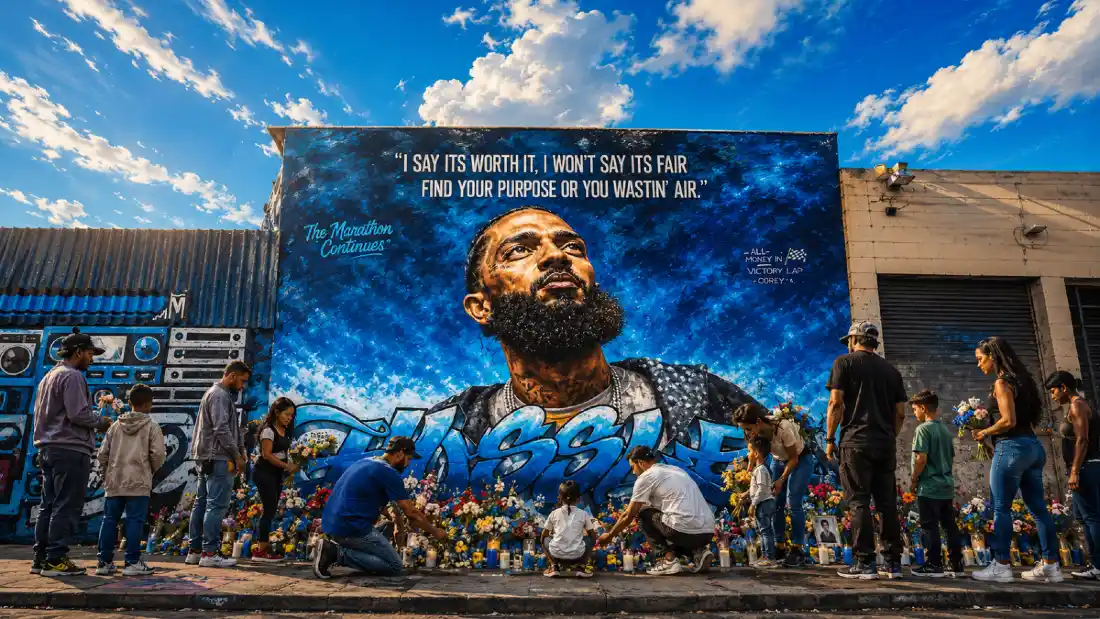
There’s a corner in South Los Angeles — Slauson and Crenshaw — where a strip mall sits that used to be nothing special, and is now something closer to a shrine. Rival gang members who hadn’t spoken civilly in decades have sat down at the same table because of what happened there. A sitting president who never met the man who owned it wrote a letter about him. Dave East, a Harlem rapper who grew up three thousand miles away, still credits that same corner with teaching him to buy his own store instead of renting one. And Nas — one of the most respected voices to ever pick up a microphone, a man who has spent thirty years being selective about who he calls great — posted a letter to his own fans the day the news broke, calling this man a “stand up General for the People who never left his people.”
That man was Ermias Asghedom, known to the world as Nipsey Hussle. He was killed outside that same strip mall on March 31, 2019, at thirty-three years old. But the reason his name still carries weight across every generation and coast of hip-hop — from Nas to Dr. Dre to 50 Cent to the artists coming up right now — has almost nothing to do with how he died. It has to do with what he built, and how he built it, in the years before.
That’s the piece of Nipsey Hussle’s story that tends to get lost when people reduce him to “the guy who bought back his block.” He wasn’t just an entrepreneur who happened to rap. He was a case study — a real, lived, occasionally messy case study — in what it looks like when a man decides to master himself before he tries to master anything else. Ownership. Loyalty. Discipline. The refusal to let pain calcify into permanent bitterness. The willingness to keep showing up for people who never showed up for him. These aren’t slogans on a t-shirt. They were how he actually operated, and the fact that the people who knew this world best — Nas, Jay-Z, Kendrick Lamar, Dr. Dre, 50 Cent, Snoop Dogg — all converged on the same handful of words to describe him tells you something. When the most respected figures in an entire genre stop competing for a moment and simply agree, that’s worth paying attention to.
This isn’t a hagiography. Nipsey Hussle was a human being who came up in genuinely brutal circumstances, carried real contradictions, and was still evolving when his life was cut short. That’s part of what makes his story useful. He wasn’t a finished product handed down from on high. He was a man actively building himself, in real time, in public, with the scars still visible.
From Survival Mode to Self-Mastery
To understand Nipsey Hussle, you have to understand the mechanism he identified, in his own words, as the root of most destructive behavior in poor communities: survival mode. In one of his most revealing interviews, he laid out a piece of psychological insight that most sociologists would take a full book to articulate. When a person doesn’t have resources, he explained, morality becomes a luxury they can’t afford. You don’t think about fairness or the future when you’re hungry today. You think about the immediate math of getting through the next twenty-four hours, “by any means necessary.” Once a person escapes that state — once the ribs stop touching, so to speak — the moral compass tends to return on its own. People don’t need lectures about right and wrong nearly as much as they need enough stability to actually access the part of themselves capable of caring about right and wrong in the first place.
This is a genuinely sophisticated insight, and it lines up with what psychologists have long understood about scarcity and decision-making: chronic deprivation narrows the mind’s bandwidth, crowding out long-term thinking in favor of immediate survival calculus. Nipsey didn’t read that in a journal. He lived it, and he reverse-engineered it into a framework he could act on — a way of thinking about personal responsibility that refuses to flatten struggling people into simple villains while still holding them, and himself, accountable for what they do with the freedom once it arrives.
The way Nipsey described his own transformation is instructive. Once he found a way out of his circumstances, he said his entire orientation toward people changed. He stopped being angry by default. He stopped keeping his guard up. He stopped operating from the assumption that anyone who wasn’t actively helping him was, by default, against him. That’s a massive psychological shift — from a scarcity-driven, zero-sum posture toward the world, to something more expansive and generous.
He was also explicit that he refused to make blanket moral judgments about “young people doing dirt,” because, in his words, nothing happens in a vacuum. That’s not an excuse for destructive behavior — he was equally clear that a person still has to answer for the energy they put into the world, whether or not they get caught by “the camera or the police.” But it’s a refusal to flatten complicated human beings into simple villains or victims. Nas made almost exactly this point in his own tribute, framing Nipsey’s death not as an isolated tragedy but as evidence of something structural — writing that it’s “dangerous to be an MC,” “dangerous to have money,” and simply “dangerous to be a Black man” in America, and comparing conditions in parts of the country to those in the developing world. Coming from a man who has spent three decades documenting exactly these dynamics on record, that assessment carries real weight.
Energy, Not Retaliation
Perhaps the most quietly radical thing Nipsey ever said in an interview wasn’t about business at all. It was about how he chose to respond when he got wronged.
After spending nearly a year and significant money building out a recording studio from scratch, he discovered the building’s actual owner had never agreed to lease it to him — the deal had gone through an intermediary — and he was evicted within forty-eight hours by the police, no real explanation given. People around him, understandably furious, wanted to retaliate. He said no. Not out of fear, and not out of some passive doormat instinct — by his own account, he wasn’t a man who typically let people cross him without consequence. But in this specific case, he made a deliberate choice: he didn’t want to be responsible for the negative energy that retaliation would put back into the world, even if he and his crew could have gotten away with it completely clean.
He framed this not as weakness but as evidence of his own maturation — a recognition that “you’re going to lay in the bed you make,” and that whatever energy a person puts out, in his understanding, eventually finds its way back to them in some form. Call it karma, call it reputation, call it the simple fact that how you handle being wronged becomes part of your permanent record among the people who matter to you. Whatever you call it, it’s a mature, disciplined philosophy of restraint that has almost nothing in common with the popular caricature of “street mentality” as pure impulsive aggression.
It’s worth noting who else lived that same calculation. 50 Cent, who survived being shot nine times early in his own career and built an entire business empire in the years after, developed a real relationship with Nipsey — one that, by Nipsey’s own account, tilted toward mentorship. In one widely circulated clip, Nipsey publicly credited 50 Cent’s early investment in VitaminWater as a teachable moment in how an artist could think past music and into ownership of an entire category. When Nipsey was killed, 50 admitted publicly that the loss hit him in a way he struggled to even articulate, writing simply that whenever he goes quiet, “it’s because I don’t understand.” Two men who’d both stared down gun violence and chosen to rebuild rather than retaliate recognized something in each other that most outside commentary on “street mentality” completely misses: restraint, deployed deliberately, is a harder and rarer skill than aggression.
Ownership as an Act of Self-Respect
If there’s a single word that defines Nipsey Hussle’s public legacy, it’s ownership — but it’s worth being precise about what he actually meant by that, because it goes deeper than the typical hustle-culture use of the term.
He grew up on the corner of Slauson and Crenshaw, an area his own family had once been chased off of by police for selling mixtapes without a permit. Rather than simply moving on once he had the means to leave, he came back and bought the entire strip mall. Not leased space in it — bought the physical real estate, the ground itself. He named his flagship store The Marathon Clothing and built it, deliberately, as a symbol: this is what it looks like when the wealth generated by a community’s culture actually stays in that community, instead of being extracted by outsiders who show up, profit, and leave.
He didn’t stop at retail. He co-founded Vector 90, a co-working and STEM incubator space in the same neighborhood, designed to give young entrepreneurs from underserved communities the same kind of infrastructure — high-speed internet, legal counsel, access to investors — that people in wealthier zip codes take for granted. He was explicit that the goal wasn’t charity. It was to create a genuine on-ramp to entrepreneurship for people who had talent and drive but no access, and to make sure that when success did come, at least some of it recirculated locally instead of evaporating out to Beverly Hills. He had plans, still unrealized at the time of his death, to build affordable housing on the same block. Industry observers have consistently pointed to this as the defining thread of his career: he prioritized ownership and long-term community investment over the kind of short-term commercial wins that usually define mainstream rap success, maintaining control of his own master recordings at a time when very few independent artists did so.
Dr. Dre — a man who has quite literally built and sold billion-dollar companies out of a career that started in a garage studio in Compton — put it in the simplest possible terms in his own tribute, writing that he respected and admired Nipsey’s career path and specifically “what you did for the neighborhood.” That’s a significant thing for Dr. Dre, of all people, to single out. Dre’s own legacy is inseparable from Beats and Aftermath, but the specific detail he chose to highlight in Nipsey wasn’t the business acumen in the abstract — it was where the money actually went.
Dave East, the Harlem rapper who considered Nipsey one of his closest friends in the industry, has talked about this same lesson from the other side — as a student rather than a peer. The two had a joint project in the works before Nipsey’s death, and East has said plainly that he turned to Nipsey for advice when he first wanted to start his own clothing line. Years later, when East bought his first piece of real estate — a store of his own in Harlem — he posted about it publicly and gave Nipsey the credit directly, saying Nipsey had “laid the blueprint for real ones everywhere.” That’s the ownership philosophy actually working exactly as designed: not a slogan admired from a distance, but a specific decision, made three thousand miles from Crenshaw, by a man who watched Nipsey do it first and decided to do the same thing.
This is a lesson that shows up again and again across hip-hop’s most respected voices on the subject of building something real rather than chasing appearances — the same territory 50 Cent covers extensively in his own business philosophy around knowing your value and refusing to accept less than what you’re owed, or in the broader hustle philosophy that treats financial independence as a form of personal sovereignty rather than mere status-seeking.
The Discipline Behind the Legend
Ask Nipsey Hussle directly what made him successful, and he didn’t point to talent, connections, or luck. In his own accounting, three things mattered most: consistency, mastery of craft, and loyalty to the people around him.
On consistency, he was unusually candid about the emotional volatility of building something meaningful — the swings between frustration and inspiration that come with any long-term project. His answer wasn’t to chase the highs or numb the lows. It was to stay committed to the daily work itself, appreciating it when it felt good and refusing to spiral when it didn’t. It’s the same discipline underlying self-discipline and persistence as a broader life principle: winners aren’t distinguished by talent so much as by their refusal to quit when the work stops feeling rewarding.
On craft, he talked about the discipline of continuously raising his own bar — whether that meant the quality of an album, a clothing line, or a live performance — rather than coasting on whatever level of success he’d already reached. That’s the difference between a man chasing a moment and a man building a body of work — the same territory covered by the idea that how you do anything is how you do everything, and by the broader principle that mastery beats passion as a long-term organizing force in a man’s life.
On loyalty, he described it less as sentimentality and more as structural integrity. He was candid that the industry regularly presents opportunities that look more lucrative on the surface but would require abandoning the team that helped build the foundation. His answer was that pre-committing to loyalty made those temptations essentially moot — the decision had already been made in advance, so it didn’t have to be re-litigated every time a shinier offer came along. Character, he suggested, reveals itself over time precisely in the opportunities a man declines, not just the ones he accepts.
Brotherhood That Crossed Battle Lines
One of the least discussed but most remarkable aspects of Nipsey Hussle’s life is what he did with his own gang affiliation. He never denied his history with the Rollin’ 60s Neighborhood Crips — he spoke about it openly, without either glorifying it or performing shame about it. But he consistently used whatever standing that history gave him to work, quietly and deliberately, toward de-escalation rather than division.
He collaborated musically and personally with artists from rival affiliations, including DJ Mustard and YG, describing the relationship not as a business convenience but as genuine brotherhood built despite starting from opposite sides of a historically violent divide. He was reportedly scheduled to meet with the Los Angeles Police Department the day after he was killed, specifically to discuss strategies for reducing gang violence and creating exit ramps for young people caught in it. In the aftermath of his death, something happened in Los Angeles gang culture that hadn’t occurred with that scale or sincerity since the early 1990s: a wave of genuine truce talks between Bloods and Crips, undertaken specifically in his memory, an echo of the peace efforts Tupac Shakur had once tried to broker in the same city decades earlier.
Snoop Dogg, arguably the single most enduring bridge-builder to come out of West Coast gang culture in the last thirty years, spoke about this directly. He explained that after Nipsey’s death, gang members who hadn’t spoken to each other in thirty or forty years came together — men who, in Snoop’s telling, had loved each other as friends underneath all the history and noise, but had never had a real reason to sit down and say so out loud until Nipsey’s death gave them one. Snoop later released a tribute track built around that same unity, describing the emotional register of the moment as comparable to the aftermath of the 1992 Los Angeles riots — a genuinely rare comparison from a man who lived through both.
That’s brotherhood in its most demanding form — not the easy camaraderie of people who already agree with each other, but the harder work of building trust across lines that are actively, sometimes lethally, contested.
The Elders He Studied, the Students He Made
Nipsey was remarkably transparent about how deliberately he approached mentorship — both receiving it and giving it. He talked openly about drawing direct advice from figures like Diddy, Rick Ross, and T.I., and studying the career architecture of people he admired from a distance, like Jermaine Dupri, whom he specifically respected for building a career across multiple roles — producer, songwriter, label owner, performing artist — rather than staying confined to one lane. One piece of advice from Rick Ross stuck with him enough that he built his entire business philosophy with his artists around it: the idea that a man should never accept a dollar less than what he’s owed, but also never take a dollar more than what’s rightfully his.
He described his approach to studying successful people not as imitation but as reverse-engineering: identifying the specific decisions that shaped someone’s trajectory and importing the underlying principle, not the surface behavior. That’s exactly the orientation behind mentorship done well, and behind finding an older man who’s been there — not to worship him, but to study his choices closely enough to make your own better ones.
Nas took that relationship a step further. The two had discussed collaborating on a documentary built around Nas’s classic 1999 album I Am…, a project Nas has said publicly he considered a genuine honor to be asked to make, and one that never got to happen. That a rapper as established and selective as Nas — a man widely regarded as one of the greatest lyricists the genre has ever produced — would treat a creative partnership with Nipsey as a privilege rather than a favor tells you how seriously his peers took him, not as a rising star to be managed, but as an equal with something real to say.
But what set Nipsey apart wasn’t just that he sought mentorship — it’s that he took the obligation to pass it forward seriously, treating it as infrastructure rather than gesture. Vector 90 existed specifically to put young entrepreneurs from his own neighborhood in physical proximity to resources, capital, and each other. He and his business partner committed to personally investing in one of the incubator’s entrepreneurs every single year. After his death, this instinct crystallized into something even more explicit: The Marathon Book Club, a men’s reading and discussion group that grew directly out of his influence, became a space where accomplished Black men gathered specifically to talk about things that rarely surface in public — mental health, vulnerability, failure — precisely because, as one participant put it, the old, narrow definition of manhood as toughness and conquest was finally giving way to something more honest.
Husband, Father, and an Honest Reckoning
Every major tribute delivered at Nipsey’s memorial — from Jay-Z, from Kendrick Lamar, from Barack Obama — made a point of naming him first as a family man before naming him as an artist. Kendrick’s tribute moved through a whole list of roles before landing on the professional one: father, brother, husband, friend, and only then, messenger. That ordering wasn’t accidental. People who actually knew him kept returning to the same observation — that his relationship with his partner, actress Lauren London, and his role as a father to his children, sat at the center of who he understood himself to be, not on the periphery of a music career.
It would be dishonest, though, to present Nipsey as a flawless figure on questions of manhood and identity. In 2018, he made public comments suggesting that young men who conform to certain trends couldn’t be gay — a comment that drew real, warranted criticism from LGBTQ+ commentators and cultural critics for reinforcing a narrow, exclusionary definition of Black masculinity. Some cultural writers pushed back hard on that comment while also noting the broader, more complicated context: a man shaped by an environment that had spent decades boxing Black men into caricatures of either dangerous hypermasculinity or performative softness, with very little room in the public conversation for anything more integrated.
That tension doesn’t cancel out the rest of his legacy, and it shouldn’t be smoothed over either. It’s a reminder that even a man widely — and rightly — celebrated for his wisdom was still a work in progress, still capable of holding views that didn’t match the depth of his other insights, still evolving. Nobody arrives at full self-awareness fully formed, and the men worth learning from are rarely the ones who never said anything wrong. They’re the ones who kept growing, kept building, kept showing up for the people around them even while working out their own contradictions in public.
His Place in Hip-Hop’s Lineage
It’s worth pausing on what made Nipsey’s music itself distinct, because the entrepreneurial story sometimes overshadows the artistry that earned him the platform in the first place. Critics and scholars who’ve studied his catalog closely have pointed to his debut album, Victory Lap, as something closer to a sustained piece of testimony than a conventional rap record — a documented account of transformation, delivered with the specificity of someone narrating exactly how he got from one place to another, rather than simply performing wealth or danger for effect. Academic analysis of the album has framed it as an example of economic empowerment rhetoric rooted in a distinctly Afrocentric tradition — using narrative and testimony as tools of community uplift, not just entertainment.
That places him in a specific lineage within West Coast and broader hip-hop culture: artists who used the form not merely to describe their circumstances but to actively model a way out of them, in real time, for anyone listening closely enough to follow the blueprint. It’s the same tradition that runs through Nas’s decades-long insistence on depth and vulnerability in rap as a legitimate expression of masculinity rather than its opposite, and through the fierce, self-determined independence Joe Budden built when he walked away from the traditional label system to build something entirely on his own terms. Nipsey belongs in that conversation — not as the loudest voice in the room, but as one of the most structurally serious. He wasn’t interested in simply rapping about ownership. He built the receipts to back it up, in real estate deeds and business filings, which is a rarer thing in the genre than the lyrics themselves.
What made his catalog resonate beyond his own city was precisely this refusal to romanticize the path. He was explicit, across interviews and lyrics alike, that the road from hustling to legitimate ownership was worth taking but never easy, and never guaranteed to be fair. That honesty — refusing to sell either despair or a fantasy of effortless success — is part of why artists as different in style and generation as Kendrick Lamar, Rick Ross, and YG all treated him not as a peer to compete with, but as something closer to a moral compass within the culture. Rick Ross has said publicly that Nipsey is admired now more than ever specifically for his forward-thinking mentality as an entrepreneur, and for the way his lyrics functioned as genuine teaching rather than posturing. That’s a rare kind of respect in an industry built substantially on competition, and it speaks to how thoroughly he’d separated his sense of self-worth from the need to outshine everyone else in the room — a form of security that let him mentor and collaborate as easily across generational and stylistic lines as he did across gang lines.
Legacy Beyond Hip-Hop
It would be a mistake to file Nipsey Hussle’s influence under “hip-hop culture” alone, because so much of what he built was never really about music in the first place — and the people who’ve kept his name alive in the years since have mostly been talking about something bigger.
Start with where he came from. Nipsey was the son of an Eritrean immigrant father and an African-American mother, and he was open about how that dual heritage shaped him — he traveled to Eritrea multiple times as an adult, spoke about the pride he took in the country’s history of self-determination after decades of war for independence, and treated that inheritance as part of the same larger story he was telling about ownership and self-sufficiency back home in Crenshaw. In that sense his legacy sits at an intersection that rarely gets enough attention: a bridge between the African diaspora’s older struggles for sovereignty abroad and the specific, local fight for economic self-determination inside Black neighborhoods in America. He treated those as versions of the same fight, not two separate causes.
That’s part of why his influence has traveled so far past music criticism and into economic development conversations. Community organizations focused on Black investment and business growth have pointed to him directly as an example of what it looks like to leverage economic power deliberately, rather than waiting for outside institutions to hand a neighborhood its own revival. His unfinished project, Destination Crenshaw — a mile-and-a-half stretch of public art, green space, and Black cultural history along Crenshaw Boulevard — was picked up and completed by his family and the city after his death specifically because it represented something bigger than a personal business venture: a permanent, physical assertion that a historically Black neighborhood facing the pressures of gentrification and a new metro line deserved to have its own culture written into its own streets, rather than erased by them.
Academics have taken him seriously enough to study him formally. Scholars writing in outlets like the Journal of Hip Hop Studies have analyzed his catalog as a documented example of Afrocentric economic empowerment rhetoric, and examined the wave of grief that followed his death as its own distinct case study in Black male bereavement and collective care. That’s a rare kind of afterlife for a rapper — being read not just as an artist to enjoy, but as a case study serious enough for peer-reviewed research on community health and healing.
And the influence keeps surfacing in unexpected places. Entrepreneurs and organizers well outside of Los Angeles — from Seattle’s hip-hop-driven Black Wealth Movement to local business associations across the country — have cited him by name as the reference point for what economic self-determination is supposed to look like in practice: buy the block, hire from the block, reinvest in the block. He was also, notably, one of the earlier voices in hip-hop taking blockchain and technology seriously as tools for decentralized wealth-building in underserved communities, years before that conversation became mainstream — one more example of a man who treated “the culture” and “the economy” as the same project, not two separate lanes.
Put simply: Nipsey Hussle’s legacy stopped being containable within rap criticism almost immediately. It lives now in city planning meetings, in academic journals, in the plans of small business owners who never met him, and in a diaspora conversation that stretches from South Central Los Angeles to the Horn of Africa. That’s an unusually wide footprint for a man who was only given thirty-three years to build it.
A Death That Revealed the Width of His Reach
The scale of grief following Nipsey Hussle’s murder told its own story about the width of what he’d actually built. Jay-Z, in his written tribute, described him as a curious soul evolving at a speed that was genuinely inspiring, and pointed to the sheer volume of love pouring in as proof of what Nipsey had spent years “farming” — a word choice that fits perfectly with everything else known about how he operated: patient, deliberate, expecting the harvest to take time. Kendrick Lamar’s tribute recalled touring alongside him a decade earlier as a young, unproven artist, and described watching him build genuine fellowship among the men around him even then, driven by an ambition for greatness that extended beyond wealth into knowledge and character. Barack Obama, writing from outside the culture entirely, captured something essential about the geography of Nipsey’s work: that most people looking at Crenshaw saw only gangs and despair, while Nipsey saw potential — and that his decision to invest in that community rather than simply escape it was, in Obama’s framing, a legacy worthy of real celebration.
Nas’s tribute, posted within hours of the news, went further than grief — it was an indictment of the conditions that made Nipsey’s death possible, and a promise. He wrote that he wouldn’t stop speaking on the same truths Nipsey had spent his career documenting, closing his message by addressing Nipsey directly as a king. Two posthumous Grammy Awards followed, alongside performances in his honor from John Legend, DJ Khaled, Meek Mill, and Roddy Ricch. Murals of his face appeared across Los Angeles, on freeway overpasses and school gymnasium walls. And the truce conversations his death catalyzed between historically warring gang factions, while imperfect and incomplete, represented something genuinely rare: evidence that one man’s example, sustained consistently over years rather than performed for a moment, could move deeply entrenched conflict in a healthier direction, even from beyond his own death.
What The Marathon Actually Means
Nipsey’s signature phrase — “the marathon continues” — has been printed on so many t-shirts and murals that it risks becoming decorative, stripped of its original meaning. But understood in the context of everything above, it’s a genuinely coherent philosophy of manhood, not just a catchphrase.
A marathon is not a sprint, and it’s not a single triumphant moment you can point to and call finished. It’s a discipline sustained over distance, through boredom and pain and the temptation to quit, toward a goal that may not even be fully realized within the runner’s own lifetime. That’s precisely how Nipsey approached everything — his business ventures, his community investment, his own psychological development. He wasn’t chasing a viral moment. He was building infrastructure — physical, cultural, and personal — designed to outlast him, which is exactly what the legacy project means at its core: the specific kind of work a man takes on once he stops measuring his life purely by what he can consume or accumulate for himself, and starts measuring it by what remains standing after he’s gone.
It’s worth noting how literally this played out. His estate, settled years after his death, continued to generate value precisely because he’d insisted on owning his masters and his real estate outright rather than leasing his future to other people. The marathon, in the most concrete sense, kept paying out to his children long after the man himself was gone — a direct, almost eerie validation of the philosophy he preached while he was alive.
The Lessons for Modern Men
Look past the murals and the headlines, at the actual choices he made, and what’s left is a genuinely instructive set of orientations toward being a man in the world:
Get out of survival mode before you judge your own morality. If you’re operating from scarcity — financial, emotional, or otherwise — extend yourself the same grace Nipsey extended to the young men he refused to write off. Stabilize first. The virtue comes easier once the fear recedes.
Choose your response to injury deliberately. The instinct to retaliate is natural. The discipline to ask whether retaliation actually serves your long-term integrity — rather than just your short-term satisfaction — is what separates reactive men from grounded ones. 50 Cent learned it after nine bullets. Nipsey learned it after an eviction. Neither of them learned it by accident.
Own what you build, and build where you’re from. Ownership isn’t just a financial strategy. It’s a form of self-respect, and it’s most powerful when it circulates back into the community that shaped you rather than extracting from it — the specific thing Dr. Dre chose to single out when the rest of the industry was still talking about record sales.
Treat consistency as the actual skill. Talent gets you attention. Showing up, day after unglamorous day, appreciating the work without needing constant external validation, is what actually compounds into something lasting.
Choose loyalty in advance. Decide who you’re building with before the tempting offer arrives, so the decision doesn’t have to be made under pressure, with your judgment compromised by ambition.
Study your elders, but extract the principle, not the persona. Mentorship is most valuable when it teaches you to reverse-engineer decisions, not when it teaches you to imitate a personality.
Build the next generation’s on-ramp, not just your own exit. Real legacy work means creating infrastructure — literal or relational — that other people can use once you’re no longer the one holding the door open.
Stay a work in progress, publicly. Nipsey’s contradictions don’t disqualify his wisdom; they humanize it. A man doesn’t need to be finished to be worth learning from. He needs to be honestly, visibly still building.
Understand that manhood and vulnerability were never actually opposites. The same man whose public image was rooted in street credibility ended up, even after death, inspiring some of the most emotionally honest conversations happening among men in his community. That’s not a contradiction. That’s what a fully integrated man actually looks like.
The marathon, in the end, was never really about running fast. It was about refusing to stop — building something real, staying loyal to the people who helped you build it, taking ownership of your own corner of the world, and trusting that the energy you put out, patiently and consistently, over years, eventually comes back around. That’s not a hip-hop slogan. It’s a philosophy serious enough that Nas, Jay-Z, Dr. Dre, 50 Cent, and Kendrick Lamar all recognized it in him independently, without needing to compare notes — offered by a man who lived it in full view, contradictions and all, until the day it was taken from him, and who left enough behind that the running never actually had to stop.
Related posts:
 Reverse or Backwards Manifestation: Why Turning Your Dream Into a Physical Object Might Work Better Than a Vision Board
 How Joe Budden Built a Million-Dollar Empire on His Own Terms: The Ultimate Guide to Creative Independence
 Work-Life Balance for Entrepreneurs Through Integrated Wealth
 The Legacy Project: What to Build at 45 That Outlives You
 Knowing Your Value: Lessons from 50 Cent in Hustle Harder Hustle Smarter by Curtis Jackson