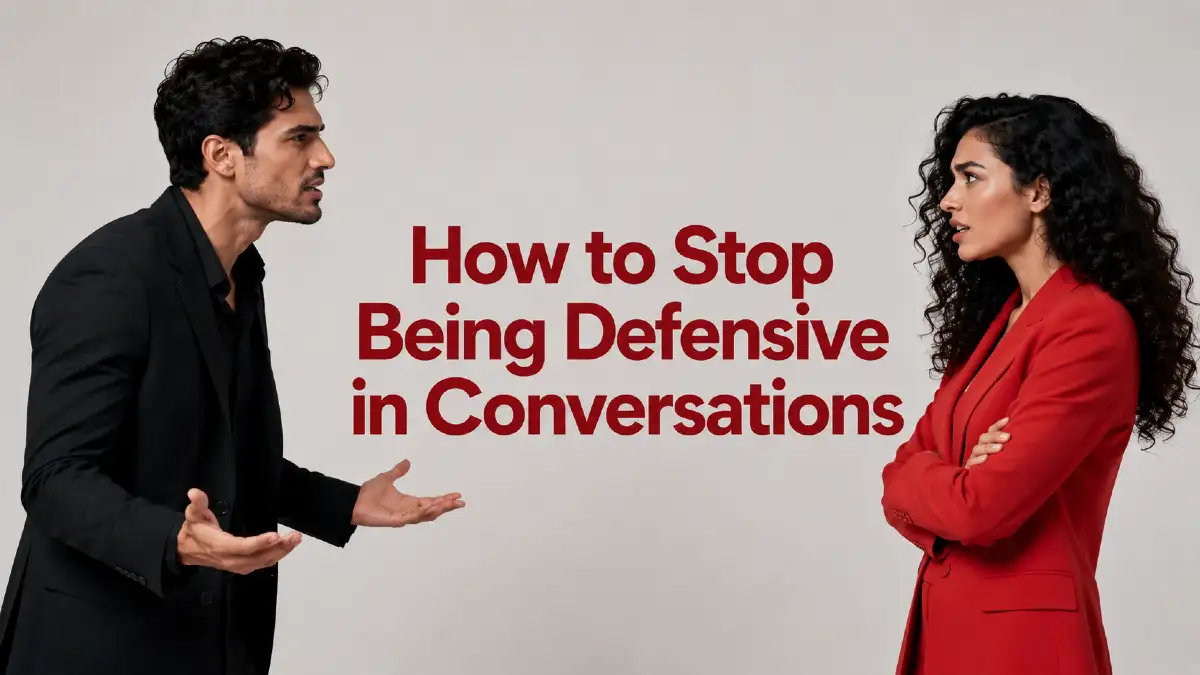
To stop being defensive, you have to change what you hear before you change what you say: criticism stops feeling like an attack once you can treat it as information about the other person’s experience rather than a verdict on your worth. Research shows that being judged by others triggers some of the strongest stress responses the body produces, which is why defensiveness feels automatic — and why willpower alone rarely fixes it. This guide explains where defensiveness comes from, how it damages relationships and careers, and the specific practices, from nonviolent communication to the three-second pause, that let you stay open without becoming a pushover.
Most of us were taught how to win arguments. Very few were taught how to communicate well when something we’ve done has upset someone. School debates, sibling rivalry, office politics and a whole culture of online point-scoring all reward the same skill: defend your position, find the flaw in theirs, never concede ground.
That training is costly in close relationships. Of all the habits that quietly end conversations and erode intimacy, defensiveness is the quiet killer in all of this. It doesn’t look as dramatic as shouting or as cold as silence. It looks reasonable. You’re just explaining. You’re just correcting the record. And every time, the other person learns a little more that bringing something to you isn’t safe.
This piece draws on the work of therapist Yolanda Renteria, author of Attuned and Attached, and on Marshall Rosenberg’s framework of nonviolent communication (NVC), alongside research on stress, feedback and relationships. The central idea is simple and harder than it sounds: the fix starts with how you perceive the other person, not just with what you say back.
What Is Defensiveness?
Defensiveness is a self-protective response to perceived criticism or blame, in which a person focuses on justifying, deflecting or counter-attacking rather than understanding the concern being raised. It’s a reflex designed to protect your self-image, and in the moment it feels entirely justified.
It takes more forms than most men realise. There is the counter-attack (“Well, you’re the one who…”), the excuse (“I was exhausted; what did you expect?”), the correction of details (“It wasn’t three times, it was twice”), the innocent victim stance (“I can’t do anything right in this house”), cross-complaining, where you answer a complaint with one of your own, and the deceptively mild “yes, but…“, which acknowledges the point in the first word and dismisses it in the second.
All of these share a single function: they shift the conversation away from the other person’s experience and back onto your defence. That’s why, even when every fact you offer is accurate, defensiveness tends to leave the other person feeling unheard — and usually more upset than when they started.
Why Am I So Defensive? The Psychology of Feeling Attacked
If you’ve ever wondered why a small comment can set off such a large reaction, the answer lies partly in biology. In a 2004 meta-analysis of 208 laboratory studies published in Psychological Bulletin, Sally Dickerson and Margaret Kemeny found that the tasks producing the largest cortisol stress responses were those combining two features: being evaluated by others and having little control over the outcome. That’s an exact description of being criticised. To your nervous system, a partner saying “you never listen” and a boss saying “this isn’t good enough” can register in the same family of threats as physical danger. The body prepares to fight before the mind has finished hearing the sentence.
Feedback research tells a similar story. In a landmark 1996 review of 607 effect sizes, Avraham Kluger and Angelo DeNisi found that while feedback improves performance on average, in more than a third of cases it actually made performance worse. The difference came down to attention. When feedback keeps attention on the task, people improve. When it pulls attention onto the self — what does this say about me? — energy goes into self-protection instead of learning. Defensiveness is what that diversion looks like from the outside.
Personal history matters too. A man who grew up with harsh or unpredictable criticism often learned that being wrong was dangerous — that a mistake could cost him approval, affection or peace in the house. As an adult, his body still reacts as if those stakes apply, even when the person in front of him is simply trying to tell him something. That voice of early criticism often becomes an internal one, and understanding the inner critic as a protector can make sense of why outside criticism lands so hard.
Finally, there’s a paradox at the heart of it. People who seem the most defensive are often not the most confident but the most fragile. A secure man can hear “you hurt me” and stay curious, because his worth isn’t on trial. A man whose sense of himself is shakier has to defend every inch, because every inch feels like the whole territory.
Signs You’re Being Defensive
Defensiveness is easiest to see in others and hardest to catch in yourself, because from the inside it feels like being reasonable. A few signs are worth watching for.
Your body moves first: a flush of heat, a tightening jaw, a rising voice, crossed arms, the urge to interrupt. You start preparing your reply before the other person has finished. You find yourself correcting small details — dates, numbers, exact wording — while the main point goes unanswered. You explain your intentions at length (“I didn’t mean it like that”) instead of acknowledging the impact. You bring up something they did wrong. Or you go the other way and collapse into exaggerated self-blame (“Fine, I’m a terrible partner”), which sounds like accountability but works as another way of ending the conversation.
Afterwards there’s often a familiar aftertaste: the argument was about something small, it became about something big, and you’re not quite sure how you got there. If that pattern repeats, defensiveness is probably part of the engine. The sense of distance it leaves behind is one of the clearer signs of emotional disconnection in a relationship.
Defensiveness starts before you open your mouth
Here is the part that most advice misses: defensiveness happens internally before it shows up externally. It begins in the split second when you interpret the other person’s words as an attack rather than as information. By the time you speak, the decision has already been made.
That’s why you can’t fix defensiveness by simply biting your tongue. Swallowing your rebuttal while still hearing an accusation only moves the battle inside; the tension leaks out through tone, posture and the next conversation. The real change happens upstream, in what you hear. When your partner says, “You’ve been on your phone all evening,” you can hear you’re a bad partner — or you can hear I’ve been missing you tonight. The words are identical. The meaning you assign to them decides almost everything that follows.
The foundation, as Renteria puts it, is a posture: curiosity over judgement, understanding over rebuttal. It isn’t a technique you deploy once things get heated. It’s a way of approaching people that makes things less likely to get heated in the first place. Much of it overlaps with the practice of not taking things personally, which is less about armour and more about recognising that most of what people say is about their experience, not your worth.
Drop the judgment
Judgment means deciding what someone is like before you’ve understood them. She’s being dramatic. He’s always negative. They’re just trying to control me. Judgments feel like clarity. They give you a quick, confident read on the situation. But they shut down curiosity, because once you’ve decided what’s going on, there’s nothing left to learn.
Renteria makes a provocative point here: we often believe our judgments keep other people accountable, but in practice judgment blocks change. People don’t open up, reflect or adjust when they feel judged; they defend. Judgment says I already know. Connection requires tell me more. The irony is that a man trying to hold his partner to account through judgement usually produces the opposite — more defensiveness, on both sides.
There’s an inner dimension to this too. Men who judge others harshly are often harder still on themselves. “I’m just bad at this,” “I always mess up,” “I’m a terrible communicator” — these are judgments turned inward, and they make criticism unbearable, because any complaint confirms the verdict you’ve already passed. Softening how you judge yourself makes it easier to hear others. This is why practising self-compassion isn’t a soft extra; research by Juliana Breines and Serena Chen (2012) found that people who took a self-compassionate view of a past wrongdoing were more motivated to make amends and improve, not less. Being kind to yourself about a mistake makes it safer to own it.
Listen to understand, not to reload
In most disagreements, people aren’t really listening. They’re reloading — formulating their rebuttal while the other person is still talking, waiting for a gap to fire back. You can feel it in yourself: the half-attention, the impatience, the sentence already loaded in your mouth.
Real listening is different. It means letting the words actually land, even when they sting, and then reflecting back what you heard before you respond with anything of your own. “So what you’re saying is that when I changed the plans last minute, it made you feel like you didn’t matter — is that right?” It sounds simple. In the middle of an argument, it’s one of the hardest things a person can do.
It’s also one of the most effective. People soften when they feel heard, often immediately. Research on active listening by Harry Weger and colleagues (2014) found that people whose conversation partners paraphrased their points felt significantly more understood. Feeling understood lowers the other person’s defences, which lowers yours, which allows the conversation to move toward a solution rather than a scoreboard. The skill sits at the centre of what we’ve called the communication secret that makes everyone like you, and it’s closely related to emotional attunement — the capacity to track what someone is feeling, not just what they’re saying.
Speak from observation, feeling, and need
Marshall Rosenberg’s Nonviolent Communication offers a four-part structure that transforms how difficult things are said, and it’s as useful for avoiding defensiveness in others as for managing your own.
The first part is an observation: neutral, specific facts, without interpretation. “The last three times we made plans, they changed last minute.” Not “You’re flaky,” which is a judgement and invites an argument about whether it’s true.
The second is a feeling, owned as yours. “I feel anxious and unimportant when that happens.” Not “You make me feel…”, which assigns blame, but a statement about your inner experience that nobody can really dispute.
The third is a need, stated explicitly. “I need a bit more reliability to feel secure.” Needs are universal, which makes them hard to argue with; most people can relate to the need for reliability, respect or rest even when they disagree about the behaviour.
The fourth is a request: specific, doable, and genuinely a request rather than a demand. “Could we agree that if plans need to change, you’ll let me know the day before?” A demand comes with an implied threat if refused. A request leaves room for a yes, a no or a counter-offer.
Compare that to “You’re flaky and you don’t care about me.” One invites defence. The other invites a conversation. The goal of this structure isn’t to lose arguments more gracefully. It’s to step out of the frame of winning and losing altogether. Our simple communication framework offers a complementary approach for everyday conversations.
Why Defensiveness Damages Relationships
The relationship researcher John Gottman spent decades observing couples in his so-called “love lab”, and he identified four communication patterns that predict relationship breakdown with remarkable reliability. He called them the Four Horsemen: criticism, contempt, defensiveness and stonewalling. Defensiveness earns its place on that list not because it’s cruel but because it’s corrosive. It tells your partner that their complaint is invalid and that the problem, on reflection, is them.
What makes it especially damaging is that it tends to provoke the other horsemen. A partner whose concerns are repeatedly deflected escalates into criticism. Escalated criticism invites more defence. Eventually one or both people give up and stonewall, because talking feels pointless. Many of the slow, quiet endings described in why marriages fail today follow exactly this pattern.
Gottman’s proposed antidote is deceptively simple: take responsibility, even for a small part of the problem. Not all of it — just the part that is genuinely yours. “You’re right, I did say I’d be home by six, and I wasn’t.” That single sentence lowers the temperature more than any amount of explanation, because it tells your partner that you’re on the same side of the problem.
Taking responsibility in this way is not the same as accepting blame for everything, or agreeing with every characterisation of you. It’s acknowledging what’s true, so that the rest of the conversation can be about what to do next. Over time, the man who can do this becomes someone it’s safe to bring problems to — which is one of the quietest, most valuable things a partner can be. And when things have gone further, the craft of apology and repair takes over from there.
When you feel yourself getting defensive
Even with the right posture, you will still feel the defensive reflex rise. It’s built into the nervous system; the aim isn’t to eliminate it but to catch it early and choose what to do next. Four practices help, and a few others from the research make them stronger.
Pause three seconds. When you feel the heat rising, wait. Breathe. Three seconds is long enough for your thinking to catch up with your reaction and short enough that the other person barely notices the pause. It’s the single most useful habit in this whole guide, because it creates the gap in which every other choice becomes possible.
Ask questions out loud. Curiosity is incompatible with defence. “Help me understand what you meant by that.” “When did you first notice it?” “What would have helped?” Questions show that you’re listening, buy time for your nervous system to settle, and often reveal that the concern is narrower and more manageable than it first sounded.
Name your reaction honestly. “I notice I’m getting defensive — give me a second.” It sounds almost too simple, but naming your state out loud lowers tension on both sides. There’s good neuroscience behind it: in a 2007 study, Matthew Lieberman and colleagues at UCLA found that putting feelings into words — what they called affect labelling — reduced activity in the amygdala, the brain’s alarm system. You calm down by saying what’s happening.
Separate feedback about your behaviour from your worth. “You forgot to call” is a statement about an action. It’s not a statement about whether you’re a good man. When you can hold that distinction, criticism becomes something you can consider on its merits, rather than something you have to repel to survive. Research on self-affirmation by David Sherman, Leif Nelson and Claude Steele (2000) supports this: people who first reflected on a value important to them were far more open to threatening personal information afterwards. Reminding yourself of what you stand for makes it safer to look at where you fell short.
Take a real break if you’re flooded. Gottman’s research found that once heart rate climbs above roughly 100 beats per minute, people become “flooded”: the capacity to listen, reason and empathise drops sharply. At that point no technique will work. The right move is to call a pause — “I want to keep talking about this, but I need twenty minutes to calm down” — and then actually come back. Twenty to thirty minutes of genuine self-soothing, not replaying the argument, usually restores enough calm to continue. Tools for controlling emotional reactions through the body are useful here, and the model of the anger iceberg helps if what rises is mostly anger.
None of these practices work in isolation from inner work. A man who has done some honest reckoning with his history, his insecurities and his patterns will find them far easier to use than one trying to manage an unexamined storm. And when you slip — you will — the most important thing is to come back and repair. A conversation that went badly isn’t a failure if you return to it with “I got defensive earlier, and I’d like to hear you properly this time.” That repair often teaches more than a perfect first attempt ever could, and it slowly rebuilds what emotional disconnection in relationships wears away.
How to Stop Being Defensive at Work
Defensiveness at work looks different but has the same root. A manager’s comment on your report, a colleague questioning your decision in a meeting, a performance review that doesn’t match your self-assessment — each can trigger the same rush of threat, with the added stakes of status and income.
The same principles apply, adapted for a professional setting. Treat feedback as data, not a verdict, which is exactly what Kluger and DeNisi’s research suggests: the people who improve are those whose attention stays on the task. Ask clarifying questions before you respond: “Can you give me an example?” or “What would a stronger version look like?” Thank the person for the feedback even when you’re not sure you agree, because thanking someone is not the same as conceding the point. And give yourself permission to take time: “That’s useful. Let me think about it and come back to you tomorrow” is a perfectly professional response that prevents a reactive one.
It’s also worth knowing that the ability to take feedback well is one of the clearest markers of professional maturity. People who can hear criticism without collapsing or counter-attacking get more honest feedback, which means they improve faster, which compounds over a career. Ryan Holiday’s warning in Ego Is the Enemy — that ego makes it hard to learn from those around us — applies with particular force here; our guide to ego as the enemy explores the theme in depth.
When the Other Person Is Actually Attacking You
None of this means you should absorb every criticism uncritically. Some feedback is unfair. Some is delivered with contempt. And some people use criticism as a tool of control, wrapping put-downs in the language of honesty. Learning not to be defensive is not the same as learning to accept mistreatment.
The distinction is between defending and setting a boundary. Defending means arguing about whether the criticism is valid, justifying yourself and trying to win. A boundary means calmly naming what you will and won’t engage with: “I’m happy to talk about what happened, but not while you’re calling me names. Let’s try again when we’re both calmer.” The first keeps you trapped in the exchange. The second steps out of it with your dignity intact. Our guide to why boundaries are important in relationships covers this in more detail.
It also helps to distinguish genuine feedback from the kind of disguised hostility explored in the psychology of backhanded compliments. You can stay curious about real concerns while recognising that some comments say more about the person making them than about you. The paradox is that the less defensive you become about genuine feedback, the clearer you get at spotting the comments that don’t deserve a response at all — and the easier it becomes to respond to insults with calm rather than counter-attack.
The Strength of Not Needing to Win
Defensiveness masquerades as strength. It feels like standing your ground, refusing to be pushed around, protecting yourself. But it is usually a sign of the opposite: a self that feels too fragile to be questioned.
Real strength looks quieter. It’s the man who can hear “you hurt me” without falling apart or striking back, who can say “you’re right, I got that wrong” without feeling smaller, and who can stay in a hard conversation long enough to understand it. That man doesn’t need to win, because his worth was never on the table. Ironically, he’s also the one people trust most, listen to most and come back to — because being around him is safe.
You don’t have to win the conversation. You only have to stay in it, honestly, until the two of you understand each other a little better than when you began.
7 Questions to Ask Yourself About Being Defensive
These questions aren’t meant to be answered quickly. Choose a quiet moment — ideally not straight after an argument — and write down what comes, not what sounds most reasonable. You’re the only audience here.
- In which relationship or setting do you most often find yourself explaining, correcting or counter-attacking instead of listening?
- When criticism lands, what are you really protecting — your image, an old fear of getting it wrong, or something else entirely?
- What happens in your body in the three seconds before you start defending yourself, and how early could you notice it?
- Which part of a recent complaint against you was genuinely true, and what would it cost you to simply own that part?
- Who in your life already lets you be wrong without making you feel small, and what does that safety give you?
- What might the people close to you finally be able to tell you if bringing something to you felt completely safe?
- Beneath the urge to win, what do you already know about the kind of man you want to be in hard conversations?
5 Questions to Turn Less Defensiveness Into Action
Insight becomes change only in the next real conversation, so let these questions prepare you for it.
- Which single practice — the pause, the question, naming your reaction or taking responsibility — will you use first?
- What is one past conversation you could return to within the next 24 hours, to listen properly this time?
- Which defensive habit, such as correcting details or “yes, but”, will you deliberately drop this week?
- Who could you ask, honestly, to tell you when you’re getting defensive, so you can learn to catch it sooner?
- When you slip back into an old reaction, how will you choose to repair it rather than judge yourself for it?
Pick one. Practise it in the next ordinary conversation. Let it get easier with time.
Frequently Asked Questions About Defensiveness
How do I stop being defensive?
Start by pausing for a few seconds when you feel the urge to justify or counter-attack, then ask a question to understand the other person’s concern. Reflect back what you heard before responding, take responsibility for the part that is genuinely yours, and separate feedback about your behaviour from your worth as a person. Over time, these habits make criticism feel less threatening.
Why am I so defensive?
Defensiveness is usually a response to perceived threat. Research shows that being evaluated by others triggers some of the strongest stress responses, and people with harsh or critical upbringings often learned that being wrong was dangerous. Low or fragile self-worth also makes criticism feel like an attack on your whole identity rather than feedback about a specific action.
What are examples of defensive behaviour?
Common examples include making excuses, counter-attacking with a complaint of your own, correcting minor details while ignoring the main point, saying “yes, but…”, playing the innocent victim, explaining your intentions instead of acknowledging impact, and collapsing into exaggerated self-blame to end the conversation.
Why is defensiveness so damaging in relationships?
Relationship researcher John Gottman identified defensiveness as one of the “Four Horsemen” that predict relationship breakdown, alongside criticism, contempt and stonewalling. Defensiveness tells your partner their concern is invalid, which tends to escalate conflict. Gottman’s recommended antidote is to take responsibility for at least part of the problem.
How can I stop being defensive at work?
Treat feedback as information rather than a verdict, ask clarifying questions before responding, thank the person for their input even if you are unsure you agree, and give yourself time to reflect before replying. Research by Kluger and DeNisi (1996) found that feedback is most useful when attention stays on the task rather than on what it says about you.
Is setting a boundary the same as being defensive?
No. Defensiveness argues about whether criticism is valid and tries to win. A boundary calmly states what you will and won’t engage with, such as refusing to continue a conversation while being insulted. You can be open to genuine feedback while still protecting yourself from contempt or abuse.
Related posts:
 63% of Young Men Are Single. The Real Reasons Aren’t What You Were Told.
 Modern Dating Isn’t Broken. It’s a Crisis of Trust. Here’s the Difference.
 Why Narcissists Are More Sensitive to Criticism (Not Less)
 Idealize, Devalue, Discard: The Complete Stage-by-Stage Guide to the Narcissistic Abuse Cycle
 The Six Stages of a Female Narcissist: From Childhood Wound to Bitter Isolation