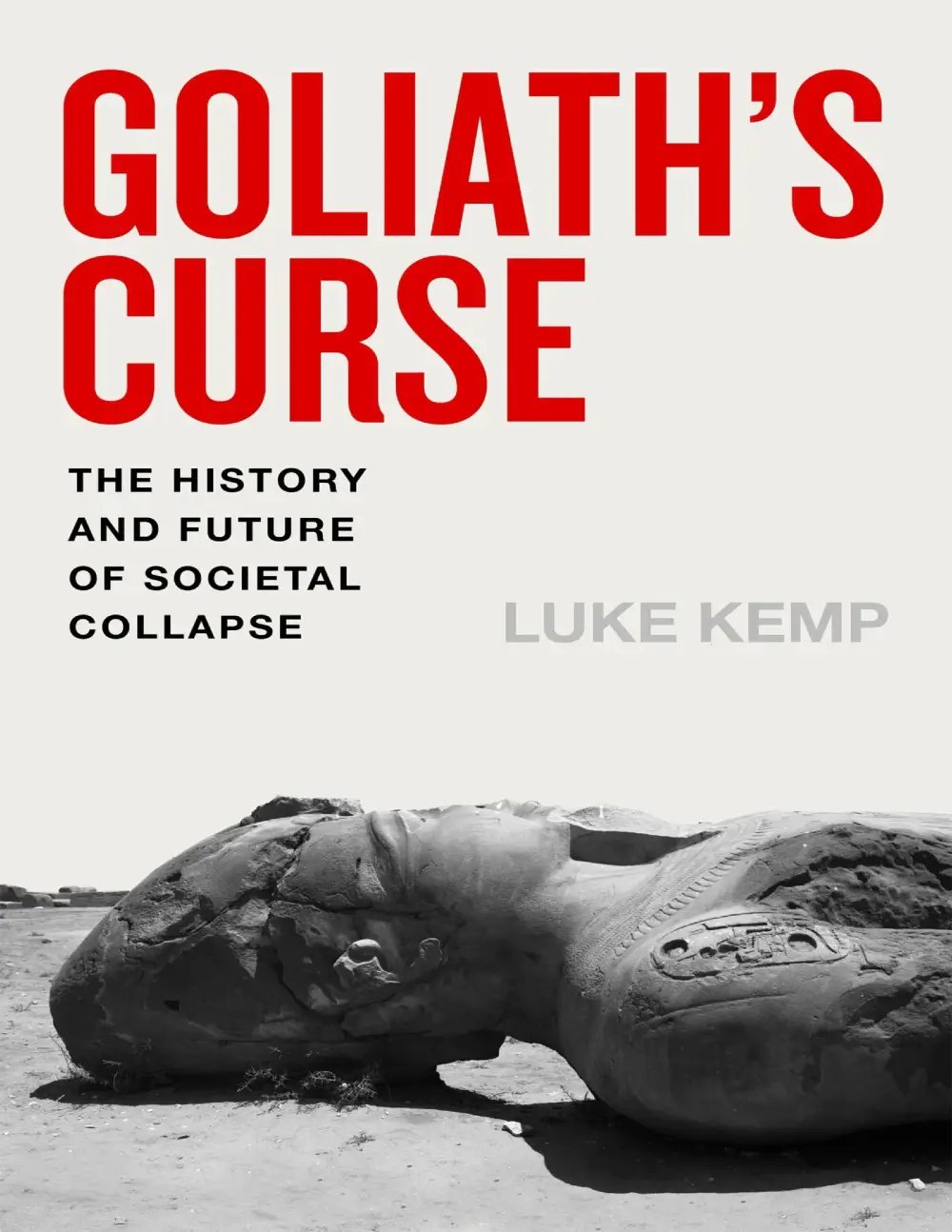
Every civilization in history believed itself exceptional, permanent, and immune to the fate of those that came before — and every one of them was wrong. In Goliath’s Curse: The History and Future of Societal Collapse, Cambridge existential risk scholar Luke Kemp analyses 324 fallen regimes to expose the hidden operating system behind the rise and ruin of human power. This is the definitive guide to why civilizations collapse, what makes a Goliath fragile, and what his findings mean for the global order we now inhabit.
Goliath’s Curse: A New Framework for an Old Question
For 300,000 years our species lived in fluid, mostly egalitarian bands that actively prevented anyone from accumulating permanent power. Then, roughly 12,000 years ago, something snapped. We settled, we farmed, we stored grain, and a small minority began to dominate the many. From that moment, Kemp argues, history has been a near-unbroken cycle of “Goliaths” — hierarchical mega-societies built on coercion and lootable resources — rising, swelling, and eventually buckling under their own weight.
Kemp deliberately rejects the word “civilization” because it smuggles in a moral judgement. Empires we romanticise in school — Rome, the Aztec Triple Alliance, the British Empire — were, in his telling, brutal engines of extraction. What we call collapse is often just the ruling class losing what it had taken from everyone else. As Kemp himself bluntly puts it in interviews about the book, collapse is “largely about the fall of great power structures.” For elites, it’s an ending. For the dominated, it’s frequently a release.
This reframing is the spine of the book. To understand why civilizations collapse, you have to first understand what a Goliath actually is — and why concentrating power is, in the long run, an act of self-destruction.
The Brutal Math: Every State Has an Expiration Date
The most sobering finding in Goliath’s Curse is statistical. Drawing on the largest historical dataset ever assembled on the lifespans of states, Kemp reports that the average state lives 326 years. The biggest states — mega-empires covering more than a million square kilometres — last on average just 155 years. As one reviewer summarised, “The largest states…are more fragile, lasting on average just 155 years.”
This is not a margin. It is a pattern across five millennia and more than 440 societal lifespans. Power, complexity, and reach correlate inversely with longevity. The bigger the Goliath, the shorter the fuse.
For Americans reading this, the implication is uncomfortable: the United States, at under 250 years old, is already deep inside the danger band where most historical states began their terminal phase. For more on the empirical scope of these patterns, see our companion analyses on why every great civilization eventually falls and the 25 key takeaways from Luke Kemp’s book Goliath’s Curse, which condense his core arguments into the headline insights every reader should know.
How Hierarchy Was Born (And Why It Cost Us Our Health)
One of Kemp’s most counter-intuitive arguments is that the agricultural revolution was not a triumph — it was a trap. Archaeological evidence shows that the first farmers were shorter, sicker, and more violent than the foragers they replaced. Skeletons show dental decay, malnutrition, repetitive-strain injuries, and infectious disease at levels hunter-gatherers rarely experienced.
So why did we do it? Because once population density rose around grain and fish, returning to foraging was no longer possible. We had walked into a one-way corridor. Worse, grain was the world’s first truly lootable resource: it ripened on a known schedule, was stored in a known place, and could be taxed in measurable units. It practically invited the formation of states.
This is where Goliaths begin — not in vision, not in social contract, but in extraction. Kemp documents how early states often emerged when militarised groups conquered settled farmers and installed themselves as the ruling class. The full archaeological case for this trade-off is explored in our deep dive on why early farmers had shorter lives than hunter-gatherers, which lays out what we genuinely gave up when we sat down.
The Bronze Age Lesson: How Global Systems Unravel in Decades
If you want to understand how a modern, interconnected world might fall apart, the closest historical analogue is the Late Bronze Age collapse of around 1200 BCE. For roughly five centuries, a tightly networked system of palace economies — Mycenae, Hatti, New Kingdom Egypt, the Levantine city-states — traded tin, copper, grain, and ideas across the eastern Mediterranean. It was the most globalised the world had ever been.
Then, within roughly fifty years, almost all of it was gone.
The collapse came from a cluster of overlapping stresses: prolonged drought, earthquakes, mass migrations (the so-called “Sea Peoples”), elite overreach, and the cascading effect of trade disruption. No single shock would have been enough. But because each kingdom depended on the others for critical inputs, the failure of one node propagated through the network. The whole system seized up. Writing systems were lost. Cities went dark.
This is the cautionary tale that haunts the back half of Goliath’s Curse, and we treat it in depth in our article on how Bronze Age globalization collapsed in just 50 years. The parallels with our globally entangled supply chains, financial systems, and food trade are uncomfortable on purpose.
Rome Didn’t Fall — It Transformed
Not every collapse is a clean catastrophe. Kemp is careful to distinguish between civilizations that vanish (Cahokia, the Indus Valley) and those that gradually transform (Rome, the Han). A peasant in fifth-century Italy probably did not realise the Roman Empire was “falling.” Aqueducts kept flowing for a while. Latin kept being spoken. Bishops took over civic functions the imperial bureaucracy had abandoned.
What actually happened was a slow devolution: tax bases shrank, militaries fragmented, central coordination decayed, and life simplified. For ordinary Romans outside the elite, archaeological indicators of nutrition and bone health actually improved in some regions after the western collapse. They were no longer being squeezed by Rome’s extractive machinery.
This nuance is critical. Collapse is not always apocalypse, and apocalypse is not always collapse. We explore the gradient in detail in our piece on how the Roman Empire survived its own collapse, which separates the Hollywood narrative from what the evidence actually shows.
Environmental Triggers: When the Land Stops Feeding Power
Across the dataset, Kemp finds that environmental degradation is one of the most consistent triggers of collapse — but it almost never works alone. It works as the final shove on a system that has already weakened itself through extraction, inequality, and overextension.
The Akkadian Empire fell during a centuries-long drought. The Classic Maya collapse coincided with severe, repeated droughts in the ninth century — exacerbated by deforestation, soil exhaustion, and elite competition for water and prestige projects. Even the late Roman Empire experienced a “Late Antique Little Ice Age” that helped tip an already fragile system.
The pattern Kemp identifies is brutal: societies that intensify agriculture to feed elite ambitions — irrigating marginal land, clearing forests, salinating soils — temporarily boost yields and then permanently undermine their own foundation. When climate fluctuates, as climate always does, there is no slack left. The hammer falls.
For a tour of the most decisive environmental collapses in history, see our companion article from Maya to Rome: how environmental degradation triggers societal collapse.
The Inequality Engine: Goliath’s Achilles’ Heel
If there is one variable that runs through every collapse in Kemp’s data, it is inequality. As Andrew Lynch summarised it in The Irish Times, “Inequality… is the ‘constant variable’ or Achilles’ heel that sooner or later causes all Goliaths to buckle. If people stop believing they are ‘all in it together’, the upshot will be a game of thrones that nobody actually wins.”
Kemp’s mechanism is not just moral, it’s structural. Extreme inequality:
It erodes legitimacy, so citizens stop cooperating with institutions. It hollows out the tax base, because elites have the resources to evade contribution. It triggers what historian Peter Turchin calls “elite overproduction” — too many ambitious aspirants competing for too few elite slots, generating destabilising intra-elite conflict. It drains the population of the health, education, and morale needed to absorb shocks. And it concentrates decision-making in the hands of people whose interests have decoupled from the society they nominally lead.
Kemp also argues something quietly explosive: that the most extractive Goliaths have repeatedly been disproportionately captured by individuals with so-called “dark triad” traits — narcissism, Machiavellianism, and psychopathy. Status-hungry, low-empathy, high-risk leaders rise to the top of dominance hierarchies precisely because those hierarchies reward those traits. The very selection mechanism of Goliaths is suicidal.
This is the heart of the book’s title — the curse that comes with growth. Our dedicated article on why extreme inequality destroys civilizations unpacks the mechanism in greater depth.
The New Threats Ancient Empires Never Faced
Here is where Goliath’s Curse turns from history book into warning. Every previous collapse was regional. The Bronze Age system collapsed; China, India, and the Americas carried on. The Roman west fell; Byzantium endured another thousand years. Even the most catastrophic failures left other Goliaths — or at minimum, surviving humans elsewhere — to start again.
Modernity has eliminated that backup.
We now live, Kemp argues, in a single global Goliath: an interlocking system of fossil-fuel-powered industrial economies, financialised supply chains, instantaneous communication networks, and shared atmospheric and biological systems. And this global Goliath has produced — for the first time in human history — genuinely existential threats:
There are roughly 13,000 nuclear warheads on the planet, capable of destroying organised civilisation in an afternoon. Anthropogenic climate change is moving systems that took millennia to stabilise into regimes we have never lived under and have no infrastructure for. Engineered pandemics, enabled by accelerating biotech, sit one lab accident or one deliberate release from a worst-case scenario. And artificial intelligence development — racing forward under intense competitive pressure with safety as an afterthought — raises control problems no previous tool has posed.
These are not the threats that toppled the Maya or Rome. They are categorically different. Kemp’s analysis of how these converging risks differ from anything ancient empires faced is explored in detail in our article on AI, climate change, and nuclear war: the new collapse threats ancient empires never faced.
The Rungless Ladder: Why This Time Might Be Different
The final dark insight in Goliath’s Curse is what Kemp calls the rungless ladder problem. Every previous civilization that collapsed left behind the conditions for a successor to climb back up: surface-accessible coal seams, easily mined iron ore, old-growth forests, undepleted soils, fish-filled seas, intact mineral deposits.
We have systematically consumed those rungs.
Industrial modernity was bootstrapped by exploiting one-time geological endowments. Should our system seize up the way the Bronze Age system did, the resources required to rebuild a technological civilization the way we built ours simply will not be there. The easy coal is gone. The easy oil is gone. The high-grade ores are gone. What remains requires industrial-scale extraction tools that themselves require industrial civilization to build.
This is what makes Kemp’s analysis genuinely novel. He is not saying collapse is certain. He is saying that if it happens, it may be terminal in a way no prior collapse has been. The full implications are walked through in our article on could civilization rebuild after collapse? The terrifying rungless ladder theory.
What Goliath’s Curse Means for the Modern Man
It would be easy to read all this and slide into either fatalism or escapism. Both are mistakes — and they are also exactly the responses that historically accelerate collapse. Apathy hollows out civic life. Bunker fantasies divert energy from collective resilience.
Kemp’s actual prescriptions are unexpectedly grounded. For societies, the imperative is to “make the world equal again” — to reduce inequality, strengthen democratic checks, decentralise power, and dismantle the selection mechanisms that elevate dark-triad personalities. For individuals, his advice, often quoted from interviews, is brutally simple: “Don’t be a dick.”
For the modern man, the takeaway is deeper than politics. It is a redefinition of what strength looks like.
The Goliath model of masculinity — dominance, accumulation, status competition, indifference to those below you — is the same model that has hollowed out every fallen empire. Kemp’s evidence suggests it is not just morally suspect but statistically self-destructive. The men who built the most resilient societies in our dataset were not the kings. They were the ones who maintained networks of mutual aid, who pushed back on extractive elites, who kept their communities knit together through the shocks. They were Davids, not Goliaths.
To live well in a Goliath era is to refuse the curse. That means building real-world skills — physical capability, financial literacy, emotional regulation, useful trades. It means investing in deep, non-transactional relationships and local community, because resilience is networked, not individual. It means refusing to outsource your worldview to status games, algorithmic feeds, or institutions that have lost legitimacy. And it means staying informed enough to see the patterns Kemp documents without collapsing into doom.
This is what Masculine Synergy means by holistic strength: the recognition that the inner and outer life are one system, and that being a man worth being in the twenty-first century looks very different from the model the last 5,000 years sold us.
Conclusion: David’s Choice
Goliath’s Curse is, finally, a hopeful book — but only if you read it carefully. Kemp’s thesis is not that we are doomed. It is that we are running on borrowed time inside a system that has historically always run out. The exit ramp exists. It is built out of equality, democratic control, ecological sanity, restraint on dominance hierarchies, and a refusal to let the dark triad keep selecting our leaders.
Whether we take that ramp is, as it always has been, a choice. The Bronze Age palaces did not have to fall. Rome did not have to extract itself into irrelevance. The Classic Maya did not have to deforest their watersheds. They did because their elites could not stop, and because enough of the rest went along.
We can stop. The question Kemp puts to every reader — and the question Masculine Synergy puts to every man reading this — is whether you intend to be part of the Goliath that falls, or part of the people who quietly, intelligently, build what comes next.
The next collapse, Kemp warns, may be our last. But it doesn’t have to be.
Goliath’s Curse: The History and Future of Societal Collapse by Luke Kemp is published by Penguin/Random House. Luke Kemp is a research affiliate at the Centre for the Study of Existential Risk at the University of Cambridge.
Related posts:
 25 Key Takeaways From Luke Kemp’s Book Goliath’s Curse
 Why Extreme Inequality Destroys Civilizations: The Goliath’s Curse Explained
 How the Roman Empire Survived Collapse and Reinvented Itself
 How Bronze Age Globalization Collapsed in Just 50 Years: Lessons for Today (Goliath`s Curse by Luke Kemp)
 Why Every Great Civilization Eventually Falls: Lessons from Goliath’s Curse by Luke Kemp