
Wealth isn’t just about money—and focusing only on it is why so many people feel successful on paper but unfulfilled in life. The five types of wealth framework expands the definition of success to include time, health, relationships, mindset, and finances, showing how each one shapes your overall quality of life. This article breaks down how these five dimensions work together—and why neglecting one can quietly undermine the others. If you want real, lasting success, it starts by building a life that’s rich in more than just money.
You can read every self-help book, attend every seminar, and absorb every insight about building a better life. But as Sahil Bloom emphasizes in “The 5 Types of Wealth,” none of it matters without what he calls “the leap of faith”—the moment when you stop gathering information and start transforming your life. Knowledge without action isn’t wisdom; it’s procrastination dressed in intellectual clothing.
This article addresses the critical question that Bloom explores in the conclusion of “The 5 Types of Wealth”: How do you actually apply the framework? How do you move from understanding the five types of wealth to building them? How do you close the gap between the life you’re living and the life you want to design?
The answer isn’t comfortable. It requires what Bloom calls “the leap”—making significant changes based on conviction rather than certainty, taking action before you feel “ready,” and choosing the discomfort of growth over the familiarity of stagnation. As he writes, “You can wait for perfect clarity, but clarity comes from action, not contemplation.”
The Playing the Wrong Game Realization
Throughout “The 5 Types of Wealth,” Bloom returns to a central metaphor: most people are playing the wrong game entirely. They’re optimizing their performance in a game that doesn’t lead to the outcomes they actually want. They’re getting better and better at climbing a ladder that’s leaned against the wrong wall.
His own story exemplifies this pattern. Bloom spent years optimizing for conventional success—the high-paying job, the impressive title, the material markers of achievement. He was winning the game society taught him to play, but the prize was misery. He had optimized Financial Wealth while sacrificing the other four types, discovering too late that the game he was winning didn’t provide the life he wanted.
The realization that you’re playing the wrong game is simultaneously devastating and liberating. Devastating because it means acknowledging that years or decades of effort have been misdirected. Liberating because it means you can stop playing that game and start playing one that actually matters to you.
For Bloom, the catalyst was that conversation about seeing his parents fifteen more times. For others, it might be a health scare, a relationship crisis, a moment of clarity during a supposedly successful but joyless period, or simply reaching a goal and discovering it feels empty. The specific trigger varies, but the pattern is consistent: something breaks through the busyness and achievement-focus long enough for you to ask, “Is this actually the life I want?”
The Five Dimensions of Transformation
In “The 5 Types of Wealth,” Bloom outlines a systematic approach to transformation across all five dimensions of wealth. This isn’t about perfection or overnight change—it’s about consistent, intentional progress over time.
Time Wealth Transformation
Immediate Actions:
- Conduct the Hard Reset: Track every hour for one week to see where time actually goes versus where you think it goes.
- Implement the Two-List Exercise: Identify your top 5 priorities and actively avoid the other 20 until the top 5 are achieved.
- Create the first “non-negotiable” time block for what matters most to you—and actually protect it.
30-Day Challenge:
- Implement time-blocking for your entire calendar, color-coded by energy (green for energizing, yellow for neutral, red for draining).
- Practice saying no to at least three requests that don’t align with your priorities.
- Eliminate one major time vampire (unnecessary meeting, energy-draining commitment, digital distraction).
90-Day Transformation:
- Achieve measurable improvement in autonomy over your schedule.
- Reduce time spent on red (draining) activities by at least 30%.
- Establish consistent routines that protect time for what matters most.
- Evaluate whether your job/career is fundamentally incompatible with Time Wealth and make decisions accordingly.
Social Wealth Transformation
Immediate Actions:
- Complete the Relationship Map exercise: Identify who’s in your inner circle versus who you actually spend time with.
- Schedule a Life Dinner with someone important to you—make it recurring and non-negotiable.
- Reach out to three people you’ve been meaning to connect with but haven’t.
30-Day Challenge:
- Implement one weekly recurring connection (dinner, call, activity) with someone in your inner circle.
- Practice the Helped, Heard, or Hugged method in every interaction.
- Conduct a relationship audit: Identify relationships that drain more than they energize and begin setting boundaries.
90-Day Transformation:
- Establish consistent rhythms of connection with inner circle relationships.
- Deepen at least one relationship significantly through increased vulnerability and presence.
- Eliminate or drastically reduce time with relationships that are consistently draining or toxic.
- Measure success by quality of connection, not quantity of interactions.
Mental Wealth Transformation
Immediate Actions:
- Establish a 5-minute daily meditation or breathing practice.
- Implement digital sunsets—pick a time when screens go off and stay off.
- Start a Curiosity List of things you want to learn or explore.
30-Day Challenge:
- Increase meditation/stillness practice to 15 minutes daily.
- Implement Morning Pages—three pages of stream-of-consciousness writing each morning.
- Choose one topic from your Curiosity List and spend 30 minutes on it weekly.
- Drastically reduce news consumption and social media scrolling.
90-Day Transformation:
- Establish sustainable practices for stillness that don’t require willpower (morning routine, bedtime routine).
- Demonstrate measurable improvement in ability to focus and be present.
- Make progress on learning something new that genuinely interests you.
- Develop awareness of mental patterns and ability to interrupt negative spirals.
Physical Wealth Transformation
Immediate Actions:
- Complete the Vital Signs protocol: Measure current state of resting heart rate, blood pressure, basic strength/mobility tests.
- Schedule sleep and wake times consistently for the next seven days.
- Move your body intentionally for 30 minutes today (walk, stretch, exercise—anything).
30-Day Challenge:
- The Thirty-Day Challenge: Move intentionally for 30 minutes every single day.
- Implement the Sleep Sanctuary protocols: Cool, dark bedroom, consistent times, digital sunsets.
- Hit your protein target (body weight in pounds × 0.7-1.0 grams) daily.
- Drink adequate water (half body weight in ounces).
90-Day Transformation:
- Establish non-negotiable movement routine that doesn’t require motivation.
- Demonstrate measurable improvement in at least two vital signs.
- Build strength training into weekly routine (2-3x per week minimum).
- Achieve consistent quality sleep (7-9 hours nightly).
Financial Wealth Transformation
Immediate Actions:
- Calculate your Enough Equation: Security Number, Freedom Number, Abundance Number.
- Track spending for one week to see where money actually goes.
- Set up automatic savings/investment transfers if you don’t have them.
30-Day Challenge:
- Implement the 24-Hour Rule for purchases over $100.
- Conduct a Values Audit: Compare spending to stated priorities and identify misalignments.
- Reduce expenses in one area that doesn’t align with your values.
- If you don’t have an emergency fund, start building one (target: 3-6 months of expenses).
90-Day Transformation:
- Achieve consistent spending below income (if you’re not there already).
- Make measurable progress toward your Freedom Number.
- Eliminate or significantly reduce one source of financial stress.
- Ensure you’re investing consistently in low-cost index funds (if appropriate for your situation).
The Integration Challenge: Building All Five Simultaneously
The most common objection to the 5 Types of Wealth framework, as Bloom addresses in the book, is: “This sounds great, but how can I possibly work on all five dimensions simultaneously? I barely have time for one!”
Bloom’s answer is both challenging and encouraging: You don’t work on all five equally all the time. Instead, you:
1. Establish Minimums: Define the minimum viable effort in each dimension that prevents complete collapse. For example:
- Time Wealth minimum: One hour of completely autonomous time per week
- Social Wealth minimum: One meaningful interaction per week
- Mental Wealth minimum: Five minutes of stillness daily
- Physical Wealth minimum: 15 minutes of movement daily
- Financial Wealth minimum: Spending less than you earn
These minimums are low enough to be achievable even during intense periods, but sufficient to prevent any dimension from completely collapsing.
2. Focus Periods: Choose one dimension as your focus for 90 days while maintaining minimums in the others. Use the systems and practices specific to that type of wealth to achieve measurable improvement. Then rotate to the next lowest-scoring dimension.
3. Leverage Synergies: Look for activities that build multiple types of wealth simultaneously:
- A morning walk combines Physical Wealth (movement), Mental Wealth (space for thought), and potentially Social Wealth (if done with someone).
- A Life Dinner combines Social Wealth (deep connection) with Time Wealth (present, quality time).
- A Think Day combines Time Wealth (protected time) with Mental Wealth (space for reflection).
4. Eliminate, Don’t Add: Often, building integrated wealth requires removing things rather than adding them. Eliminate energy-draining relationships (increasing Social Wealth), time vampires (increasing Time Wealth), and financial waste (increasing Financial Wealth) rather than trying to add more activities to an already overscheduled life.
The Common Obstacles and How to Overcome Them
In “The 5 Types of Wealth,” Bloom identifies several obstacles that prevent people from transforming their lives, even after understanding the framework:
Obstacle 1: “I’ll Start When…”
The belief that you’ll implement these changes when circumstances are better—when work calms down, when you get the promotion, when the kids are older, when you have more money. Bloom’s response: circumstances rarely improve on their own, and waiting for perfect conditions means never starting.
Solution: The “Start Ugly” principle. Begin with imperfect action now rather than perfect action later. Five minutes of meditation is better than zero minutes while you wait for the perfect meditation cushion and quiet space. One weekly family dinner is better than waiting until you can afford a fancy vacation.
Obstacle 2: Sunk Cost Fallacy
The feeling that changing course now means all the previous effort was wasted. You’ve spent years building a career that requires 70-hour weeks—walking away feels like abandoning the investment. Bloom points out that continuing to invest in the wrong game doesn’t honor previous investment; it compounds the error.
Solution: Reframe sunk costs as tuition. The years spent in the wrong game taught you what you don’t want. The misery revealed what actually matters. Now you have clarity that many people lack. Use it.
Obstacle 3: Social Pressure and Comparison
Fear of what others will think if you step off the conventional success track. Concern about disappointing people who are proud of your achievements. Worry about seeming like a failure if you voluntarily reduce income or status for better work-life integration.
Solution: Recognize that you’re comparing your internal experience to others’ external presentation. The people who seem to judge you for choosing integrated wealth over conventional success are often envious that you had the courage they lack. And the opinions of people who value your success more than your happiness shouldn’t determine your choices.
Obstacle 4: Identity Threat
When your identity is wrapped up in conventional success—”I’m a high-performer,” “I’m the person who makes things happen,” “I’m the provider”—changes that build integrated wealth can feel like losing yourself. Bloom addresses this directly: the identity that’s keeping you trapped isn’t your true self; it’s a role you’ve been playing.
Solution: Redefine achievement. Being a high-performer in the game of integrated wealth is far more impressive than being a high-performer in the game of maximizing one dimension while sacrificing others. The person who builds 8s across all five dimensions demonstrates more capability than the person who builds a 10 in one while maintaining 3s in the others.
Obstacle 5: Lack of Models
It’s hard to pursue integrated wealth when everyone around you is optimizing for conventional success. You don’t see many examples of people living the life you want to design, which creates doubt about whether it’s possible.
Solution: Bloom argues that integrated wealth is less visible than conventional success precisely because it doesn’t involve conspicuous consumption or status signaling. The people living rich, balanced lives aren’t advertising it on social media. But they exist—you just need to look for them consciously. Additionally, be willing to be the model for others rather than waiting for perfect examples.
The Practical Roadmap: Your First 90 Days
Based on the frameworks in “The 5 Types of Wealth,” here’s a practical roadmap for beginning your transformation:
Days 1-7: Assessment and Awareness
- Complete your Wealth Score across all five dimensions
- Conduct the Hard Reset time audit
- Track spending for the week
- Journal about the gap between your current life and your ideal life
- Identify which dimension is suffering most
Days 8-14: Planning and Commitment
- Define your Enough Equation (Security, Freedom, Abundance numbers)
- Complete the Relationship Map exercise
- Choose your focus dimension for the next 90 days
- Identify specific systems you’ll implement
- Share your intentions with someone who will support you
Days 15-30: Building Foundation
- Implement minimum viable practices in each dimension
- Focus intensively on your chosen dimension using the 30-Day Challenge
- Track progress daily (simple journal: what went well, what was hard, what you learned)
- Adjust practices based on what’s working
Days 31-60: Establishing Consistency
- Troubleshoot obstacles that emerged in the first 30 days
- Deepen practices that are working well
- Evaluate whether you need to make bigger changes (job, location, major commitments)
- Begin having difficult conversations if significant changes are needed
Days 61-90: Integration and Assessment
- Complete another Wealth Score assessment
- Measure specific progress in your focus dimension
- Identify which minimum viable practices are now habits versus still requiring effort
- Plan your next 90-day cycle—either continuing with the same focus or rotating to the next lowest dimension
The Big Changes: When Incremental Isn’t Enough
Sometimes, building integrated wealth requires more than optimized practices—it requires major life restructuring. Bloom doesn’t shy away from this reality in “The 5 Types of Wealth.” Sometimes the job is fundamentally incompatible with Time Wealth. Sometimes the location is incompatible with Social Wealth. Sometimes the lifestyle is incompatible with Financial Wealth.
These realizations require what Bloom calls “the leap”—making significant changes based on your assessment of what will enable integrated wealth:
Job/Career Changes: Bloom shares his own story of walking away from a lucrative investment career because it was fundamentally incompatible with the life he wanted to design. This doesn’t mean everyone should quit their job—but it does mean honestly evaluating whether your career can coexist with integrated wealth or whether it’s the primary obstacle preventing it.
Location Changes: Sometimes, building Social Wealth requires moving closer to family. Sometimes, building Financial Wealth requires moving to a lower cost-of-living area. Bloom and his wife ultimately moved from California to the East Coast to increase time with aging parents—a major disruption that dramatically improved their Social Wealth and Time Wealth.
Relationship Changes: Some relationships are fundamentally draining and will never become energizing. Building Social Wealth sometimes requires ending relationships that consume energy without providing genuine connection or support. This is painful but necessary.
Lifestyle Changes: The lifestyle that consumes your entire income might need to shrink to build Financial Wealth. The packed schedule that leaves no margin might need to be drastically simplified to build Time Wealth. These changes feel like sacrifices in the short term but are investments in long-term integrated wealth.
Bloom emphasizes that these big changes require conviction, not certainty. You’ll never feel completely ready. You’ll never have perfect information. But waiting for perfect clarity means never making the leap—and the cost of not leaping is continuing to live a life that doesn’t align with what you actually value.
Measuring Progress: What Success Looks Like
One of the most helpful sections in “The 5 Types of Wealth” is Bloom’s discussion of how to measure progress toward integrated wealth. Unlike conventional success (which has clear metrics like income, title, possessions), integrated wealth requires different measures:
Subjective Well-being: Do you generally feel content? Are you more at peace than you were six months ago? This subjective experience matters more than any external metric.
Alignment: Is there increasing alignment between your stated values and your actual time allocation? Between what you say matters and what your calendar shows?
Energy: Do you have more energy throughout the day? Are you less exhausted, less depleted, more capable of engaging fully with life?
Presence: Are you more able to be where you are when you’re there? Less distracted, less ruminating, more engaged with the moment?
Trajectory: Are your Wealth Scores improving over time? You might not be where you want to be yet, but are you moving in the right direction consistently?
Bloom emphasizes celebrating progress, not perfection. The person who improves their Time Wealth from 3/10 to 5/10 has made dramatic progress, even though 5/10 isn’t the ultimate goal. The trajectory matters more than the absolute score.
Conclusion: The Life You Design vs. The Life You Accept
The central message of “The 5 Types of Wealth” is deceptively simple: you can design your life or accept what circumstances create. Most people default to acceptance—they react to demands, opportunities, and obligations without consciously choosing the life that emerges from those reactions. They’re on autopilot, accumulating a life by default rather than designing one by intention.
Sahil Bloom’s framework provides an alternative: conscious design based on what actually creates life satisfaction across all five dimensions of wealth. But—and this is crucial—knowing the framework doesn’t change anything. Reading about the five types of wealth doesn’t build them. Understanding the Wealth Score doesn’t improve it. Recognizing you’re playing the wrong game doesn’t put you in a better one.
Transformation requires the leap—the moment when you stop consuming information and start changing behavior. When you stop planning and start acting. When you stop waiting for perfect circumstances and start working with current reality. When you stop optimizing for conventional success and start building integrated wealth.
The leap is uncomfortable. It requires admitting that years of effort might have been misdirected. It requires making changes when you don’t feel ready. It requires choosing the discomfort of growth over the familiarity of stagnation. It requires faith that the framework will work even when you can’t see the full path ahead.
But as Bloom demonstrates through his own transformation and the stories throughout “The 5 Types of Wealth,” the alternative—continuing to play the wrong game, continuing to optimize one dimension while sacrificing others, continuing to defer genuine living for some future that never arrives—isn’t actually more comfortable. It’s just more familiar. And familiar misery is still misery.
The question isn’t whether transformation is hard—it is. The question is whether the difficulty of transformation is worth the reward of a life well-lived across all five dimensions of wealth. Bloom’s answer, demonstrated through his own journey and supported by decades of research on human flourishing, is clear: absolutely.
Your life is happening right now, not someday when circumstances are perfect. The moments you’re deferring—with family, in your body, in presence and peace—are moments you’ll never get back. The math that broke Bloom—fifteen more times seeing his parents before they die—applies to everyone. We all have finite time, finite opportunities, finite moments remaining.
The leap of faith is choosing to invest those finite resources in building integrated wealth rather than accepting the imbalanced success that society programs us to pursue. It’s choosing to design a life you’ll be proud to have lived rather than accepting whatever life circumstances create.
As Bloom writes in the conclusion of “The 5 Types of Wealth”: “You can spend your life climbing a ladder only to discover it was leaned against the wrong wall. Or you can take the leap, design your life according to what actually creates wealth across all dimensions that matter, and discover that the view from the right mountain—even halfway up—is more beautiful than the summit of the wrong one.”
The framework is here. The systems are defined. The path is clear. What remains is the leap—and only you can take it.
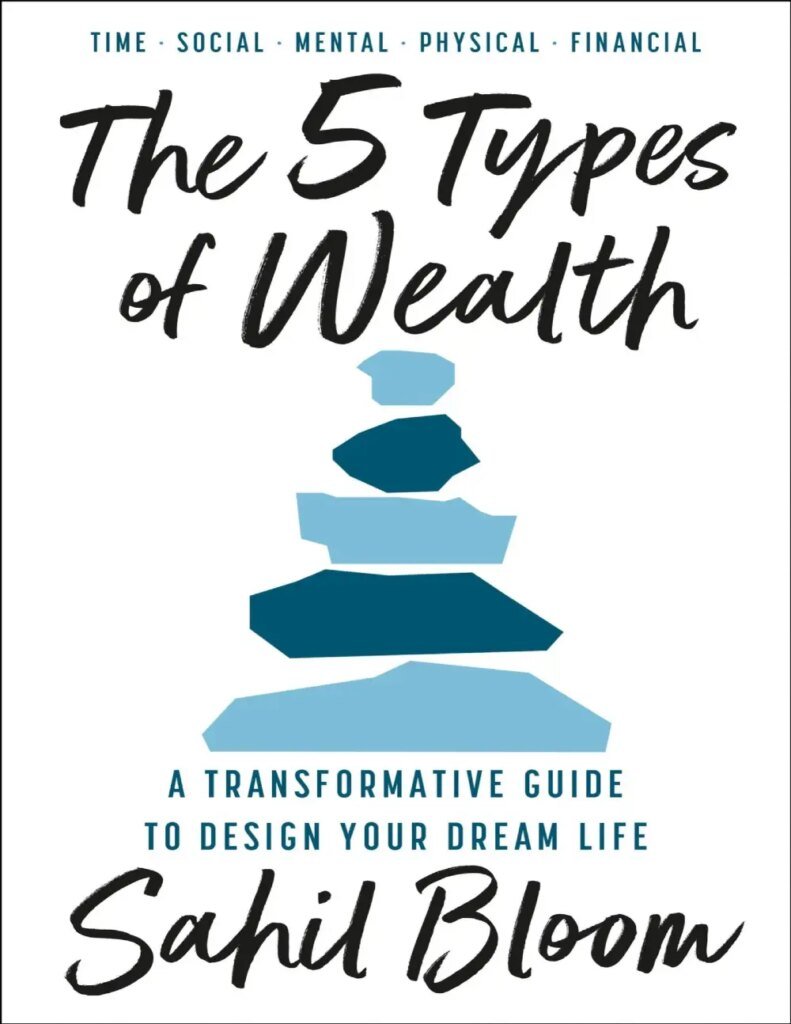
About “The 5 Types of Wealth”: Sahil Bloom’s “The 5 Types of Wealth: A Transformative Guide to Design Your Dream Life” (Ballantine Books, 2025) presents a comprehensive framework for building genuine wealth across five dimensions: Time, Social, Mental, Physical, and Financial. More than a philosophical exploration, the book provides practical systems, exercises, and roadmaps for transformation, helping readers move from conventional success metrics to integrated wealth that creates lasting life satisfaction. Bloom draws on his own journey from high-income misery to integrated wealth, combined with research from psychology, economics, and philosophy, to create a guide for anyone ready to take the leap from accepting life by default to designing it by intention.
Related posts:
 The Wealth Score: Why Measuring Success in Just One Dimension Is Destroying Your Life (The 5 Types of Wealth by Sahil Bloom)
 The Entrepreneurial Path to Integrated Wealth: Building a Business That Serves All Five Dimensions
 How to Create Wealth as a Man: 9 Powerful Strategies for Financial Freedom
 Mental Wealth: How to Build Clarity in an Age of Infinite Distraction
 The Body Budget: Why Your Physical Wealth Determines Every Other Form of Success