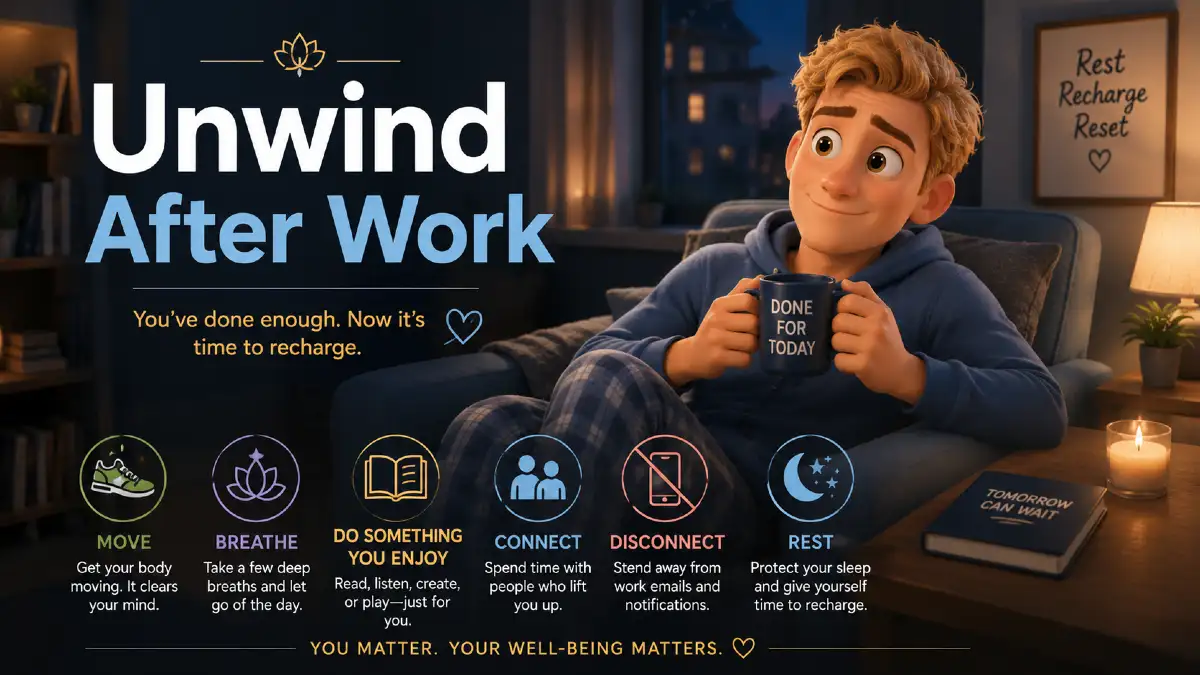
The way many men try to recover after work—collapsing on the couch with screens until bedtime—doesn’t always address the mental fatigue they bring home. Drawing on clinical psychologist Guy Winch’s book Mind Over Grind, this guide explains what knowledge work depletes, why your body can be resting while your mind is still on the clock, and how a multi-sensory transition ritual can help you close the workday. By the end, you’ll have a routine to try this week—and a clearer idea of why some evenings leave you more drained rather than refreshed.
It’s 9:47pm on a Tuesday. You’ve eaten something, you’re on the couch, screens are on. You’re three episodes into something you couldn’t summarise if asked. Your phone is in your hand. You’ve been there for nearly three hours. You will go to bed in another ninety minutes and wake up tomorrow morning feeling roughly as tired as you did this morning.
That’s the version of “unwinding after work” many professional men run by default. It looks like recovery. It feels like recovery in the moment. Yet afterwards, you may not feel restored.
In Mind Over Grind: How to Break Free When Work Hijacks Your Life, Winch explores why recovery needs to match the demands of the working day. The instinct to lie still makes sense after physical labour. But knowledge work also drains mental, emotional, and attentional resources. Physical rest alone may leave that depletion unaddressed, especially when the evening becomes another stream of messages, decisions, and fragmented attention.
This article unpacks what knowledge work drains, why familiar “unwind” tactics can leave you feeling stuck, and how to build a deliberate transition between work and the rest of your life.
How to Unwind After Work: The Short Version
If you’ve got two minutes:
- Match your recovery to your fatigue. After a mentally demanding day, lying still may be only part of what you need.
- Notice whether your mind is still at work. Without a clear transition, unresolved conversations and tasks can occupy the evening.
- Use a multi-sensory transition ritual. Combine changes in lighting, music, clothing, or another familiar sensory cue to mark the end of work.
- Use movement to help change your state. A walk, cycle, workout, or other enjoyable activity can give your attention somewhere different to go.
- Make room for recharging as well as resting. Connection, hobbies, and meaningful activities can restore something that passive downtime leaves untouched.
Why Couch-and-Screens Can Leave You Mentally Exhausted After Work
To understand the problem, consider what your working day has actually demanded.
A physically demanding shift can leave your muscles and body needing rest. Lying down, eating, and sleeping may be exactly what you need. That instinct—that rest means stopping movement—makes sense for physical depletion.
Knowledge work adds a different kind of demand. Meetings, emails, decisions, interpersonal tension, and sustained concentration can leave you mentally exhausted even when you’ve spent most of the day sitting.
Your body may have had little movement while your attention has been repeatedly stretched. When you move straight from the desk to the couch with several screens, two patterns can continue:
Your body gets more inactivity. After sitting through much of the working day, you spend the evening in another largely stationary position. The opportunity for a change of pace, environment, and movement disappears.
Your mind gets more input without necessarily disengaging from work. Watching a programme while checking your phone can keep your attention fragmented. If work notifications remain accessible, the boundary becomes even weaker. You may be consuming media and rehearsing tomorrow’s conversation at the same time.
By bedtime, you’ve had hours away from your desk but little sense of having left work behind.
This doesn’t mean television or the couch can never be restorative. Watching something you enjoy, especially with someone you care about, can be a worthwhile part of an evening. The question is whether your particular routine leaves you rested, engaged, or merely distracted until bedtime.
Many men feel they “had time off” without experiencing much recovery because the activity didn’t address the kind of fatigue they were carrying.
Why You Can’t Switch Off After Work Even When Your Body Is Resting
Even when your body has stopped working, your attention may not have followed.
Winch describes how work can remain mentally prominent during the hours we intend to spend elsewhere. An unanswered email, a pending decision, or an uncomfortable conversation can keep pulling us back.
The signs are familiar: you’re watching a show but can’t remember the last five minutes. You snap at your partner over something minor. At 10:30pm, you realise you’ve been holding tension in your shoulders since dinner.
For fathers, this can widen the gap between being physically home and emotionally present with your children. You’ve arrived at the dinner table, but your attention is still inside the meeting that ended hours ago.
Simply telling yourself to relax may not be enough. A practical transition gives you something to do with that intention. It marks a change in environment, activity, and role rather than relying entirely on willpower.
That’s what a transition ritual offers: a repeatable way to acknowledge that the working day has ended and the evening has begun.
Build an After-Work Transition Ritual to Help You Relax
Before remote work, many people had a physical transition built into the day: the commute.
Whether twenty-five minutes on a train or forty in a car, travelling home separated environments and created a period between work and home life. It wasn’t necessarily relaxing, but it was a transition.
Working from home can remove that separation. The bedroom becomes the office, the dining table becomes a desk, and the same screen follows you onto the couch. There may be no obvious point at which work ends.
A transition ritual rebuilds that boundary deliberately. The multi-sensory approach described in the article’s reading of Winch combines two or more familiar cues to mark the change.
Sight: Change Your Visual Environment
Switch off the work lighting and turn on a different lamp. Close the laptop and put work materials away. Move to another room if you can.
If you work from home, a visible change is one of the simplest ways to distinguish the evening from the working day. Your surroundings no longer need to look exactly as they did during the morning’s meetings.
Sound: Give the Evening Its Own Soundtrack
Pick an album, playlist, or song you associate with being off duty. Play it while you change clothes, prepare dinner, or tidy away your workspace.
Repeating the cue can help it become familiar. There’s no fixed number of days after which it will work automatically; the aim is to build an association you find useful.
Scent: Use a Familiar Cue You Enjoy
A shower, a favourite soap, or the smell of dinner cooking can contribute to a change of atmosphere.
You don’t need to buy anything or add scent if it bothers you. This is simply another possible way to make the evening feel different from the workday.
Touch: Change Your Clothes
Out of the work outfit, into something different. Even if you work from home in casual clothes, changing them can help mark the end of that role.
The practical value is in the change itself: you’re doing something concrete that says you’ve finished.
You don’t need all four. Start with two that fit easily into your life. The point is to make the transition deliberate and repeatable—a five- or ten-minute sequence you can actually use.
Some possible combinations:
- The shower and playlist: A quick shower, followed by music while you get dressed or prepare dinner.
- The walk and lighting change: Build a daily walking practice into the end of your workday, then switch from work lighting to your evening lamps when you return.
- The clothes and cooking routine: Change out of work clothes, put your phone aside, and begin preparing something to eat.
What matters is finding a sequence you can repeat. A similar order and a clear trigger—such as closing your laptop—may be more practical than insisting on an identical clock time every day.
Missing a day doesn’t erase the habit. Return to it at the next opportunity.
Exercise After Work: Using Movement to Interrupt Rumination
Some days, the work loop follows you through the transition. You’ve changed clothes, put on music, and moved rooms, but you’re still replaying a conversation.
Movement can provide another way to shift your attention.
A run, a cycle, a brisk walk, or a workout gives you a different activity to engage with. Instead of sitting with the same thoughts and the same screen, you’re responding to your surroundings and the physical task in front of you.
Physical activity can also reduce short-term feelings of anxiety, while regular activity can support sleep. These benefits don’t require treating every session as an all-out effort. CDC guidance on the benefits of physical activity includes moderate activity as well as vigorous exercise.
Exercise doesn’t guarantee that rumination will disappear. It can, however, become a useful part of your after-work routine.
Three principles help keep it restorative:
Make it engaging enough to hold your attention. Choose an activity and pace that suit your fitness and the day you’ve had. Brisk walking, cycling, swimming, resistance training, or a class can all be options. Pain is not the goal.
Make it manageable enough to do. A short session you can fit into the evening is more useful than an ambitious plan you continually avoid. Start with a duration you can sustain.
Make it predictable enough to become an option. Put a few movement sessions into your week, while leaving room to adjust when your body needs rest.
If you exercise in the morning, that’s useful too. An evening walk or lighter activity can still serve a separate purpose: helping you mark the transition out of work.
Notice how timing and intensity affect you. The best after-work exercise routine is one that supports the rest of your evening rather than becoming another demand to recover from.
Resting vs Recharging: What Actually Helps You Recover From Work?
Resting and recharging describe different needs, although the same activity can sometimes meet both.
Resting means reducing your demands. Lying down. Sleeping. Sitting quietly. Doing less. This matters when you’re physically exhausted or simply need a break.
Recharging means engaging with something that gives something back. Energy, enjoyment, meaning, connection, or a sense of being yourself outside your job.
The distinction matters because some evenings contain plenty of low-effort activity but very little that feels nourishing. You spend hours on the couch without feeling that the time belonged to you.
Recharging activities are individual. Some possibilities include:
- Time with someone you genuinely love spending time with, with enough attention to enjoy each other.
- A hobby that engages you and produces something tangible: cooking, woodwork, music, photography, or drawing.
- Reading something you actually want to read.
- Sport with friends.
- Consensual intimacy with your partner.
- A creative project you’re slowly building.
- Meaningful conversation.
- Being outside.
- Sharing a laugh or using humour to manage stress when the day has left you tense.
The test isn’t whether the activity looks productive. It’s whether you feel more like yourself afterwards.
A film with your partner might be restorative. Three hours of distracted scrolling might not be. Cooking could feel absorbing one evening and like another chore the next.
Use the distinction to pay attention to what helps rather than to create another set of rules you must perform correctly.
On some evenings, fifteen to thirty minutes of an activity you care about may offer more than another two hours spent drifting between screens. On others, you may need food, quiet, and an early night.
A Five-Day Evening Routine to Try This Week
Use this as an experiment, not a promise that every difficult day will disappear.
Day 1: Choose and try your transition ritual. Pick two sensory cues and decide on a simple five- to ten-minute sequence. Run it when work ends.
Day 2: Repeat the ritual. Notice how you feel later in the evening compared with your usual routine. Is work still occupying your attention? Did the transition help at all?
Day 3: Add one recharging activity. Give twenty minutes to something you want to do: a conversation, a hobby, a walk, or another activity that draws you into your own life.
Day 4: Try movement after work. Replace part of your usual couch time with exercise or a walk suited to your energy and fitness. Notice how you feel afterwards and how you sleep.
Day 5: Keep the useful parts. Repeat the combination that worked best. Simplify anything that felt cumbersome and leave enough time for sleep.
Treat the ritual as one part of daily habits that support a calmer life, rather than asking a ten-minute routine to compensate for every pressure in your week.
At the end of the five days, ask:
- Which cue helped me leave work behind?
- Which activity made the evening feel like mine?
- What was easy enough to repeat?
- What needs adjusting?
You may notice a difference quickly, or you may need to experiment. The useful result is a routine based on your experience rather than a fixed deadline for feeling better.
Recovering From Work Starts With How You Spend Your Evenings
The way you recover from work matters. Yet it’s easy to rely on a familiar routine without asking whether it fits the demands of your day.
If work has exhausted your attention, more passive input may leave you feeling occupied rather than restored. A deliberate transition, some movement, and time for an activity or relationship you value can give the evening a different shape.
Physical rest still matters. So does sleep. The aim is to make room for the kinds of recovery your current life calls for.
Close the workday deliberately. Change your surroundings. Move when movement helps. Choose something that reconnects you with life beyond your job.
Your evenings aren’t merely the gap between one working day and the next. They’re part of the life the work is supposed to support.
Source: Guy Winch, Mind Over Grind: How to Break Free When Work Hijacks Your Life (Simon & Schuster, 2026).

Related posts:
 Does Everyday Activity Count As Exercise: Why Believing It Does Changes Your Blood Pressure
 Mind Over Grind Book Summary: Guy Winch’s Field Manual for Men Whose Work Has Quietly Taken Over
 How to Stop the Sunday Scaries: A Psychologist’s Counter-Move That Actually Works
 Is Work Stress Affecting Your Relationship? The Damage You Don’t See
 The Morning and Evening Routines That Set High Performers Apart