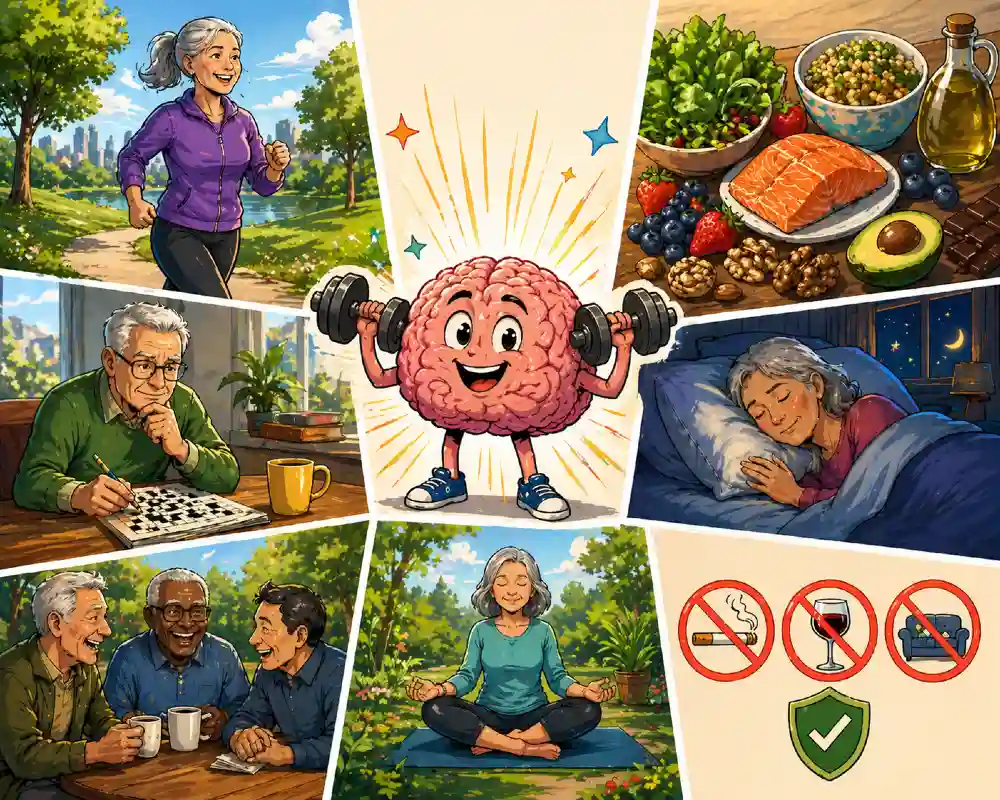
Keeping your brain healthy as you age isn’t about one habit—it’s the result of how you live every day. Research shows that physical activity, quality sleep, mental stimulation, and strong social connections all play a critical role in maintaining cognitive function and reducing decline. This article breaks down the key habits that protect your brain over time, from managing stress and diet to staying mentally and socially engaged. If you want to stay sharp, focused, and resilient as you get older, it starts with the daily choices you make now.
How to Keep Your Brain Healthy Starts Earlier Than You Think
Most people begin thinking about brain health when something starts to decline.
Memory slips. Focus weakens. Energy feels lower. And the question emerges quietly: how do I protect my brain as I get older?
But according to David Eagleman, the more important truth is this: brain health is not something you fix later. It is something you build continuously.
The brain is always changing. The only question is whether those changes are strengthening your capacity or allowing it to narrow over time.
Why the Brain Naturally Declines Without Challenge
There is a reality that is easy to avoid but important to face.
The structure of the brain is always, slowly, degenerating.
Cells die. Connections weaken. This is a natural part of aging. The goal is not to stop this process entirely—that is not possible—but to build enough resilience that decline does not immediately translate into loss of function.
This is where the concept of cognitive reserve becomes important.
Cognitive reserve refers to the brain’s ability to compensate for damage by using alternative pathways. In simple terms, the more connections you build over time, the more flexibility your brain has later.
Without this reserve, even small amounts of degeneration can have noticeable effects.
The Surprising Study That Changed How We Think About Aging
One of the most striking findings in neuroscience comes from a long-term study of nuns.
Researchers examined the brains of individuals who had lived active, socially engaged lives in convents. Many of these brains showed clear signs of Alzheimer’s disease.
But here is what stood out: during their lives, these individuals did not show the expected symptoms.
They maintained memory, clarity, and cognitive function despite the physical deterioration.
The explanation lies in cognitive reserve.
Because their lives involved constant interaction, problem-solving, and engagement, they had built rich networks in the brain. Even as some pathways degraded, others remained available.
Their brains had developed redundancy.
Why Social Interaction Is Critical for Brain Health
One of the most overlooked aspects of brain health is social life.
There is a tendency to think of cognitive strength as something individual—reading, learning, thinking alone. These are valuable, but they are not enough.
Human interaction places unique demands on the brain.
When you engage with another person, you are constantly interpreting signals, adjusting your responses, managing emotions, and predicting behavior. It is unpredictable and dynamic.
As Eagleman puts it, nothing is as complex for the brain as dealing with other people.
This is why social isolation can be so damaging. It removes one of the most powerful sources of cognitive stimulation.
Over time, a shrinking social world often leads to a shrinking cognitive world.
How to Keep Your Brain Healthy Through Lifelong Challenge
If there is one principle that stands out clearly, it is this: the brain needs challenge.
Not occasional challenge, but continuous engagement with things that are slightly beyond your current ability.
This does not mean constant stress or overwhelm. It means regularly stepping into situations where you are learning, adapting, and figuring things out.
It could be learning a new skill, taking on unfamiliar responsibilities, or entering new environments. What matters is that the brain is required to work in new ways.
There is also an important nuance here. Once something becomes easy, it stops being useful for growth.
Activities that once challenged you can eventually become automatic. At that point, they maintain ability but do not expand it.
To keep your brain healthy, you need to repeatedly place yourself back into the position of a beginner.
Why Retirement Can Accelerate Cognitive Decline
Many people look forward to retirement as a time to finally relax.
But from a neurological perspective, complete disengagement can be risky.
When structured work, responsibility, and social interaction disappear, the brain loses many of the challenges that kept it active.
Without new demands, the brain has less reason to maintain and build pathways.
This does not mean retirement itself is harmful. It means that how you spend that time matters.
A life filled with curiosity, activity, and connection continues to stimulate the brain. A life that becomes passive can allow decline to accelerate.
The Role of Exercise, Sleep, and Physical Health
While cognitive and social factors are critical, physical health also plays a central role.
Exercise supports blood flow to the brain and is associated with the growth of new neural cells in animal studies. Sleep allows the brain to restore itself and regulate essential processes.
Diet, movement, and rest are not separate from brain health. They are part of the same system.
The brain is not an isolated organ. It is deeply connected to the condition of the body.
What It Really Means to Protect Your Brain
To keep your brain healthy is not to avoid decline entirely. It is to build enough capacity that decline does not immediately limit you.
It is the difference between a system with a single pathway and one with many.
The more pathways you build, the more resilient your brain becomes.
This requires effort. It requires engagement. It requires a willingness to stay mentally active even when it would be easier not to.
But it is also one of the most direct ways to influence how you experience aging.
Final Thoughts on How to Keep Your Brain Healthy
The brain does not respond to intention alone. It responds to what you do consistently.
If your life involves challenge, connection, and learning, your brain adapts to support that. If it becomes passive and repetitive, the brain adapts in that direction as well.
The process is always ongoing.
To keep your brain healthy, you do not need a perfect plan. You need a pattern of living that continues to stretch you, engage you, and connect you to the world around you.
Over time, those patterns become the foundation of resilience.
Related posts:
 The Importance of Sleep for Success (Why Discipline Depends on Rest)
 Can You Function on Bad Sleep? Why Your Belief Matters More Than Your Hours
 Hume Band Review: Does This Stress-Tracking Wearable Actually Work?
 How Physical Health Affects Anxiety and Emotional Regulation
 The Body Budget: Why Your Physical Wealth Determines Every Other Form of Success