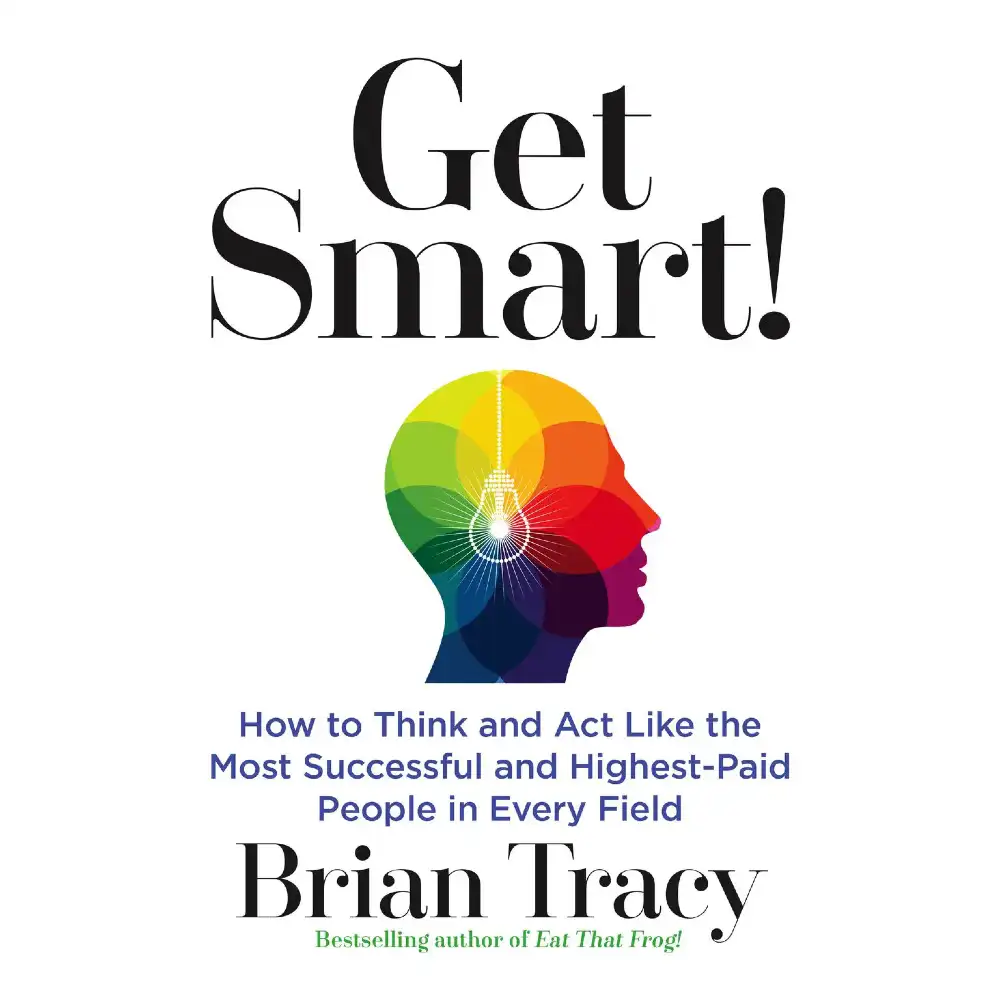
What separates highly successful people from those who struggle? It’s not intelligence, education, or even opportunity. According to Brian Tracy’s “Get Smart!”, the difference comes down to thinking patterns – specific, learnable ways of processing information, making decisions, and approaching problems that successful people use consistently.
After decades studying self-made millionaires, business leaders, and high achievers, Tracy identified ten fundamental contrasts between superior and inferior thinking. Each contrast represents a choice point where you can either think like successful people or think like those who never reach their potential.
The book’s central premise is revolutionary: “You become what you think about most of the time.” Your thinking patterns create your reality. Change how you think, and you change your life.
This isn’t motivational platitude – it’s practical psychology backed by research into human achievement. Tracy synthesizes insights from Edward Banfield’s studies of upward mobility, Daniel Kahneman’s research on decision-making, Abraham Maslow’s work on self-actualization, and his own extensive interviews with wealthy, successful people.
What emerges is a comprehensive framework for upgrading your mental operating system.
The Power of Perspective
Tracy opens with a quote from Robert Browning: “Truth is within ourselves; it takes no rise from outward things… There is an inmost centre in us all, where truth abides in fulness… And to know, rather consists in opening out a way whence the imprisoned splendor may escape.”
Your mind contains extraordinary power. You have 100 billion brain cells, each connected to as many as twenty thousand others. The total number of thoughts you can think equals one hundred billion to the twenty thousandth power – more potential ideas than all the molecules in the known universe.
The question is: How are you using this mental supercomputer?
Most people use only about 2 percent of their mental capacity. They have enormous reserves of mental ability they fail to use, apparently saving them up for some good reason.
Tracy compares this to inheriting a bank account containing $1 million but only ever accessing twenty thousand dollars because you lack the necessary code to acquire the rest. The remainder is yours, but you can’t get at it because you don’t know the correct account number.
The book provides those codes – the thinking patterns that unlock more of your natural talents and abilities.
The Ten Thinking Contrasts
1. Long-Term Versus Short-Term Perspective
Dr. Edward Banfield’s fifty years of research into upward mobility revealed one overwhelmingly important factor: time perspective. How far into the future you think when making present decisions determines your economic success more than any other variable.
At the lowest socioeconomic levels, time perspective measured in hours or minutes. At the highest levels, people projected years or decades into the future when making daily decisions.
The very act of long-term thinking changes how you think and act in the present, increasing the likelihood of greater success in the future.
Tracy provides specific tools for developing long-term perspective: “back from the future” thinking, where you imagine your ideal life five years ahead and work backward to identify necessary steps; idealization exercises for business, relationships, health, and finances; and the discipline of sacrifice – delaying immediate gratification for long-term gains.
The critical word is sacrifice. “Successful people are willing to sacrifice, to delay immediate gratification in the present, in the short term, to enjoy greater rewards in the future.”
Without the willpower and discipline for “short-term pain for long-term gain,” little success is possible.
2. Slow Thinking Versus Fast Thinking
Drawing on Daniel Kahneman’s research, Tracy distinguishes between fast thinking (automatic, instinctive, intuitive) and slow thinking (deliberate, analytical, effortful).
Both have their place. Fast thinking works for routine decisions and familiar tasks. Slow thinking is essential for decisions with significant long-term consequences.
“The biggest mistake that most people make,” Tracy writes, “is that they use fast thinking in making long-term, vital decisions, where slow thinking is much more appropriate.”
Decisions about career paths, major relationships, business strategies, and significant investments all require slow thinking. The more important the decision’s long-term impact, the more time you should take before committing.
Tracy recommends the Seventy-Two-Hour Rule for major decisions, thinking on paper to force deliberate analysis, and the regular practice of solitude – thirty to sixty minutes alone in complete silence, allowing your subconscious and superconscious minds to surface insights.
“The very first time you do this, almost without exception, the answer to your biggest problem will come to you,” Tracy promises.
3. Informed Versus Uninformed Thinking
The two most popular words among experienced businesspeople are “due diligence” – taking whatever time necessary to get critical information needed for right decisions.
According to Forbes, the number one reason for business failure is simple: there’s no demand for the product or service. Despite $8 billion spent on market research in 2013, 80 percent of new products eventually fail.
The reason: companies ask wrong questions, make unwarranted assumptions, or fail to truly understand customers.
Tracy emphasizes Harold Geneen’s principle: “Get the real facts, not the obvious facts or assumed facts or hoped-for facts. Get the real facts. Facts don’t lie.”
He recommends validation over assumption, using the scientific method to test hypotheses by attempting to disprove them, hiring experts who have pattern recognition from experience, and searching for the hidden flaw that could prove fatal to any decision.
Bernard Baruch, one of America’s richest self-made men, wrote that his biggest financial mistakes came from failing to do sufficient due diligence. Warren Buffett spends roughly 80 percent of each day reading and gathering information to inform investment decisions.
The more information you gather and the more experience you accumulate, the better decisions you make and the better results you achieve.
4. Goal-Oriented Versus Reaction-Oriented Thinking
Tracy’s personal turning point came at age 24 when he discovered goals. After writing down ten goals on a piece of paper, his life transformed within thirty days – he accomplished almost everything on that lost list in completely unexpected ways.
“Only about 3 percent of people have clear, specific, written goals and plans that they work on each day. The other 97 percent have hopes, dreams, wishes, and fantasies, but not goals. And the great tragedy is that they don’t know the difference.”
The 3 percent earn and accomplish, on average, ten times as much as the bottom 97 percent combined.
Tracy provides a seven-step goal-setting formula proven to work for millions:
Decide exactly what you want Write it down Set a deadline Make a list of everything you could do to achieve it Organize the list into a plan Take action immediately Do something every day toward your goal
Goals activate your subconscious mind’s achievement mechanisms, give you control over your direction in a chaotic world, and develop the three keys to success: clarity, focus, and concentration.
“You become what you think about most of the time,” Tracy writes. When you identify your major goal and think about it constantly, you activate multiple psychological systems working toward its achievement.
5. Result-Oriented Versus Activity-Oriented Thinking
Your most valuable financial asset isn’t your house, car, or savings – it’s your earning ability. Your capacity to get results people will pay for.
Tracy discovered that “highly paid people are highly productive. They use their time better than average people. They get more and better results for which people are willing to pay them.”
All success in work boils down to one simple result: task completion. Your ability to complete important tasks consistently and dependably makes you valuable and indispensable.
The 80/20 rule applies: 20 percent of people are on the fast track while 80 percent are timeservers. According to Robert Half International, fully 50 percent of working time is wasted.
Tracy’s rule is simple: “Work all the time you work. When you go to work, work.”
He introduces the Law of Three: only three tasks account for 90 percent of the value of your contribution. Identify them, then do fewer things, do more important things, do your most important tasks more of the time, and get better at each.
The central question of time management: “What is the most valuable use of my time right now?”
Your ability to ask and answer this question accurately and then do exactly that determines your success more than any other factor.
6. Positive Versus Negative Thinking
Aristotle concluded that the ultimate goal of human life is happiness. Every act aims at achieving greater happiness.
Tracy discovered that “the main obstacle between each person and the happiness that he desires is negative emotions. Negative emotions lie at the root of virtually all problems in human life.”
If you could eliminate negative emotions, you would wipe out most of mankind’s problems. When you eliminate negative emotions, “your mind automatically fills with positive emotions. You become a fully functioning person.”
The starting point: understanding where negative emotions come from. No child is born with fears or negative emotions – all must be taught during formative years. Because they’re learned, they can be unlearned.
Tracy identifies four sources: rationalization, justification, judgmentalism, and hypersensitivity. All stem from the trunk of the negative emotion tree: blame.
“It is impossible to experience a negative emotion without blaming others for something. The minute you stop blaming, your negative emotions cease completely.”
How do you stop blaming? “It is impossible to blame someone else for a negative emotion and accept responsibility for the situation at the same time. The very act of accepting responsibility cancels the negative emotion.”
The magic words: “I am responsible.”
This positive, present-tense affirmation eliminates negative emotions instantly.
The practice requires forgiveness – of parents, everyone who hurt you, and yourself. “For you to be free, you must free everyone else.”
7. Flexible Versus Rigid Thinking
In 1952, Albert Einstein gave the same exam to the same physics students two years in a row. When questioned, he explained simply: “Because the answers have changed.”
In times of rapid change, your ability to think flexibly and respond effectively can have enormous impact on your business and career.
The Menninger Institute’s 1995 study concluded that the most important quality for 21st-century success would be “flexibility” – the ability to rapidly react and respond to accelerating change.
Tracy emphasizes that many if not most companies operate on partially or totally obsolete business models. The rule: whatever you’re doing today, you’ll have to be much better a year from now just to stay even.
He introduces zero-based thinking: “Is there anything that we are doing today that, knowing what we now know, we wouldn’t start up again if we had to do it over?”
How do you know if you’re dealing with a zero-based thinking situation? The answer is stress. If there’s something you wouldn’t get into again today, you’ll continually experience stress, worry, anger, frustration in that area.
Tracy provides the three statements of superior executives:
“I was wrong.” “I made a mistake.” “I changed my mind.”
The more readily you can say these words, the better you’ll think and the more respected you’ll be.
8. Creative Versus Mechanical Thinking
Creative thinkers rule the world. They’re responsible for all great breakthroughs, innovations, and progress. They practice CANEI – Continuous And Never-Ending Improvement.
Tracy argues that “you have more creative potential than you could use in a hundred lifetimes. The more of your creative ability you use, the more you can use. You actually become more creative each time you come up with something new.”
Studies of geniuses reveal that intelligence isn’t about IQ. Geniuses develop three qualities: approaching problems with open minds, carefully considering every aspect before concluding, and using systematic approaches to problem-solving.
Tracy provides a nine-step systematic problem-solving method:
Define the problem clearly in writing Ask “What else is the problem?” Ask “What is the solution?” and “What else is the solution?” Make a decision Determine how you’ll measure success Assign responsibility to specific people Set deadlines and sub-deadlines Develop Plan B Take action immediately
The Principle of Constraints states that between you and any goal is a constraint determining how fast you achieve it. Your first job: identify this limiting factor and focus single-mindedly on alleviating it.
“What-If Thinking” – continually asking “What if?” – breaks limited thinking bonds and opens your mind to possibilities. This concept made Federal Express and Apple two of the most successful companies in the world.
9. Entrepreneurial Versus Corporate Thinking
According to Thomas Stanley, fully 80 percent of self-made millionaires are entrepreneurs who earned their fortunes by starting and building businesses.
Entrepreneurial thinking means focusing on customers at all times. Tom Peters wrote that the single most important quality of successful businesses was “an obsession with customer service.”
Corporate thinkers view customers either with disinterest or as problems. They’re preoccupied with doing their jobs, pleasing superiors, following rules, doing the minimum necessary to avoid being fired.
Entrepreneurial thinkers are committed to the company’s success. They see themselves as self-employed and act as if they owned their companies personally. They accept high levels of responsibility for results.
Above all, entrepreneurial thinkers search for ways to increase sales and profitability.
Tracy emphasizes asking basic questions:
What business are you really in? Who is your ideal customer? What does your ideal customer consider valuable? What is your area of excellence? What is your business model?
Your ability to think like an entrepreneur rather than an employee will do more to liberate your full potential than any other single factor.
10. Rich Thinking Versus Poor Thinking
The Law of Correspondence says your outer world reflects your inner world. To be wealthy outside, you must think like a rich person inside.
Tracy identified seven reasons people don’t become wealthy – all psychological:
It never occurs to them They never decide to do it They procrastinate They fear failure They fear criticism and disapproval They stop learning and growing They lack persistence
All can be overcome through learning and practice.
Your self-concept – the bundle of beliefs about yourself – determines everything. You always act externally consistent with your self-concept. All improvements in external performance begin with improving your self-concept.
Rich people have rich habits. Poor people have poor habits. Tracy provides a seven-step strategy for developing new habits:
Develop only one habit at a time Input new data Affirm you already have this habit Visualize yourself practicing it Act as if you already had it Refuse to allow exceptions If you fall off, get back on immediately
In the Forbes 2015 survey of self-made billionaires, 76 percent attributed success to “hard work and self-discipline.”
Millionaires work about sixty hours per week. They don’t waste time. They’re intensely goal-oriented. They’re frugal. They plan every day in advance. They’re always learning. They watch less than one hour of television daily. They take excellent care of physical health.
The key: Do what you love. Most millionaires say they never work a day in their lives – they just do something they love and get paid very well for it.
The Central Message
Tracy’s fundamental thesis is that quality thinking determines quality of life. “The better you think, the better results you will get and the more successful you will be in every area.”
Intelligence isn’t IQ or academic credentials. It’s “a way of acting.” If you act intelligently – taking actions that move you toward what you genuinely want – you’re smart. If you act stupidly – doing things that don’t move you toward your goals – you’re stupid, regardless of test scores.
The true measure of thinking quality is results. “Did it work? Did your action, based on your thinking, move you toward something you wanted?”
Not intentions. Not effort. Not how much you care. Just results.
This creates personal accountability. You can’t blame circumstances, other people, or bad luck. Your results reveal your thinking. If you don’t like your results, change your thinking.
The Promise
Tracy promises that these thinking patterns are learnable. You don’t need to become someone different. You just need to unleash more of your existing mental powers.
“You do not need to become more than you are or someone different. You only need to become all that you are already and to unleash more of your existing mental powers.”
The book contains “some of the best combinations ever discovered in terms of thinking tools that enable you to make quantum leaps in your life.”
Often what holds you back is simply perspective – your particular way of looking at things. Dr. Martin Seligman calls this your “explanatory style” – how you explain or interpret things to yourself.
This can be as simple as the difference between optimism and pessimism, the glass half-full or half-empty. The optimist looks for good and what can be gained from every situation. The pessimist looks for problems and downsides.
But as Josh Billings said, “It ain’t what a man knows what hurts him; it’s what he knows that ain’t true.”
Ignorance is not bliss. Failing to use appropriate thinking tools in particular situations can be disastrous.
The Application
Tracy structures the book to be immediately actionable. Each chapter ends with three action exercises – specific steps you can take immediately to apply the concepts.
For example, after the chapter on long-term thinking:
Resolve today to think long term, to consider likely consequences before acting Project forward three to five years, and imagine your life was ideal in every way. How would it differ from today? Decide upon one action you’re going to take immediately to create your ideal future
The emphasis is always practical application, not theoretical knowledge. Tracy repeatedly emphasizes that success comes from doing, not just knowing.
As he writes in the summary: “Success is not an accident. Failure is not an accident either. You are where you are and what you are because of yourself, because of your own thinking and behavior.”
The Takeaway
“Get Smart!” is Brian Tracy’s synthesis of decades studying successful people and the thinking patterns that set them apart. The ten contrasts – long-term versus short-term perspective, slow versus fast thinking, informed versus uninformed thinking, goal-oriented versus reaction-oriented thinking, result-oriented versus activity-oriented thinking, positive versus negative thinking, flexible versus rigid thinking, creative versus mechanical thinking, entrepreneurial versus corporate thinking, and rich versus poor thinking – provide a comprehensive framework for upgrading how you think.
The central insight is deceptively simple: you become what you think about most of the time. Your thinking patterns create your reality. Change how you think, and you change your life.
Everything you are today you learned from childhood through input and practice. At any time, you can decide to learn new ideas, practice new behaviors, and get different results.
As Tracy concludes: “Fortunately, everything you are today, you have learned from early childhood as the result of input and practice. At any time, you can decide to learn new ideas, practice new behaviors, and get different results.”
The question is whether you’ll actually do it.
Related posts:
 Why Slow Thinking Beats Fast Reactions in High-Stakes Decisions
 The Root of All Negative Emotions (And Why Fighting Them Never Works)
 Work All the Time You Work: Why Earning Ability Matters More Than Hours
 Why Only 3% of People Write Down Goals—and How This Quietly Creates the Wealth Gap
 Why Long-Term Thinking Determines Wealth (More Than Talent or Income)