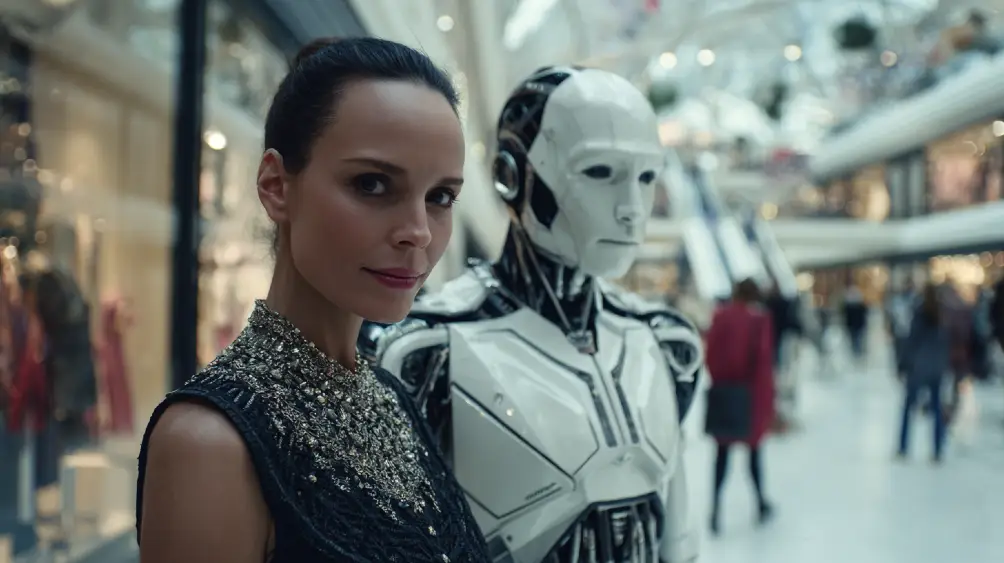
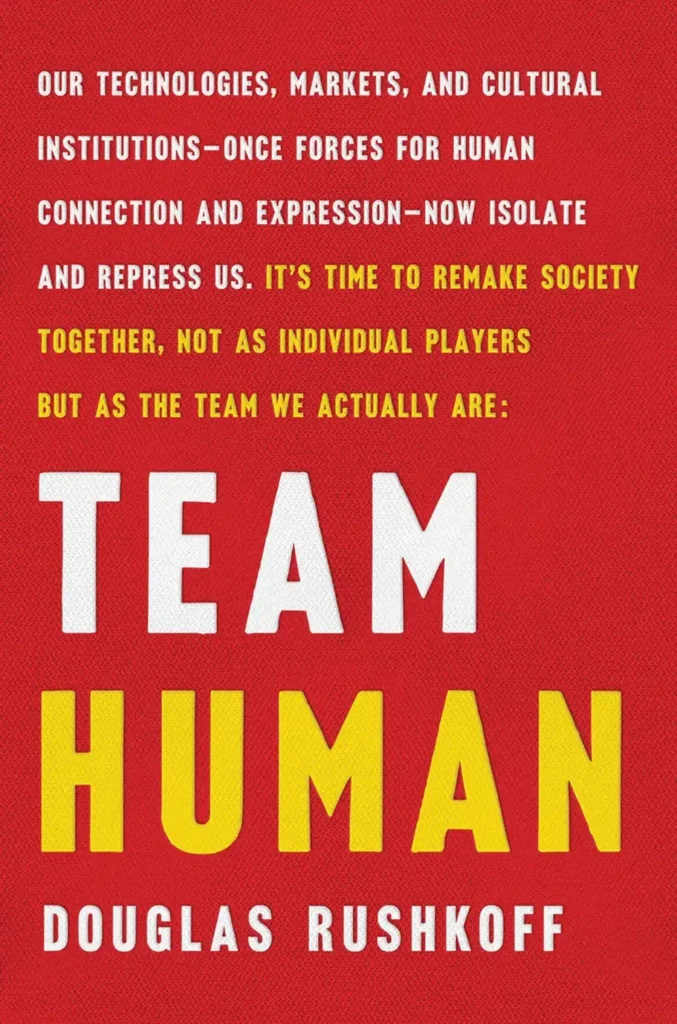
Douglas Rushkoff’s “Team Human” is not a gentle book. It doesn’t offer easy answers or comfortable reassurance. Instead, it’s an urgent, necessary wake-up call about the systematic assault on human autonomy, connection, and flourishing being conducted through our technologies, economies, and institutions.
“It doesn’t have to be this way,” Rushkoff declares in the opening pages. And that simple truth—that the current trajectory isn’t inevitable, that we have agency, that things could be different—is the book’s central message and greatest gift.
For men navigating modern life, trying to build meaningful careers and relationships while maintaining integrity and purpose, “Team Human” offers both diagnosis and remedy. It exposes the systems working against human flourishing while providing a framework for conscious resistance and collective renewal.
The Core Diagnosis
Rushkoff’s central argument is stark: “There’s a reason for our current predicament: an antihuman agenda embedded in our technology, our markets, and our major cultural institutions, from education and religion to civics and media. It has turned them from forces for human connection and expression into ones of isolation and repression.”
This isn’t conspiracy theory. It’s documented history. The book traces how institutions and technologies that began as tools for human benefit systematically become forces for control and extraction:
Language gave us unprecedented ability to communicate, but also created the possibility of lies and systematic deception. Writing enabled record-keeping and knowledge transfer, but was first used primarily to track slaves and inventory. The printing press promised universal literacy but was initially monopolized by monarchs who executed anyone operating unauthorized presses. Radio began as peer-to-peer communication but became dominated by propaganda and advertising. Television enabled shared cultural experiences but evolved into an isolation machine optimizing individual consumption.
The pattern repeats with digital technology. What began as a peer-to-peer communication network promising unprecedented human connection has become a sophisticated system for surveillance, manipulation, and extraction that leaves users more isolated and controlled than ever.
The Biological Foundation
Before diving into technological critique, Rushkoff establishes crucial biological context: humans are fundamentally social beings. “Being human is a team sport,” he writes. “We cannot be fully human alone.”
This isn’t feel-good rhetoric—it’s evolutionary biology. Human brains developed primarily to handle increasing social complexity. We evolved sophisticated mechanisms for bonding: mirror neurons, limbic resonance, oxytocin release, preverbal communication systems. These biological systems require physical presence and full-bandwidth interaction to function properly.
“Our nervous systems learned to treat our social connections as existentially important—life or death,” Rushkoff explains. “Threats to our relationships are processed by the same part of the brain that processes physical pain.”
Understanding our nature as social beings reframes everything that follows. Technologies and systems that isolate us aren’t just unpleasant—they’re attacking our fundamental nature. The loneliness epidemic, rising suicide rates, and pervasive sense of meaninglessness aren’t personal failings or inevitable modern conditions. They’re predictable results of systematic disconnection.
The Mechanism of Control
Rushkoff exposes how social control operates through calculated disconnection: “Social control is based on thwarting social contact and exploiting the resulting disorientation and despair.”
When people are isolated, they’re easier to manipulate. Disconnected individuals are more anxious, more susceptible to advertising, more compliant with authority, and less capable of collective resistance. They lack the social support that would enable them to resist pressure or think critically about their circumstances.
Digital platforms accelerate this isolation while appearing to do the opposite. Social media creates the simulation of connection while systematically undermining the biological mechanisms that create actual bonding. You get enough pseudo-connection to keep coming back, but not enough real connection to satisfy your nervous system’s needs.
The result? You feel lonely, so you return to the platforms seeking connection, which makes you lonelier, perpetuating the cycle while generating profit for platform owners.
The Economic Engine
Behind technological manipulation lies extractive capitalism. Rushkoff traces how central currency and chartered monopolies, invented in the late Middle Ages to consolidate aristocratic power, evolved into modern corporate capitalism with its requirement for perpetual growth.
“That growth mandate remains with us today,” he writes. “Corporations must grow in order to pay back their investors.” This creates a system where human and environmental wellbeing are subordinate to shareholder returns. Anything that can’t be monetized is externalized as someone else’s problem.
Digital platforms represent the latest evolution of this extractive model. They insert themselves between people who want to transact or communicate, capture value from every interaction, and externalize costs to users who provide the labor (data generation), capital (personal devices), and infrastructure (internet costs) while the platform captures the profit.
“Digital businesses work the same way as their extractive forebears,” Rushkoff observes. “A digital business does the same thing, only faster.”
The Attention Economy
Perhaps the most direct assault on human autonomy is what Rushkoff calls the attention economy: “Internet industry magazines declared that we were living in an ‘attention economy,’ where a company’s profits would depend on its ability to wrest ‘eyeball hours’ from users.”
Your attention—your life energy, your capacity to direct your mind toward what matters—is the commodity being bought and sold. Persuasive technology, borrowed from casino design and behavioral psychology, creates compulsive use through variable rewards, social pressure, fear of missing out, and other manipulation tactics.
The goal isn’t to help you live well. It’s to keep you distracted, anxious, and consuming. “We now know, beyond any doubt, that we are dumber when we are using smartphones and social media,” Rushkoff notes. This cognitive degradation isn’t an unfortunate side effect—it’s the intended outcome, making users more impulsive and easier to manipulate.
The Algorithm Problem
Algorithms add another layer of control by predicting and shaping behavior. They don’t care about your actual interests or wellbeing. They care about making you more predictable and profitable.
“Algorithms use our past behavior to lump us into statistical groups and then limit the range of choices we make moving forward,” Rushkoff explains. Over time, you’re nudged to conform to your algorithmic profile, eliminating the unpredictable, anomalous behaviors that make you fully human.
The implications go beyond targeted advertising. When your newsfeed, dating prospects, job opportunities, and even your friends are algorithmically curated, you’re living in a progressively narrower reality tunnel, optimized not for your flourishing but for platform profit.
The Transhumanist Escape Plan
For the ultra-wealthy, aware that their extractive practices are destroying livability for most people, the solution isn’t to stop extracting—it’s to escape.
Some invest in apocalypse bunkers, buying property in predicted safe zones and building underground shelters. Others pursue technological transcendence: life extension, consciousness uploading, genetic engineering. “Transhumanists hope to transcend or at least improve upon biological existence,” Rushkoff writes.
This isn’t human enhancement—it’s human evacuation. The premise is that being human itself is the problem, that biological existence is obsolete, and that the solution is to become something else. This philosophy, deeply embedded in Silicon Valley culture, helps explain why technology often seems designed to undermine rather than support human flourishing.
The Renaissance Opportunity
Despite the grim diagnosis, Rushkoff offers hope grounded in historical pattern recognition. We’re not facing inevitable decline—we’re in the midst of a potential renaissance.
“Are we in the midst of a renaissance?” he asks. “Might the apparent calamity and dismay around us be less the symptoms of a society on the verge of collapse than those of one about to give birth?”
Renaissance means retrieval—bringing forward values and approaches lost in previous eras. The last Renaissance retrieved classical individualism while suppressing medieval collectivism. Our current renaissance offers the opportunity to retrieve collectivism, solidarity, and mutual aid while retaining modern individuality and autonomy.
This isn’t regression—it’s spiral ascent. We don’t reject the values of the last era; we integrate them with what was lost, creating a more dimensional and balanced culture.
The Path Forward
Rushkoff’s prescription is both simple and challenging: “Find the others.”
Restore the social connections that make us fully human. Oppose all systems that keep us apart. Build communities based on physical proximity, regular gathering, mutual aid, and shared purpose.
This requires:
Prioritizing place-based community. “Solidarity begins with place.” Connect with people who share your geographic location. Build relationships with neighbors, local businesses, local organizations. Physical proximity creates resilience that purely interest-based digital communities lack.
Face-to-face interaction. Digital tools can supplement but never replace physical presence. Your nervous system requires full-bandwidth, embodied interaction to create genuine bonds. Make in-person connection the priority and digital the exception.
Conscious technology use. “Human beings can intervene in the machine. That’s not a refusal to accept progress. It’s simply a refusal to accept any particular outcome as inevitable.” Use technology deliberately for your purposes rather than letting it use you for someone else’s.
Values-driven choices. Reconnect with the ideals—love, connection, justice, solidarity—that make life meaningful. Let these guide your choices rather than metrics, algorithms, or market pressures.
Collective action. Individual solutions aren’t sufficient. We need to work together to build alternatives: platform cooperatives, local circular economies, community support structures, political engagement aimed at human flourishing rather than corporate profit.
For Men Specifically
While “Team Human” isn’t gender-specific, its insights have particular relevance for men navigating modern masculinity:
Rejecting isolation as strength. The myth of the rugged individual undermines genuine masculine development. You need other people. You need community. You need support. This isn’t weakness—it’s biological reality.
Building real brotherhood. Male friendship in the digital age often stays superficial. Creating genuine bonds requires physical presence, vulnerability, and consistent showing up. This is hard work, but essential work.
Resisting mechanization. The pressure to treat yourself as a machine to be optimized, to measure worth through metrics, to pursue enhancement over authenticity—all of this runs counter to genuine human flourishing. Be willing to be fully, messily human rather than a polished performance.
Engaging with limits. Mortality, uncertainty, ambiguity—these aren’t problems requiring technological solutions. They’re the conditions within which human meaning emerges. Embrace them rather than seeking escape.
Collective over individual transcendence. Rather than pursuing personal optimization or enhancement, direct your energy toward collective flourishing. Your life has meaning in relationship to others and the larger whole you’re part of.
The Stakes
Rushkoff frames this as fundamentally a choice: “We are increasingly depending on technologies built with the presumption of human inferiority and expendability.”
The question is whether we accept this presumption or reject it. Whether we let technologies and systems shape us according to their requirements, or whether we consciously shape them according to human needs and values.
This isn’t about rejecting technology or progress. It’s about refusing to let any particular technological or economic system determine what it means to be human. It’s about maintaining our autonomy, our connections, and our values in environments designed to erode all three.
Taking Action
“Team Human” isn’t just analysis—it’s a call to action. Rushkoff doesn’t offer a ten-step program but rather a orientation toward life: actively human, consciously connected, deliberately opposed to systems of isolation and control.
Practical steps emerge from this orientation:
This week:
- Have one important conversation face-to-face instead of digitally
- Disable non-essential notifications on all devices
- Attend one local community gathering, meeting, or event
- Reach out to someone you’d like to know better and schedule time together
- Identify one way platforms are extracting value from you and take action to reduce it
This month:
- Establish one consistent face-to-face gathering—weekly or biweekly—with people you want deeper connection with
- Audit your digital habits and eliminate those that aren’t serving your actual values and purposes
- Join or support a local organization, cooperative, or community group
- Have honest conversations with people you care about regarding what you’re experiencing and building
- Read and discuss “Team Human” with others as a way of finding your people
This year:
- Build genuine community—people who know you, show up for each other, and create mutual aid structures
- Reduce platform dependence by building direct relationships and using cooperative alternatives where possible
- Engage locally—governance, organizations, businesses—as a way of strengthening place-based connections
- Develop practices that keep you grounded in physical reality and embodied experience
- Help others understand these dynamics by sharing what you’re learning and building
The Ultimate Message
Rushkoff’s final words in “Team Human” are simple but profound: “You are not alone. None of us are.”
This truth—that we’re fundamentally connected, that isolation is manufactured, that solidarity is both possible and necessary—is the antidote to the loneliness, despair, and powerlessness that digital capitalism cultivates.
You’re not isolated by accident. You’re not lonely because you’re defective. You’re not disconnected because you’re antisocial. These conditions are produced by systems that profit from them. And because they’re produced systematically, they can be opposed systematically.
By understanding the mechanisms of control and extraction, by recognizing our nature as social beings, by choosing connection over isolation, and by building actual community with other humans, we can resist the antihuman agenda and assert a different vision: one where technology serves human flourishing, where economies distribute prosperity, where institutions support rather than undermine our wellbeing.
This is possible. But only if we do it together.
Find the others. Build something real. Show up.
Team Human.
Related posts:
 Team Human Summary: 25 Essential Ideas From Douglas Rushkoff
 The Transhumanist Delusion: Why Tech Billionaires Want to Escape Being Human
 Digital Wellbeing: How Your Digital Life Is Impacting Real-World Human Connection
 Digital Loneliness: Why We Feel Isolated Online and How to Build Real-World Community
 Platform Capitalism: How Digital Monopolies Extract Value From Your Life