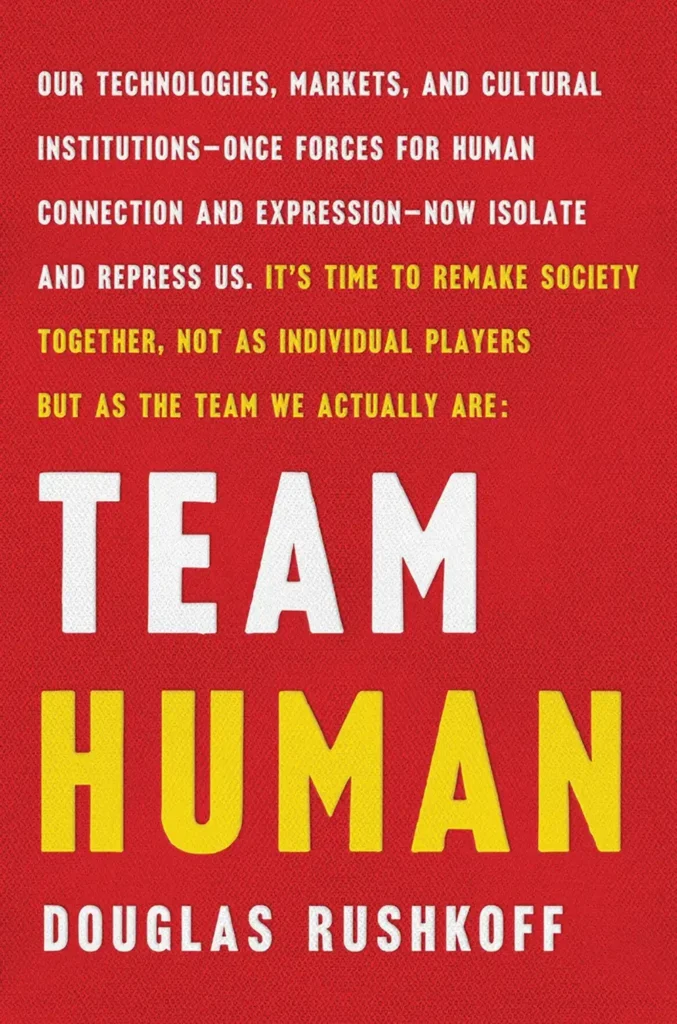
The story Silicon Valley tells about itself is seductive: innovative companies disrupting inefficient industries, creating value for everyone, and building a more connected, prosperous world. The reality, as Douglas Rushkoff exposes in “Team Human,” is far less benign.
“Digital businesses work the same way as their extractive forebears,” Rushkoff writes. “A digital business does the same thing, only faster.” Understanding how platform capitalism actually works—and who it serves—is essential for anyone trying to build genuine prosperity and autonomy in the modern economy.
The Platform Business Model
Most major digital platforms operate on a deceptively simple model: create a space where people can transact or interact, then extract value from every transaction while externalizing as many costs as possible.
A ride-sharing platform doesn’t own cars, employ drivers, or build roads. It simply creates the software to connect riders and drivers, takes a significant cut of every ride, and leaves the drivers to absorb costs of vehicle ownership, maintenance, insurance, and their own healthcare. The company extracts profit while externalizing nearly all actual costs.
Rushkoff explains the underlying logic: “Such businesses end up destroying the marketplaces on which they initially depend. When the big box store does this, it simply closes one location and starts the process again in another. When a digital business does this, it pivots or expands from its original market to the next.”
The platform itself produces nothing. It merely positions itself between people who want to transact and captures value from their exchange. This is classic rentier capitalism—making money not through creating value but through controlling the channels through which value flows.

The Monopoly Playbook
Platform companies follow a predictable trajectory:
Phase 1: Subsidized growth. The company operates at a loss, subsidized by venture capital, to undercut existing businesses and capture market share. Ride-sharing companies pay drivers well and charge riders little. The goal isn’t profit—it’s market dominance.
Phase 2: Competition elimination. Once competitors are driven out and alternatives destroyed, the platform has monopoly or near-monopoly power. At this point, the company can dictate terms to both sides of the marketplace.
Phase 3: Value extraction. With monopoly established, the platform squeezes. It takes a larger cut of transactions, lowers payment to service providers, raises prices to consumers, and maximizes extraction from its captive market.
Rushkoff notes this creates a “winner takes all” dynamic: “Scale is everything. This sensibility trickles down to all of us, making us feel like our careers and lives matter only if we’ve become famous, earned a million views, or done something, even something destructive, ‘at scale.'”
Traditional businesses had to maintain some relationship with their communities because they existed in physical places and needed ongoing customers. Platform monopolies face no such constraint. They can extract value until a market is depleted, then move to the next market.
How It Affects Workers
For workers, platform capitalism represents a significant degradation of employment conditions disguised as flexibility and entrepreneurship.
The “gig economy” sounds empowering—be your own boss, set your own hours, work when you want. The reality is often: lower pay, no benefits, no job security, complete surveillance, and algorithmic management that’s more controlling than any human boss ever was.
Rushkoff observes: “Automation and extractive platforms combine to disadvantage anyone who still works for a living, turning what used to be lifelong careers into the temp jobs of a gig economy.”
These aren’t independent contractors in any meaningful sense. They can’t set prices, negotiate terms, or choose how to do their work. They’re subject to constant ratings, algorithmic monitoring, and arbitrary deactivation. They’re employees in every way except the one that matters legally—they receive none of the protections or benefits that employment historically provided.
For men trying to build careers and support families, this represents a genuine crisis. The stable employment that previous generations could depend on is being replaced by precarious gig work that offers neither security nor advancement. The platforms capture the gains while workers absorb all the risk.
The Attention Extraction Model
Social media platforms operate on a different but equally extractive model: they give you “free” access to a social platform, then monetize your attention and data.
The business model is stark: keep you on the platform as long as possible, collect as much data about you as possible, and sell both your attention (to advertisers) and your data (to whoever will pay) for maximum profit.
“Humans were no longer the customers of social media,” Rushkoff explains. “We were the product.” This reversal changes everything about how these platforms operate. They’re not trying to serve your interests—they’re trying to serve you to advertisers.
This creates profound misalignment. The platform profits from your distraction, compulsion, and time spent scrolling. You suffer from all of these things, but the platform is optimized to maximize them anyway. Your wellbeing and the platform’s profit are in direct opposition.
The Data Extraction Economy
Beyond immediate attention, platforms extract something more valuable: comprehensive data about your behavior, preferences, relationships, and patterns.
This data has multiple uses:
Behavioral prediction. Platforms use your data to predict what you’ll do next with startling accuracy. “Social media sites use the data they’ve collected about us to determine, with about 80 percent accuracy, who is about to get divorced, who is coming down with the flu, who is pregnant, and who may consider a change in sexual orientation—before we know ourselves,” Rushkoff notes.
Behavioral modification. Beyond prediction, platforms actively work to shape your behavior to be more profitable. They feed you content designed to make you behave more predictably, purchase more, engage more, and conform to your algorithmic profile.
Surveillance capitalism. Your data is sold to third parties, used to train AI systems, and leveraged in ways you’ll never know about. Every click, pause, scroll, and interaction generates data that’s monetized in multiple ways.
You’re working for these platforms every moment you use them—generating valuable data through your behavior—but you’re never paid for this labor. The platforms capture 100% of the value you create.
Breaking Free
Understanding platform capitalism enables more strategic responses:
Recognize the true cost of “free.” Nothing is free. If you’re not paying for the product, you are the product. Free platforms are extracting value from you in ways less visible than money but often more costly—your attention, your data, your behavioral patterns, your autonomy.
Support alternatives when possible. Platform cooperatives, where users own the platform collectively, exist in many spaces. They’re often less polished than venture-backed monopolies, but they align incentives better—the platform serves users because users are the owners.
Minimize platform dependence. The more essential a platform becomes to your life or livelihood, the more leverage it has over you. Maintain alternatives. Don’t let any single platform become indispensable. Build direct relationships where possible rather than platform-mediated ones.
Value direct exchange. Whenever possible, transact directly with people rather than through platforms. Pay cash to local businesses. Exchange services with friends. Build relationships that don’t require corporate mediation. Every platform-free transaction is value the platforms can’t extract.
Demand better terms. As users become more aware of extraction economics, platforms face pressure to offer better terms. Support regulation that limits monopolistic behavior. Demand transparency about data use. Vote with your usage for platforms that treat users better.
The Broader Economic Picture
Platform capitalism exemplifies a larger problem: an economy organized around extraction rather than creation. “Corporations destroy the markets on which they depend, or sell off their most productive divisions in order to increase the bottom line on their quarterly reports,” Rushkoff observes. “That’s because the main product of a company is no longer whatever it provides to consumers, but the shares it sells to investors.”
This creates an economy where:
- Wealth concentrates at the top
- Workers absorb increasing amounts of risk
- Communities are depleted rather than enriched
- Short-term extraction trumps long-term sustainability
- Shareholder value supersedes all other considerations
For men trying to build stable lives and support families, this economic landscape is increasingly hostile. The platforms aren’t designed to help you prosper—they’re designed to extract maximum value from you while giving minimum benefit in return.
A Different Economic Model
Rushkoff points toward alternatives: “The economy needn’t be a war; it can be a commons… The commons is a conscious implementation of reciprocal altruism.”
This means several concrete shifts:
Worker ownership. When workers own the tools and platforms they use, incentives align properly. The company succeeds when workers prosper. Platform cooperatives demonstrate this is possible even in digital spaces.
Local, circular economies. Instead of extractive platforms sucking value out of communities, local economies can retain and recirculate value. Support local businesses. Build local networks. Keep money flowing within communities rather than up to distant shareholders.
Subsidiarity principle. Businesses should only grow as large as necessary to accomplish their purpose, then replicate rather than expand. This creates distributed prosperity instead of concentrated monopoly power.
Values-based commerce. Not all exchange needs to be maximally profitable. Commerce can prioritize fair dealing, sustainability, community benefit, and worker welfare alongside profitability.
Taking Action
This week, identify one way platform capitalism is extracting value from your life and take action to reduce that extraction:
- Delete an app that profits from your attention addiction and find a non-platform alternative
- Support a local business instead of ordering through a platform
- Join or support a platform cooperative in a space you care about
- Reduce your dependence on one platform by building direct relationships or using alternative services
- Calculate how much unpaid labor you’re doing for platforms (content creation, data generation, etc.) and decide if that’s a trade you want to continue making
The platforms aren’t going away. But understanding how they work enables you to engage more strategically, protect more of your value, and support alternatives that serve human flourishing rather than shareholder profit.
As Rushkoff reminds us: “Instead of determining the investment required to insulate oneself from the world, we can look instead at how much of our time, energy, and money we need to invest in the world so that it doesn’t become a place we need to insulate ourselves from in the first place.”
Stop feeding monopolies. Start building alternatives.
Related posts:
 Team Human Summary: 25 Essential Ideas From Douglas Rushkoff
 Surveillance Capitalism Explained: Why Your Data Is So Profitable
 Gig Economy Exploitation: How Uber’s Algorithms Control Drivers
 How to Stay Human in the Digital Age: A Practical Team Human Guide
 What Is Enshittification? Why Every Platform Gets Worse