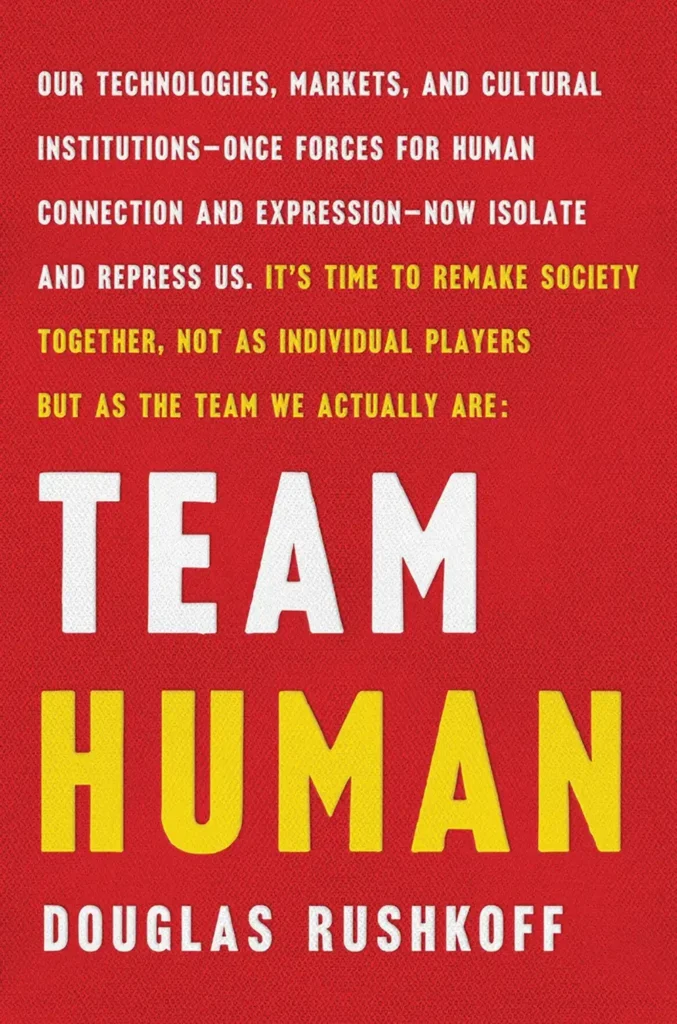
“Find the others.” This simple directive, shared by counterculture psychologist Timothy Leary in the 1960s and echoed by Douglas Rushkoff in “Team Human,” contains more wisdom than a thousand self-help books about networking or personal branding.
The phrase speaks to a fundamental human need that modern digital life systematically undermines: the need to find and connect with people who see the world similarly, who share your values, who can breathe the same air you breathe—literally and metaphorically.
For men especially, who often struggle with isolation and lack of intimate friendship, this directive offers both challenge and hope. Real community is possible. But you have to actively build it.
Why Digital Networks Aren’t Community
Rushkoff is blunt about the limitations of online connection: “Engagement through digital media is just a new way of being alone.” This isn’t anti-technology posturing—it’s biological reality.
Human nervous systems evolved over hundreds of thousands of years to create bonds through physical presence. When you’re face-to-face with someone, subtle processes activate that can’t occur through screens: “When human beings are engaged in mimesis, they learn from one another and advance their community’s skill set… We flash our eyebrows when we want someone to pay attention to us. We pace someone else’s breathing when we want them to know we empathize.”
These micro-behaviors create what neuroscientists call “limbic consonance”—the synchronization of emotional states that allows genuine bonding. Your nervous system literally syncs with another person’s. This releases oxytocin, creates trust, and establishes the foundation for real relationship.
Digital platforms can’t provide this, no matter how high-resolution the video or how instant the messaging. The bandwidth isn’t there. The timing is off. The full sensory engagement is missing. Your nervous system knows the difference, even if you can’t articulate why digital interaction feels hollow.
This matters profoundly for men trying to build friendships and community. You can’t shortcut the biological requirements for bonding. You need physical presence, shared time, and regular face-to-face interaction. Everything else is a pale substitute.
What Real Community Looks Like
Rushkoff emphasizes that genuine community isn’t about agreement or similarity in every respect. It’s about solidarity—showing up for each other even when it’s difficult, committing to mutual aid, and creating structures that support collective wellbeing.
“Communities composed of genuinely interdependent individuals, in which each of us is both needed and accountable, offer the highest quality of life and greatest level of happiness,” he writes. This interdependence is key. You’re not just collecting people who share your interests—you’re building a web of reciprocal support where people actually need each other and contribute to each other’s lives.
This requires vulnerability. You have to let people know what you actually need, which means revealing that you’re not entirely self-sufficient. For many men, raised to be independent and avoid burdening others, this is uncomfortable. But without it, you can’t build real community—only a network of people who don’t actually know you.
Real community involves:
Showing up physically and regularly. Community isn’t built through occasional contact. It requires consistent presence. This means committing to regular gatherings, meetings, or activities where you see the same people repeatedly over time. Trust and depth develop through accumulated shared experience.
Knowing and being known. Community requires that people actually understand who you are—not your curated social media version, but your actual struggling, uncertain, learning self. This means having conversations that go beneath the surface, sharing what you’re genuinely dealing with, and creating space for others to do the same.
Mutual aid and practical support. Community proves itself through action. When someone needs help moving, or going through a breakup, or dealing with a crisis—people show up. Not out of obligation, but because that’s what the community does. You help because you’ve been helped. The support flows in multiple directions.
Shared values and purpose. While you don’t need to agree on everything, communities cohere around some common commitments. Maybe it’s shared spiritual practice, or collective work toward a goal, or commitment to certain principles. This shared orientation creates the ground for solidarity even across differences.
Accountability and honesty. Real community includes the capacity to call each other out when necessary. Not with cruelty, but with the understanding that genuine care sometimes means difficult conversations. This requires trust that the community will survive disagreement and conflict.

The Masculine Need for Brotherhood
Men’s isolation is well-documented. Despite being more “connected” than ever through digital means, many men report having no close friends they can confide in, no one they’d call in a crisis, no community they truly belong to.
This isn’t just lonely—it’s dangerous. Rushkoff notes that “social isolation is a greater public health problem than obesity.” Men’s rates of suicide, addiction, and despair correlate strongly with isolation and lack of community.
Brotherhood—genuine, committed friendship between men—addresses needs that romantic relationships alone can’t meet. You need other men who understand masculine experience, who can help you process what you’re dealing with, who can call you forward into better versions of yourself.
This brotherhood looks different from the superficial “bro” culture often portrayed in media. It’s not about drinking buddies or guys you watch sports with (though those activities might be involved). It’s about men who know you, who you can be vulnerable with, who will tell you hard truths and support you through difficulty.
Building this requires initiative. Most men don’t have structures that automatically create brotherhood the way previous generations might have through military service, fraternal organizations, or tight-knit neighborhoods. You have to deliberately create it.
Practical Steps to Finding Your People
Rushkoff’s directive—”find the others”—is both simple and challenging. Here’s how to actually do it:
Start with existing contexts. Don’t try to build community from scratch if you don’t have to. Look at the places you already show up: gym, workplace, church, hobby groups, volunteer organizations. Who there might become deeper connections? Who seems like they’re looking for similar depth?
Create consistent gathering points. Once you’ve identified a few potential people, create a regular structure. Weekly breakfast. Monthly hikes. Regular poker night. The specific activity matters less than the consistency. Commit to it and show up reliably. Deep connection develops through accumulated time together.
Go beyond the activity. Whatever brings you together—sports, work, hobbies—make sure to create space for actual conversation. Before or after the main activity, have time to talk about what’s actually happening in your lives. The activity provides a comfortable context, but the conversation builds the relationship.
Be the first to be vulnerable. Someone has to model openness. When asked how you’re doing, give a real answer occasionally. Share something you’re actually struggling with. Talk about your doubts, fears, or uncertainties. This gives others permission to do the same and signals that deeper connection is welcome.
Invite depth explicitly. At some point, acknowledge what you’re trying to build. “Hey, I really value these conversations. I’d like to make this a consistent thing where we can actually talk about what’s going on in our lives.” This moves the relationship from implicit to explicit and creates shared understanding of what you’re building together.
Create structures for mutual aid. Make it normal to ask for and offer help. Start small—help someone move, watch their kids for an evening, assist with a project. Demonstrate through action that you’re building a community of practical support, not just occasional socializing.
Meet in person. This cannot be emphasized enough. Digital communication can supplement face-to-face connection but cannot replace it. The biological bonding mechanisms require physical presence. Make in-person gathering the priority and use digital tools only to coordinate or maintain contact between meetings.
Overcoming Barriers
Several obstacles typically prevent men from building community:
The vulnerability problem. Men are often socialized to hide struggle and project competence. This makes it hard to admit you need connection or support. The solution isn’t to suddenly bare your soul—it’s to practice gradual, appropriate vulnerability. Share one real thing. See how it’s received. Build from there.
The time excuse. “I don’t have time for regular commitments” usually means “I haven’t prioritized this.” You make time for what matters. If you’re isolated and struggling, community needs to become a priority comparable to your career or relationship. Block the time. Protect it. Show up.
The scarcity mindset. Some men hesitate to invest in friendship because they assume the other person isn’t interested or won’t reciprocate. This becomes self-fulfilling. Assume people want connection too—because most do. Make the first move. Extend the invitation. Be willing to try with multiple people until you find those who respond.
The comparison trap. Looking at others’ seemingly perfect social media friendships can make your own efforts feel inadequate. Remember that what you see online is curated and often shallow. Real community isn’t photogenic. It’s messy, mundane, and mostly undocumented. Build what you need, not what looks good online.
Place-Based Community
Rushkoff emphasizes the importance of local, place-based community: “Solidarity begins with place.” There’s particular power in building connections with people who share your geographic location—neighbors, local business owners, people who use the same parks and streets.
These relationships have resilience that purely interest-based communities lack. When crisis hits—personal or collective—proximity matters. The people nearby can actually help. They experience similar challenges (local policies, shared weather events, common concerns). They have ongoing incentive to work through conflicts rather than ghosting.
Consider ways to engage your local area: neighborhood associations, local governance meetings, community gardens, local businesses you can frequent and support, volunteer work in your area. These activities connect you to the physical place you inhabit and the people who share it.
The Spiritual Dimension
Community isn’t just practical—it’s spiritual. Rushkoff notes that “the experience of awe can counteract self-focus, stress, apathy, and detachment. Awe helps people act with an increased sense of meaning and purpose, turning our attention away from the self and toward our collective self-interest.”
Being part of something larger than yourself addresses existential needs that no amount of individual achievement can satisfy. Community provides context for your life, meaning for your struggles, and connection to something ongoing that transcends your individual existence.
This doesn’t require religious belief, though many find community through spiritual practice. It simply requires recognizing that you’re part of a larger whole, that your life has meaning in relationship to others, and that your flourishing is connected to collective flourishing.
Taking Action
This week, take one concrete step toward building real community:
- Identify three people you’d like to know better and invite one to have coffee or do something together
- Find one group, organization, or regular gathering in your area and commit to attending consistently for three months
- Reach out to someone you used to be close with and see if you can rebuild that connection
- Start a regular gathering yourself—invite a few people for monthly dinners, weekly hikes, or another consistent activity
- Join a men’s group, recovery group, or other intentional community focused on growth and support
Whatever you choose, commit fully. Show up. Be patient. Real community takes time to develop, but the investment pays dividends for the rest of your life.
As Rushkoff reminds us: “You are not alone. None of us are. The sooner we stop hiding in plain sight, the sooner we can avail ourselves of one another.”
Find the others. Build something real. Show up.
Related posts:
 Team Human Summary: 25 Essential Ideas From Douglas Rushkoff
 How to Stay Human in the Digital Age: A Practical Team Human Guide
 Digital Wellbeing: How Your Digital Life Is Impacting Real-World Human Connection
 Why Video Calls Feel Exhausting: The Science Behind Digital Communication Fatigue
 Platform Capitalism: How Digital Monopolies Extract Value From Your Life