The average person now checks their phone 96 times per day—once every 10 minutes. This isn’t an accident of human nature or a personal failing. It’s the intended outcome of billions of dollars invested in what’s euphemistically called “persuasive technology.”
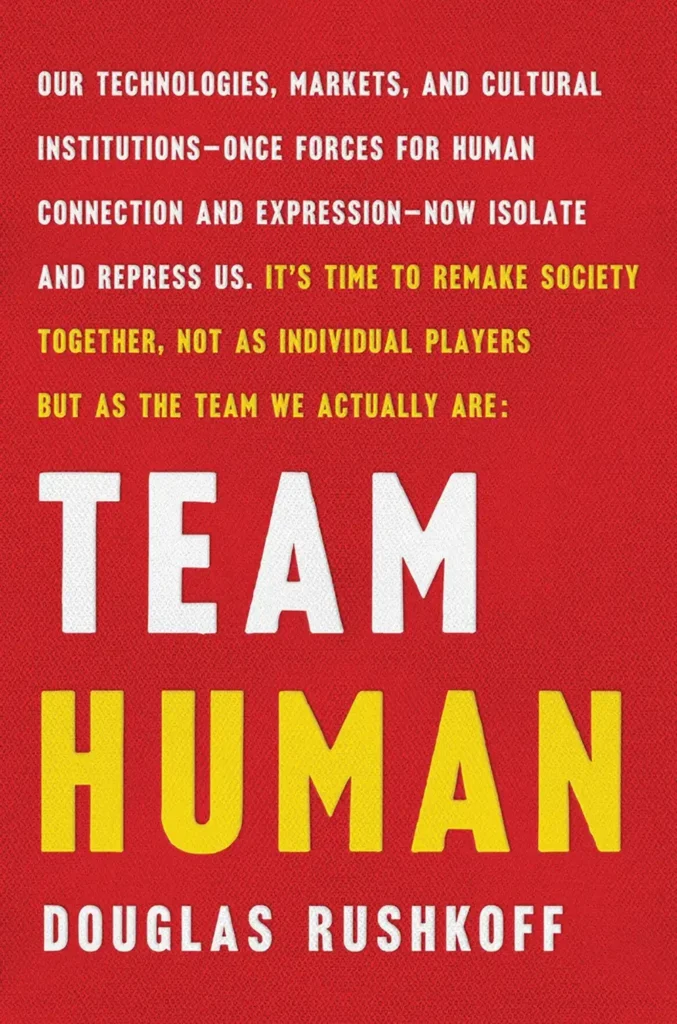
Douglas Rushkoff’s “Team Human” exposes the sophisticated manipulation systems built into every app, platform, and digital interface we use. Understanding these systems isn’t optional for men committed to living deliberately and building meaningful lives—it’s essential.
The Attention Economy Explained
“Internet industry magazines declared that we were living in an ‘attention economy,'” Rushkoff writes, “where a company’s profits would depend on its ability to wrest ‘eyeball hours’ from users.”
This shift transformed the internet from a tool for human purposes into a system that treats humans as the raw material to be processed. Your attention—your finite life energy, your capacity to focus, your ability to be present—became the commodity being bought and sold.
Tech companies don’t make money from helping you live well. They make money by keeping you engaged, distracted, and coming back for more. The longer they can keep you scrolling, clicking, and consuming, the more ads they can show you and the more data they can collect about your behavior.
This creates a fundamental misalignment of interests. The platforms profit from your distraction and compulsion. You suffer from both, but keep coming back because the systems are designed to make you do exactly that.
How Persuasive Technology Works
The manipulation isn’t subtle once you know what to look for. Rushkoff identifies the core techniques deployed by every major platform:
Bottomless feeds ensure you never reach a natural stopping point. The absence of an ending keeps you scrolling. “Designers have discovered that ‘bottomless feeds’ tend to keep users swiping down for additional articles, posts, or messages, consuming more than they intend to because of that unsatiated feeling of never reaching the end.”
This exploits a fundamental human psychological need for completion. We’re wired to finish things—to reach the end of the chapter, to complete the task, to close the loop. Infinite feeds deliberately prevent that closure, keeping you in a state of perpetual mild anxiety that maybe, just maybe, the next scroll will bring something satisfying.

Interruption architecture keeps you in constant transition between different feeds, apps, and notifications. You never settle into deep focus on anything. “Designers want to keep us in a state of constant disorientation—always scrolling and paying attention to something, but never so much attention that we become engrossed and regain our bearings.”
Every transition is an opportunity for the platform to reassert control, serve another ad, or steer you toward more engaging content. They don’t want you absorbed in one thing—they want you surface-level engaged with many things, always vulnerable to the next interruption.
Variable reward schedules turn checking your phone into a slot machine. Rushkoff explains: “By doling out rewards at random intervals, the slot machine confounds the human being attempting to figure out the pattern.” You check your phone because you might get a rewarding notification—a like, a message, a match. The randomness makes the behavior compulsive.
This is the same mechanism that creates gambling addiction, applied to your social life and self-worth.
Social pressure mechanics weaponize your relationships. Read receipts, typing indicators, streaks, and “seen” messages all create anxiety about your responsiveness and availability. You’re not just managing your own use—you’re managing others’ expectations that you’re always accessible.
The Real Cost
The impact goes far deeper than wasted time, though that alone should concern us. Rushkoff argues that “We now know, beyond any doubt, that we are dumber when we are using smartphones and social media. We understand and retain less information, comprehend with less depth, and make decisions more impulsively than we do otherwise.”
This isn’t about intelligence—it’s about how sustained interruption and surface-level engagement literally changes how your brain functions. Deep work becomes difficult. Sustained attention feels impossible. Reading a book or having an uninterrupted conversation starts to feel uncomfortable because you’re conditioned to expect constant stimulation and frequent interruption.
For men building careers, relationships, and personal growth, this is catastrophic. The work that matters—developing expertise, building deep relationships, understanding yourself, creating something meaningful—all requires sustained attention and presence. The attention economy makes both nearly impossible.
The Masculine Cost
Men particularly struggle with the costs of attentional depletion. Masculine development requires the capacity for sustained focus on difficult things—whether that’s mastering a skill, building a business, processing emotional complexity, or showing up fully in relationships.
The attention economy undermines all of this. You can’t develop mastery when you’re interrupted every ten minutes. You can’t build deep intimacy when you’re half-present, phone always nearby. You can’t process your inner landscape when you’re constantly fleeing into digital distraction.
Many men experience this as personal failure—”I just can’t focus like I used to” or “I’m not as sharp as I was”—without recognizing that their environment has been deliberately engineered to produce exactly these effects.
The loss of presence shows up everywhere. In conversations where you’re planning your response instead of actually listening. In relationships where you’re never fully there. In work where you’re constantly task-switching rather than going deep. In leisure where you can’t even enjoy downtime without checking your phone.
Fighting Back
Awareness alone won’t solve this. You need concrete strategies for reclaiming your attention and rebuilding your capacity for sustained focus.
Treat your attention as your most valuable resource. Because it is. Your attention is your life—it’s the resource through which you experience everything else. Ruthlessly guard it. Ask of every app, notification, and digital engagement: is this worth the piece of my life it’s taking?
Disable notifications aggressively. Most notifications aren’t urgent, they’re manipulative. Turn off everything except what truly matters (texts from specific people, actual emergencies). Let everything else wait until you choose to check it.
Create friction for compulsive behavior. Rushkoff emphasizes the importance of consciously opposing automatic systems. Move social media apps off your home screen. Require yourself to type the full URL to access sites you check compulsively. Use website blockers during work time. These small frictions break the automatic reach-and-check loop.
Schedule specific times for digital engagement. Instead of constant reactive checking, designate specific times to process emails, check social media, or browse news. Outside those times, be somewhere else entirely. This transforms digital engagement from an interruption into a deliberate choice.
Build practices that require sustained attention. Read physical books. Have long conversations without your phone present. Work in focused blocks without any digital input. Practice meditation or another attention-training discipline. These aren’t just nice activities—they’re rebuilding your capacity for focus.
Notice the difference. Pay attention to how you feel after an hour of focused work versus an hour of fractured, interrupted activity. Notice how present you are in conversations when your phone isn’t nearby. Notice what becomes possible when you’re not constantly context-switching. Let the contrast between distracted and focused living motivate continued changes.
Recovering Deep Work
Cal Newport’s research on deep work aligns perfectly with Rushkoff’s warnings. The ability to focus intensely on cognitively demanding tasks is becoming both rarer and more valuable. It’s also becoming harder to develop, precisely because our digital environment is designed to prevent it.
Recovery requires deliberate practice. Start with 30-minute blocks of completely undistracted focus. Build up from there. Protect these blocks fiercely—no notifications, no email, no browsing “just for a second.” Your brain needs to relearn that sustained focus is possible and rewarding.
This isn’t about becoming a productivity machine. It’s about reclaiming your capacity to direct your own mind toward what matters to you, rather than having it constantly hijacked by others’ agendas.
The Larger Stakes
Rushkoff frames the attention economy as part of a broader assault on human autonomy and flourishing: “Instead of designing technologies that promote autonomy and help us make informed decisions, the persuasion engineers in charge of our biggest digital companies are hard at work creating interfaces that thwart our cognition and push us into an impulsive state where thoughtful choices—or thought itself—are nearly impossible.”
The goal isn’t just to sell you products. It’s to keep you in a perpetual state of distraction, anxiety, and compulsion that makes you easier to manipulate and monetize. A clear-minded, focused person is less profitable than a distracted, anxious one.
Taking Action
This week, experiment with one major change. Pick the intervention that will have the biggest impact on your attention and implement it fully for seven days:
- Delete social media apps from your phone (you can still access via browser if needed)
- Turn off all non-essential notifications permanently
- Establish phone-free zones (bedroom, dining table, first hour after waking)
- Schedule specific times for email/social media and ignore them otherwise
- Use a basic phone for a week and leave your smartphone at home
Notice what happens. Notice what becomes possible. Notice how differently you feel when you’re not constantly interrupted and stimulated.
Then decide whether you want to keep living in the attention economy’s version of reality, or build something different.
As Rushkoff reminds us, this isn’t about rejecting technology—it’s about refusing to let technology’s worst implementations determine how we live: “We can choose differently. We can build differently. We can show up for each other in ways that honor our actual nature as social beings, not our utility as data points and consumers.”
Your attention is your life. Stop letting others profit from stealing it.
Related posts:
 Team Human Summary: 25 Essential Ideas From Douglas Rushkoff
 How to Stay Human in the Digital Age: A Practical Team Human Guide
 Digital Wellbeing: How Your Digital Life Is Impacting Real-World Human Connection
 Michael Saylor’s Bitcoin MENA 2025 Keynote: The Blueprint for Digital Capital, Credit, and Banking Revolution
 Platform Capitalism: How Digital Monopolies Extract Value From Your Life