The electric vehicle revolution has reached a critical milestone with the arrival of the 2026 Hyundai Ioniq 9. This isn’t just another three-row SUV with batteries instead of a gas tank—it’s a comprehensive reimagining of what families should expect from their vehicles in the electric age. Built in Georgia and designed with a bold vision, the Ioniq 9 represents Hyundai’s most ambitious EV project to date.
Design Philosophy: Where Aerodynamics Meets Aesthetics
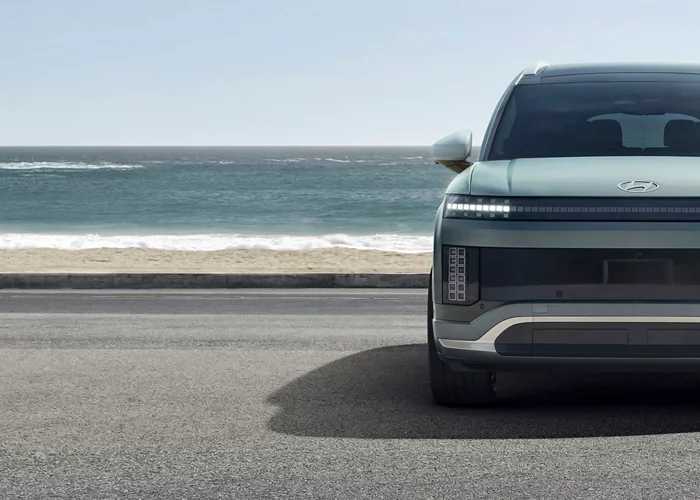
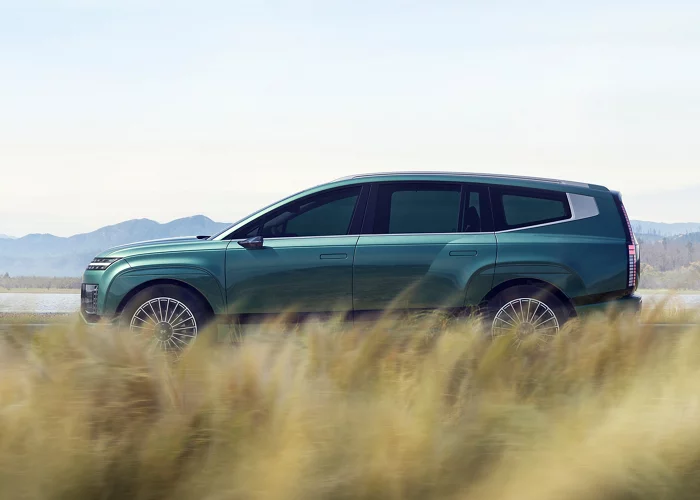
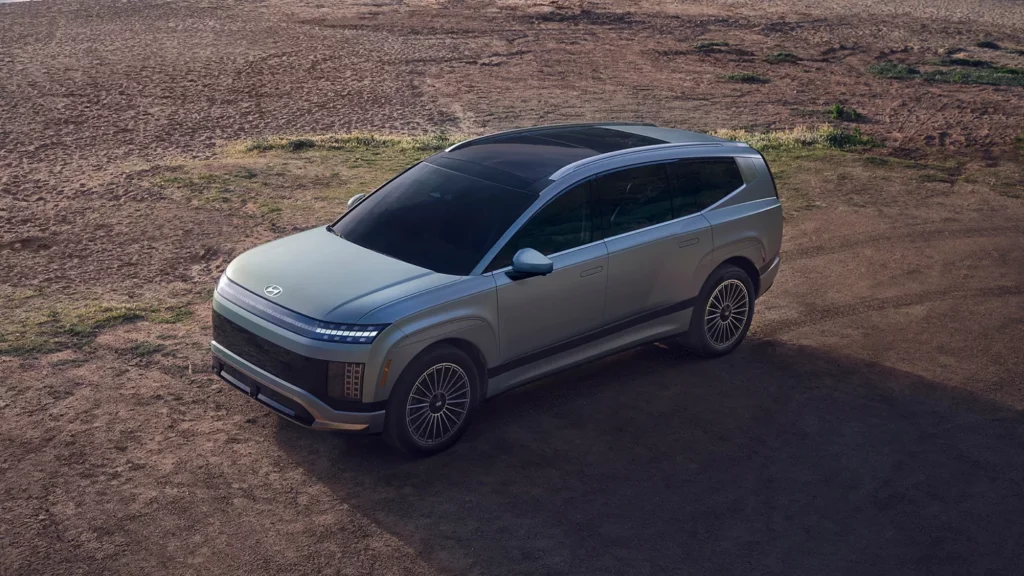
Hyundai has coined the term “Aerosthetic” to describe the Ioniq 9’s design philosophy, and it’s more than marketing speak. The vehicle achieves an impressive drag coefficient of 0.259 with optional digital side mirrors (0.269 with traditional mirrors)—a remarkable achievement for a vehicle of this size. To put that in perspective, it’s a 10 percent improvement over the already-efficient Ioniq 5, translating to an extra 10.5 miles of range under similar driving conditions.
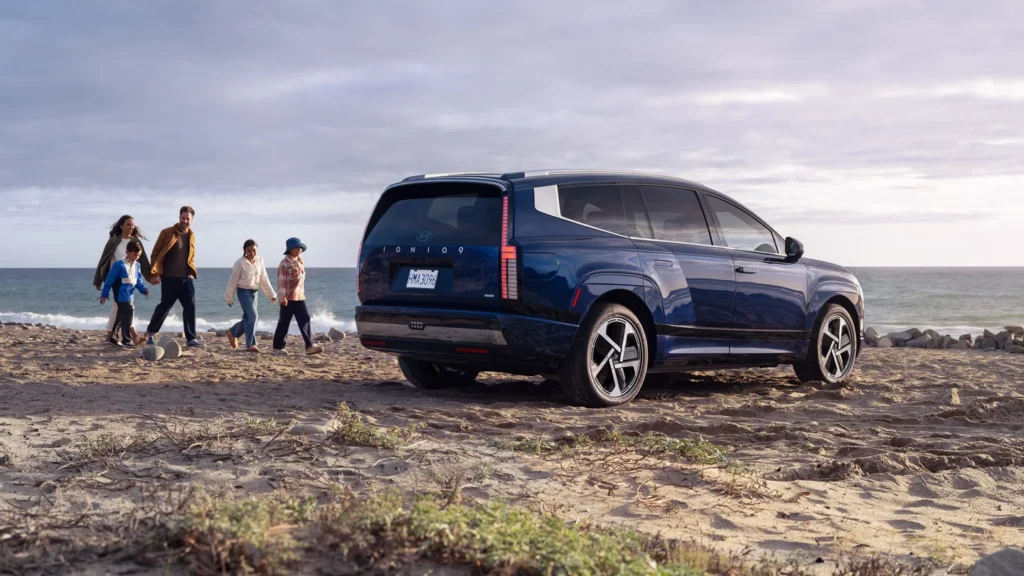
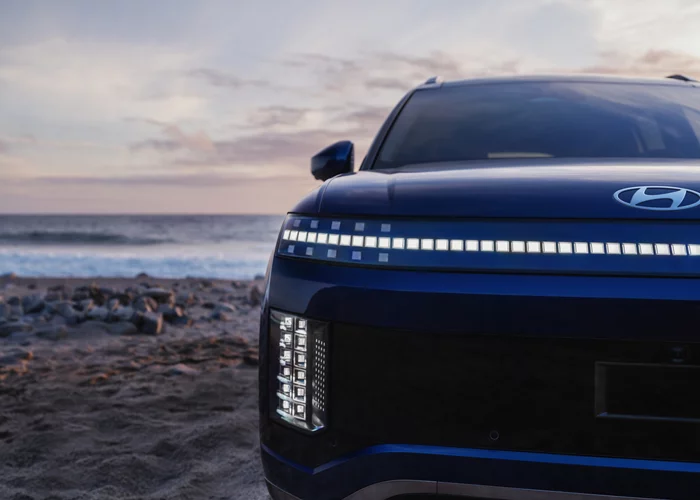
The exterior design draws inspiration from Hyundai’s Seven Concept, unveiled at the 2021 LA Auto Show. Sleek, aerodynamic curves merge seamlessly with retro-futuristic elements, including the signature Parametric Pixel lighting that has become Hyundai’s electric vehicle calling card. These distinctive LED lights give the Ioniq 9 a commanding presence that several reviewers have described as looking like “an angry alien robot” in the rearview mirror—and they mean that as a compliment.
Beyond aesthetics, the design incorporates sophisticated aerodynamic elements invisible to the casual observer. A dual-motion active air flap at the front opens and closes to manage cooling airflow while minimizing drag. The mechanism combines straight movement with rotation to reduce air resistance disruption. The underbody features a fully enclosed 3D-shaped cover that bulges strategically under the front and rear axles, while aero-optimized alloy wheels and low-resistance tires further contribute to efficiency.
Interior: A Lounge on Wheels
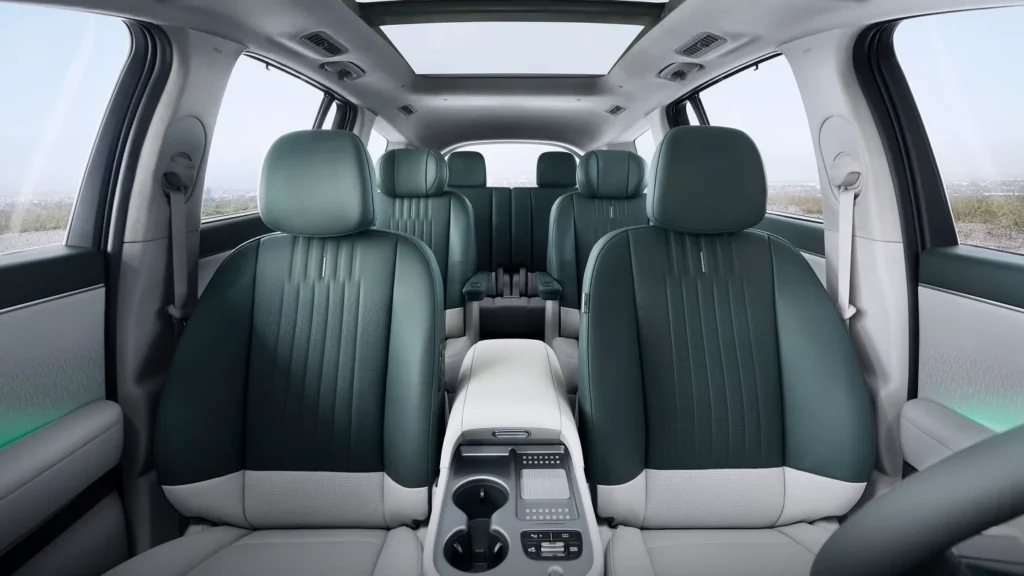
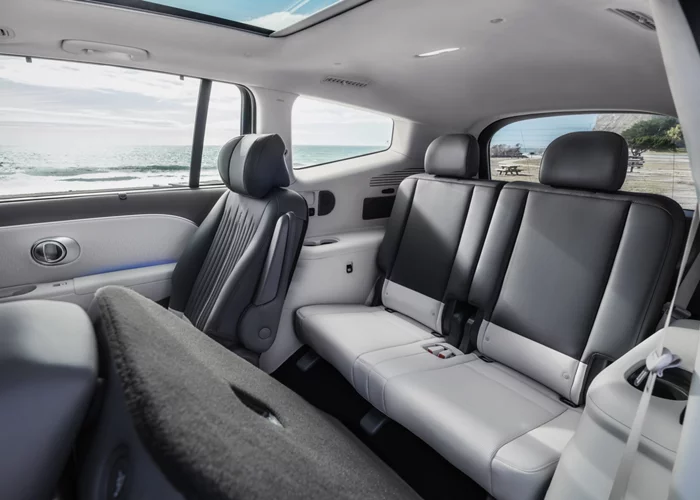
Step inside the Ioniq 9, and you’ll find what Hyundai calls a “lounge-like atmosphere”—a space genuinely designed for human connection and comfort rather than mere transportation. The cabin leverages Hyundai’s E-GMP platform to deliver a completely flat floor, maximizing usable space and creating an open, airy feeling that rivals luxury sedans.
Exceptional Space
With a wheelbase of 123.1 inches—2.3 inches longer than a Chevrolet Tahoe—the Ioniq 9 offers genuinely impressive dimensions. Second-row passengers enjoy 42.8 inches of legroom, while third-row occupants get 32.0 inches, making it one of the most adult-friendly three-row EVs available. Total cargo capacity reaches 86.9 cubic feet with both rear rows folded, 46.7 cubic feet with the third row down, and a still-respectable 21.9 cubic feet behind the third row.
Revolutionary Seating
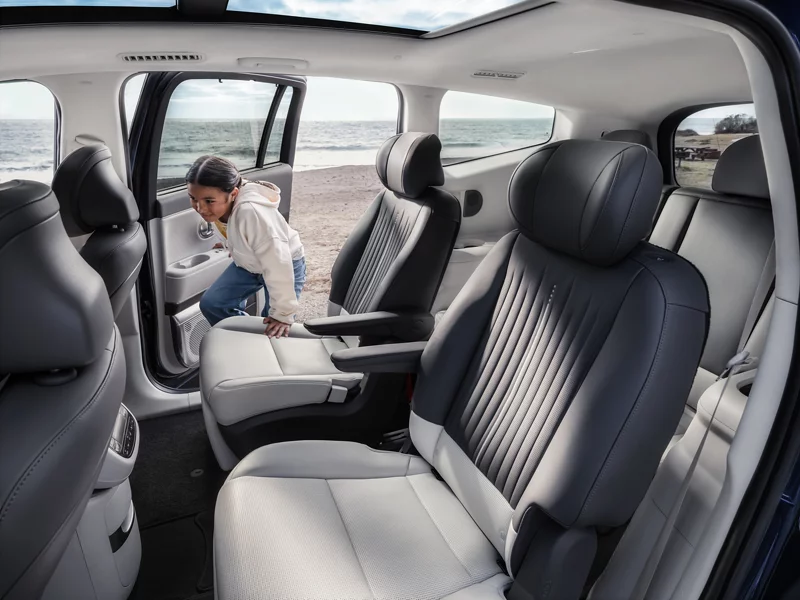
The Ioniq 9 introduces several seating innovations that set it apart from competitors. Available Relaxation Seats in the first and second rows can fully recline with integrated leg rests, transforming the cabin into a genuine relaxation space during charging stops. These seats feature a Dynamic Body Care system with Dynamic Touch Massage functionality to alleviate fatigue on long journeys.
The Universal Island 2.0 center console slides forward and backward, allowing second-row passengers to access storage while creating a pass-through between the front seats. In Korean and some international markets, second-row captain’s chairs can swivel 90 degrees (helpful for loading child seats) or 180 degrees to create a face-to-face conversation space when parked—though U.S. safety regulations prevent this feature from being offered domestically.
Buyers can choose between six-passenger (with second-row captain’s chairs) or seven-passenger (with second-row bench) configurations. Higher trim levels (Limited and Calligraphy) offer power-adjustable captain’s chairs with heating, cooling, and one-touch tilting for easy third-row access.

Sustainable Materials and Quiet Comfort
Hyundai has prioritized sustainability in material selection, using recycled PET plastic, wool, synthetic faux leather, and suede throughout the interior. The cabin benefits from acoustic laminated glass in the first and second rows, A-pillar sound plates, triple door seals, and Active Noise Control-Road technology. The result is an exceptionally quiet environment where only minor wind noise becomes noticeable at highway speeds.
The curved panoramic display features two seamlessly joined 12.3-inch screens—one for the instrument cluster and one for infotainment—mounted on a satin-finish panel that avoids the current “iPad stuck on dashboard” trend. However, some reviewers have noted that the silver plastic HVAC vent panel and molten-metal-finish passenger panel feel less premium than expected in a flagship model.
Powertrain Options: Performance for Every Need
The Ioniq 9 offers three distinct powertrain configurations, each designed for different priorities:
Long-Range RWD (S trim)
The base configuration uses a single 215-horsepower rear motor paired with the 110.3-kWh battery pack. This setup targets an EPA-estimated range of 335 miles, making it the longest-range variant. Acceleration reaches 60 mph in approximately 7.8 seconds—adequate for most driving situations but not particularly thrilling. The single-motor configuration also provides a towing capacity of 3,500 pounds and includes a 3-cubic-foot frunk.
Long-Range AWD (SE, SEL trims)
Adding a front motor to the rear motor creates an all-wheel-drive system with 303 combined horsepower. This configuration increases towing capacity to 5,000 pounds while maintaining a respectable 320-mile range estimate. The AWD system provides enhanced traction for winter conditions and challenging terrain, with acceleration to 60 mph expected in under six seconds. The frunk capacity decreases slightly to 2 cubic feet with the addition of the front motor.
Performance AWD (Limited, Calligraphy, Calligraphy Design)
The range-topping powertrain features dual motors producing a combined 422 horsepower (some sources cite 421 or 429 hp due to measurement variations) and 516 lb-ft of torque. This configuration accelerates from 0-60 mph in a claimed 4.9 seconds, though independent testing has achieved 4.4 seconds. The quarter-mile takes 13.1 seconds at 104 mph, with a governed top speed of 129 mph. Range drops to 311 miles in this configuration due to the increased power consumption and heavier equipment on Calligraphy trims.
Battery Technology and Charging
The Ioniq 9’s 110.3-kWh battery pack represents a 10 percent increase over the related Kia EV9’s 100-kWh unit, providing a crucial range advantage. The 800-volt architecture enables ultra-fast charging capabilities that address one of the primary concerns of EV ownership.
Under ideal conditions at a 350-kW DC fast charger, the Ioniq 9 can recharge from 10 to 80 percent in just 24 minutes, with an average charging speed of 201 kW. More impressively, the battery adds approximately 130-304 kilometers (80-190 miles) of range in just 15 minutes of charging. The system also supports 400-volt chargers for maximum compatibility, though charging speeds will be slower.
Perhaps most significantly for North American buyers, every Ioniq 9 comes standard with a NACS (North American Charging Standard) port—the Tesla-designed connector that’s becoming the industry standard. This provides access to over 17,000 Tesla Supercharger stations without requiring an adapter, plus an additional 45,000+ DC fast chargers across the continent. Hyundai has also committed to supporting the new IONNA charging network, ensuring multiple high-quality charging options.
Advanced Thermal Management
The Ioniq 9 excels in cold-weather performance through sophisticated thermal management. An advanced heat pump system recycles waste heat to maintain cabin temperature without heavily draining the battery. The HVAC system features independent front and rear circuits—the rear can be deactivated when unoccupied to conserve energy.
Remote climate pre-conditioning allows drivers to warm the cabin before departing, optimizing both comfort and efficiency. The system intelligently maintains an optimal interior temperature of 22°C (72°F) while minimizing energy consumption. An EV route planner uses real-time data including battery temperature, external conditions, and traffic to optimize routing and charging schedules.
Real-World Performance
Independent testing reveals some variance from Hyundai’s official estimates. MotorTrend’s Road Trip Range test showed the base RWD model achieving 262 miles, while the Performance AWD managed 269 miles—both figures approximately 20 percent below EPA estimates, though this is not uncommon for highway-focused testing. However, the lightning-fast charging capability helps offset the range deficit in real-world use.
Fuel economy testing showed a combined 62 MPGe average, compared to Hyundai’s 85 MPGe estimate—again, the difference likely reflects the specific testing conditions and driving style. The Ioniq 9 proves surprisingly fun to drive despite its size, with responsive steering, composed handling through corners, and confidence-inspiring brakes. The dual-motor version offers reassuring performance with abundant passing power at any speed.
Technology and Safety Features
The Ioniq 9 incorporates Hyundai’s latest driver assistance systems, though some reviewers note that the Highway Driving Assist 2 system lags behind competitors like GM’s Super Cruise. The system occasionally struggles with lane tracking and lacks advanced features such as hands-free driving or automatic lane changes.
However, the technology package includes several innovative features:
- Hyundai AI Assistant: Advanced voice control and intelligent assistance
- Features on Demand: An app store for vehicles, offering dynamic interior light shows, content streaming services, and customizable screen themes
- UV-C Sterilizer: A multitray system that can disinfect phones, wallets, and other small items
- Forward Collision-Avoidance Assist 2: Enhanced collision prevention technology
- Hyundai Digital Key 2 Premium: (Limited and Calligraphy trims) Smartphone-based vehicle access
Safety equipment includes three-point outboard seatbelts, adjustable front shoulder belt anchors, seatbelt pretensioners and load limiters for all three rows, regenerative braking with ABS, Vehicle Stability Management with ESC and traction control, and comprehensive child safety features.
Trim Levels and Pricing
The Ioniq 9 launches in the United States with six trim levels, providing options for various budgets and feature preferences:
S (RWD): Starting at $58,955 The base model includes the single rear motor, 335-mile range capability, LED lighting, proximity key with push-button start, dual 12.3-inch displays, and comprehensive safety features.
SE (AWD): Price TBD Adds all-wheel drive, increased towing capacity, and additional comfort and convenience features.
SEL (AWD): Price TBD Builds on SE with enhanced technology and premium materials.
Limited (Performance AWD): Price TBD Introduces the high-performance powertrain, Hyundai Digital Key 2 Premium, power-folding third row, and heated/cooled captain’s chairs.
Calligraphy (Performance AWD): Price TBD The luxury flagship offers the most comprehensive feature set, premium materials, and exclusive design elements.
Calligraphy Design (Performance AWD): Approximately $74,990-$80,000 (as shown) The ultimate Ioniq 9 adds exclusive 21-inch alloy wheels, unique interior and exterior aesthetics, and every available feature. Range for this heavily-equipped variant is 311 miles.
The Canadian market receives a slightly different trim structure: Essential RWD, Preferred AWD, Preferred AWD+, Preferred AWD with Luxury Package, and Preferred AWD+ with Ultimate Calligraphy Package.
Comparison with Key Competitors
Kia EV9
As corporate cousins sharing the E-GMP platform, comparisons are inevitable. The Ioniq 9’s larger 110.3-kWh battery (versus EV9’s 100 kWh) provides a range advantage, and prices are nearly identical. The design approaches differ significantly—the EV9 embraces bold, Transformers-inspired styling, while the Ioniq 9 opts for smoother, more sophisticated aerodynamic curves. Interior philosophies also diverge, with the Ioniq 9 emphasizing lounge-like comfort and the EV9 focusing on rugged versatility.
Lucid Gravity
At similar pricing (around $80,000 for loaded configurations), the Lucid Gravity emphasizes luxury and performance with superior power and adjustable features. The Ioniq 9 prioritizes comfort, practicality, and value. Both offer exceptional family EV credentials but appeal to different buyer priorities.
Rivian R1S
The Rivian offers genuine off-road capability and adventure-focused features that the Ioniq 9 doesn’t match. However, the Ioniq 9 provides superior range, faster charging, and significantly more interior space—plus wider service network access.
Volvo EX90
Starting over £82,000 (approximately $103,000), the Volvo positions itself as a luxury offering with Scandinavian refinement. The Ioniq 9 delivers comparable space and technology at a substantially lower price point.
Manufacturing and Market Positioning
The Ioniq 9 is manufactured at Hyundai Motor Group’s new Metaplant America in Savannah, Georgia—a $12 billion investment representing Hyundai’s commitment to the U.S. market and electric vehicle future. This domestic production helps the Ioniq 9 potentially qualify for federal tax incentives and demonstrates Hyundai’s confidence in American EV demand.
Sales began in spring 2025 (May in North America), with the vehicle also launching in Australia (July 2025), the Philippines (July 2025, made-to-order only), and various European and Asian markets. The Ioniq 9 represents Hyundai’s flagship EV offering, positioned above the Ioniq 5 crossover and Ioniq 6 sedan to create a comprehensive electric vehicle lineup.
Industry Recognition
The Ioniq 9 has earned significant pre-launch recognition:
- Named among Newsweek’s “America’s Most Anticipated New Vehicles for 2025”
- Recognized as a MotorTrend 2026 SUV of the Year finalist
- Praised by automotive journalists for design innovation and practical execution
The Verdict: A Genuine Game-Changer
The 2026 Hyundai Ioniq 9 succeeds in its ambitious goal of redefining the three-row electric SUV. It combines futuristic design with genuine practicality, offering space that challenges luxury sedans, technology that enhances rather than overwhelms, and range that addresses one of the primary barriers to EV adoption.
Where many manufacturers treat three-row EVs as afterthoughts—essentially electrified versions of existing designs—Hyundai has created a purpose-built electric vehicle that leverages the unique advantages of EV architecture. The flat floor, massive wheelbase, and innovative seating configurations would be impossible in a traditional internal combustion vehicle.
The Ioniq 9 isn’t perfect. The Highway Driving Assist 2 system trails segment leaders, the base RWD model feels underpowered, and some interior materials don’t quite match the flagship positioning. Real-world range testing suggests the EPA estimates may be optimistic, particularly on highway journeys.
However, these minor shortcomings pale against the Ioniq 9’s accomplishments. It offers genuinely class-leading interior space, ultra-fast charging that makes long-distance travel practical, distinctive design that stands out in a sea of anonymous SUVs, and pricing that delivers exceptional value. The sustainable materials, quiet cabin, innovative seating, and thoughtful features demonstrate that Hyundai has created more than just a vehicle—it’s a genuine space for families to connect and belong.
For families considering the transition to electric vehicles, the Ioniq 9 removes nearly every excuse. It provides the space of a traditional three-row SUV, the range for road trips, the charging speed to minimize downtime, and the comfort for daily use. It proves that the electric future doesn’t require compromise—it can actually deliver improvements over the combustion-powered past.
The Korean manufacturers have wrested design leadership from established premium brands, and the Ioniq 9 represents the culmination of that achievement. It’s not just a good electric SUV or a good family vehicle—it’s a genuinely excellent automobile that happens to be electric. That might be the highest compliment possible in 2025.
Note: Specifications, features, and availability may vary by market. Prices and features are based on U.S. market information as of December 2025 and are subject to change.