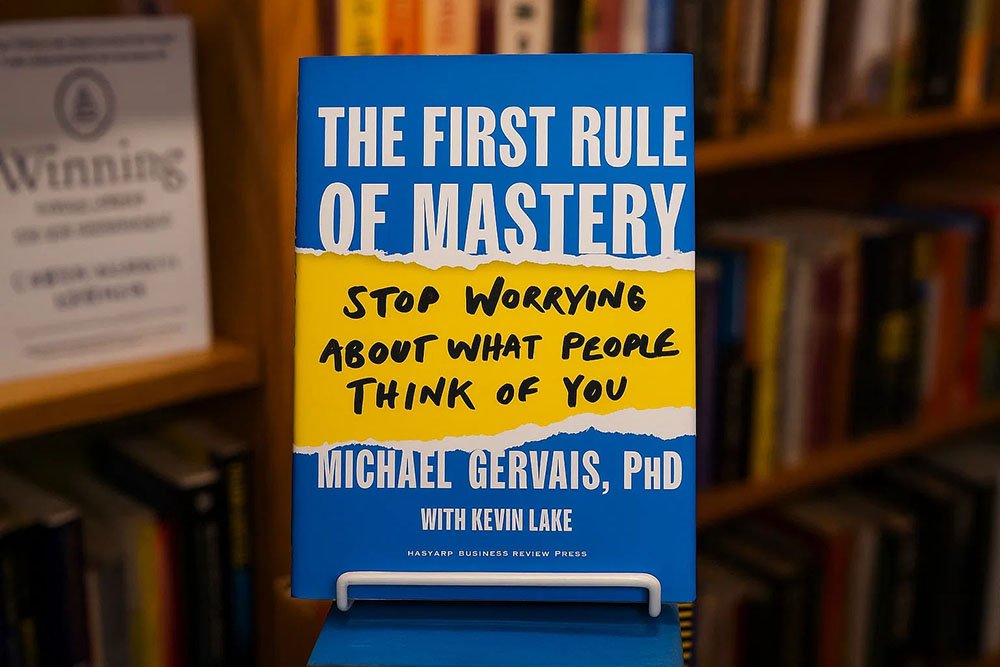
The First Rule of Mastery Book Summary: Understanding FOPO and External Validation
Dr. Michael Gervais’ The First Rule of Mastery: Stop Worrying About What People Think of You delivers a framework for anyone struggling with the paralyzing effects of external validation. This book summary explores insights from a high-performance psychologist who has worked with Olympic champions, Super Bowl winners, and Fortune 500 CEOs to address a pervasive barrier to excellence: FOPO—the fear of people’s opinions.
Gervais argues that our obsession with what others think isn’t merely uncomfortable—it may be one of the greatest constrictors of human potential. Drawing from neuroscience, ancient philosophy, and decades of work with elite performers, he challenges a familiar assumption about mastery: progress begins with learning to work on what’s within our control.
The central idea is simple: mastery requires looking inward and committing to the thoughts, choices, preparation, and actions you can work on. Everything else—including the opinions of others—exists beyond your direct control. When we give more value to other people’s opinions than our own considered judgment, we risk living life on their terms.
What makes Gervais’ approach useful is his integration of research with real-world application. He describes how anticipated judgment can activate threat responses, consume attention, and interfere with performance. Under pressure, we may react defensively instead of choosing a response that serves our goals. Recognizing this pattern is the first step toward changing it.
FOPO manifests across many domains: leadership decisions avoided, creative risks not taken, authentic voices silenced, relationships compromised, and potential unrealized. Gervais worked with softball player Lauren Regula when she faced criticism for pursuing Olympic dreams at thirty-nine. By confronting the weight of those opinions, she continued her pursuit and won bronze in Tokyo.
The book presents three essential phases: Unmask, Assess, and Redefine. Unmask exposes FOPO’s mechanics—how anticipating other people’s reactions consumes psychological resources. Assess teaches discernment between perception and reality, including how confirmation bias shapes our interpretation of others’ thoughts. Redefine provides tools for changing our relationship with identity, feedback, and purpose.
Some of the most revealing insights concern identity and vulnerability. Gervais discusses research suggesting that challenges to deeply held beliefs can engage brain regions involved in emotional and defensive processing. This helps explain why criticism feels like attack and why a disagreement can feel more personal than its subject warrants.
The book also examines Beethoven’s relationship with fear and self-expression. Gervais presents the composer’s efforts to conceal his hearing loss, and his later confrontation with it, as an illustration of the movement from external approval toward internal commitment. The Heiligenstadt Testament becomes a turning point in that account: a decision to continue creating despite profound personal difficulty.
These lessons extend beyond individual behavior to cultural critique. Gervais identifies modern amplifiers of FOPO: social media’s constant feedback loops, pressure to present curated perfection, metrics replacing meaning, and an isolated sense of self. The digital age hasn’t created concern about social acceptance, but it has made public evaluation harder to escape.
The book’s insights challenge fundamental assumptions about success and self-worth. Elite performers aren’t immune to FOPO; visibility can increase their exposure to judgment. Musician Moby describes external validation as initially intoxicating before becoming destructive.
The solution isn’t to stop caring about other people’s perspectives. It’s to develop what the book calls “the screen”—a filtering mechanism that lets useful feedback through while keeping contempt and unhelpful noise from directing your life.
Our neurobiological wiring prioritizes connection and belonging. FOPO emerges when legitimate social needs become entangled with hypervigilance and outsourced self-worth. The response involves strengthening internal authority while maintaining meaningful relationships.
Gervais also draws on Stoic philosophy and reflection on mortality. Awareness that life is finite can clarify values and expose how much time approval-seeking consumes. The useful question becomes less “Will everyone approve?” and more “Is this how I want to spend my life?”
Steve Jobs described remembering death as a way to loosen the grip of external expectations, pride, and embarrassment. Palliative care worker Bronnie Ware similarly identified living according to others’ expectations as a recurring regret in the experiences she documented.
These reflections make the book’s practical message urgent: don’t postpone meaningful choices until approval becomes certain.
Gervais’ work with the Seattle Seahawks, Felix Baumgartner, and business leaders gives the book a performance-focused perspective. Its lessons concern the moments when attention, preparation, and values must hold up under pressure.
The argument culminates in a view of mastery as an inner-directed life expressed through action. Technical excellence matters, but so does alignment between what you value and how you behave. Comparison alone cannot tell you whether you’re becoming the person you’re capable of becoming.
The following twenty-five takeaways explore that framework and its practical implications for overcoming fear of judgment.
25 Key Takeaways: Overcoming Fear of People’s Opinions and Building Self-Mastery
1. FOPO Constricts Human Potential
The fear of people’s opinions can affect every aspect of life. When we experience FOPO, we lose faith in ourselves and performance can suffer. Instead of focusing on the task, our thoughts, or our values, we become preoccupied with others’ opinions—spoken or imagined.
Key idea: Gervais describes FOPO as a hidden epidemic that may be one of the greatest restrictions on human potential.
Recognizing its influence is the foundation for changing your relationship with external validation.
2. Mastery Begins With What You Can Control
The first rule of mastery requires looking within and committing to work on what’s under your control. Mastery in any area—arts, business, parenting, or sports—requires distinguishing your own choices from outcomes you cannot dictate.
Learning to stop stressing over things you cannot control redirects attention from managing other people’s reactions toward your preparation, decisions, and next action.
Key idea: You can work on your own contribution without assuming responsibility for everyone else’s response.
Other people’s opinions may influence you, but you cannot guarantee what they will think.
3. We Trade Authenticity for Approval
When FOPO dominates, we become performers rather than authentic humans. The patterns are familiar: laughing when something isn’t funny, biting your tongue when offended, rehearsing responses instead of listening, pursuing status instead of purpose, and chasing someone else’s dreams.
Key idea: We trade in authenticity for approval when acceptance becomes more important than honest expression.
Recognizing these compromises is the first step toward reclaiming authenticity.
4. We Externalize Self-Worth
FOPO leads us to outsource our sense of value. If people approve of us or our choices, we feel good. If they disapprove, we feel diminished. This creates an exhausting cycle of seeking reassurance while dismissing our own needs and judgment.
Key idea: When other people become the sole judges of your worth, your self-esteem rises and falls with feedback you cannot control.
A more sustainable sense of self-worth includes your values, effort, and behavior—not only others’ reactions.
5. Beethoven’s Story Illustrates the Path Toward Mastery
Gervais uses Beethoven’s experience of hearing loss to explore the fear of judgment and the struggle to protect an identity. In this account, confronting his condition helped the composer move toward creating from internal commitment rather than trying to preserve an external image.
Key idea: The shift is from performing primarily for the world outside you to creating from the world within you.
The lesson is about the freedom to continue meaningful work despite uncertainty about how you’ll be perceived.
6. FOPO Is Anticipatory and Exhausting
FOPO often begins before anyone has offered an opinion. It attempts to prevent rejection by imagining what others might think and changing behavior in advance.
This anticipatory process consumes attention and energy, much like background applications using computer memory.
Key idea: You may be reacting to predicted rejection rather than actual feedback.
That makes FOPO especially difficult to recognize: it can feel like preparation when it is really repeated rehearsal of feared outcomes.
7. Self-Esteem Can Function as a Social Gauge
Psychologist Mark Leary’s sociometer theory proposes that self-esteem helps monitor perceived acceptance and relational value. This offers one explanation for why acceptance can lift self-esteem while rejection can lower it.
Key idea: Changes in self-esteem may reflect how you think you stand with other people, rather than an objective assessment of your worth.
Understanding this mechanism helps you treat social feedback as information without making it your entire identity.
8. Challenges to Identity Can Feel Threatening
Gervais discusses research on how people respond when deeply held beliefs are challenged. A disagreement about an idea may become entangled with a perceived threat to the self.
This helps explain why criticism can feel like an attack and why people sometimes defend a belief before considering the evidence.
Key idea: The more closely you identify with a belief, the more personal a challenge to it may feel.
Noticing that reaction gives you a chance to examine the criticism more carefully.
9. Create Space Between Stimulus and Response
Between something happening and your next action, there may be an opportunity to pause. Moby’s account of stepping back from strangers’ opinions on social media illustrates the value of interrupting automatic reactions.
Practicing strategic self-control under provocation means choosing a response that serves your larger purpose, even when the immediate urge is to defend your pride.
Key idea: You cannot choose every feeling that arises, but you can practice influencing what you do next.
That pause is a skill to develop, especially under pressure.
10. Use “The Screen” to Filter Opinions
NFL player Nate Hobgood-Chittick developed “the screen”—a mental tool for receiving useful coaching while leaving contempt and emotional abuse with the person delivering it.
Instead of accepting or rejecting all feedback, the screen creates a pause for evaluation.
Key idea: Ask what helps you improve, and distinguish it from the hostility or unnecessary judgment surrounding it.
Filtering feedback protects your attention while keeping you open to learning.
11. Establish a Roundtable of Trusted Advisors
Rather than reacting to every opinion as it arrives, identify a small group whose counsel you trust. Look for people who understand you, care about your well-being, value truth, and have judgment you respect.
Key idea: Be deliberate about whose opinions deserve serious consideration.
A carefully chosen roundtable gives you a useful feedback loop without handing authority to every passing comment.
12. We Are Social Beings, Not Isolated Selves
Gervais emphasizes that human beings are fundamentally social. Connection isn’t an optional accessory to an otherwise independent life; it helps shape how we think, feel, and understand ourselves.
FOPO grows from legitimate belonging needs that become entangled with excessive monitoring of others’ reactions.
Key idea: Reducing approval-seeking does not require rejecting connection.
The aim is to develop healthier relationships with both other people and your own judgment.
13. The Culture of Self Can Fuel FOPO
The book examines cultural forces that place constant attention on the individual: personal branding, visible metrics, comparison, and pressure to demonstrate success.
Geographic mobility and digitally mediated relationships can also change how people experience connection and evaluation.
Key idea: Your struggle with approval does not happen in a vacuum.
Recognizing the surrounding pressures helps you decide which environments and habits deserve less influence over your attention.
14. Confirmation Bias Shapes How We Interpret Opinions
Our minds tend to notice and remember information that supports existing beliefs. If you already believe you’re inadequate, an ambiguous comment may feel like confirmation—even when other explanations are possible.
Practicing separating facts from your interpretation helps you distinguish what someone actually said from the meaning you added.
Key idea: Your interpretation of an opinion may reveal as much about your expectations as about the other person’s intent.
Awareness of confirmation bias creates room for a more accurate reading.
15. Beliefs Are Thoughts We Hold as True
Beliefs shape what we notice and what we consider possible. Some help us act effectively; others constrain us long after the circumstances that produced them have changed.
Gervais encourages curiosity about whether those beliefs serve our current goals and values.
Key idea: A familiar belief is not automatically an accurate or useful one.
Questioning beliefs creates space for growth without requiring you to abandon everything you know.
16. Belonging Is a Fundamental Human Need
Research by Roy Baumeister and Mark Leary positioned belonging as a fundamental human motivation. The desire for acceptance influences thoughts, feelings, and behavior.
Approval-seeking can therefore begin with a legitimate need for connection, even when the strategies we use become costly.
Key idea: Wanting to belong is understandable; continually suppressing yourself to secure acceptance deserves examination.
Understanding that distinction helps you work with your social nature.
17. Connect to Something Bigger Than Yourself
Focusing on contribution can reduce the amount of attention available for self-monitoring. When you apply your strengths to a purpose beyond your image, the question changes from “How am I being seen?” to “What does this situation need?”
Key idea: Meaningful contribution can help put personal evaluation into perspective.
Service, teamwork, and shared purpose offer ways to participate fully without making every moment a referendum on your worth.
18. Develop Virtues Through Practice With Others
Kindness, courage, justice, service, and humility develop through action. They are practiced within families, schools, teams, workplaces, and communities.
Gervais connects this daily work with moving attention away from self-judgment and toward contribution.
Key idea: Values become useful when they shape how you treat people and handle difficult choices.
Regular practice gives you a standard for your behavior beyond whether it wins approval.
19. Notice Defensive Reactions When Beliefs Are Challenged
The book discusses Jonas Kaplan’s research examining responses to challenges to political beliefs. The findings offer a way to think about why disagreement can trigger emotional defensiveness.
Recognizing that defensiveness doesn’t establish that your belief is wrong—or that the criticism is right. It tells you that the topic matters to your sense of self.
Key idea: Feeling threatened by information is a reason to pause, not a reason to treat it as false.
That pause can help you evaluate the argument without immediately defending your identity.
20. Hold Beliefs Up to the Light
Robert Frost’s “Mending Wall” becomes an invitation to examine inherited assumptions. Before maintaining a boundary or rule, ask what it protects, what it excludes, and whether it still serves a purpose.
The same questions apply to beliefs about success, acceptance, and who you’re allowed to become.
Key idea: Ask whether a belief helps you live according to your values or keeps you inside an unnecessary limitation.
Examining beliefs allows a more conscious choice about which to maintain and which to revise.
21. Mortality Awareness Can Clarify What Matters
Reflecting on the finite nature of life can help put embarrassment, comparison, and external expectations into perspective.
Gervais draws on examples such as Steve Jobs’ reflection on death as a tool for making important choices.
Key idea: A limited lifetime gives your attention and decisions significance.
The purpose of the exercise is to clarify how you want to live, rather than to dwell on fear.
22. Living for Approval Can Become a Source of Regret
Bronnie Ware’s accounts of end-of-life conversations describe a recurring regret: not having lived more faithfully to oneself.
Gervais uses this theme to question the cost of continually conforming to others’ expectations.
Key idea: Approval gained today may not compensate for repeatedly abandoning what matters to you.
The practical invitation is to notice where that compromise is happening while you still have opportunities to change it.
23. Time Is a Precious Resource
The book examines the gap between what people say brings satisfaction and how they actually spend their time.
Without deliberate attention, immediate habits can crowd out relationships, meaningful work, reflection, and other stated priorities.
Key idea: Your allocation of time reveals whether your choices match your values.
Treating attention as finite can help you make decisions that approval-seeking would otherwise postpone.
24. Mastery Is an Inner-Directed Life Expressed Through Action
Mastery involves alignment between internal values and external expression. Technical skill matters, but comparative achievement alone does not tell you whether your work reflects who you are.
For a creator, this might mean showing up as yourself on camera instead of maintaining a persona designed mainly to win approval.
Key idea: Mastery develops through honest engagement with your work and continual exploration.
The aim is to create from a considered internal direction while remaining open to useful feedback.
25. Ask What You Already Regret
The final test is immediate: what do you regret right now?
If you wish you were more present for your children, more honest in a relationship, or more committed to meaningful work, that regret points toward a choice worth examining.
Key idea: You don’t have to wait until the end of life to recognize a direction you want to change.
Present regrets can guide a concrete next step rather than becoming another reason for self-criticism.
Applying The First Rule of Mastery: Reduce Approval-Seeking and Strengthen Internal Authority
These twenty-five takeaways from Dr. Michael Gervais’ The First Rule of Mastery offer a framework for understanding FOPO and changing how much influence it has over your life.
The book brings together performance psychology, philosophy, and reflections on identity and belonging. Its central concern is practical: what happens to your attention and behavior when other people’s judgments become more important than your own values?
Transformation follows the three-part structure of Unmask, Assess, and Redefine. Unmask the mechanics of FOPO so you can recognize when it is operating. Assess your interpretations to distinguish evidence from assumptions. Redefine your relationship with opinions, identity, and purpose.
Each phase combines awareness with practice. Noticing approval-seeking is useful, but the change becomes meaningful when you approach a conversation, decision, or performance differently.
The goal is a more grounded, connected, and purposeful way of living. Working from the inside out means taking direction from considered values while still recognizing that feedback and relationships matter.
For anyone struggling with external expectations, Gervais offers ways to make those expectations less controlling. FOPO may continue to appear, especially in situations that matter to you. The aim is to recognize it without automatically letting it decide what you do.
The book’s emphasis on our social nature matters here. Wanting connection is legitimate. Reducing approval-seeking does not require becoming indifferent, isolated, or unwilling to listen. It requires distinguishing meaningful connection from the exhausting attempt to secure universal acceptance.
Gervais’ experience with elite performers makes the costs of misplaced attention particularly visible. Yet the same tension appears in everyday life: speaking honestly at work, making a creative choice, setting a boundary, or pursuing a goal that others don’t understand.
Confronting FOPO can be uncomfortable. Beethoven’s story and Lauren Regula’s Olympic pursuit illustrate different forms of that challenge. In each, the question is whether anticipated judgment will have the final say over meaningful work.
You can begin with a decision already in front of you. Identify the opinion you fear, ask what evidence supports your prediction, and name the action that fits your values. Then consider whose feedback would actually help.
“The screen” and the trusted roundtable provide useful boundaries. They let you remain teachable while becoming more selective about which voices deserve authority.
The broader lesson is that you can be socially attentive without outsourcing your self-worth. You can care about people without making agreement a condition of action. You can acknowledge discomfort and still choose a response that serves your purpose.
Mastery, in Gervais’ account, begins with that internal authority. Whether you’re an athlete, artist, parent, or leader, the work is to bring attention back to the choices and practices you can influence.
The first rule is therefore something to practice repeatedly: recognize the pull of other people’s opinions, listen for what is useful, and return to the work that reflects the person you want to become.
Related posts:
 How Our Thoughts Affect Our Everyday Life: 33 Life-Changing Lessons from The Expectation Effect by David Robson (Complete Summary)
 How to Overcome Fear of What Others Think With Let Them
 Does Believing You’re Old Make You Old: How Aging Expectations Change Your Biology
 Is Willpower Limited? The Science Behind Mental Strength and Self-Control
 The Narrative Rewrite Method: How to Rewrite Limiting Beliefs and Change Your Life