
Master your emotional responses: Create space between feeling and acting with metacognition, limbic hijack insights, and strategies from Arthur Brooks’ ‘Build the Life You Want.’ Pause, journal, reframe memories, and build resilience for lasting happiness and better decisions.
Your emotions aren’t the enemy—but letting them run the show might be ruining your happiness. In “Build the Life You Want,” Arthur C. Brooks and Oprah Winfrey present a counterintuitive truth that challenges everything most of us believe about emotional well-being: you can’t eliminate negative feelings, but you can master how you respond to them. The answer lies in metacognition—the practice of thinking about your thinking.
Most men spend their lives reacting. Someone cuts us off in traffic, we rage. A colleague criticizes our work, we spiral into defensiveness or self-doubt. A relationship ends, we let bitterness consume us for months or years. We believe our emotions are forces of nature that simply happen to us, leaving us powerless in their wake.
This is fundamentally wrong. And it’s costing us our peace, our relationships, and our ability to build meaningful lives.
What Your Brain Is Actually Doing When You Feel
Brooks and Winfrey explain that when something triggers an emotional response, your brain operates through three distinct functions. First comes detection—your sensory systems register what’s happening in your environment. Then reaction—your limbic system translates that stimulus into an emotion designed to keep you safe and thriving. Finally, decision—your prefrontal cortex, if you choose to use it, determines how you’ll actually respond to that feeling.
Here’s where most people get stuck. They conflate the second and third steps. They feel anger and immediately act angry. They experience fear and let it dictate their choices. They confuse the signal with the response.
Viktor Frankl, the psychiatrist who survived Nazi concentration camps, understood this distinction with devastating clarity. Despite enduring brutality most of us can’t imagine, he recognized a fundamental truth about human freedom. Frankl wrote that while everything can be taken from a person, one thing remains: the freedom to choose your attitude in any circumstance, to choose your own way.
This isn’t positive thinking or spiritual bypassing. It’s the recognition that between stimulus and response, there exists a space. In that space lies our power.
The Limbic Hijack: Why You Say Things You Regret
Your limbic system doesn’t care about your long-term happiness. It cares about immediate survival. When your amygdala detects a threat—whether it’s a speeding car or a critical email from your boss—it floods your body with stress hormones in about 0.074 seconds. Your heart pounds. Your muscles tense. You’re ready to fight or flee.
This system evolved to save us from predators. Today, it activates over Twitter disagreements and uncomfortable conversations. The problem isn’t that we have these reactions. The problem is that we let them drive our behavior without engaging the part of our brain capable of wisdom, judgment, and perspective.
Brooks and Winfrey call people who consistently react without thinking “limbic.” You know these people. Maybe you are one of them. They explode at minor inconveniences. They send emails they immediately regret. They damage relationships because they can’t create space between feeling and acting.
The authors present a simple but powerful technique: when angry, count to thirty while imagining the consequences of saying what’s in your head. Imagine your boss reading that email. Imagine seeing the person face-to-face after they receive your response. This brief pause allows your prefrontal cortex to catch up to your limbic system.
It’s not suppression. It’s sovereignty over yourself.
Rewriting Your Past: The Neuroscience of Memory
One of the book’s most liberating insights concerns memory itself. You can’t change what happened to you, but neuroscience reveals something remarkable: you can change how you remember it.
Memory isn’t retrieval—it’s reconstruction. Each time you recall an event, your brain pieces together fragments of stored information. These reconstructions shift based on your current emotional state, circumstances, and self-narrative. This is why you and your sibling remember the same childhood event completely differently. You’re both right. You’re both assembling different details that reinforce your current sense of who you are.
This means the baggage you carry from your past isn’t as fixed as you think. Brooks and Winfrey suggest a practice: when you remember painful events, consciously look for what you learned from them, what meaning they created, and what positive outcomes eventually emerged. This isn’t denial. It’s choosing which aspects of complex experiences to emphasize when reconstructing them.
For men trying to move beyond past failures, rejections, or traumas, this is crucial. The story you tell yourself about your divorce, your business failure, or your difficult upbringing literally changes each time you remember it. You can reconstruct those memories to emphasize growth rather than victimhood, learning rather than resentment, strength rather than damage.
Four Practices for Emotional Mastery
Brooks and Winfrey offer concrete techniques for developing metacognitive awareness. These aren’t abstract concepts—they’re practices that create real change when applied consistently.
First, observe your feelings as if they’re happening to someone else. When you notice strong emotion arising, consciously move it from your limbic system into your prefrontal cortex. Sit quietly. Imagine the emotion as a distinct phenomenon you’re studying. Say to yourself: “I am not this anger. It will not make my decisions for me.” This simple act of observation creates distance between you and the feeling.
Second, journal your emotions daily. Writing forces you to translate vague feelings into specific thoughts, which requires your prefrontal cortex. Research shows that people who engage in structured self-reflective journaling better understand and regulate their emotions. When you’re overwhelmed by all you need to do, don’t let your limbic system send panic signals. Make a list. Prioritize. Decide what actually matters and what you can release.
Third, maintain a database of positive memories. Your brain’s negativity bias means you’ll naturally focus on what’s wrong. Counter this by keeping a journal of genuinely happy moments and reviewing it when you feel down. Studies show that deliberately recalling positive memories significantly improves mood and interrupts destructive thought patterns.
Fourth, find meaning in suffering. Every life contains authentic pain. Instead of trying to forget difficult experiences, Brooks and Winfrey recommend reflecting on them with the explicit goal of extracting wisdom. In your journal, write down painful experiences. After one month, return and note what you learned. After six months, record the positive outcomes that emerged.
This practice transforms how you relate to inevitable suffering. It doesn’t eliminate pain, but it prevents pain from becoming meaningless.
The Space Between Stimulus and Response
Metacognition fundamentally changes how you experience being a man in the world. It means you’re no longer at the mercy of every slight, every setback, every disappointment. You don’t become emotionless. You become someone who feels deeply but responds wisely.
This matters in your work, where emotional volatility can derail careers. It matters in your relationships, where reactive behavior damages trust. It matters in your sense of self, where the inability to manage difficult emotions creates a constant undercurrent of anxiety and shame.
Brooks and Winfrey remind us that we can’t control what we feel. Feelings arise unbidden from parts of our brain operating below conscious awareness. But we absolutely can control what we do with those feelings. We can create space. We can observe. We can choose.
This is the essence of emotional adulthood. Not the absence of difficulty, but the presence of agency. Not freedom from pain, but freedom in how we carry it.
The next time you feel overwhelmed by emotion, remember: that feeling is information, not instruction. It’s data about your current state, not a directive for your behavior. Your limbic system is doing its job. Now let your prefrontal cortex do yours.
Between stimulus and response lies your power. Between feeling and acting lies your freedom. That space is where you build the life you want.
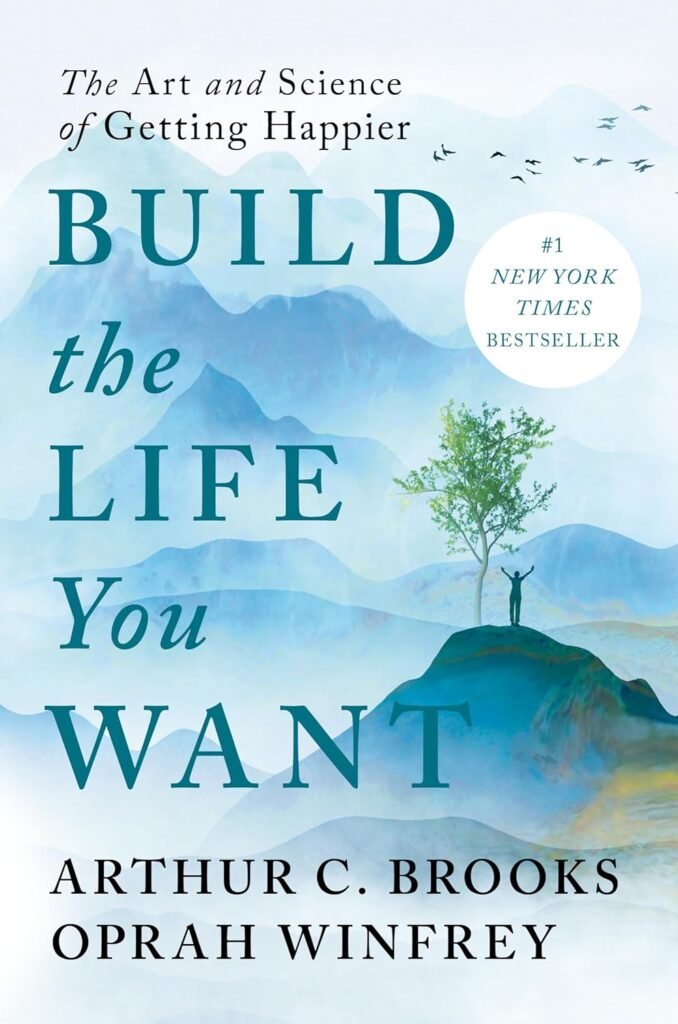
“Build the Life You Want: The Art and Science of Getting Happier” by Arthur C. Brooks and Oprah Winfrey offers evidence-based strategies for increasing well-being through emotional self-management and building what matters most in life.
Related posts:
 Build the Life You Want by Arthur Brooks & Oprah: Summary
 The Productive Power of Sadness, Fear, and Regret: Why You Need Negative Emotions
 How to Use Humor to Manage Stress and Build Resilience
 The Neuroscience of Gratitude: How to Rewire Your Negativity Bias
 The Happiness Formula: Balancing Enjoyment, Satisfaction, and Purpose